What TCX's annual report and its chief executive's replies tell solar developers about hedging currency risk
By SolarQuant Editorial. Published 2026-10-31. Last updated 2026-11-01.
Our earlier article, Who carries currency risk in a dollar-priced solar project? Lessons from the Ugandan shilling, looked at the shilling's loss of about 16% of its value against the US dollar this year, most of it after August, and at TCX's report that the loss on its shilling hedges reached about USD 25 million at the currency's low point while the businesses it had hedged stayed protected. It argued that a solar project pricing its power in dollars keeps the currency risk in place and passes it to the offtaker, whose bill rises in local currency when the currency falls, so that the risk returns to the project as late or missing payments. On an invented 40 MWp example, a project whose tariff is fixed in local currency reached its lock-up level after a 6.1% rise in local currency per dollar and its default level after 13.0%. We also argued that a hedge removes the exchange rate risk on the loan, while convertibility, tenor and cost remain for the model to carry.
This article builds on that one with two newer sources: the replies TCX's chief executive gave to readers who questioned his post about the fund's loss, and TCX's own annual report for 2025, which sets out how the fund carries currency risk and where it struggles to reach. Read together, they show what currency protection costs, who stands behind it, and why the energy sector, solar included, has so far made little use of it.
What did TCX's chief executive add in his replies?
In his replies to readers, Ruurd Brouwer described TCX as working like an insurer: it keeps the currency risk it takes on, pays for losses out of reserves built from the higher interest rate that hedged borrowers pay, and relies on a large equity buffer from public and impact investors to carry it through crises that hit many currencies at once.
One reader, a banker, asked why a fund like TCX would carry a loss at all, when it could pass the exposure on in the derivatives market as soon as it takes it on. Brouwer replied that this would be the right question for an investment bank or a broker, but that TCX was set up to hedge exposures for which no liquid commercial market exists, so it keeps them on its own books and relies on spreading them across more than 60 currencies. He added that private investors are showing more interest in frontier currency risk, so TCX increasingly passes part of it on, although often for shorter tenors than the hedges it provides.
A second reader asked, using the image of blankets, what protects TCX itself, and who keeps whom warm when the cold reaches everyone at once. Brouwer described two blankets. The first is the hedging portfolio itself, where the higher interest rate that comes with each hedge builds reserves that are paid out in Uganda today and in another region tomorrow. The second is an equity buffer from shareholders he described as patient and not profit maximising, namely multilateral and bilateral development banks, impact investors, governments and the European Commission, which he said has carried TCX through the financial crises of the past two decades, including periods when all currencies fell against the dollar and the euro. He compared the model to insurance, built "to pay out so hard currency borrowers don't suffer during crises".
Can TCX absorb a loss of this size?
On its own figures it can, comfortably, and that gives the original post's statement that the loss is "perfectly OK" a sound basis. At the end of 2025 TCX reported available capital of USD 2.05 billion and a capital ratio of 27.6% of risk-weighted assets, against a liquidation trigger set at 14%, and it calculated that it could absorb a loss of USD 1.01 billion before reaching that trigger. The loss on the shilling book at the currency's low point, about USD 25 million according to the post, is roughly 2.5% of that capacity and about 8% of the USD 305 million profit TCX made in 2025.
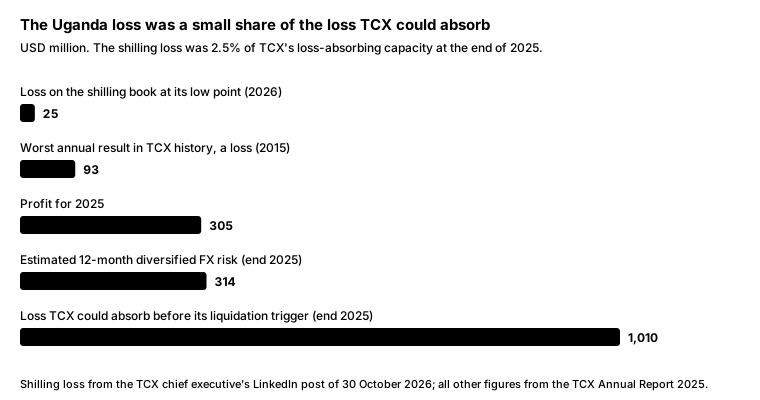
Two cautions belong next to these figures. First, the 2025 profit came mainly from currency and interest rate movements as the US dollar weakened, together with the interest carry on TCX's derivatives book and the returns on its liquidity portfolio, so a strong year for the fund was a weak year for the dollar, the mirror image of the conditions behind this autumn's losses, and a single year's result says little about the long-run return. Second, the buffer exists because public institutions provided it, through subordinated convertible debt, a first-loss loan and, in total, EUR 561 million of support from the European Commission. In our reading, a solar lender relying on a TCX hedge is relying on a counterparty whose strength rests on development finance, a sound base that depends on continued public support as well as on commercial returns.
Why does TCX say the energy sector is hard to reach?
TCX's annual report names energy as one of the sectors where it faces long-standing structural obstacles, because most of the underlying commercial contracts are denominated in US dollars and the currency risk is passed on to the end clients. Our earlier article described the same pattern from the solar side. A project that sells power under a dollar tariff has matched its revenue to its dollar debt and has no currency exposure left for a hedge provider to cover, while the offtaker, which earns local currency and pays the dollar bill, is usually a utility or business that no hedge provider is dealing with.
The report also names infrastructure as hard to reach because of the large amounts and long tenors it needs, and the portfolio figures show how small both segments still are within TCX. Hedges in the report's SE4ALL segment (in our reading, sustainable energy access; the report does not spell the label out) made up USD 260 million of gross outstandings at the end of 2025, or 4% of the primary portfolio, and other infrastructure made up USD 525 million, or 8%, while microfinance and SME lending together still accounted for 64%. The report says that changing this requires patient work to explain to lenders, borrowers, regulators and governments that local currency arrangements may be better suited. In our reading, the solar sector's habit of pricing power in dollars is one of the first things that work would have to change.
What does a currency hedge cost a solar project, and how should it be compared?
A hedged local-currency loan carries a higher interest rate than a dollar loan, and the gap between the two rates is in effect the premium for the protection. The fair comparison is between that premium and the depreciation the borrower can expect over the life of the loan. TCX's report states the economics plainly: on average, the higher interest rates in frontier markets more than compensate for the devaluing trend of their currencies, which is what allows the fund to be modestly profitable over the long term. Brouwer's reply makes the same point from the other side, since the higher rate that comes with each hedge is what builds the reserves that pay for losses such as Uganda's.
A simple way to compare the two loans is the break-even depreciation rate, which is the average yearly fall in the local currency at which a borrower with local-currency revenue would pay the same under either loan:
Using the illustration a TCX executive gave in a 2021 interview, a dollar loan at 8% set against a local-currency loan at 16%, the break-even is about 7.4% a year, so a borrower whose currency falls faster than that on average is better off hedged, while one whose currency falls more slowly pays more for the protection than it saves. The shilling, which TCX says lost just over 1% a year on average from the start of 2022 before falling around 13% in two months this autumn, shows why the average is a poor guide on its own: a hedge also removes the risk of a sudden step that can break a covenant in a single year, and the average depreciation figure does not capture that.
For a solar project the comparison has a second side that is easy to miss. When lenders size debt so that each year's debt service stays within the cash flow divided by the target cover ratio, a higher interest rate reduces the debt the same cash flow can carry. On the invented 40 MWp example from our earlier article, with debt sculpted at 1.30x on the same year 1 cash flow of USD 4.2 million, the debt the project can raise falls from USD 25.1 million at a 7% dollar rate to about USD 17.2 million at 15%, which is roughly where the same 7.4% break-even would put a hedged rate set against a 7% dollar loan, and the sponsor would have to replace the difference with equity.
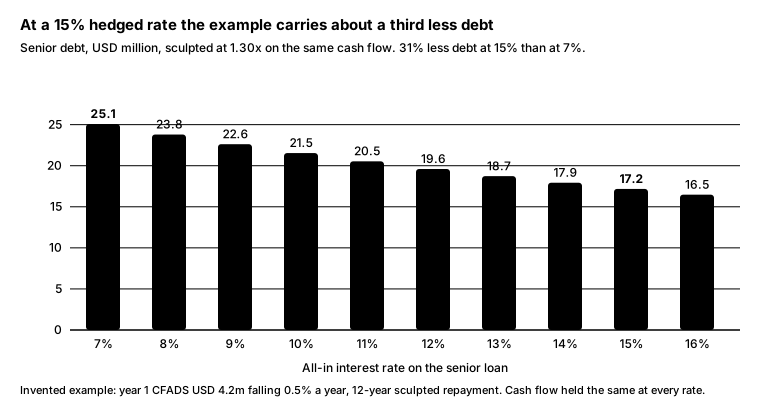
This comparison deliberately holds the cash flow the same at every rate, which overstates the cost of hedging, because a tariff set in local currency is usually indexed to local inflation, and local inflation is part of the reason local interest rates are higher in the first place. A modeller comparing the two structures should build both cases in full, with the local-currency case carrying its own tariff indexation and debt sizing, because changing only the interest rate in an otherwise unchanged dollar model leaves the cash flow wrong for the hedged structure.
What does a TCX hedge not cover?
A TCX hedge removes the movement of the exchange rate on the hedged loan, and several other risks remain that a solar model still has to carry. The annual report and TCX's earlier public statements are clear about most of them.
| Risk | Covered by a TCX hedge? | What TCX says | What the solar model still needs |
|---|---|---|---|
| Exchange rate moves on the hedged loan | Yes | The swap guarantees the lender's income in USD or EUR while the borrower's obligations stay in local currency | The hedged interest rate and its effect on debt size |
| Getting and sending dollars (convertibility and transfer) | No | Its products are largely non-deliverable and the borrower's convertibility risk is not covered (2021 interview) | A period of trapped local cash, and the reserves to bridge it |
| Credit and country risk | No | As a market risk vehicle it cannot absorb a significant amount of credit and country risk, so it depends on counterparties or guarantors | Guarantees or political risk cover arranged separately |
| The offtaker's currency risk under a dollar PPA | No | Energy contracts are mostly in USD, with the currency risk passed on to end clients | Payment delay and affordability cases for the offtaker |
| Long tenors | Partly | Long tenors are a structural barrier in infrastructure, and offsets are often shorter than the hedges TCX provides | A hedge shorter than the loan, and the cost and risk of renewing it |
| Size in a single currency | Partly | Each individual currency had a notional limit of USD 487.7 million at the end of 2025 | An early check that capacity is available in the project's currency (in our reading, the limit is shared with TCX's other clients) |
Why does the market for passing the risk on thin out when it is needed most?
TCX's report warns that, as the fund increasingly acts as a temporary warehouse for currency risk that it later sells on, it becomes more dependent on the market's appetite for frontier currencies. Periods of risk aversion towards frontier markets have in the past reduced its ability to offset its positions, which uses up capital and shrinks its room to take on new business. Brouwer's reply describes the same mechanism from the positive side, saying that private investors are increasingly interested in frontier currency risk, although often for shorter tenors than the hedges TCX provides.
The Ugandan episode shows that risk aversion arriving. As our earlier article reported, foreign investors left Uganda's bond market, with Citigroup estimating, according to The Observer, that more than USD 200 million left it in two weeks. TCX's report, which describes the position at the end of 2025, lists no shilling position in the table of the fund's own hedging transactions (cross-currency derivatives it enters for concentration and balance sheet management), against one with a notional value of USD 13 million a year earlier. That table shows the fund's own hedges and does not by itself show what it has sold to clients, and the position may well have changed during 2026 as new shilling business came in.
In our reading, this matters to a solar sponsor in two ways. Investors who sell a frontier currency's bonds in a panic are unlikely to be buying long-dated exposure to the same currency at that moment, so capacity for a large, long hedge can be scarce or expensive just when currency stress is in the news. The strength of a hedge also rests on TCX's own capital and on the spread of its book across currencies, because the market cannot be relied on to take the risk off its hands, which answers the reader who asked who keeps whom warm when the cold reaches everyone at once.
What can a solar developer do with this now?
These sources bear on when in a project's life the currency decision should be made and how it should be tested in the model. In our reading, five steps follow from the two sources.
- Raise the currency question with lenders before the PPA currency is fixed. TCX generally prefers to hedge the lender, who then lends in local currency, so the availability of a hedged local-currency loan should shape the currency of the tariff before the tariff is set.
- Treat the offtaker's currency exposure as the project's credit risk when the PPA is in dollars. That means running the devaluation case together with a payment delay case, as our earlier article set out, because that is the route by which the shilling's fall reaches a dollar-priced project.
- Compare the hedged and unhedged structures on the break-even depreciation and on a stress step, and build each case in full. The hedged case should carry its smaller debt and the local-currency tariff its own indexation, so that neither the cost of the hedge nor the risk without it is understated.
- Ask whether the deal could qualify for pricing support. Under the EU's EFSD+ programme, TCX can allocate EUR 150 million of pricing discount to eligible deals, with the first deals expected, according to the report, to trade in the first quarter of 2026, and the African Development Bank, which committed USD 25 million of equity to TCX, plans to work with it on fragile states, infrastructure, energy access and public sector borrowers.
- Model what the hedge leaves out. A hedge that is shorter than the loan, the risk of not being able to convert or transfer cash, and credit and country risk each need their own line in the model or their own form of cover, whether or not the exchange rate itself is hedged.
Sources
Pages opened on 31 October 2026. The example project is invented and has no source.
- We lost big money on the Ugandan shilling: and that's the point, Ruurd Brouwer, chief executive of TCX, LinkedIn post of 30 October 2026 and his replies to readers' comments. Used for the shilling loss, the shilling's earlier drift and the two replies quoted and paraphrased.
- TCX Annual Report 2025, The Currency Exchange Fund N.V., dated 13 April 2026. Used for the 2025 results, capital, loss-absorbing capacity, portfolio by sector, the business model, the ongoing challenges on energy, infrastructure and offsetting, the currency limit, the hedging book, the EFSD+ pricing discount and the African Development Bank investment.
- The Currency Exchange Fund: hedging plays key role in developing local financial markets, Impact Investor, 13 September 2021. Used for the 8% versus 16% illustration and the limits of convertibility cover.
- Uganda Shilling at depreciation: A market correction, not just an external shock, The Observer (Uganda), 28 October 2026. Used for the Citigroup estimate of bond market outflows.