Who carries currency risk in a dollar-priced solar project? Lessons from the Ugandan shilling
By SolarQuant Editorial. Published 2026-10-30. Last updated 2026-11-01.
The Ugandan shilling's slide this autumn left a hedge provider showing a loss of about USD 25 million at its worst, and the local businesses it hedged protected. For a solar project with a dollar tariff, the same move falls on the offtaker, where it is far less visible. Pricing the tariff in dollars leaves the currency risk in place and passes it to the offtaker, and any strain it puts on the offtaker's finances comes back to the project later as late or missing payments.
What example does this article use?
We use an invented 40 MWp ground-mounted solar plant in no named market. It sells all its output to one buyer under a 20-year power purchase agreement at USD 80 per MWh, and it borrows in US dollars. We use annual periods for simplicity; real deals usually test cover every six months.
| Item | Invented figure |
|---|---|
| Year 1 generation, lender's case (P90) | 70.0 GWh |
| Tariff | USD 80 per MWh, flat |
| Year 1 revenue | USD 5.6m |
| Operating costs and tax, year 1 | USD 1.0m and USD 0.4m |
| Cash flow available for debt service (CFADS), year 1 | USD 4.2m |
| Senior debt | USD 25.1m, 7.0%, 12 years, sculpted |
| Year 1 debt service | USD 3.231m |
| Debt service cover ratio (DSCR): sizing, lock-up, default | 1.30x, 1.20x, 1.10x |
| Payment terms | Monthly invoices, paid 60 days after invoice |
To test currency risk we add one invented what-if. The tariff is fixed in local currency at the rate on day one, so a weaker local currency means fewer dollars per invoice. Costs, tax and debt service stay in US dollars.
What happened to the Ugandan shilling?
By our arithmetic from the two rates below, the Ugandan shilling lost about 16% of its value against the US dollar between January and late October 2026, most of it after August. One Ugandan asset manager puts the rate at about 3,623 shillings per dollar when the year opened and around 4,300 in the last week of October. On 12 October it touched 4,143, its weakest level since 1993.
The fall was fast and recent: the same writer notes that the Bank of Uganda reported only 3.3% depreciation over twelve months as late as July, and that since August the shilling has fallen about 10% while the Kenyan and Tanzanian shillings stayed broadly flat.
On 14 October the Bank of Uganda raised its policy rate from 9.75% to 12.0% at a special meeting. It was the largest monthly adjustment since October 2011, and the bank pointed to the Middle East conflict, higher energy prices and tighter global financial conditions; Reuters reported that the shilling gained more than 2% once the rise was announced.
TCX, a currency hedging fund set up to solve currency risks faced by development finance institutions, wrote about the episode on LinkedIn on 30 October. Its chief executive said its shilling book showed a loss of about USD 8.5m at the end of September and about USD 25m at the shilling's low point. He added that a Ugandan business with unhedged dollar debt now needs around 15% more shillings to repay it than at the end of August.
What does TCX get right?
TCX's core point is right: a business that earns local currency and borrows dollars carries a risk it cannot see in calm years, and a hedge looks like a wasted cost until the month it pays out. The Ugandan borrowers who hedged before September were protected, while those who did not now owe about 15% more in shillings.
The principle is an old one for TCX, since in a 2021 interview one of its executives argued that a business with local-currency revenue should in principle borrow in local currency, and he described the trap well when he explained that a dollar loan at 8% looks cheaper than a local loan at 16% even when the currency tends to fall.
Three cautions keep the post in proportion. The USD 25m was the loss at the shilling's low point and the shilling recovered some ground after the rate rise, so the realised figure may be smaller; TCX sells the protection it is praising; and its new Ugandan hedging went mainly to small businesses and farmers, which in our reading is a different borrower from a 12-year project loan.
Where does the argument stop short for a solar project?
With a dollar tariff, a devaluation reaches the offtaker before it reaches the project: the offtaker's bill rises in local currency while its own income does not, and the project feels it only later as late payment, disputes or default.
Public guidance describes this chain plainly. A Power Africa handbook notes that developers usually insist on a dollar PPA to match dollar borrowing while the offtaker earns local currency, and says the mismatch weakens the offtaker's ability to pay, which can then leave the project short of funds for its dollar debt.
Where the currency switch sits decides who feels the move first:
| Structure | Who holds the mismatch | How a 15% move reaches the project | What the model must test |
|---|---|---|---|
| Local-currency tariff, dollar debt | The project | Directly: each invoice buys about 13% fewer dollars | DSCR under a step devaluation |
| Dollar tariff, buyer earns local currency | The offtaker | Indirectly: the buyer's bill rises about 15% in local terms, and payment slips | Payment delay and arrears, offtaker affordability |
| Dollar tariff, buyer earns dollars | Nobody, in substance | Little effect, beyond convertibility | Whether the buyer can get and send dollars |
| Local-currency or hedged debt | The lender or a hedge provider | Little direct effect | Hedge cost, available tenor, convertibility |
The third row is the one real exception: the same handbook notes that a corporate buyer whose own business earns the PPA currency can absorb the mismatch, which makes an exporter a natural hedge.
For most other buyers the dollar tariff turns the currency risk into payment risk for the project. In our example the year 1 invoice stays at USD 5.6m while the buyer needs about 15% more local currency to pay it, and if that buyer leaves one month of year 1 unpaid, the year 1 DSCR falls from 1.30x to 1.16x, while two unpaid months take it to 1.01x, below the default level.
In our reading, the key question is affordability: a buyer that signed for solar to save money against its grid bill may find after a devaluation that the saving has gone, and a buyer who no longer sees a saving has little reason to keep paying on time.
How far can the local currency fall before a solar project breaks its covenants?
If the tariff is fixed in local currency and everything else is in dollars, a 6.1% rise in local currency per dollar trips the 1.20x lock-up in our example, and a 13.0% rise reaches the 1.10x default level.
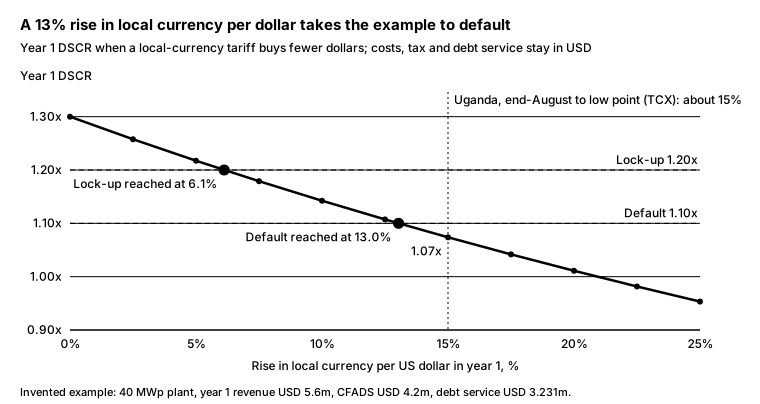
The move TCX describes for Uganda, about 15% more shillings per dollar, would take year 1 cover to 1.07x. The two thresholds correspond to revenue losses of about 5.8% and 11.5% of year 1 revenue, which are the same losses that trip the same covenants when a buyer simply stops paying for part of the output.
Why do calm years mislead a currency assumption?
A currency assumption built from recent history captures the drift and misses the jump. TCX notes the shilling lost just over 1% a year on average from the start of 2022, then about 13% in two months, so a model fed the average would have needed more than a decade to reach the move that came in one autumn.
In our reading, the arithmetic shows why the average misleads: a 1% annual drift compounds to about 13% only by year 12, spread across the life of the loan, so each year's cover barely moves, whereas a step of the same size arrives in a single year against a single debt service payment.
The broader record argues against calm as a base case: BloombergNEF's 2017 Climatescope found that developing countries held 46 of the 50 most volatile currencies over the previous five years. That figure is dated, but the shilling has just shown the same pattern again.
Does hedging the loan solve currency risk for a solar project?
Hedging or local-currency debt removes the price risk of a devaluation, and three gaps remain that a solar model still has to fill, each easy to miss in a post that celebrates a hedge paying out.
Access to dollars. In the 2021 interview, the TCX executive said its products are largely non-deliverable and do not cover the borrower's convertibility risk. Climatescope treats convertibility and transfer as their own risk, usually covered by political risk insurance or guarantees from MIGA and the regional development banks.
Tenor and size. The Power Africa handbook says long-term local-currency debt in the size grid-scale projects need is often unavailable, and that local banks, usually the best source, may not lend the amount or tenor required.
Who pays for the protection. Nominal rates on local-currency loans are almost always higher, and Climatescope notes that developers either mitigate currency risk or price it into the tariff. In our reading, someone always pays, whether the buyer through a higher tariff, the project through hedge cost, or a donor through a subsidised hedge.
The right comparison is a hedged structure against the expected cost of a devaluation, because the same handbook says the cheaper dollar loan looks cheaper only when the comparison ignores depreciation, and a hedged rate set against an unhedged dollar rate does exactly that.
We look at what a hedge costs a solar project, who stands behind it and what it leaves out in a follow-up article, What TCX's annual report and its chief executive's replies tell solar developers about hedging currency risk.
What should modellers and lenders change now?
In our reading, currency risk should be modelled as a chain that ends at the project wherever it starts, and seven changes cover most of what a model needs.
- Find the currency switch. Record the tariff currency, the payment currency and the currency the buyer earns. Our article Currency risk in a solar power purchase agreement: denominated versus paid, local-currency security and the FX true-up covers the contract side.
- Run a step as well as a drift. Add a one-year devaluation case alongside any trend assumption, and report it in the year with the tightest cover.
- Report the breaking points. State the move that trips lock-up and the move that reaches default. In our example these are about 6.1% and 13.0%.
- Link currency to payment for dollar tariffs. Run the devaluation case together with a payment delay case, since that is the route by which the move reaches a dollar-priced project.
- Test the buyer's saving after the move. Compare the tariff in local currency with the buyer's alternative supply before and after a step devaluation.
- Keep convertibility separate. Model a period where the buyer pays in local currency that cannot yet be turned into dollars, and check what reserves cover it.
- Price the hedge against the loss. Compare the hedge cost with the downside it removes.
Sources
Pages opened on 30 October 2026. The example project is invented and has no source.
- We lost big money on the Ugandan shilling: and that's the point, Ruurd Brouwer, chief executive of TCX, LinkedIn post, 30 October 2026. Used for TCX's loss figures, its new Ugandan hedging, the shilling's earlier drift and the 15% more shillings needed since August.
- Uganda Shilling at depreciation: A market correction, not just an external shock, The Observer (Uganda), 28 October 2026. Used for the exchange rate path in 2026, the 3.3% July figure and the comparison with Kenya and Tanzania.
- Bank of Uganda raises benchmark interest rate to 12% amid currency, inflation pressures, Nairametrics, 14 October 2026. Used for the rate decision, its size and the reasons the bank gave.
- Uganda hikes main interest rate to try to arrest currency's slide, Reuters via CNBC Africa, 14 October 2026. Used for the shilling's gain after the rate rise.
- The Currency Exchange Fund: hedging plays key role in developing local financial markets, Impact Investor, 13 September 2021. Used for TCX's view on local-currency borrowing, the 8% versus 16% example, and the limits on convertibility cover.
- Understanding Power Project Financing, second edition, Power Africa and the Commercial Law Development Program, US Department of Commerce. Used for the currency mismatch between dollar PPAs and offtaker revenue, corporate offtakers that earn dollars, and the limits of local-currency debt.
- How to Mitigate Renewables Risks in Emerging Markets, Climatescope 2017, BloombergNEF. Used for currency volatility in developing countries, pricing currency risk into tariffs, and convertibility as a separate risk.