Currency risk in a solar power purchase agreement: denominated versus paid, local-currency security and the FX true-up
By SolarQuant Editorial. Published 2026-10-05. Last updated 2026-10-05.
A solar project with US dollar debt and an offtaker that earns local currency carries several separate currency risks, not one. A dollar tariff covers the exchange rate on the invoice date and little else. This article separates the risks, shows which clause or instrument covers each, and shows how each one enters the financial model.
What is the difference between the currency a tariff is denominated in and the currency it is paid in?
The denomination currency is the one the tariff is set in. The payment currency is the one that reaches the project company's account. The two can differ, and most currency risk hides in the gap between them.
Developers in emerging markets typically insist on a reserve currency power purchase agreement (PPA), to match their reserve currency borrowings. That is how the public handbook Understanding Power Project Financing puts it.
The companion handbook Understanding Power Purchase Agreements says PPA payments are most often made in the currency needed to repay the debt. Where they are not, it says the project needs hedging, or exchange rate indexation with a true-up mechanism.
The example is the series' invented 40 MWp plant, placed here in an invented, unnamed emerging market. A state-owned utility is the only offtaker, the senior debt is in US dollars, and the local currency is called local currency units (LCU). Every figure in this article is invented.
| Structure | Tariff set in | Paid in | Who carries exchange rate risk | Who has to find the dollars |
|---|---|---|---|---|
| Set and paid in US dollars | USD | USD | The offtaker | The offtaker |
| USD-indexed | USD | LCU, converted at a reference rate | The offtaker in principle; the project company between rate fixing and conversion | The project company |
| Set and paid in local currency | LCU | LCU | The project company and its lenders, unless hedged | The project company |
The table is our reading of the three structures. A 2026 paper by TCX and the African Development Bank makes a similar point about Africa. It says hard currency PPAs allocate currency risk almost entirely to host governments and their utilities.
What still leaks under a USD-indexed tariff?
A USD-indexed tariff removes exchange rate risk only at the moment the invoice is converted into local currency. Three leaks remain: conversion timing, the rate basis, and the ability to convert and transfer.
- Conversion timing. The invoice fixes an LCU amount at the invoice date rate. The offtaker pays weeks later, and the company converts later still. Any depreciation in between is a dollar loss unless a true-up repairs it.
- Rate basis. The invoice converts at a reference rate, often an official or mid rate. The bank sells dollars at its own dealing rate, which is worse.
- Convertibility and transfer. An indexed tariff says nothing about whether dollars are available, or whether they may leave the country.
Take an invented 2% gap between the reference rate and the bank's selling rate. Converting a full year of USD 5.6m revenue then costs USD 0.110m. Year 1 DSCR falls from 1.30x to 1.27x.
Only the converted amount bears the gap. If USD 1.4m of operating costs and tax is paid in LCU, USD 4.2m converts and the cost is USD 0.082m.
What is an FX true-up?
An FX true-up is a clause that adjusts a payment for exchange rate movement after the invoice rate was fixed. Its aim is that the project company ends up with the invoiced dollar amount. Without it, a USD-indexed tariff protects the invoice and not the cash.
In our reading, two drafting approaches are common:
- Convert at the payment date. The offtaker pays the LCU equivalent of the dollar invoice at the rate on the day it pays.
- Settle on the next invoice. The offtaker pays the LCU amount first invoiced. The shortfall or surplus is added to the next invoice.
The monthly invoice is USD 5.6m divided by 12, about USD 0.467m. At 100 LCU per USD on the invoice date, that is LCU 46.67m. The offtaker pays 45 days later, when the rate is 105.
| Case | Offtaker pays | Dollars received | Shortfall |
|---|---|---|---|
| No true-up | LCU 46.67m | USD 0.444m | USD 0.022m |
| Convert at the payment date | LCU 49.00m | USD 0.467m | Nil |
| Settle on the next invoice | LCU 46.67m now, LCU 2.33m next month | USD 0.444m now, USD 0.022m later | Nil if the carried amount is fixed in dollars |
Four drafting details decide how much the clause is worth:
- Which rate. A published reference rate, or the rate the company's bank actually deals at.
- Which date. The payment date, the conversion date, or a few days either side.
- Late payment. Whether the rate keeps floating until the cash arrives, and whether default interest runs on the dollar amount.
- One-way or two-way. Whether the company refunds a surplus when the local currency strengthens.
A 5% move in 45 days is a sharp episode. The chart below uses steady depreciation instead and shows the cost of having no true-up.
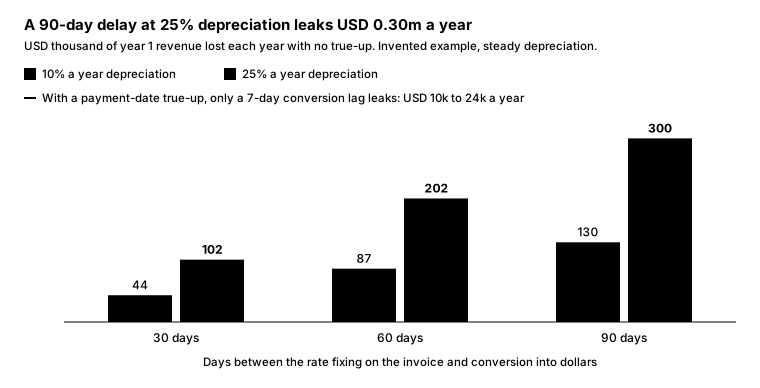
At 90 days and 25% a year, year 1 DSCR falls from 1.30x to 1.21x, close to the 1.20x lock-up. The article "The cover ratio ladder" explains what lock-up then does to distributions.
What is the difference between convertibility risk and transfer risk?
Convertibility risk is the risk that local currency cannot be exchanged for dollars. Transfer risk is the risk that dollars cannot be sent out of the country. Both arise after the offtaker has paid.
The normal path of the money has four steps:
- The offtaker pays local currency into the project company's onshore account.
- The company asks its bank for dollars.
- The bank sources the dollars in the interbank market.
- The dollars go to an offshore debt service account, from which lenders are paid.
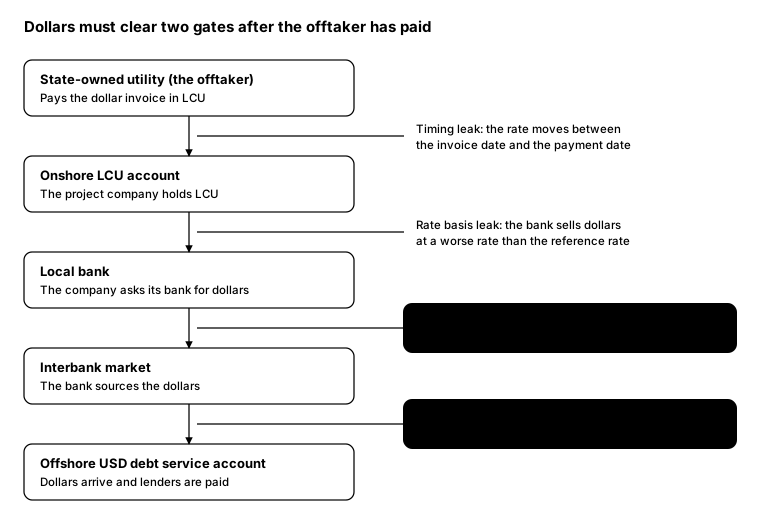
The two risk points sit at steps 3 and 4. A Global Infrastructure Hub article from 2018 notes that some governments restrict converting local currency revenue or transferring it abroad. A 2017 World Bank blog describes convertibility risk as the scarcity of foreign currency in host countries at times of stress.
A late conversion can put the borrower in payment default even though the offtaker paid in full and on time. The loan agreement requires dollars on the payment date. In our reading, holding the local currency equivalent onshore does not discharge that obligation.
Real deals usually use six-month periods, so half of year 1 debt service of USD 3.231m is a USD 1.62m instalment. Suppose the bank takes six weeks longer than planned to deliver dollars. The offshore DSRA of USD 1.62m pays that instalment in full, then stands empty until the dollars arrive.
With no reserve, the instalment is missed and a payment default follows once any grace period ends. Waiting also costs money. At 25% depreciation a year, LCU held for six weeks loses 2.5% of its dollar value, about USD 0.041m on the instalment.
How does local-currency payment security work when the invoices are in dollars?
Payment security is a liquid instrument the project company can draw when the offtaker pays late. The usual forms are a letter of credit, a bank guarantee or an escrow account. A World Bank Group product page describes such a letter of credit as a buffer against short-term payment disruptions.
In our reading, the security is often issued in local currency for practical reasons: a local bank issues it, and the utility earns local currency. The invoices it protects are still measured in dollars.
In the example the security is sized at three months of invoices at 100 LCU per USD, which is LCU 140m. It is never re-sized. As the currency weakens, the same LCU amount covers fewer months of dollar invoices.
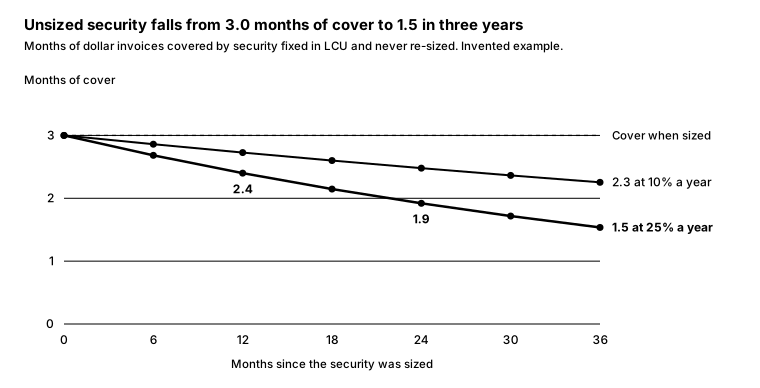
At 25% a year, cover drops below two months after about 22 months. In our reading the fix is periodic re-sizing. The PPA requires the offtaker to restore the agreed months at the current rate, each year or when the rate passes a threshold.
What does political risk insurance cover, and what does it not cover?
Political risk insurance covers losses caused by defined government actions. It does not cover a weaker exchange rate, and in our reading it is not day-to-day liquidity. The rows below paraphrase the public product pages of MIGA, the World Bank Group's political risk insurer, and other insurers' terms differ.
| Cover | What triggers it | What it does not cover | How fast it pays |
|---|---|---|---|
| Currency inconvertibility and transfer restriction | Inability to legally convert local currency into hard currency, or to transfer hard currency out of the host country, resulting from government action or failure to act | "Currency depreciation is not covered." | The page gives no timetable |
| Breach of contract | A government's breach or repudiation of a contract such as a PPA. Cover may extend to state-owned enterprises in certain circumstances | Payment before the dispute process has run. The investor first invokes the contract's dispute resolution mechanism | After a specified period, if recourse is denied or an award is unpaid. A provisional payment is at MIGA's discretion |
| Non-honouring of financial obligations by a state-owned enterprise | Failure to pay when due under an unconditional and irrevocable financial payment obligation or guarantee | It applies only where the obligation is unconditional and not subject to defences | No arbitral award is required. The page gives no timetable |
Three points follow for a PPA, all our reading of those pages. None of the covers pays for the depreciation leak or the rate basis. Breach of contract cover pays after dispute resolution, so it protects value and is not liquidity.
The third point concerns an ordinary missed invoice. A monthly invoice can usually be disputed, so it rarely counts as an unconditional obligation. MIGA's 2013 announcement of the state-owned enterprise cover called it cover for "credit-worthy SOEs", so the utility's credit standing matters.
The convertibility wording also has a limit. It refers to an inability to convert legally that results from government action or failure to act. In our reading, a commercial shortage of dollars with no government act behind it may fall outside that wording.
Premiums are deal specific. Take an invented premium of 1.0% a year of the insured amount, with the outstanding senior debt insured. Year 1 premium is USD 0.251m, so CFADS falls from USD 4.2m to USD 3.95m and DSCR from 1.30x to 1.22x.
Sizing the debt at 1.30x after the premium cuts senior debt by USD 0.99m, to USD 24.1m.
What are the layers of protection, and what gap is left?
The protections are called in a fixed order: payment security first, the reserve account second, insurance behind. Each layer buys time and none of them restores a weaker exchange rate. What they do not cover stays with lenders and sponsors.
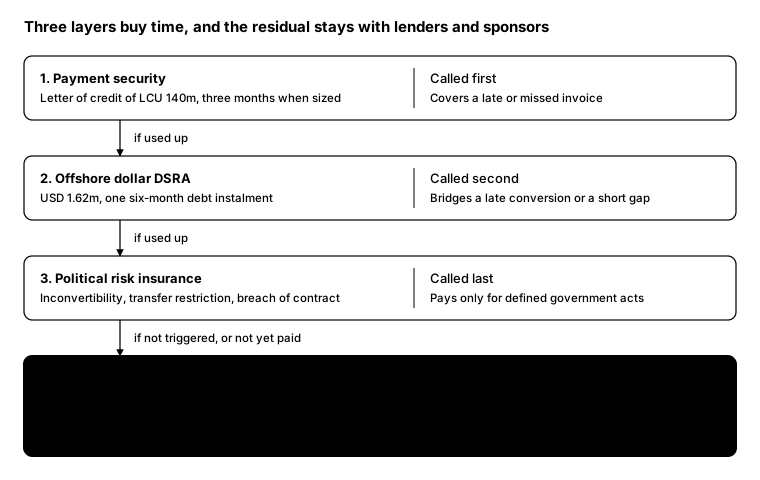
In our reading, lenders price the gap through a higher sizing ratio, a larger reserve or sponsor support. Sponsors carry the rest as lower and later distributions. The pillar article, "How to read a solar project finance term sheet: a modeller's guide", shows where those terms sit in a term sheet.
How do you model it?
Model currency risk as a set of separate inputs, each with its own row, so that each leak can be switched on alone. The steps below follow the order of the cash.
- Tag the currency of every line. Mark revenue, each operating cost, tax, debt service and each reserve as USD or LCU.
- Add an exchange rate path. One row of LCU per USD for every period, with a base case and depreciation cases.
- Add the payment delay in days. It moves each invoice from its invoice date to its payment date.
- Add the conversion lag. Days from receipt of LCU to receipt of dollars.
- Add the rate spread. Apply the gap between reference rate and dealing rate to the amount converted.
- Add the true-up as a switch. None, payment date, or next invoice. Compute the dollars actually received under each.
- Re-measure the security each period. Cover in months is the LCU amount divided by the monthly dollar invoice at the current rate. Add the re-sizing rule.
- Model an offshore dollar DSRA. Draw it when dollars arrive late, then refill it before distributions.
- Add the insurance premium as a cost line. Premium rate times insured amount, deducted before CFADS.
- Run downside cases. For example 25% depreciation with a 90-day delay, and a six-week conversion delay across a payment date.
The timing leak in steps 3 and 4 uses one formula. R is annual dollar revenue, g is annual depreciation and d is the days between rate fixing and conversion.
With R of USD 5.6m, g of 25% and d of 90 days, the leak is USD 0.30m a year. Test each case against the 1.20x lock-up and the 1.10x default level.
What are the common mistakes?
Most errors come from treating currency risk as one line. The list is our reading of where models and term sheets go wrong.
- Treating a dollar tariff as dollar cash. A USD-indexed tariff fixes the invoice. The cash still depends on timing, the rate basis and conversion.
- Using one exchange rate. The reference rate on the invoice and the bank's dealing rate are different inputs.
- Leaving the true-up out of the model. A clause that exists in the PPA but not in the model cannot be tested.
- Fixing the security in local currency and never re-sizing it. Three months of cover becomes 1.5 months in three years at 25% depreciation.
- Counting insurance as liquidity. Breach of contract cover pays after dispute resolution, long after a missed debt payment.
- Holding the DSRA onshore or in local currency. A reserve behind the same two gates cannot bridge a conversion delay.
- Leaving the premium out of CFADS. The invented 1.0% premium takes year 1 DSCR from 1.30x to 1.22x.
Frequently asked questions
Does a USD-indexed tariff remove currency risk?
No. It removes exchange rate risk on the invoice date only. The project company still carries the timing leak, the rate basis, and the risk that dollars cannot be obtained or sent abroad.
Is an FX true-up the same as indexation?
No. Indexation sets the local currency amount of each invoice from a dollar tariff. A true-up corrects for the exchange rate movement after that amount was set.
Does political risk insurance cover currency depreciation?
No, not under the convertibility cover described here. MIGA's page on currency inconvertibility and transfer restriction says: "Currency depreciation is not covered." Depreciation is handled by the tariff structure, the true-up or a hedge.
Why should the DSRA be offshore and in dollars?
The reserve exists to pay dollar debt service when project cash is late. An onshore local currency reserve sits behind the same conversion and transfer steps as the revenue. In the example, the offshore USD 1.62m covers one full instalment during a six-week conversion delay.
How often should local-currency payment security be re-sized?
Practice varies, and we found no public norm. The example shows why it matters: at 25% depreciation a year, three months of cover falls below two months in about 22 months. Annual re-sizing or a rate threshold both limit the erosion.
Would a local-currency PPA solve the problem?
It moves the problem: the project company carries exchange rate risk unless its debt is in local currency or hedged. The 2026 TCX and African Development Bank paper argues that local currency PPAs should become the standard in Africa. It says this needs more local currency lending and hedging.
Sources
Pages opened on 5 October 2026. The example project is invented and has no source.
- Currency Inconvertibility and Transfer Restriction, MIGA, World Bank Group. Used for what the cover responds to and for the statement that depreciation is not covered.
- Breach of Contract, MIGA, World Bank Group. Used for the trigger, the dispute resolution step and the discretionary provisional payment.
- Non-honoring of Public Debt, MIGA, World Bank Group. Used for non-honouring cover of state-owned enterprise obligations and its unconditional obligation test.
- MIGA Expands Non-Honoring of Financial Obligations Coverage for State-Owned Enterprises, MIGA press release, 26 June 2013. Used for the description of the cover as for credit-worthy state-owned enterprises.
- Project-Based Payment Guarantee for the Private Sector, World Bank Group Guarantees, on the MIGA site. Used for the letter of credit as a buffer against short-term payment disruptions.
- Understanding Power Purchase Agreements, African Legal Support Facility and US Commercial Law Development Program, hosted by the World Bank PPP Resource Center. Used for the payment currency, indexation and true-up statement.
- Understanding Power Project Financing, US Commercial Law Development Program and African Legal Support Facility, Power Africa Understanding Series. Used for why developers ask for a reserve currency PPA.
- Financing Cross-Border Infrastructure Projects: Currency Risk, Global Infrastructure Hub, 24 August 2018. Used for government restrictions on conversion and transfer.
- Foreign exchange risk: How a liquidity facility could help, World Bank Blogs, 18 July 2017. Used for the description of convertibility risk.
- The case for local currency Power Purchase Agreements in Africa, TCX and African Development Bank, 2026. Used for who carries currency risk under hard currency PPAs in Africa, and for its case for local currency PPAs.