Senior versus subordinated debt in solar project finance: drawdown order, pricing and ratios
By SolarQuant Editorial. Published 2026-10-05. Last updated 2026-10-05.
A subordinated loan sits between senior debt and equity: it is paid after the senior lender and before shareholders. Once a term sheet adds one, the model needs two debt tranches, two sets of cover ratios and one clear order of payment. This article explains what subordination means in cash flow terms and how to model it, using one invented 40 MWp example.
What are senior and subordinated debt?
Senior debt is the loan that is paid first from project cash and holds first-ranking security. Subordinated debt is a loan that is paid only after the senior debt has been served in each period. It is also called junior debt, and mezzanine debt when it sits between senior loans and equity.
The World Bank places mezzanine funding below senior debt and above equity. Its examples are subordinated loans and preference shares.
The example project needs USD 40.0m. Senior debt is USD 25.07m, sized by a 1.30x DSCR. The pillar article "How to read a solar project finance term sheet: a modeller's guide" explains that sizing. The term sheet then adds a USD 2.81m subordinated loan at 10.0% over the same 12 years.
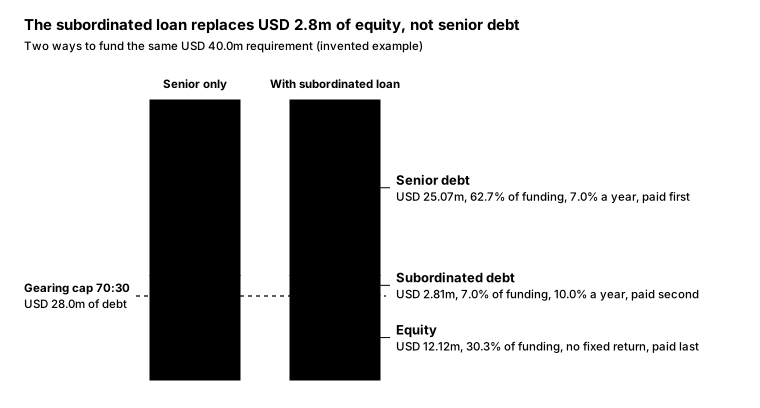
The subordinated loan fills almost all the room between the senior debt and the USD 28.0m gearing cap. Equity falls from USD 14.93m to USD 12.12m, and senior debt does not change.
What does subordination mean in cash flow terms?
Subordination means the junior lender receives cash only after the senior lender has received everything due in that period. It has two parts: subordination in payment and subordination in security.
Subordination in payment fixes the order of the cash flow waterfall. Senior interest, senior principal and senior reserve top-ups come first, then subordinated debt service, then distributions. Wall Street Prep gives the same order.
Subordination in security fixes who is paid first if the security is enforced. A Pinsent Masons guide on leveraged finance says any junior security ranks behind the senior security. It adds that junior lenders cannot enforce until senior debt is repaid, unless agreed otherwise.
Why does a project use subordinated debt, and who provides it?
A project uses subordinated debt to fill the gap between what the senior lender will lend and what the shareholders want to invest. The World Bank notes that it allows a higher debt to equity ratio, at a higher cost than senior debt.
The gap exists because senior debt is capped by a cover ratio. In the example the 1.30x DSCR stops senior debt at USD 25.07m, although the gearing cap would allow USD 28.0m. A lender that accepts a thinner cushion can lend into that space.
There are two main providers. The APMG PPP Guide names shareholders, for tax efficiency, and third-party investors seeking a higher return. Development finance institutions also lend on a subordinated basis in some markets, which is our own observation, not a sourced one.
The provider matters for the model. A shareholder loan is equity in economic terms, so in our reading lenders tend to treat its payments like distributions.
How is subordinated debt priced and sized?
Subordinated debt is priced above senior debt because it is riskier, as Financial Edge Training notes. In the example the senior loan costs 7.0% and the subordinated loan 10.0%, both invented. The sources we opened give no project finance range, so treat pricing as deal specific.
The subordinated loan is sized on the cash left after senior debt service, using a lower target ratio on total debt service:
Year 1 gives USD 3.652m of total debt service less USD 3.231m senior, so USD 0.421m. Discounting 12 years of this at 10.0% gives a loan of USD 2.81m. We assume no fees and no interest during construction on this tranche, and hold the funding requirement at USD 40.0m.
| Year | Interest (USD m) | Principal (USD m) | Closing balance (USD m) |
|---|---|---|---|
| 1 | 0.281 | 0.140 | 2.669 |
| 2 | 0.267 | 0.152 | 2.516 |
| 3 | 0.252 | 0.166 | 2.351 |
| 4 | 0.235 | 0.180 | 2.171 |
| 5 | 0.217 | 0.196 | 1.975 |
| 6 | 0.197 | 0.213 | 1.761 |
| 7 | 0.176 | 0.233 | 1.528 |
| 8 | 0.153 | 0.254 | 1.274 |
| 9 | 0.127 | 0.277 | 0.997 |
| 10 | 0.100 | 0.303 | 0.694 |
| 11 | 0.069 | 0.331 | 0.363 |
| 12 | 0.036 | 0.363 | 0.000 |
| Term | Senior loan | Subordinated loan |
|---|---|---|
| Amount (USD m) | 25.07 | 2.81 |
| Share of funding | 62.7% | 7.0% |
| All-in interest rate | 7.0% | 10.0% |
| Repayment | 12 years, sculpted | 12 years, sculpted |
| Average life | 7.2 years | 7.5 years |
| Total interest paid (USD m) | 12.66 | 2.11 |
| Sized by | Senior DSCR 1.30x | Total DSCR 1.15x |
| Lock-up and default levels | 1.20x and 1.10x | 1.08x and 1.03x, on total DSCR |
| Rank in payment | First | Second, after senior reserves |
| Security | First ranking | Second ranking or none |
The subordinated loan pays USD 0.75 of interest per dollar borrowed against USD 0.50 for the senior loan. The blended cost of all debt rises from 7.0% to 7.3%.
In what order are senior debt, subordinated debt and equity drawn?
Drawdown order is the sequence in which each funding source pays construction costs. The usual choices are equity first, pro rata, or debt first with equity committed and paid in later.
Yescombe's Principles of Project Finance states that lenders prefer equity to be invested first or pro rata with the debt. They accept debt first if the sponsors are legally committed to invest. The World Bank notes that equity investors prefer to pay in late.
Subordinated debt normally follows the equity rule, because the senior lender sees it as part of the cushion beneath it. That is our reading, so check the conditions precedent to each drawdown in the term sheet. In a pro rata structure, each dollar of cost in the example is funded 62.7% senior, 7.0% subordinated and 30.3% equity.
The order changes the model through interest during construction, although the example assumes none on the subordinated tranche. As a what-if outside the example, drawing it evenly over 12 months gives an average balance of about USD 1.4m. At 10.0% that would cost about USD 0.14m, which the example leaves out.
Where does subordinated debt service sit in the order of payments?
Subordinated debt service sits after senior debt service and senior reserve top-ups, and before distributions to shareholders. It is paid only from cash that has passed every senior line of the waterfall.
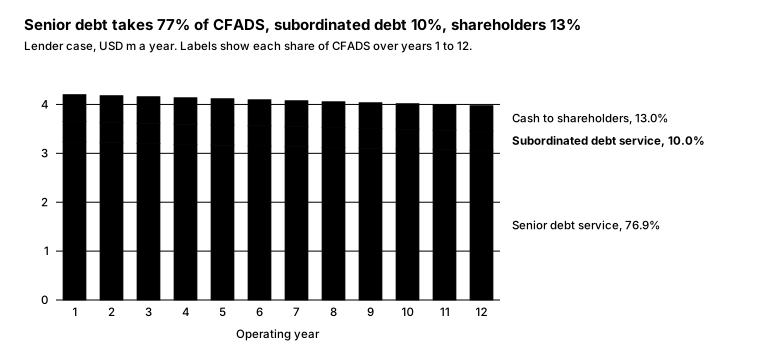
The subordinated loan takes about USD 0.4m a year that would otherwise reach shareholders. Year 1 distributions fall from USD 0.969m to USD 0.548m.
Three things can block the payment:
- No cash. Senior debt service or a DSRA top-up has used all the CFADS.
- A lock-up test. Some term sheets treat subordinated payments like distributions, so a senior DSCR below 1.20x traps them. In our reading this is the norm for shareholder loans and negotiable for third-party loans.
- A senior default. A mezzanine financing note by United States law firm Bass, Berry & Sims says a senior payment default always triggers permanent payment blockage. For other senior defaults it gives a negotiated blockage period, usually 90 to 180 days, in that market and not for project finance.
The Pinsent Masons leveraged finance guide says only interest on junior debt and certain fees and expenses are allowed during the senior term. Check whether the term sheet also permits scheduled subordinated principal.
Why does a deal with two tranches have two DSCRs?
A deal with two tranches has two DSCRs because each lender tests the cash against its own claim. The senior DSCR divides CFADS by senior debt service alone. The total DSCR divides CFADS by senior plus subordinated debt service.
Forvis Mazars describes two conventions for a mezzanine ratio. One puts total debt service in the denominator. The other puts cash available for junior debt service in the numerator, which gives 2.30x in year 1 of the example.
Each ratio has its own sizing, lock-up and default level, because each lender sets its own cushion. "The cover ratio ladder" explains the three rungs for one loan. With two loans there are two ladders, and they are not reached in the order of seniority.
| Trigger | Level | Fall in CFADS that reaches it |
|---|---|---|
| Total DSCR lock-up | 1.08x | 6.1% |
| Senior DSCR lock-up | 1.20x | 7.7% |
| Total DSCR default | 1.03x | 10.4% |
| Senior DSCR default | 1.10x | 15.4% |
The junior triggers come first because the total DSCR starts from a thinner cushion.
What does the intercreditor agreement do?
An intercreditor agreement is the contract between the lenders that sets who is paid first and who may act when things go wrong. Corporate Finance Institute defines it as a contract between creditors that governs their relationship with a joint borrower, including the priority of claims.
The World Bank lists the matters it covers. They include the order of drawdown, the order of allocation of debt service payments, subordination, the holding of security and voting on decisions.
Three clauses matter most to the modeller, as described in the Pinsent Masons guide on leveraged finance:
- Payment restrictions. The borrower agrees not to pay junior debt except as permitted.
- Standstill. After a junior default, the junior lender must give notice and wait before it accelerates or enforces.
- Turnover. A junior lender that receives a payment in breach of the ranking must pass it to the senior lender.
None of these clauses adds a model line, but they decide which waterfall switches the model needs.
What does subordinated debt do to gearing and equity returns?
Subordinated debt raises gearing and cuts the equity cheque, but it raises the equity return only if it costs less than that return. In the example it lifts total debt to USD 27.88m, which is 69.7% gearing against the 70% cap.
| Measure (USD m unless stated) | Senior only | With subordinated loan |
|---|---|---|
| Senior debt | 25.07 | 25.07 |
| Subordinated debt | 0.00 | 2.81 |
| Total debt | 25.07 | 27.88 |
| Gearing | 62.7% | 69.7% |
| Room under the USD 28.0m cap | 2.93 | 0.12 |
| Equity | 14.93 | 12.12 |
| Distributions, year 1 | 0.969 | 0.548 |
| Distributions, years 1 to 12 | 11.32 | 6.40 |
| Distributions, years 13 to 20 | 31.09 | 31.09 |
Shareholders invest USD 2.81m less and give up USD 4.92m of distributions over 12 years. On our assumptions the equity IRR is about 0.14 percentage points lower with the loan than without it.
The assumptions are simple. Equity is paid in one amount at financial close, distributions equal CFADS less debt service for 20 years, and there is no terminal value. We ignore the tax saving on subordinated interest, the DSRA release and any fees on the subordinated loan.
Equity IRR rises only when the subordinated rate is below the equity IRR without the loan.
A shareholder loan is different. The same investors hold both instruments, so their combined return before tax is unchanged.
Check how the term sheet defines the gearing ratio. In our reading, third-party subordinated debt counts as debt and shareholder loans often count as equity. On the second definition the example stays at 62.7%.
What happens to each tranche in a downside case?
In a downside case the junior tranche is hit first and hardest, because it is paid from the cash left after senior debt service. The shared downside cuts CFADS by 10%, 12%, 13% and 3% in years 3 to 6.
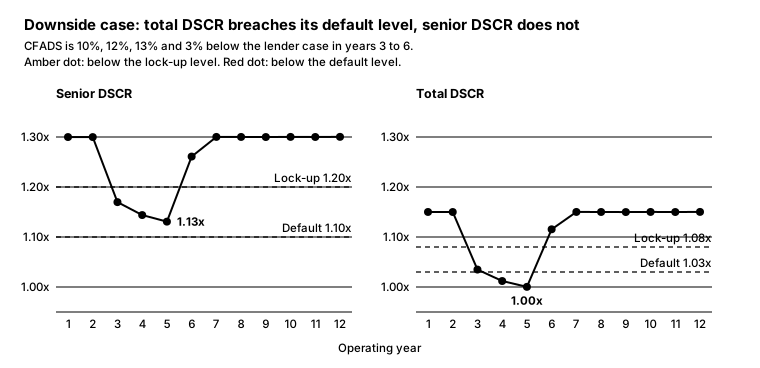
The senior DSCR falls below its 1.20x lock-up in years 3 to 5 and never reaches its 1.10x default level. The total DSCR is below its 1.08x lock-up in the same years. It is 1.035x in year 3, then below its 1.03x default level in years 4 and 5.
| Year | Cash after senior debt service (USD m) | Subordinated debt service due (USD m) | Cash left after both (USD m) |
|---|---|---|---|
| 3 | 0.544 | 0.417 | 0.127 |
| 4 | 0.458 | 0.415 | 0.043 |
| 5 | 0.415 | 0.413 | 0.002 |
| 6 | 0.822 | 0.411 | 0.411 |
Whether the subordinated loan is paid depends on the term sheet. We model two treatments:
- Payment allowed during senior lock-up. There is enough cash, so the USD 1.245m due in years 3 to 5 is paid. Only USD 0.17m of distributions is held, and shareholders receive USD 0.58m in year 6. The junior lender still has a ratio default in years 4 and 5, but the standstill delays enforcement.
- Payment blocked during senior lock-up. All USD 1.417m is held and the subordinated loan goes unpaid for three years. We assume unpaid amounts accrue at 10.0%, so they reach USD 1.512m. In year 6 the lock-up ends, the loan receives USD 1.923m and shareholders USD 0.316m.
Without the subordinated loan, shareholders would receive USD 2.239m in year 6.
How do you model it?
Model two tranches as two separate debt blocks that share one waterfall. The example uses annual periods for simplicity, while real deals usually use six-month periods.
- Give each tranche its own inputs. Amount, rate, fees, tenor, repayment profile, and its own sizing, lock-up and default ratios.
- Size the senior loan first. Sculpt senior debt service as CFADS divided by 1.30x and discount at 7.0%. This gives USD 25.07m.
- Size the subordinated loan on what is left. Total debt service is CFADS divided by 1.15x. Subtract senior debt service and discount the rest at 10.0%, giving USD 2.81m.
- Test the gearing cap on the defined debt. Total debt of USD 27.88m must not exceed USD 28.0m. If it does, cut the subordinated loan, not the senior loan.
- Set the drawdown order. Add a switch for equity first, pro rata or debt first, and compute interest during construction for each tranche.
- Build one waterfall. CFADS, senior interest and principal, senior DSRA, subordinated interest and principal, then distributions.
- Add the payment tests. Pay subordinated debt service only if cash is available, no senior default is running and any lock-up condition is met.
- Track unpaid amounts. Carry deferred subordinated interest and principal in their own balance, accrue interest on it and repay it when the block lifts.
- Calculate both ratios every period. Report senior DSCR and total DSCR against their own lock-up and default levels.
- Run the downside. Check which ratio trips first and whether held cash and catch-up payments tie to the bank balance.
What are the common mistakes?
- Adding the two loans into one debt line. The blended 7.3% rate hides the order of payment, so the model cannot show who goes unpaid.
- Testing only the senior DSCR. In the example the total DSCR reaches its lock-up after a 6.1% fall in CFADS, before the senior ratio does.
- Using the wrong ratio definition. A junior ratio of 2.30x and a total ratio of 1.15x describe the same year. Use the definition in the term sheet.
- Paying subordinated debt during a lock-up without checking. If the term sheet blocks it, the model overstates cash to the junior lender by USD 1.245m in years 3 to 5.
- Assuming the equity IRR must rise. It falls by about 0.14 percentage points in the example, because the loan costs more than the equity return without it.
Frequently asked questions
Is mezzanine debt the same as subordinated debt?
Mezzanine debt is one form of subordinated debt. The World Bank uses the word for funding that ranks below senior debt and above equity. In project finance models both are built the same way: a second tranche paid after the senior loan.
Can subordinated debt be repaid before senior debt?
Normally not. Pinsent Masons describes leveraged finance intercreditor terms under which the borrower agrees not to pay or prepay junior debt, apart from permitted payments. Any early repayment of the junior loan needs to be allowed by the senior lender.
What is a typical total DSCR?
We did not find a public source that gives a range, and practice varies by deal. The example uses invented levels of 1.15x for sizing, 1.08x for lock-up and 1.03x for default. Take the levels from your own term sheet.
What happens to subordinated interest that is not paid?
The term sheet decides whether it is capitalised, accrues interest or is simply deferred. The example assumes unpaid amounts accrue at the 10.0% loan rate. USD 1.245m blocked in years 3 to 5 grows to USD 1.512m by year 6.
Sources
Pages opened on 4 October 2026 and checked again on 5 October 2026. The example project is invented and has no source.
- Intercreditor Arrangements, World Bank Public-Private Partnership Resource Center. Used for the rank of mezzanine funding, its effect on the debt to equity ratio, equity timing and the list of intercreditor matters.
- 7.2. Financial Structure: Categories, Instruments and Sources (fund suppliers): Financial Strategy of the Sponsor/Private Partner, APMG PPP Certification Guide. Used for who provides subordinated debt and why shareholders provide it.
- 13.3 Drawdown of Debt and Equity, excerpt from E. R. Yescombe, Principles of Project Finance, hosted by GlobalSpec. Used for lender preferences on the order of drawdown.
- Debt Service Coverage Ratio (DSCR): formula, meaning and use in project finance, Forvis Mazars. Used for the two conventions for a mezzanine DSCR.
- Distinctive Features of a Project Finance Model, Wall Street Prep. Used for the waterfall order of senior debt, reserve accounts, subordinated debt and equity.
- Intercreditor documents, Pinsent Masons, 30 August 2011. A guide written about leveraged finance, not project finance. Used for the ranking and enforcement of junior security, payment restrictions, standstill and turnover.
- Stuck in the Middle of the Cap Stack: Intercreditor and Subordination Agreements in Mezzanine Financings, Bass, Berry & Sims. A United States law firm's note on mezzanine financings, not project finance. Used for payment blockage after a senior default.
- Intercreditor Agreement, Corporate Finance Institute. Used for the definition of an intercreditor agreement.
- Subordinated Loan, Financial Edge Training. Used for the point that subordinated loans are riskier than senior loans and carry a higher interest rate.