The cash flow waterfall in project finance: the order of payments and how to model it
By SolarQuant Editorial. Published 2026-10-05. Last updated 2026-10-05.
The cash flow waterfall is the point where the legal order of payments in a term sheet becomes rows in a financial model. It decides who is paid first, which accounts hold the cash, and what is left for shareholders. Build it in the agreed order and equity returns rest on cash that can actually be distributed.
What is a cash flow waterfall?
A cash flow waterfall is the fixed order in which a project company must apply its cash in each period. Each item is paid only from the cash left after the items ranked above it. Lenders also call it the cascade or the priority of payments.
Forvis Mazars describes it as a presentation of cash flows "in order of seniority". It makes sure every item is paid, or reserved for, in the correct order. Yescombe lists the cascade as one of the ways lenders control cash during operations, next to reserve accounts and limits on distributions.
What it changes in the model. The cash flow statement becomes an ordered ladder. Every payment row is followed by a "cash available after" row, and the last row is the only cash equity can take.
What is the standard order of payments?
The standard order is operating costs and taxes, agent fees, senior interest and hedging, senior principal, reserve transfers, subordinated debt, then distributions. Yescombe's cascade gives the first five steps in that order. A term sheet summary published by Verdigris adds subordinated debt and shareholders as steps six and seven.
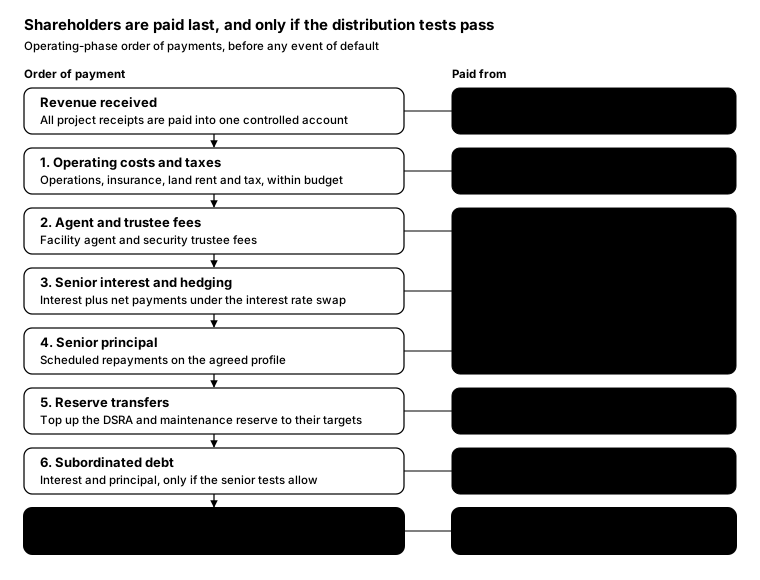
Read the diagram from the top: each step is paid only from what the step above leaves. The right column shows the account that makes the payment, which is where the model needs a balance.
What the term sheet typically says. The Verdigris summary heads the clause Priority of Payments. In our reading, other deals call it application of proceeds or cash waterfall, and the items and order differ by deal. For the lines that build CFADS, Forvis Mazars says to check them against the project's financing documents.
Which project accounts sit behind the waterfall?
Project accounts are the bank accounts the waterfall moves cash between, and the accounts agreement sets the lenders' control over them. An East Africa Law Society training note says all revenues are paid into a proceeds account. It also names a debt service reserve account and a maintenance reserve account.
Each account becomes a small control account in the model: opening balance, cash in, cash out, closing balance. Account names and the number of accounts vary by deal. The operating and debt service accounts below are our reading of a common set-up, not a rule.
| Account | Cash in | Cash out | Model rows |
|---|---|---|---|
| Proceeds (revenue) account | All project receipts, reserve releases | Every waterfall payment and transfer | Revenue received; each "cash available after" line |
| Operating account | Transfers from proceeds, within budget | Operating costs, tax | Operating costs paid; tax paid |
| Debt service account | Transfers from proceeds ahead of each payment date | Agent fees, senior interest, hedging, principal | Interest paid; principal paid; shortfall |
| Debt service reserve account (DSRA) | Initial funding, top-ups | Draws to cover a debt service shortfall, releases | DSRA target; transfer; balance |
| Maintenance reserve account | Scheduled transfers | Major maintenance costs | Reserve target; transfer; spend; balance |
| Distribution account | Cash that passes the distribution tests | Dividends, shareholder loan payments | Distribution test flag; distributions paid |
One term sheet summary we opened carves the distributions account out of the lenders' security. Our reading is that cash moved there has left the lenders' control, which is why the tests sit before the transfer.
How does the construction phase differ from the operating waterfall?
During construction there is no revenue, so the model shows a use of funds, not a waterfall. In our reading, debt drawdowns and equity go into a disbursement account and pay budgeted project costs. The question is who funds each cost, not who is paid first.
In the example, USD 25.1m of senior debt and USD 14.9m of equity fund the USD 40.0m requirement. About USD 1.4m of that is financing cost: the upfront fee, commitment fee and interest during construction. We assume the USD 40.0m also covers the initial DSRA balance of USD 1.62m, funded at completion.
The order of funding is deal specific, so read it from the term sheet. The Verdigris summary lists three equity injection styles: up-front, pari passu with debt, or back-ended. In our reading, the operating waterfall starts on the first day of operations, and the two phases should not share rows.
What does the waterfall look like in year 1 of the example?
In year 1 of the example, USD 5.6m of revenue leaves USD 0.97m for distribution after every senior claim is paid. The agency fee of USD 40,000 is part of the example's USD 1.0m of operating costs. We show it as its own step, so other operating costs are USD 0.96m and CFADS stays at USD 4.2m.
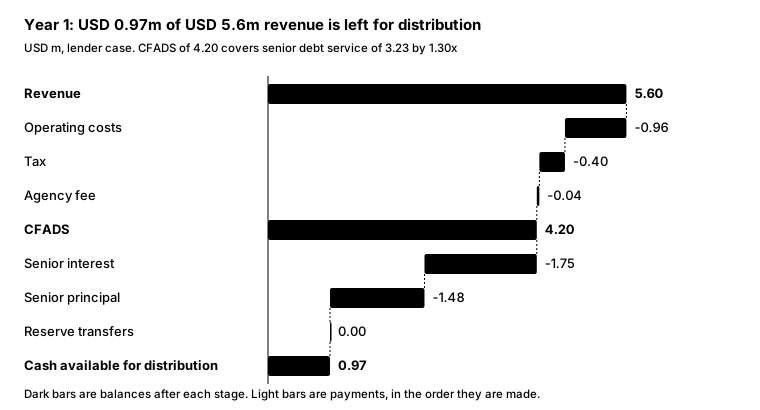
Lenders take about three quarters of CFADS, which is the 1.30x sizing ratio at work. The reserve step is nil in year 1 because the DSRA is assumed funded at completion and maintenance reserving starts in year 7.
Where do reserves and subordinated debt sit?
Reserve transfers rank after senior debt service and before subordinated debt and distributions. Both Yescombe's cascade and the term sheet summary we opened place reserve payments straight after senior principal. The term sheet summary then lists subordinated interest and principal, and last the shareholders.
Reserves. The model compares each reserve's target with its balance. A positive gap is a transfer, limited to the cash available. A negative gap is a release back to the proceeds account.
In the example the DSRA target is six months of debt service, USD 1.62m in year 1. The target drifts down by less than USD 0.01m a year, so we treat the year 1 transfer as nil. The maintenance reserve takes USD 0.6m a year in years 7 to 10 and pays the USD 2.4m inverter replacement in year 11.
Subordinated debt. The subordinated lender is paid from cash left after senior debt service and reserves. At a total DSCR of 1.15x, year 1 CFADS of USD 4.2m supports USD 3.65m of total debt service. That leaves USD 0.42m for the subordinated lender after USD 3.23m of senior debt service.
What are distribution conditions and lock-up?
Distribution conditions are tests the project must pass before cash can leave for shareholders, and lock-up is what happens when a test fails. Forvis Mazars puts it simply: in lock-up, distributions are suspended and cash is trapped in the project until the DSCR recovers. The APMG PPP Guide gives the same example of a covenant: no distributions if the previous year's DSCR missed a threshold.
What the term sheet typically says. A lock-up DSCR, set below the sizing ratio, and a list of other conditions. Our reading is that the list often includes fully funded reserves and no default, but practice varies. Take the list from the document.
The example. The lock-up level is 1.20x. In the downside case the DSCR is 1.17x, 1.14x and 1.13x in years 3 to 5, so USD 1.4m of distributions is held. In year 6 the DSCR is 1.26x and the held cash is released.
The common mistake. Locked-up cash is not lost, and it is not distributed. It needs its own balance row, so the equity cash flow shows the delay.
How does CFADS split between lenders and shareholders over the loan life?
Over the 12-year loan, senior lenders take about 77% of each year's CFADS and shareholders take what is left after reserves. That share follows from sculpting: debt service is CFADS divided by 1.30.
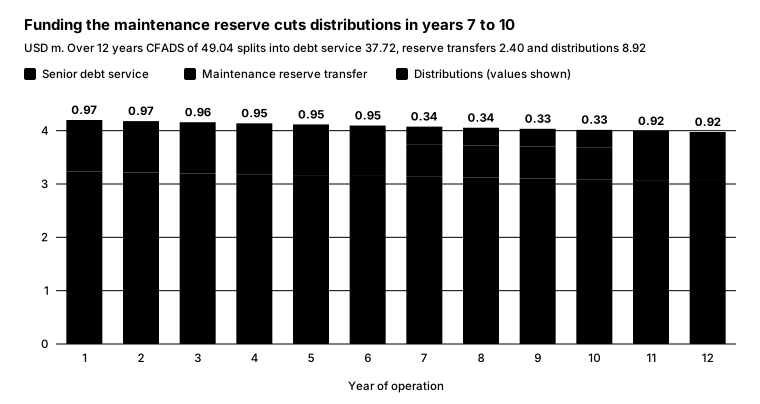
Years 7 to 10 show why the waterfall matters to equity. The USD 0.6m reserve transfer ranks ahead of distributions, so they fall by almost two thirds while the DSCR stays at 1.30x. We assume the DSRA balance is released on final repayment in year 12, which the chart leaves out because it is not CFADS.
What changes after an event of default?
After an event of default the normal waterfall stops serving shareholders, and the lenders' remedies take over. Forvis Mazars notes that lenders can then use the remedies in the loan agreement. These may include requiring immediate repayment or, in severe cases, taking control of the project from the sponsors.
In the example the default level is a DSCR of 1.10x. Our reading of common practice is that distributions are blocked and account withdrawals need lender consent while a default continues. Enforcement proceeds then follow a separate order set in the intercreditor terms, again on our reading.
In our reading, a lender's base case does not usually model enforcement. A default flag is enough: when it is on, distributions and subordinated payments are zero and cash stays in the proceeds account.
How do you model it?
Model the waterfall as one block where each item has three rows: amount due, amount paid, and cash available after. The rule for every item is the same.
- Copy the order of payments from the term sheet into rows, in the same order and with the same names.
- Start with cash received in the period. Use cash, not accrued revenue, so customer payment terms flow through.
- Pay operating costs, tax and agent fees. Label the line where the documents define CFADS.
- Pay senior interest and hedging, then senior principal. Add a shortfall row for any amount due but unpaid.
- Cover any shortfall from the DSRA, up to its balance.
- Calculate each reserve transfer as target less balance, limited to cash available. Treat a negative result as a release.
- Pay subordinated debt from the cash left, and carry unpaid amounts forward as its terms require.
- Test the distribution conditions with a flag. If it passes, distribute the cash left plus any locked-up balance. If it fails, add the cash to the locked-up balance.
- Build each account as opening balance, plus cash in, less cash out, equals closing balance.
- Take equity returns from the distributions row only.
The example uses annual periods for simplicity. The Verdigris summary has capital and interest paid three- or six-monthly, and Wall Street Prep describes operations modelled quarterly or semi-annually.
What checks should the waterfall pass?
A waterfall is right when no balance goes negative and every unit of cash is traced to a payment or an account. Forvis Mazars calls a flag on a negative closing cash balance a critical component, because a negative balance implies funding that does not exist.
- Cash never negative. Every "cash available after" line and every account balance is zero or more in every period.
- Sources equal uses. Cash received plus releases equals payments, transfers, distributions and the change in cash.
- Accounts reconcile. The sum of account balances equals cash on the balance sheet.
- Paid equals due. Senior debt paid matches the debt schedule unless the shortfall flag is on.
- Tests bite. Distributions are zero in every period where the distribution flag fails.
What are the common mistakes?
Most of these mistakes take cash from the wrong line or in the wrong order, so the model departs from the waterfall in the documents.
- Wrong order. The model follows a template order, not the term sheet's. Check the position of tax, hedging and reserve transfers line by line.
- DSCR from the wrong line. The ratio uses CFADS as defined in the documents, before reserve transfers. A maintenance reserve transfer cuts distributions, not the DSCR.
- Equity returns from CFADS less debt service. This ignores reserves, lock-up and subordinated debt. In years 7 to 10 of the example it would overstate distributions by USD 0.6m a year.
- Reserve spend counted twice. The USD 2.4m inverter cost in year 11 is paid from the reserve. Deducting it again from CFADS double counts it.
- Negative cash hidden by a plug. A balancing overdraft row hides a shortfall. Show the shortfall and let the checks fail.
- One CFADS for every tranche. Forvis Mazars flags seniority errors as a common mistake. Subordinated debt needs its own cash line after senior debt service.
Frequently asked questions
Is the cash flow waterfall the same as a cash flow statement?
No. Wall Street Prep says the waterfall has the same line items as a cash flow statement, rearranged by the hierarchy of payments. The statement reports what happened, and the waterfall decides what may be paid.
Where does tax sit in the waterfall?
In the orders we opened, tax sits at the top with operating costs. Yescombe's first step covers operating costs and taxes, and the term sheet summary lists project taxes with operating and maintenance spending. Always check the project's own documents.
Is the DSRA funded before or after debt service?
Top-ups to the DSRA come after senior interest and principal. The initial balance can be funded at completion from the construction budget or built up from operating cash. The term sheet says which, and the two give different equity cash flows.
Does lock-up reduce the DSCR?
No. Lock-up is a result of the DSCR, not an input to it. The cash stays in the project, so it delays distributions and lowers the equity IRR, but CFADS and debt service are unchanged.
Can the agency fee sit inside operating costs?
Yes, in a model, if the documents rank it above debt service either way. The example's USD 1.0m of operating costs includes the USD 40,000 agency fee. We show it as its own step so the rows match the legal order.
Sources
Pages opened on 4 October 2026 and checked again on 5 October 2026. The example project is invented and has no source.
- 13.5 Control of cash flow, Principles of Project Finance (E. R. Yescombe), GlobalSpec excerpt. The cascade as a lender control, and the order from operating costs and taxes to reserve accounts.
- Features of a Cash Flow Waterfall in Project Finance, Forvis Mazars. Definition of the waterfall and the negative cash balance check.
- CFADS: Cash Flow Available for Debt Service, Forvis Mazars. The advice to check CFADS line items and their order against the financing documents, and the need for CFADS at the right level of seniority.
- Debt Service Coverage Ratio (DSCR): formula, meaning and use in project finance, Forvis Mazars. Lock-up suspending distributions and lender remedies on a default covenant breach.
- Core finance documents, East Africa Law Society Institute, course on public private partnerships in the infrastructure sector. The accounts agreement, the proceeds account and reserve accounts, and distributions ranking last subject to conditions.
- Project finance principles: A typical project finance term sheet, Verdigris. A seven-step priority of payments including subordinated debt, how the DSRA is funded, equity injection styles, payment frequency, and the distributions account outside the security.
- 3. Ideologies of Project Finance, APMG PPP Certification Program, PPP Guide appendix on project finance. The example covenant that blocks distributions when the previous year's DSCR misses a threshold.
- The Debt Service Reserve Account (DSRA) in Project Finance: Save the Lenders, Save the World, Breaking Into Wall Street. Reserve funding as the lower of cash after debt service and the required amount, and releases when the requirement is negative.
- Distinctive Features of a Project Finance Model, Wall Street Prep. The waterfall as a cash flow statement rearranged by payment hierarchy, and operations modelled quarterly or semi-annually.