The facilities modellers forget: VAT and working capital facilities in solar project finance
By SolarQuant Editorial. Published 2026-10-05. Last updated 2026-10-05.
Most solar models are built around the term loan. Two small facilities sit beside it: the VAT facility in construction and the working capital facility in operations. Neither changes the size of the senior debt much, but a model that leaves them out can run out of cash.
Why must refundable VAT be funded?
Refundable VAT must be funded because the project pays it to contractors months before the tax authority pays it back. A project company in construction has no sales, so it has no VAT on sales to set against the VAT it pays. The VAT becomes a claim on the tax authority that turns into cash only when the refund arrives.
A 2001 law firm note on Spain says the project company's VAT can be a substantial amount, so a VAT facility finances it. In our example, 15% VAT on USD 30m of construction contracts is USD 4.5m. That sits on top of the USD 40.0m funding requirement and equals 11% of it.
VAT treatment differs by jurisdiction. An IMF paper on extractive industries says common VAT measures there exempt or zero-rate the goods and services that companies buy.
Other regimes shift the VAT charge to the buyer. Operis notes that under the UK's domestic reverse charge VAT facilities are likely to disappear from financial models. Confirm the rules with a tax adviser before building any of this.
What is a VAT facility?
A VAT facility is a short-term loan used only to pay VAT on construction costs, and repaid from the VAT refunds as they arrive. One contract definition describes it as a facility set up solely to bridge the payment of VAT refunds from an official body. It sits outside the term loan and is usually much smaller.
What the term sheet typically says. The facility is drawn with each contractor invoice, for the VAT part only. The same 2001 note says repayment is automatic each time a refund is paid. It describes no repayment schedule, but a final maturity date.
Structures vary. Some VAT facilities are revolving. A 2020 Bracewell note on Saudi Arabian PPPs says VAT there was wrapped in ordinary working capital facilities, with no dedicated VAT facility.
What it changes in the model. The model needs a VAT line in construction costs, a refund line that lags it, and a facility balance between the two. Interest and commitment fees on the facility are a real cost that the sources and uses must cover.
What happens if refunds are late. The final repayment date does not move when the tax authority is slow. Our reading is that any balance left on that date must be repaid from equity, sponsor support or project cash, so read the clause.
Late refunds are a real risk. An IMF paper on extractive industries says refund delays can reach years. It adds that a refund paid in a weaker local currency is worth less in USD.
What does refund lag cost?
Refund lag is the time between paying VAT to a contractor and receiving the refund. It sets both the peak balance of the VAT facility and its interest cost, so it belongs on the inputs sheet.
The example. The USD 30m of contracts is invoiced evenly over 12 months, so USD 0.375m of VAT is drawn each month. Each drawing is repaid when its refund arrives. Our assumptions: drawings at the start of each month, a USD 4.5m commitment that falls as it is drawn, and no redrawing.
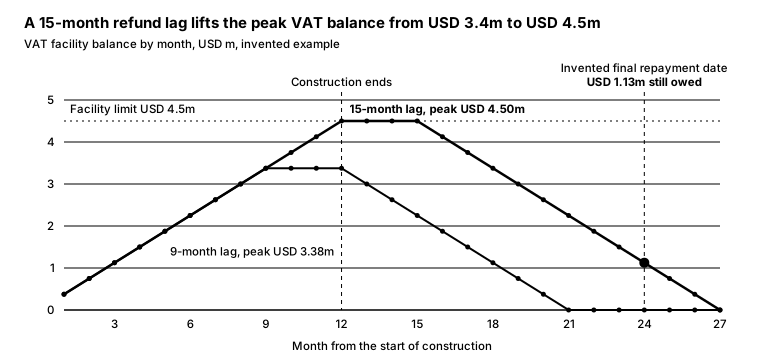
At the base lag the facility is cleared by month 21, eight months into operations. At 15 months the full limit is used. A balance is still owed at the final repayment date, which we have invented as 12 months after construction ends.
Each drawing is outstanding for exactly the lag, so the interest has a simple form.
At the base lag that is USD 4.5m x 7.5% x 9/12, or USD 0.253m. The commitment fee adds USD 0.025m, for a total of USD 0.28m.
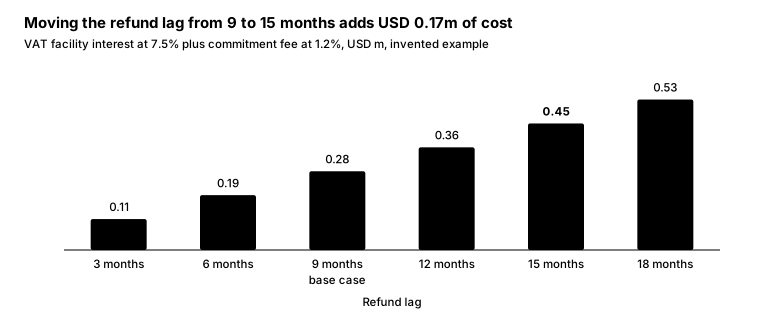
Each extra month of lag adds about USD 28,000 of interest. In the base case USD 0.17m of the interest falls in construction and USD 0.08m after completion, when it must come from operating cash.
The common mistake is to refund VAT in the month it is paid. The facility then never draws, so about USD 0.19m of construction-period cost drops out of the funding requirement. The USD 0.08m of interest after completion, paid from operating cash, is missed too.
What is a working capital facility?
A working capital facility is a revolving credit line that pays operating costs while the project waits for customers to pay. It is repaid from revenue as cash comes in, and it can be drawn again up to its limit. The lender charges interest on the drawn part and a commitment fee on the undrawn part.
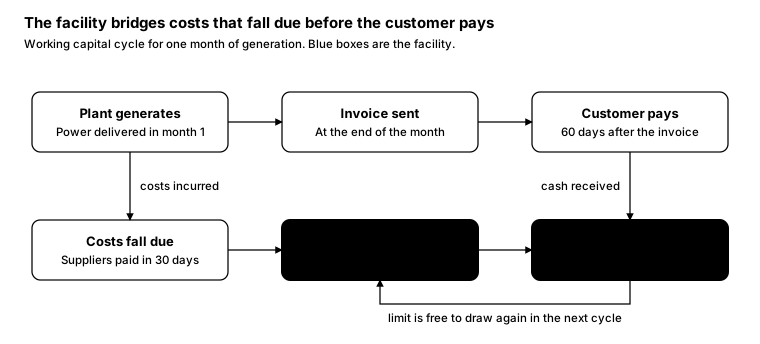
The cycle repeats every month, so the facility is never drawn for long on any one invoice. Three things drive how much is needed: customer payment days, supplier payment days and seasonal output. A solar plant invoices more in its sunniest months, so the receivable peaks then, not at the annual average.
One modelling guide adds a warning: the first build-up of working capital is a permanent cash need. It says the permanent part should come from core funding, with a revolving facility used for flexibility.
How big is the working capital need?
The working capital need is the cash tied up in unpaid customer invoices, less the credit that suppliers give. A first estimate uses payment days.
The example. Receivables are USD 5.6m x 60/365, or USD 0.92m. Payables are USD 1.0m x 30/365, or USD 0.08m. The need is USD 0.84m, which leaves USD 0.16m of headroom under the USD 1.0m limit.
That headroom is thin. If customers pay in 71 days instead of 60, the need reaches the limit. At 90 days it is USD 1.30m, and the last USD 0.30m must come from the project's own cash.
The cost. We assume the facility is half drawn on average, which is an invented utilisation. Interest is USD 0.5m x 7.5%, or USD 37,500, using the 4.0% base rate plus the 3.5% margin. The commitment fee is USD 0.5m x 1.5%, or USD 7,500.
The total is USD 45,000 a year, about 1.1% of year 1 CFADS.
The common mistake is to size the need on annual averages. A monthly model shows the peak, and the peak is what the limit must cover.
How do the two facilities compare?
Both facilities bridge timing, not a lack of value, but they differ in when they are drawn and what repays them. The sizes and prices below are from the invented example. The other rows are our reading of common practice.
| VAT facility | Working capital facility | |
|---|---|---|
| Purpose | Pays VAT on construction costs until it is refunded | Pays operating costs until customers pay |
| When drawn | Construction, with each contractor invoice | Operations, when costs fall due before receipts |
| Repaid from | VAT refunds | Revenue |
| Redrawable | Usually not, though some are revolving | Yes, up to the limit |
| Tenor | Short: construction plus the expected refund lag, with a final repayment date | Revolving, for the term set in the documents |
| Limit in the example | USD 4.5m | USD 1.0m |
| Price in the example | 7.5% all-in, 1.2% commitment fee | 7.5% all-in, 1.5% commitment fee |
| In or out of gearing | Practice varies, read the definition | Practice varies, read the definition |
How are these facilities treated in the gearing ratio and cover ratios?
Practice varies, and the answer sits in the definitions of each deal, not in a market rule. We found no public source that sets a standard treatment, so this section is our reading. The pillar article, How to read a solar project finance term sheet: a modeller's guide, explains where to find those definitions.
Gearing. The result depends on whether debt means the term loan only or all financial debt. In the example, senior debt of USD 25.1m against USD 40.0m of funding is 62.7%. Adding the USD 4.5m VAT facility to both sides gives 66.4%, and a project already at the 70% cap would show 73.0%.
Cover ratios. Two definitions matter: what counts in CFADS and what counts in debt service. Published guides define CFADS after working capital movements, and one writes the formula with a change in working capital line.
This is an illustration, not the example's result. The series' example assumes no working capital movement inside the USD 4.2m of year 1 CFADS, as stated in "CFADS, DSCR and LLCR defined properly". On the published definition, deducting the USD 0.84m build-up in year 1 would cut CFADS from USD 4.2m to USD 3.36m. With debt service of USD 3.231m, the DSCR would read 1.04x instead of 1.30x, under the 1.10x default level. The 1.04x figure shows what would happen if the one-off build-up were deducted and not funded by the facility. Whether a facility drawing offsets this, and whether facility interest counts as debt service, is set by the documents.
VAT payments, refunds and VAT facility flows are normally kept out of CFADS, in our reading, because they net to zero over time. The related article, The cover ratio ladder, explains how each ratio is tested.
Where do their interest and repayment sit in the order of payments?
Interest and fees on both facilities are financing costs that usually rank with senior debt costs, but the exact place is deal-specific. One published illustration of the order runs: operating costs, taxes, senior debt service, reserve accounts, subordinated debt, then distributions. The same guide says the exact ordering is deal-specific.
Neither facility appears in that generic list, which is part of why modellers forget them. Our reading of common practice is below.
- VAT refunds go straight to repay the VAT facility, outside the operating order of payments. This matches the automatic repayment described above.
- VAT facility interest is a construction cost until completion, funded from the sources of funds. After completion it is paid with senior interest.
- Working capital interest and fees are paid with senior financing costs.
- Working capital principal is repaid from spare cash. One training model repays it from cash flow available for debt repayment, limited to the balance outstanding.
How do you model it?
Model each facility as its own account on a monthly timeline, because both exist to solve timing inside a period. Our example uses annual periods for the term loan, and real deals usually use six-month periods. Neither is fine enough for these two facilities.
- Add VAT as its own construction line: contract cost in each month times the VAT rate.
- Make the refund lag an input in months. The refund line is the VAT line shifted by the lag.
- Build the VAT facility account: opening balance, plus drawings equal to VAT paid, less repayments equal to refunds.
- Cap drawings at the limit. Fund any VAT above the limit from equity, and show it.
- Charge interest on the balance and the commitment fee on the undrawn commitment. Put both in the uses of funds during construction.
- Add the final repayment date. Repay any balance left on that date from cash or equity, and flag it.
- Run the refund lag as a sensitivity, here 9 months against 15.
- Build receivables and payables from payment days. The monthly change in the net balance is the working capital movement.
- Build the working capital facility as a revolving account. It draws when cash before the facility is negative and repays when cash is positive.
- Limit drawings to the facility limit, and charge interest on the drawn part and the fee on the undrawn part.
- Apply each ratio definition as written, and add a check that the cash balance never goes below zero.
What are the common mistakes?
Most errors come from treating these facilities as too small to model. The list below is our reading.
- Refunding VAT in the month it is paid. The facility never draws. About USD 0.19m of construction-period cost (USD 0.17m of interest plus the USD 0.025m commitment fee) drops out of the funding requirement. About USD 0.08m of interest that falls after completion, paid from operating cash, is missed as well.
- Leaving out the final repayment date. A late refund then looks free, when it is a call on equity or project cash.
- Ignoring currency. VAT is paid and refunded in local currency. A USD facility repaid from local refunds carries exchange rate risk.
- Assuming VAT is refundable at all. Rules differ by jurisdiction. Some VAT is not recoverable and becomes a project cost.
- Sizing working capital on annual averages. Seasonal output and a slow customer both push the peak above the average.
- Letting the revolving facility hide a shortfall. A balance that only grows is funding losses, not timing.
- Guessing the ratio treatment. Whether each facility counts in gearing, CFADS or debt service is written in the definitions.
- Forgetting the first months of operation. No cash arrives for 60 days, yet costs and the first debt service still fall due.
Frequently asked questions
Is a VAT facility part of the senior debt?
A VAT facility is a separate loan from the term loan, with its own limit, price and final repayment date. Whether it shares the senior security and counts in the gearing ratio depends on the documents. In our reading, it is rarely part of the debt that the DSCR sizes.
Can equity fund the VAT instead of a facility?
Yes. Sponsors can pay the VAT with equity and take the refunds back later. In the example that means up to USD 3.4m of extra equity at the base lag, so the choice is a cost comparison.
What happens if the refund never arrives?
The VAT becomes a permanent project cost, and the facility must still be repaid on its final repayment date. In the example that is up to USD 4.5m from equity or project cash. Model it as a downside case, not as the base case.
Do I need a working capital facility if the project holds cash?
Not always. A project can fund the USD 0.84m need from equity at completion or from retained cash. The facility costs about USD 45,000 a year at our invented utilisation, so compare that with the cost of holding cash.
Can one revolving facility cover both needs?
Sometimes. The Renewables Valuation Institute says a revolving facility in renewable energy can serve as a working capital line, VAT facility or debt service reserve facility. Check the permitted purposes in the term sheet, and model each use against its own limit.
Does the working capital facility replace the DSRA?
No. The DSRA protects lenders when cash flow falls short of debt service. The working capital facility covers the timing of operating cash, and it must be repaid.
Sources
Pages opened on 4 October 2026 and checked again on 5 October 2026. The example project is invented and has no source. Public sources on VAT facilities are thin, so points marked as our reading have no source.
- Project Finance In Spain, Squire Sanders & Dempsey on Mondaq, 25 April 2001. A note on Spanish practice at that date: why VAT on construction is financed by a VAT facility, automatic repayment from refunds, and the final maturity date.
- VAT Domestic Reverse Charge (DRC): a carousel of project finance cashflows, Operis. On the UK's domestic reverse charge: VAT facilities bridging VAT until recovery, and their likely disappearance from financial models.
- VAT Facility definition, Law Insider. Sample contract definition of a VAT facility as a bridge to VAT refunds.
- VAT to increase to 15% in KSA: what does this mean for PPPs?, Bracewell. A 2020 note on Saudi Arabian PPPs: the VAT cash flow burden there was wrapped in ordinary working capital facilities. The example's 15% rate is invented and is not taken from this page.
- Value Added Tax in the Extractive Industries, IMF Working Paper WP/23/221. Common VAT exemptions and zero-rating for extractive projects, refund delays that can reach years, and the currency effect on late refunds.
- Revolving Credit Facility in Renewable Energy Finance, Renewables Valuation Institute. Uses of revolving facilities, redrawing, and commitment fees on undrawn amounts.
- Building a Project Finance Financial Model: Structure, Inputs, and Outputs, Ryan O'Connell, CFA, FRM. Illustrative order of payments, and working capital as a permanent cash need.
- Building a Full Project Finance Model, Felix by Financial Edge. Lesson 16, "Main Model: Revolving Credit Facility": how a revolving facility is repaid in a training model.
- CFADS: Cash Flow Available for Debt Service, Forvis Mazars. CFADS defined after working capital movements.
- The Debt Service Coverage Ratio (DSCR): Full Guide to a Critical Metric in Project Finance, Breaking Into Wall Street. CFADS formula with a change in working capital line.