Solar project finance glossary: the term sheet terms a modeller needs
By SolarQuant Editorial. Published 2026-10-05. Last updated 2026-10-05.
This glossary defines the terms a lender's term sheet uses, in the words of someone building the financial model. Each entry gives one definition that stands alone, then says where the term appears in the model. Figures come from one invented 40 MWp solar project, so every number ties to the others.
How do you use this glossary?
Read each definition as the meaning a lender's term sheet intends, then follow the third column to the place in the model. The groups follow the order in which a model is built: parties, dates, funding, pricing, repayment, ratios, accounts and documents.
The definitions are in our own words. The terms named under Sources were checked against the public pages listed there. The other definitions are our reading of common usage. Deals differ, so the definition in your own facility agreement always wins.
Every figure comes from one invented example: a 40 MWp ground-mounted solar plant with one offtaker and a 20-year USD power purchase agreement (PPA). It needs USD 40.0m of funding, takes 12 months to build and repays its senior debt over 12 years. The example uses annual periods for simplicity; real deals usually use six-month periods.
For the reasoning behind each clause, read the pillar article, How to read a solar project finance term sheet: a modeller's guide. For the ratio levels and what each one triggers, read The cover ratio ladder.
Who are the parties, and how is the deal structured?
A solar project financing is a loan to a single-purpose company, repaid from that project's cash flows alone. These terms name the borrower, the banks and the contract counterparties around it.
| Term | Definition | Where it appears in the model |
|---|---|---|
| Special purpose vehicle (SPV) | A company set up to own and finance one project and nothing else. It is the borrower, and its cash flows are what the lenders rely on. | The whole model is the SPV: its cash flow, its accounts and its debt. |
| Sponsor | A company that develops the project and owns shares in the SPV. Sponsors provide the equity. | Equity in sources and uses (USD 14.9m in the example), distributions and the equity return. |
| Lender | A bank or institution that lends to the SPV under the facility agreement. | The debt schedule: USD 25.1m of senior debt in the example. |
| Mandated lead arranger (MLA) | A bank the borrower appoints to structure the loan and bring in the other lenders. | The upfront fee paid at financial close. |
| Agent | The bank that administers the loan for all the lenders: drawdown requests, payments, notices and ratio certificates. | The agency fee, USD 40,000 a year. |
| Account bank | The bank that holds the project accounts and moves cash between them as the finance documents instruct. | The account structure behind the cash flow waterfall. |
| Hedging bank | A bank that provides the interest rate swap, or another hedge, to the SPV. | Swap payments in the interest calculation and their rank in the waterfall. |
| Offtaker | The buyer of the plant's electricity under the PPA. | Revenue, and the payment terms that drive working capital. The example has one offtaker. |
| EPC contractor | The contractor that designs, procures and builds the plant under one engineering, procurement and construction contract. | Construction cost and its payment schedule in the uses of funds. |
| O&M contractor | The contractor that operates and maintains the plant under an operation and maintenance agreement. | Operating costs, USD 1.0m in total in year 1. |
| Non-recourse and limited recourse | Non-recourse means lenders are repaid only from the project's cash flows and security, with no claim on the sponsors. Limited recourse means the sponsors give support only in defined, limited cases. | The reason debt is sized on project cash flow and cover ratios, not on the sponsors' balance sheets. |
Which dates and periods does a term sheet set?
A term sheet fixes when the loan can be drawn, when repayment starts and when the debt must be gone. Each date below becomes a flag or a period count on the model's timeline.
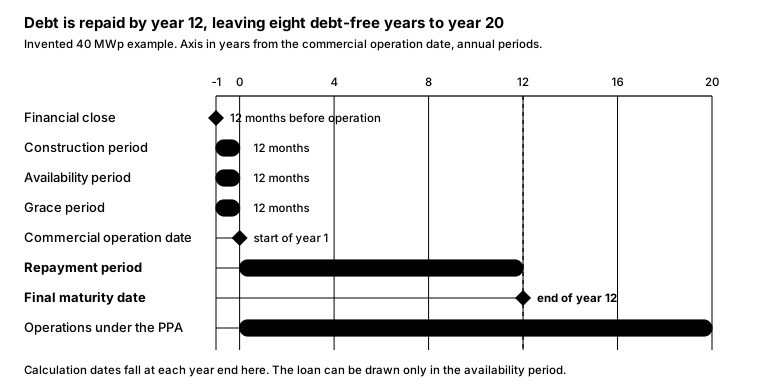
The loan is drawn during construction, repaid over operating years 1 to 12, and the plant then runs debt free until the PPA ends in year 20. In the example the availability period and the grace period both match the 12 months of construction.
| Term | Definition | Where it appears in the model |
|---|---|---|
| Financial close | The date when the finance documents are signed and the conditions precedent are met or waived, so the loan can be drawn. | Time zero of the funding plan and the start of construction. |
| Availability period | The period in which the borrower may draw the loan. Commitments still undrawn when it ends are cancelled. | The window for drawdowns, and the period over which the commitment fee runs. 12 months in the example. |
| Construction period | The time from the start of works to completion of the plant. | Phasing of construction cost, drawdowns and interest during construction. 12 months in the example. |
| Commercial operation date (COD) and scheduled COD | COD is the date the plant passes its completion tests and starts selling power under the PPA. Scheduled COD is the date the contracts target for it. | The switch from construction to operations: revenue, operating costs and the repayment clock start here. |
| Long-stop date | The final deadline for an event such as COD. If it is missed, the other party gains the right to terminate or call a default. | Delay cases: check that a late COD still falls before it. The example assumes no delay. |
| Grace period | A period, usually during construction, in which the borrower does not yet pay debt service. No principal is due, and interest may be payable or capitalised. | The first repayment date. In the example no principal is due during construction; the first instalment falls at the end of year 1. |
| Tenor | The length of the loan, from signing to final maturity. A quoted tenor may or may not include construction, so check. | The number of repayment periods: 12 years of repayment after 12 months of construction. |
| Final maturity date | The date by which all of the debt must be repaid. | The last period of the debt schedule: the end of year 12, with a closing balance of nil. |
| Calculation date | A date on which the cover ratios are tested and cash is applied through the waterfall. The term sheet lists these dates. | Period ends in the model. Each year end in the example. |
What do the funding terms mean?
Funding terms say how much money the project needs up to completion and who provides it. They fill the sources and uses table, which is the first place a model has to balance.
| Term | Definition | Where it appears in the model |
|---|---|---|
| Facility | A loan commitment with its own amount, purpose and terms. One financing can hold several, such as a term loan, a VAT facility and a working capital facility. | One debt schedule per facility, each with its own drawdown, pricing and repayment. |
| Gearing ratio | The level of debt relative to equity. Term sheets often write it as a debt to equity split of total funding, for example 70:30. | A cap in debt sizing. The 70:30 cap allows USD 28.0m, but the DSCR allows only USD 25.1m, which is 62.7% gearing. |
| Drawdown | A borrowing under a facility: the SPV requests funds and the lenders advance them. | Debt drawn in each construction period. The example draws evenly over 12 months. |
| Sources and uses | A table listing every cost to be funded up to completion (uses) and the debt and equity that pay for it (sources). The two sides must be equal. | The funding sheet: uses of USD 40.0m, met by USD 25.1m of debt and USD 14.9m of equity. |
| Interest during construction (IDC) | Interest that accrues on the loan before the plant earns revenue. It is treated as a project cost and funded like one. | A use of funds, about USD 0.88m. It depends on the debt drawn, which depends on total uses, so the calculation is circular. |
| Equity bridge loan and equity last | Equity last means the debt is drawn first and the sponsors pay in their equity afterwards. An equity bridge loan is a short loan, backed by the sponsors, that stands in for the equity until they pay it in. | The order of drawdowns in the funding cascade. It changes IDC and the timing of equity cash flows. |
| Subordinated debt | Debt that ranks behind the senior debt for payment and security. | A second debt schedule, paid below senior debt service in the waterfall. USD 2.81m in the example's subordinated variant. |
| Shareholder loan | A loan from the sponsors to the SPV. It forms part of their investment and ranks behind all lender debt. | The equity side of sources and uses. Its interest and repayments are treated as distributions. |
What do the pricing terms mean?
Pricing terms set what the loan costs: an interest rate built from a base rate and a margin, plus fees. In the example the construction-period cost of these items is about USD 1.4m.
| Term | Definition | Where it appears in the model |
|---|---|---|
| Base rate | The floating reference rate for the loan currency, to which the margin is added. | An interest rate input by period. 4.0% in the example. |
| Margin | The lender's spread over the base rate. It may step up at set dates. | Added to the base rate. 3.0% in the example. |
| All-in rate | The total interest rate the borrower pays: the base rate, or the swap rate where hedged, plus the margin. | The rate applied to the debt balance: 7.0%, fully hedged. |
| Upfront fee | A one-off fee paid to the arranging banks at financial close, set as a percentage of the facility. | A use of funds: 1.5% of the facility, about USD 0.38m. |
| Commitment fee | A fee charged on the undrawn part of the lenders' commitment while it remains available. | A construction-period cost: 1.2% a year on undrawn amounts, about USD 0.15m. |
| Agency fee | A fixed yearly fee paid to the agent for administering the loan. | A cost line of USD 40,000 a year. Check whether the term sheet places it inside CFADS. |
| Interest rate swap | A contract that exchanges a floating interest rate for a fixed one on an agreed notional amount. The SPV pays fixed and receives floating, so its interest cost is fixed. | The hedged share and the swap rate. The notional amount should follow the planned debt balance. |
| Break costs | The loss a lender or hedging bank suffers when a loan or swap ends before its scheduled date, which the borrower must cover. | Prepayment and refinancing cases, as an added cost of repaying early. |
| Default interest | Extra interest charged on amounts that are overdue. | Downside cases only. It has no place in the base case. |
What do the repayment terms mean?
Repayment terms set the shape of the debt schedule and the rules for repaying early. The shape matters because it decides how much debt a given cash flow can carry.
| Term | Definition | Where it appears in the model |
|---|---|---|
| Amortisation | Repayment of loan principal in instalments over time. | The principal column of the debt schedule: USD 1.476m in year 1, rising to USD 2.857m in year 12. |
| Sculpted repayment | A repayment profile shaped so that debt service follows CFADS and the DSCR holds at its target in every period. | Debt service = CFADS / 1.30 each year, which is USD 3.231m in year 1. |
| Annuity | A repayment profile with the same total debt service in every period, so principal rises as interest falls. | The alternative profile: USD 3.156m a year, with the DSCR falling from 1.33x to 1.26x. |
| Balloon | A large final payment of principal left at maturity because the scheduled instalments do not clear the loan. | The closing balance at legal maturity: USD 14.8m, 59% of the loan, in the mini-perm variant. |
| Mini-perm | A loan that covers construction and the first years of operation and is meant to be refinanced. In a hard mini-perm, failure to refinance is a default. In a soft mini-perm, it triggers a higher margin and a cash sweep. | The variant with maturity at the end of year 6. Its soft terms add 1.0% to the margin and sweep 100% of spare cash. |
| Cash sweep | A rule that uses surplus cash to prepay debt in place of paying it out to shareholders. | A waterfall line below debt service: prepayment = sweep share x cash left after debt service and reserves. |
| Voluntary and mandatory prepayment | Voluntary prepayment is early repayment the borrower chooses to make. Mandatory prepayment is early repayment the documents require when a listed event occurs. | Extra principal lines. The model must also state which later instalments a prepayment reduces. |
| Prepayment fee | A fee charged on amounts repaid before their scheduled date. | 1.5% of the amount prepaid in operating years 1 to 3, 1.0% in years 4 and 5, nil after. |
What do the cash flow and ratio terms mean?
Cash flow terms measure the cash a project has to pay its lenders, and ratio terms test whether that cash is enough. All of them start from one line: cash flow available for debt service (CFADS).
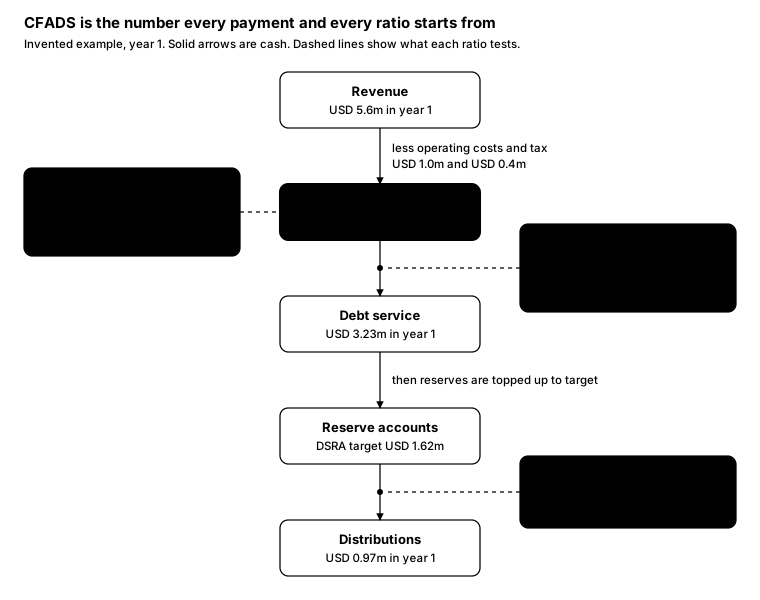
Cash runs down the page, and each ratio hangs on the step it tests. The DSCR compares one period's CFADS with that period's debt service; the LLCR and PLCR compare all future CFADS with the debt still owed.
The three cover ratios are written below. Here t is the test date, M the final maturity, N the last year of the project, DS debt service, D the debt outstanding and r the discount rate, usually the cost of debt.
In the example, CFADS discounted at 7.0% is worth USD 32.6m to year 12 and USD 42.9m to year 20, against debt of USD 25.1m. These two present values are computed from the example and exclude the DSRA. Some definitions add the reserve balance to the numerator, so check yours.
| Term | Definition | Where it appears in the model |
|---|---|---|
| CFADS | Cash flow available for debt service: the cash a project generates in a period after operating costs, capital expenditure, tax and working capital movements, and before any interest or principal. | The line that feeds every ratio: USD 5.6m revenue less USD 1.0m costs and USD 0.4m tax gives USD 4.2m in year 1. |
| Debt service | The interest and scheduled principal due on the debt in a period. | USD 3.231m in year 1: USD 1.755m of interest plus USD 1.476m of principal. |
| DSCR | Debt service cover ratio: CFADS for a period divided by debt service for the same period. | A ratio row tested at every calculation date. 1.30x in every year of the lender's case. |
| LLCR | Loan life cover ratio: the present value of CFADS from the test date to final maturity, divided by the debt outstanding on the test date. | A ratio row built on a present value: 1.30x at the start of repayment. |
| PLCR | Project life cover ratio: the present value of CFADS over the remaining life of the project, divided by the debt outstanding. | The same row with a longer horizon: 1.71x, because it counts the eight years after maturity. |
| Sizing ratio | The DSCR the lender's case must show in every period. It sets the largest debt the cash flow can support. | The target in debt sculpting: 1.30x, which gives USD 25.1m of debt. |
| Lock-up ratio | The DSCR below which the SPV may not pay distributions. The cash stays in the project until the test is met again. | A gate above the distribution line: 1.20x. |
| Default ratio | The DSCR below which an event of default occurs. | A flag in the ratio checks: 1.10x. |
| Headroom | The gap between a forecast ratio and a threshold, often stated as the fall in CFADS the project can absorb before the threshold is reached. | A sensitivity output. Year 1 CFADS can fall 7.7% before lock-up, 15.4% before default and 23.1% before it no longer covers debt service. |
| P50 | The annual energy output that the plant has a 50% chance of exceeding. It is the central estimate. | The energy input to the sponsor's case, where the term sheet allows it. |
| P90 | The annual energy output that the plant has a 90% chance of exceeding. It is lower than the P50, so it is the cautious estimate. | The energy input to a lender's or downside case. The term sheet states which yield the debt is sized on. |
What do the account and reserve terms mean?
Account terms describe where the project's cash sits and the order in which it may leave. Reserve terms describe cash, or a bank's promise of cash, held back to protect debt service and planned maintenance.
| Term | Definition | Where it appears in the model |
|---|---|---|
| Cash flow waterfall | The order of priority in which the SPV must apply its cash, from operating costs at the head to distributions at the foot. | The layout of the cash flow sheet, line by line in the order the documents give. |
| Proceeds account | The bank account into which all project revenue must be paid, and from which the waterfall payments are made. | Opening cash plus receipts at the head of the waterfall. |
| Debt service reserve account (DSRA) | A reserve account holding cash to pay interest and principal if CFADS falls short. Its target is set as a number of months of coming debt service. | Target balance, funding and release lines. Six months of debt service is USD 1.62m in year 1, funded in cash at the end of construction. |
| Maintenance reserve account (MRA) | A reserve built up ahead of time to pay for large planned maintenance or replacement costs. | USD 0.6m a year in years 7 to 10, to meet the USD 2.4m inverter replacement in year 11. |
| Standby facility | A credit line that stays undrawn unless it is needed. A DSRA facility is one kind: it stands in for cash in the reserve account. | Removes the cash DSRA from uses. Costs an availability fee of 1.5% a year undrawn and a margin of 3.75% if drawn. |
| Letter of credit | A bank's promise to pay up to a stated amount on demand. It can take the place of cash in a reserve account. | A fee of 2.5% a year on the amount, in place of funding the reserve in cash. |
| Distribution account | The account that receives cash only after every higher item in the waterfall is paid and the distribution tests are met. | Cash available to shareholders. The lock-up test sits just above it. |
| Distribution | Any payment from the SPV to its shareholders, such as a dividend or a payment on a shareholder loan. | The equity cash flows behind the equity return. USD 0.97m in year 1: CFADS of USD 4.2m less debt service of USD 3.231m. |
What do the document and covenant terms mean?
Document terms name the contracts that turn the term sheet into binding obligations. Most of them carry no cash flow, but they decide which numbers the model must test and report.
| Term | Definition | Where it appears in the model |
|---|---|---|
| Term sheet | A short document setting out the main agreed terms of a financing. It is generally not meant to be legally binding. | The source of most financing inputs. |
| Facility agreement | The binding loan contract between the SPV and its lenders. It replaces the term sheet once signed. | The final word on definitions such as CFADS, debt service and each ratio. |
| Conditions precedent | Conditions that must be met, or waived by the lenders, before the borrower may draw the loan. | The timing of financial close and of the first drawdown. |
| Representations | Statements of fact that the borrower confirms are true, at signing and on later dates set by the agreement. | No model line. An untrue representation is an event of default. |
| Undertakings | Promises by the borrower to do, or not do, stated things while the loan is outstanding. They are also called covenants. | Ratio tests, reporting dates and limits on new debt and distributions. |
| Event of default | A listed event that entitles the lenders to cancel the facility and demand immediate repayment. | Flags such as a DSCR below 1.10x. No distributions while one continues. |
| Material adverse effect | A defined level of serious harm to the project or to the borrower's ability to perform. It sets the threshold in many representations and defaults. | Not modelled. It is a legal judgement, not a number. |
| Intercreditor agreement | An agreement among the lender groups that sets their ranking and their rights against the borrower on default. | The order of senior, hedging and subordinated payments in the waterfall. |
| Direct agreement | An agreement between the lenders and a project counterparty that lets the lenders step in if the SPV fails to perform. | Not modelled. It supports the assumption that the PPA and other contracts continue. |
| Security | The lenders' legal rights over the SPV's shares, assets, contracts and bank accounts, which they can enforce on default. | Not a cash flow. It is the reason all cash runs through controlled accounts. |
How do you model it?
You model a term sheet by turning each defined term into an input, a date flag or a test, in the same order as the groups above. The steps below are our reading of a sound build order, with the example's results.
- Mark every defined term in the term sheet and match it to an entry in this glossary. List any term whose definition differs.
- Build the timeline from the dates group: financial close, 12 months of construction, COD, 12 repayment years and final maturity.
- Fill sources and uses. Total uses are USD 40.0m. That total covers construction and development costs plus the upfront fee, commitment fee, IDC and the cash DSRA.
- Build CFADS exactly as the term sheet defines it. In year 1 it is USD 4.2m.
- Size the debt. Set debt service to CFADS / 1.30 in each year, then discount it at the 7.0% all-in rate to get USD 25.1m.
- Compare that with the gearing cap of USD 28.0m and take the lower figure. Equity fills the rest, USD 14.9m.
- Lay out the waterfall in the documents' order: costs and tax, debt service, reserves, then distributions behind the lock-up test.
- Add a ratio check at every calculation date: DSCR against 1.20x and 1.10x, plus LLCR and PLCR where the term sheet asks for them.
- Keep the term sheet clause number beside each input, so a reviewer can trace every figure to its source.
What are the common mistakes?
Most vocabulary mistakes come from treating a deal-specific definition as if it were universal. These are the ones we see most often in models; the list is our own reading.
- Reading tenor as the repayment period. In the example a tenor counted from financial close is 13 years, but only 12 of them carry repayments.
- Using a generic CFADS. Each deal defines its own. Check whether tax, capital expenditure, agency fees and reserve movements sit inside or outside it.
- Mixing the ratio levels. The sizing ratio of 1.30x sets the debt once. The lock-up ratio of 1.20x and default ratio of 1.10x test performance at every later date.
- Treating the gearing cap as the debt amount. The cap allows USD 28.0m here, yet the DSCR limits the debt to USD 25.1m.
- Discounting the reserve balance in the LLCR. Where the DSRA counts, Forvis Mazars notes it is added to the present value of CFADS, not discounted with it.
- Swapping P50 and P90. The higher P number is the lower energy figure, because it must be exceeded more often.
- Stopping at the term sheet. The facility agreement replaces it, and its definitions are the ones the lenders will test.
Frequently asked questions
What is the difference between a term sheet and a facility agreement?
A term sheet is a short summary of the main agreed terms and is generally not legally binding. The facility agreement is the full, binding loan contract that follows it. A model built from the term sheet should be checked again against the signed definitions.
What is the difference between DSCR, LLCR and PLCR?
The DSCR tests one period: CFADS divided by that period's debt service. The LLCR tests the whole remaining loan: the present value of CFADS to maturity divided by the debt outstanding. The PLCR does the same over the remaining project life, so it also counts cash earned after the loan is repaid.
Is CFADS the same as EBITDA?
No. EBITDA is a profit measure, while CFADS is a cash measure taken after tax, capital expenditure and working capital movements. Corporate Finance Institute shows one way to build CFADS that starts from EBITDA and makes those adjustments.
What is the difference between a sizing ratio and a lock-up ratio?
The sizing ratio is used before financial close to set how much debt the forecast cash flow can support. The lock-up ratio is tested during operations and blocks distributions when the DSCR falls below it. In the example they are 1.30x and 1.20x.
What does P90 mean in a solar term sheet?
P90 is the annual energy output that the plant is expected to exceed in 90% of years. It is lower than the P50, which the plant is as likely to beat as to miss. Check which of the two the term sheet uses for debt sizing.
What is a mini-perm?
A mini-perm is a loan that the sponsors are expected to refinance after the first years of operation. Norton Rose Fulbright describes two kinds: in a hard mini-perm, failing to refinance is an event of default, and in a soft mini-perm it is not. In the example's variant, maturity at the end of year 6 leaves a balloon of USD 14.8m.
Sources
Pages opened on 4 October 2026 and checked again on 5 October 2026. The example project is invented and has no source.
- PPP Online Reference: Glossary, World Bank Public-Private Partnership Resource Center. Checked the definitions of special purpose vehicle, non-recourse, limited recourse, financial close, conditions precedent, drawdown, commitment fee, grace period, tenor, gearing, debt service, subordinated debt, reserve account, term sheet, event of default, intercreditor agreement, direct agreement and security.
- PPP Certification Guide Glossary, APMG International. Checked the definitions of sponsor, DSCR, LLCR, PLCR, financial close, conditions precedent, mini-perm, swap, breakage costs and long-stop date.
- Lender Protections and Government Support in PPPs, World Bank Public-Private Partnership Resource Center. Checked lender step-in rights and direct agreements.
- CFADS: Cash Flow Available for Debt Service, Forvis Mazars. Checked the definition of CFADS and the items deducted to reach it.
- Debt Service Coverage Ratio (DSCR): formula, meaning and use in project finance, Forvis Mazars. Checked the DSCR formula and its use for debt sizing, sculpting, lock-up and default.
- LLCR Explained: A Project Finance Lender's Key Metric, Forvis Mazars. Checked the LLCR formula, the discount rate and the point that a reserve balance is added without discounting.
- Project Life Cover Ratio (PLCR), Forvis Mazars. Checked the PLCR formula and the use of the cost of debt as the discount rate.
- Debt Sculpting to Target DSCR without VBA, Forvis Mazars. Checked the definition of sculpted repayment.
- Cash Flow Available For Debt Service (CFADS), Corporate Finance Institute. Checked the build of CFADS from EBITDA.
- Debt Service Reserve Account (DSRA), Corporate Finance Institute. Checked the definition of a DSRA.
- Cash Sweep, Corporate Finance Institute. Checked that a cash sweep uses excess cash to pay down debt.
- Commitment Fee, Corporate Finance Institute. Checked that the fee is charged on the unused amount.
- Interest Rate Swap (IRS), Corporate Finance Institute. Checked the fixed for floating definition.
- Project Bonds and Mini-Perms: A New Era in the Middle East, Norton Rose Fulbright, November 2012. Written about Middle East power and water projects. Checked hard and soft mini-perms, margin step-ups and cash sweeps.
- P50/P90 Analysis for Solar Energy Systems Using the System Advisor Model, National Renewable Energy Laboratory. Checked the meaning of P50 and P90 as exceedance probabilities.