How to read a solar project finance term sheet: a modeller's guide
By SolarQuant Editorial. Published 2026-10-05. Last updated 2026-10-05.
A term sheet is the lender's summary of the loan it is prepared to offer. Almost every line of it becomes an input to the project's financial model.
This guide reads a solar term sheet in the order a model is built. For each group of clauses it answers one question: what does this change in the model?
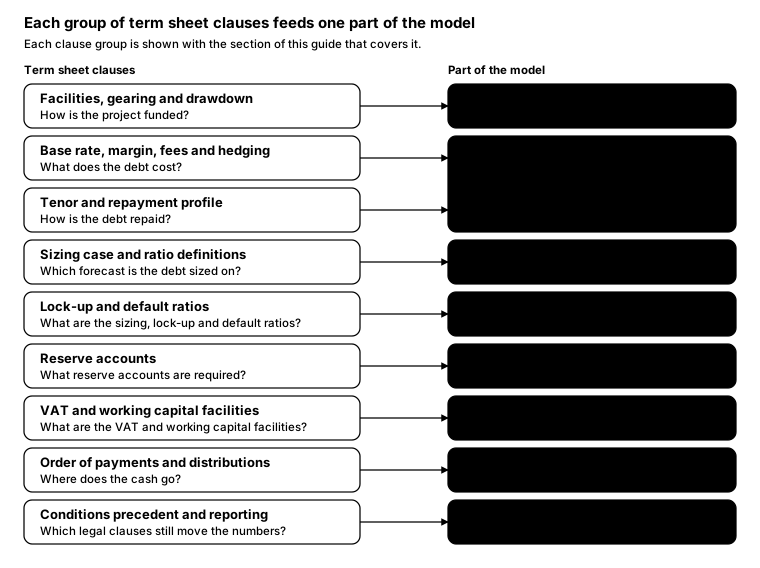
Read each row from left to right. Pricing and repayment terms both feed the debt schedule, so nine clause groups map to eight parts of the model.
What example project does this guide use?
One invented project runs through every section. Its figures are round numbers chosen for teaching. They are not market quotes and do not describe any real transaction.
| Assumption | Value |
|---|---|
| Installed capacity | 40 MWp, ground-mounted, one offtaker |
| Total funding requirement | USD 40.0 million, including financing costs and a cash-funded debt service reserve of USD 1.62m |
| Gearing cap | 70:30 debt to equity |
| Construction period | 12 months |
| Repayment period | 12 years after construction |
| All-in interest rate | 7.0% (base rate 4.0% plus margin 3.0%, fully hedged) |
| Upfront fee | 1.5% of the facility |
| Commitment fee | 1.2% a year on undrawn amounts |
| Sizing DSCR | 1.30x on the lender's case |
| Lock-up DSCR | 1.20x |
| Default DSCR | 1.10x |
| Year 1, lender's case | Revenue USD 5.6m, operating costs USD 1.0m, tax USD 0.4m |
| CFADS | USD 4.2m in year 1, falling 0.5% a year |
The example uses annual periods so the arithmetic stays visible. Many term sheets test ratios and schedule repayments every six months, so check which period yours uses.
What is an indicative term sheet?
An indicative term sheet is a non-binding summary of the main commercial terms on which a lender is prepared to finance a project. It is issued before due diligence and credit approval, and the binding terms come later in the facility agreement.
What it typically says. The opening disclaimer states that the document is not a commitment and is subject to due diligence, credit approval and final documentation. Many figures appear in square brackets, which means they are still open.
What it changes in the model. Every bracketed figure is a placeholder. Build each one as a single labelled input with a status next to it (indicative or agreed), so a change is made in one cell. Record the term sheet's date and version on the inputs sheet.
Common mistake. Typing a bracketed figure directly into a formula, then presenting equity returns as if the terms were final.
Who are the parties, and why does the modeller care?
The borrower is a special purpose vehicle (SPV): a company that owns only the project and borrows against the project's cash flows alone. Lenders rely on the project's assets and contracts, not on the sponsors' other businesses.
What it typically says. The term sheet names the sponsors (who provide equity), the lenders and the arranger. It names the agent (who administers the loan for the lenders) and the account bank (which holds the project accounts). It also names the hedging bank (which provides the interest rate swap).
What it changes in the model. The SPV is the boundary of the model. Only its revenues, costs, taxes and debt belong inside. Several named parties also bring a cash line of their own: the agency fee, account bank charges and hedging payments.
Common mistake. Mixing sponsor-level items, such as holding company overheads, into project cash flows. That distorts the cash available to service debt.
How is the project funded?
The facilities clause lists every loan the lenders will provide, and the gearing ratio caps the share of project cost that debt may fund. Together they define the sources side of the sources and uses table.
What it typically says. There is a senior term loan and sometimes a subordinated loan. Smaller facilities may sit beside them: standby facilities for reserves, a VAT facility and a working capital facility. The clause states the gearing ratio and which facilities count towards it.
IFC's 2015 developer guide describes solar project finance as typically at least 30 percent equity with the remainder as debt. A drawdown clause sets the order of funding: debt and equity pro rata, equity first, or equity last. Equity last is backed by credit support such as a letter of credit.
What it changes in the model. Sources must equal uses in every construction month. Uses include construction cost, development cost, financing fees, interest during construction and the first funding of reserves.
The drawdown order changes two results. Drawing equity last delays the sponsors' cash outflow, which raises equity IRR, but it draws debt earlier, which raises interest during construction.
In the example. The gearing cap allows 70% of USD 40.0m, which is USD 28.0m of debt. The section on debt sizing shows that the cash flows support only USD 25.1m, so the cap is not the binding limit.
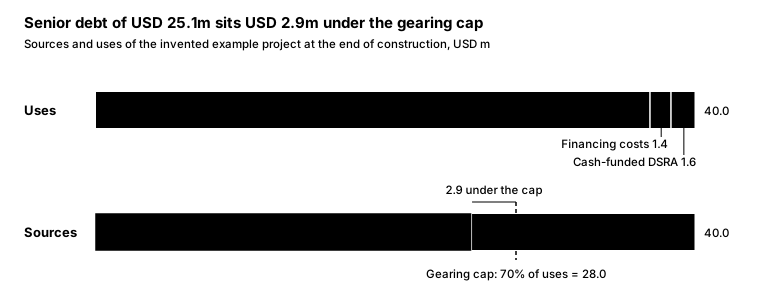
Debt stops short of the cap, so equity funds the rest of the USD 40.0m. The uses bar includes the cash-funded debt service reserve account (DSRA), funded at the end of construction.
Common mistake. Reading the gearing ratio as the debt amount. It is a ceiling. The second mistake is assuming every facility counts towards it without checking.
What does the debt cost?
The all-in cost of debt is the base rate plus the margin, plus fees that are charged whether or not the loan is drawn. The interest rate alone understates it.
| Term | What it is | Where it goes in the model |
|---|---|---|
| Base rate | A floating reference rate, for US dollar loans usually a SOFR-based rate | Interest rate curve input |
| Margin | The lender's spread over the base rate, sometimes different in construction and operations | Added to the base rate, by phase |
| Upfront or arrangement fee | A one-off percentage of the facility, paid at financial close | Uses of funds at close |
| Commitment fee | A charge on the committed but undrawn balance during the availability period | Construction cost, calculated on the undrawn balance |
| Agency fee | A fixed annual amount paid to the agent | Paid ahead of debt service in every period |
| Hedging | An interest rate swap that fixes some or all of the base rate | Swap rate replaces the floating rate on the hedged share |
| Default interest | A higher rate on overdue amounts | Not in the base case; relevant to downside cases |
A commitment fee is charged on the undrawn portion of a facility (FE Training). In FE Training's bank lending illustration, its usual level is 50% of the lender's spread.
In the example. The upfront fee is 1.5% of USD 25.1m, which is USD 0.38m. If the loan is drawn evenly over 12 months, the average undrawn balance is about USD 12.5m, so the commitment fee is roughly USD 0.15m.
The average drawn balance is the same, so interest during construction is roughly USD 0.88m. That is about USD 1.4m of financing cost before the first kilowatt-hour is sold.
Common mistake. Calculating the commitment fee on the drawn balance. A second one is ignoring the circularity: fees and construction interest are funded partly by debt, which raises the debt, then the fees and interest. Solve it deliberately, with iteration or a controlled copy-and-paste routine.
How is the debt repaid?
Tenor is the time from first drawdown to final repayment. The repayment profile sets how much principal falls due in each period within that time.
What it typically says. The clause gives an availability period, which usually matches construction and is when the loan can be drawn. It then gives a grace period on principal, a repayment frequency, a profile (equal instalments, annuity or sculpted) and a final maturity date.
What it changes in the model. These terms become timeline flags: end of availability, first repayment date and final maturity. With a sculpted profile, each period's principal is CFADS divided by the target DSCR, less interest. Debt service then follows the shape of the project's cash flow.
In the example. Sculpting holds DSCR at 1.30x in every year. The same loan repaid as a level annuity would cost USD 3.16m a year. Its DSCR would start at 1.33x and fall to 1.26x by year 12, because output degrades while the payment stays flat.
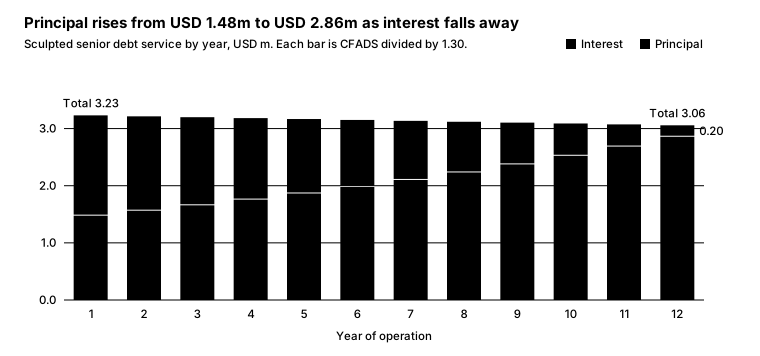
Total debt service drifts down with CFADS, while the split inside it changes. Interest falls as the balance is repaid, so principal can rise within a shrinking total.
What is a mini-perm?
A mini-perm is a loan whose legal maturity is much shorter than its repayment profile, which leaves a balloon to refinance. Norton Rose Fulbright distinguishes two forms.
In a hard mini-perm, failing to refinance before maturity is an event of default. In a soft mini-perm it is not, but the margin steps up and lenders sweep the project's spare cash.
In the example, a maturity at the end of year 6 on the 12-year profile would leave USD 14.8m outstanding, 59% of the loan. The model then needs an explicit refinancing assumption with its own rate, fees and tenor, and a downside case in which refinancing is delayed.
What does prepayment cost?
Term sheets often charge a fee on voluntary prepayment or refinancing in the early years. The borrower also pays any cost of breaking the hedge. Both belong in every refinancing case.
Common mistake. Starting repayments at commercial operation when the term sheet gives a grace period. With a mini-perm, the mistake is quoting a base case equity IRR that depends on a refinancing nobody has committed to.
How much debt can the project carry?
Debt is sized so that cash flow covers debt service by a minimum ratio in every period. The term sheet names the ratio, the forecast case it is tested on, and the lower thresholds that trigger a distribution block and a default.
What are CFADS, DSCR and LLCR?
Cash flow available for debt service (CFADS) is the cash a project generates in a period before any interest or principal is paid. It is measured after operating costs, capital expenditure, tax and working capital movements. That is the Forvis Mazars definition, and the same page lists including depreciation, cash balances or reserve account balances as a mistake.
The debt service cover ratio (DSCR) tests one period. The loan life cover ratio (LLCR) tests the whole remaining loan. Operis defines it as the NPV of CFADS over the debt balance outstanding, discounted at the loan's interest rates.
The term sheet's own definitions govern. Read them line by line: whether interest income counts and whether transfers to a maintenance reserve are deducted. Check also whether the ratio is tested on past cash flows, forecast cash flows or both.
Which forecast is the debt sized on?
Lenders size debt on their own case, not the sponsor's. For energy yield, P50 is the output with a 50% chance of being exceeded. P90 is the output with a 90% chance of being exceeded.
IFC's developer guide notes that investors most often require a P90 energy yield. Practice varies on how the cases are used.
The Renewables Valuation Institute says P50 is typically used to size debt, giving 1.30x for contracted revenues as an example DSCR. It adds that some lenders impose a second test on P99, a 1-in-100 downside, at a lower ratio such as 1.00x. The lower of the two debt amounts applies.
The same page's case study uses 1.20x on P50 and 1.00x on P99. Forvis Mazars says a project with contracted revenue and a strong counterparty might be sized to around 1.20x to 1.35x.
What are the sizing, lock-up and default ratios?
A term sheet sets three DSCR levels, and debt is sized at the highest. Below the lock-up level, distributions to shareholders stop. Below the default level, lenders may exercise their remedies.
In the example. Year 1 debt service is USD 4.2m divided by 1.30, which is USD 3.23m. Discounting each year's permitted debt service at 7.0% gives a debt capacity of USD 25.1m.
That is 62.7% of the funding requirement, below the 70% cap. The DSCR is the binding limit, so equity is USD 14.9m, not USD 12.0m.
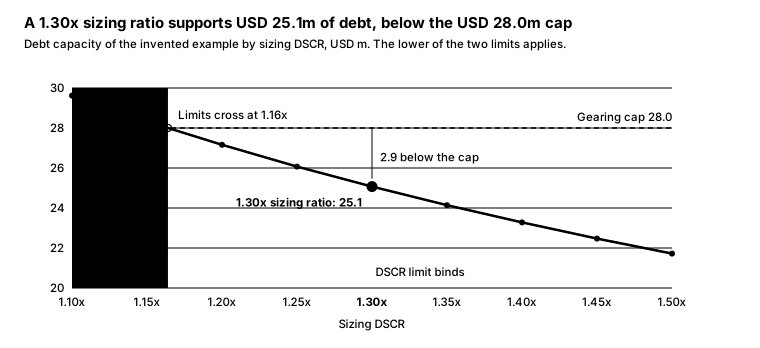
The blue line is the debt the lender will actually provide: the lower of the two limits. In this example the cap would bind only if the sizing ratio were below about 1.16x.
| Threshold | DSCR | Year 1 CFADS (USD m) | Fall from the sizing case | What happens |
|---|---|---|---|---|
| Sizing | 1.30x | 4.20 | 0% | Debt is sized here |
| Lock-up | 1.20x | 3.88 | 7.7% | Distributions are blocked |
| Default | 1.10x | 3.55 | 15.4% | Lenders may enforce |
| Break-even | 1.00x | 3.23 | 23.1% | CFADS only just covers debt service |
A year in which revenue comes in 8% under the lender's case, with costs unchanged, gives CFADS of USD 3.75m and a DSCR of 1.16x. The project is in lock-up but not in default.
One useful check: when debt is sculpted to a flat 1.30x and CFADS is discounted at the loan rate, the opening LLCR is also 1.30x.
Common mistake. Calculating DSCR on EBITDA instead of CFADS. With subordinated debt, a second mistake is running one ratio when the term sheet sets separate senior and total ratios.
What reserve accounts are required?
A reserve account holds cash inside the project company for one defined purpose, and that cash cannot be distributed. The debt service reserve account (DSRA) holds enough to cover a set number of months of upcoming debt service.
What it typically says. Forvis Mazars describes the DSRA as generally sized to a number of months of projected debt service, commonly six or twelve. It can be funded in full at the end of construction, built up from cash flow, or a mix.
A maintenance reserve covers major replacements such as inverters, and its size is usually settled after the lenders' technical adviser reviews the maintenance plan. Some term sheets let the borrower replace cash with a standby facility from the lenders or a letter of credit.
What it changes in the model. The target balance in each period is the next months of debt service. The transfer is the target less the opening balance, and it ranks after debt service in the order of payments. The funding method changes the economics:
- Cash at the end of construction. Raises the funding requirement, so it needs more debt and equity.
- Standby facility. No cash funding, but an availability fee every year on the undrawn amount, and interest if it is drawn.
- Letter of credit. A fee to the issuing bank, usually backed by the sponsor's own credit.
In the example. Six months of year 1 debt service is half of USD 3.23m, which is USD 1.62m. That is about 4% of the funding requirement. It is funded in cash at the end of construction and is counted in the USD 40.0m.
Common mistake. Counting releases from a reserve as CFADS, which inflates the DSCR. Reserve movements stay out of CFADS unless the term sheet's definition says otherwise.
What are the VAT and working capital facilities?
A VAT facility is a short-term loan that funds the VAT paid on construction costs until the tax authority refunds it. A working capital facility is a revolving loan that covers the gap between paying costs and collecting revenue during operations.
What it typically says. Each facility has its own amount, margin and commitment fee, and often sits outside the gearing ratio. The VAT facility is repaid from refunds, with a final date by which it must be cleared in any case. The working capital facility is repaid from revenue and can be redrawn.
What it changes in the model. VAT becomes a construction-period line with a refund lag as an input. Working capital needs assumptions for how many days customers take to pay and how many days the project takes to pay suppliers.
In the example. If 15% VAT applies to USD 30m of construction contracts, USD 4.5m must be funded until it is refunded. Each six months of delay costs about USD 0.17m in interest at a 7.5% facility rate.
Common mistake. Leaving VAT out of sources and uses because it is refundable. The refund lag is a real financing cost. If refunds arrive after the facility's final date, the project repays it from its own cash, ahead of shareholders.
Where does the cash go?
The cash flow waterfall is the fixed order in which the project company must apply its cash in each period. Shareholders are paid last, and only when the distribution tests are passed.
What it typically says. Yescombe's Principles of Project Finance sets out the first five steps in the order below. Subordinated debt and shareholders follow.
- Operating costs and taxes
- Fees and expenses of the agent and security trustee
- Interest and hedging payments
- Scheduled principal
- Transfers to the debt service reserve and other reserve accounts
- Subordinated debt service, where there is any
- Distributions to shareholders, if the conditions are met
The usual conditions for a distribution are that the lock-up ratios are met, no default exists and the reserve accounts are fully funded. Distributions are often allowed only on set dates.
What it changes in the model. Each row is calculated from the cash left after the row above. The project accounts named in the term sheet map onto these rows. A lock-up flag traps cash in the project until the test is passed again, which delays equity cash flows and lowers equity IRR.
In the example. Year 1 CFADS of USD 4.20m less debt service of USD 3.23m leaves USD 0.97m. It reaches shareholders only if DSCR is at least 1.20x and the reserves are full.
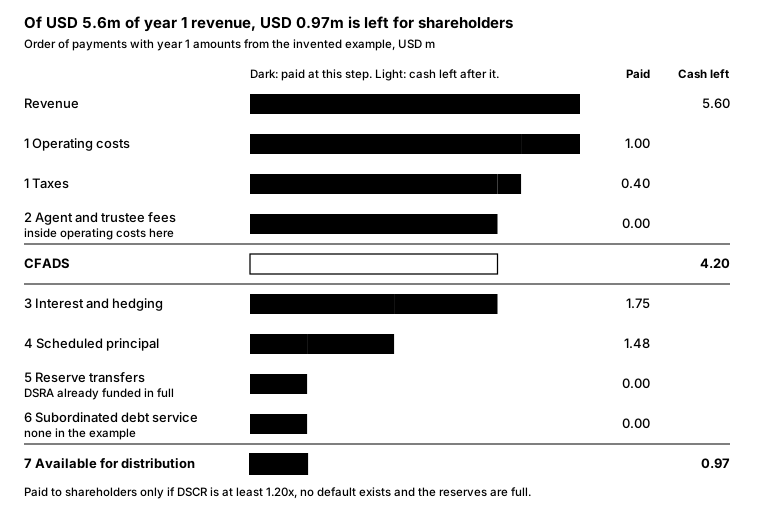
Debt service takes most of CFADS, and nothing reaches shareholders until every step above them is paid. The example treats the USD 40,000 agency fee as part of operating costs, and the DSRA needs no top-up in year 1.
Common mistake. Paying out all spare cash in every period regardless of the tests. Equity IRR must be built on cash that can be distributed, not cash that is generated.
Which legal clauses still move the numbers?
Several clauses that read as legal text change the model's timeline, costs or downside cases. A modeller should read them even though they contain few numbers.
| Clause | What it says | Effect on the model |
|---|---|---|
| Conditions precedent | Documents and approvals required before financial close and before each drawdown | Sets the date of financial close and first drawdown; development costs are carried until then |
| Reporting | Regular operating reports, financial statements and an updated financial model | The model must take actual results and recalculate ratios at each test date |
| Insurance | The cover the project must hold | An operating cost line |
| Tax gross-up and increased costs | The borrower compensates lenders for withholding tax and for certain new regulatory costs | Withholding tax on interest is a cash cost; both are sensitivities |
| Lenders' advisers and expenses | The borrower pays the lenders' legal, technical, insurance and model audit costs | Uses of funds at close |
| Events of default | Events that let lenders stop drawdowns or enforce security | Not inputs, but they define the downside cases worth running |
The model is often a condition precedent in its own right. Lenders commonly require an agreed base case and an independent model audit before financial close.
Common mistake. Fixing the financial close date as an assumption without checking it against the conditions precedent list. Every month of delay adds development cost and moves every later date.
What should you reconcile before you model?
Indicative term sheets are assembled from templates, so one section can contradict another. Find the contradictions before building, because each one is a different model.
- Gearing. Is each facility stated as inside or outside the ratio, and stated the same way everywhere it appears?
- Pricing. Does each facility have one margin per phase, and one commitment fee?
- Dates. Do the availability period, grace period and first repayment date fit together?
- Ratio definitions. Do sizing, lock-up and default use the same CFADS and the same debt service? Senior debt only, or total debt?
- Test basis. Past cash flows, forecast cash flows or both, and over six or twelve months?
- Reserves. Cash or facility, and is the amount counted in the funding requirement?
Send the list to the lender as written questions. Record each answer next to the input it settles.
How do you turn a term sheet into a model, step by step?
Build the model in the order this guide reads the term sheet, one group of clauses at a time. Each step below draws on one section above.
- Record the term sheet's date and version, and enter every bracketed figure as a labelled input with a status.
- List the contradictions between sections and send them to the lender as written questions.
- Draw the model boundary around the SPV, and add a cash line for each party that charges one.
- Build sources and uses from the facilities clause, the gearing cap and the drawdown order.
- Add the cost of debt: base rate, margin, hedging and each fee on its correct balance.
- Set the timeline flags for availability, grace period and maturity, then build the repayment profile.
- Calculate CFADS as the term sheet defines it, on the lender's case.
- Size the debt at the sizing DSCR, compare it with the gearing cap and take the lower amount.
- Add the lock-up and default tests on each test date.
- Add the reserve accounts with their targets, funding method and any facility fees.
- Add the VAT and working capital facilities, with the refund lag and payment days as inputs.
- Build the waterfall in the term sheet's order, and pay distributions only when every condition is met.
- Check the financial close date against the conditions precedent list, and set up the reporting cycle.
- Run the downside cases and record which threshold each one reaches.
In the example, steps 7 and 8 give USD 25.1m of debt against a cap of USD 28.0m.
What are the common mistakes?
Most mistakes treat a term sheet figure as simpler than it is: final, unconditional or the same in every section. These are the ones that change the result most.
- Treating indicative terms as final. A bracketed figure typed into a formula hides what is still open.
- Reading the gearing ratio as the debt amount. It is a ceiling. In the example the DSCR sets a lower figure.
- Charging the commitment fee on the drawn balance. It applies to the undrawn balance. Fees and construction interest also feed back into the debt.
- Ignoring the grace period or the refinancing. Repayments start when the term sheet says. A mini-perm needs a refinancing case that nobody has committed to yet.
- Calculating DSCR on EBITDA. The ratio uses CFADS, and releases from reserves stay out of it.
- Leaving VAT out because it is refundable. The refund lag is a real financing cost.
- Paying out all spare cash. Equity IRR rests on cash that passes the lock-up test and the other distribution conditions.
- Assuming the financial close date. Check it against the conditions precedent list.
What is the term sheet to model checklist?
Every group of clauses maps to a set of inputs and one part of the model. Use this table as the reading order.
| Term sheet clause | Inputs to extract | Part of the model | Deeper guide |
|---|---|---|---|
| Facilities and gearing | Facility list, gearing cap, whether each facility counts towards it | Sources and uses | Debt sizing for solar projects: gearing cap versus DSCR sculpting |
| Drawdown order | Pro rata, equity first or equity last | Construction funding | Senior versus subordinated debt in solar project finance: drawdown order, pricing and ratios |
| Base rate, margin, hedging | Rate curve, margin by phase, hedged share, swap rate | Debt | The all-in cost of debt: base rate, margin, fees and hedging in a solar project loan |
| Fees | Upfront, commitment and agency fees | Debt; sources and uses | The all-in cost of debt: base rate, margin, fees and hedging in a solar project loan |
| Tenor and repayment | Availability period, grace period, frequency, profile, maturity | Debt schedule | Mini-perm versus full-tenor debt: refinancing risk in the solar project model |
| Sizing case and ratio definitions | Yield case, sizing DSCR, CFADS definition | Debt sizing | CFADS, DSCR and LLCR defined properly: formulas, inclusions and a worked example |
| Lock-up and default ratios | Thresholds, test dates, test basis | Covenant tests | The cover ratio ladder: sizing, lock-up and default DSCR explained |
| Reserve accounts | Months of cover, funding method, facility fees | Reserves | Reserve accounts in project finance: DSRA, maintenance reserve and their alternatives |
| VAT and working capital facilities | Amount, margin, refund lag, payment days | Short-term facilities | The facilities modellers forget: VAT and working capital facilities in solar project finance |
| Order of payments and distributions | Waterfall order, distribution conditions and dates | Waterfall and equity returns | The cash flow waterfall in project finance: the order of payments and how to model it |
| Conditions precedent | Target date of financial close | Timeline | Conditions precedent as a roadmap to financial close: what a solar project must deliver before the first drawdown |
| Reporting | Reporting cycle, model update dates | Actuals and covenant reporting | Life after financial close: reporting covenants, model updates and events of default |
Two further guides sit outside the table. Lending to a multi-offtaker solar project: how lenders assess an aggregated portfolio covers projects with more than one offtaker. Solar project finance glossary: the term sheet terms a modeller needs defines the terms used in this guide.
Frequently asked questions
Is a project finance term sheet legally binding?
An indicative term sheet is not a commitment to lend. The lender's offer stays subject to due diligence, credit approval and signed finance documents. Some provisions, such as confidentiality and responsibility for costs, may be drafted to bind, so read the wording.
What limits the size of the loan, gearing or DSCR?
Both do, and the lower result applies. The gearing ratio caps debt as a share of project cost.
The DSCR caps debt at what the cash flows can service. In this guide's example the cap allows USD 28.0m and the DSCR allows USD 25.1m, so the DSCR binds.
What is a lock-up ratio?
A lock-up ratio is the DSCR level below which the project company may not pay distributions to its shareholders. It sits below the sizing ratio and above the default ratio. Cash trapped by a lock-up stays in the project until the test is passed again.
Why do lenders look at P90 instead of P50?
P50 is the expected energy yield, which the project will miss in half of all years. P90 is a level the project should exceed in nine years out of ten. Lenders are repaid from cash flow alone, so they want debt service covered in a weak year as well as an average one.
What is the difference between DSCR and LLCR?
DSCR compares one period's CFADS with that period's debt service. LLCR compares the present value of all CFADS over the remaining loan life with the debt outstanding.
DSCR shows whether a single period is tight. LLCR shows whether the loan as a whole can be repaid.
What is CFADS?
CFADS is cash flow available for debt service: revenue less operating costs, capital expenditure and tax, adjusted for working capital, before interest and principal. It is a cash measure, so it excludes depreciation and reserve balances.
Sources
Pages opened on 4 October 2026 and checked again on 5 October 2026. The example project is invented and has no source.
- Debt Service Coverage Ratio (DSCR): formula, meaning and use in project finance, Forvis Mazars. Sizing ratios, lock-up and default, sculpting.
- CFADS: Cash Flow Available for Debt Service, Forvis Mazars. CFADS definition and exclusions.
- Debt Service Reserve Account (DSRA), Forvis Mazars. Reserve sizing, funding and ranking.
- Loan Life Cover Ratio: A First Principles Explanation, Operis, 2018. LLCR formula and discount rate.
- P50 vs. P99 in Project Finance: How Lenders Size Debt, Renewables Valuation Institute. P50 and P99 sizing tests and the example ratios.
- P50/P90 Analysis for Solar Energy Systems Using the System Advisor Model: Preprint, National Renewable Energy Laboratory, 2012, record on OSTI.GOV. P50 and P90 exceedance probabilities, defined in the full paper linked from the record.
- Utility-Scale Solar Photovoltaic Power Plants: A Project Developer's Guide, International Finance Corporation, 2015. Equity share, P90 yield requirement, P50 and P90 definitions.
- Project Bonds and Mini-Perms: A New Era in the Middle East, Norton Rose Fulbright, November 2012. Hard and soft mini-perms.
- Commitment Fees, Financial Edge Training (FE Training). Commitment fee basis and usual level.
- Principles of Project Finance, section 13.5: Control of cash flow, E. R. Yescombe, excerpt hosted by GlobalSpec. First five steps of the order of payments.