The all-in cost of debt: base rate, margin, fees and hedging in a solar project loan
By SolarQuant Editorial. Published 2026-10-05. Last updated 2026-10-05.
The headline interest rate on a term sheet understates what a project loan costs. Fees, interest during construction and hedging terms add to it, and each one has its own line in the model. This article lists every component, shows where it goes, and turns them into one all-in rate so two offers can be compared.
What is the all-in cost of debt?
The all-in cost of debt is the single annual rate that equates everything the lender advances with everything the borrower pays, fees included. It is the internal rate of return (IRR) of the loan's cash flows seen from the lender's side.
The headline rate, base rate plus margin, only prices the drawn balance. An upfront fee, a commitment fee and an annual agency fee are paid on top. In the example used across this series, the headline rate is 7.0% and the all-in rate is 7.64%.
The example is invented: a 40 MWp solar plant with a 12-month build and a USD 25.1m senior loan repaid over 12 years. Periods are annual for simplicity; real deals usually use six-month periods. The pillar article, "How to read a solar project finance term sheet: a modeller's guide", sets out the full term sheet.
What makes up the interest rate on a project loan?
The interest rate on a project loan is a floating base rate plus a margin. The base rate resets at the start of each interest period. The margin is fixed in the term sheet.
The base rate. FE Training notes that a variable rate is usually quoted as a margin added to a benchmark rate. For US dollar loans a common benchmark is SOFR, which the Fed-convened ARRC recommended in 2017 as its alternative to USD LIBOR. The New York Fed calls SOFR, the Secured Overnight Financing Rate, a broad measure of the cost of overnight borrowing collateralised by Treasury securities.
SOFR is an overnight rate, so loans need a way to turn it into a rate for a whole interest period. CME Term SOFR does this with forward-looking estimates for 1, 3, 6 and 12 month tenors. In the model, the base rate is a curve by period, not one number.
The margin. The margin is the lender's return over the base rate. A term sheet may set one margin for construction and another for operations, or step the margin up in later years. Enter it as a time series so that each step lands in the right period.
The example. The base rate is 4.0% and the margin is a flat 3.0%, so the headline rate is 7.0%.
The common mistake. Applying the operating margin during construction, or missing a step-up late in the loan.
Which costs does a term sheet list, and where does each go in the model?
A term sheet lists three kinds of cost: interest on the drawn balance, fees, and terms that only cost money if something changes. Each has its own base, its own timing and its own line in the model.
| Cost term | Charged on | When it is paid | Where it sits in the model |
|---|---|---|---|
| Base rate | Drawn balance | Each interest period | Interest line, from a rate curve by period |
| Margin | Drawn balance | Each interest period | Interest line, from a margin time series |
| Upfront or arrangement fee | Whole facility, drawn or not | Once, at financial close | Uses of funds at close |
| Commitment fee | Undrawn committed amount | Each period until fully drawn | Uses of funds during construction |
| Agency fee | Flat annual amount | Each year of the loan | Operating costs or a senior fee line |
| Interest during construction | Drawn balance during the build | Each period, in cash or capitalised | Uses of funds, circular with the loan size |
| Swap fixed rate | Hedged notional | Each interest period | Replaces the base rate on the hedged share |
| Swap break cost | Value of the swap when it ends early | On prepayment or refinancing | Refinancing and prepayment cases |
| Default interest | Overdue amounts | While they stay unpaid | Downside cases only |
| Tax gross-up | Interest subject to withholding tax | With each interest payment | A switch on the interest line |
| Increased costs | A lender's claim after a change in law | If and when claimed | Risk note, not a base case line |
FE Training defines a commitment fee as a fee charged on the undrawn portion of a facility. Its example, written for bank lending in general, puts the usual fee at about half of the spread.
Corporate Finance Institute gives the formula for a credit line as the unused amount times the commitment rate. PitchBook's leveraged loan glossary describes the administrative agent fee as an annual fee typically paid to administer the loan. Both pages cover corporate or leveraged loans, so we take definitions from them and no market figures.
In the example the upfront fee is 1.5% of the facility, the commitment fee is 1.2% a year and the agency fee is USD 40,000 a year. The commitment fee is 40% of the 3.0% margin. Practice varies by deal, so read each base and each date from the term sheet.
What does the loan cost during construction?
During construction the loan costs three things: the upfront fee, the commitment fee on the undrawn amount and interest on the drawn amount. In the example they total about USD 1.40m, which is 3.5% of the USD 40.0m funding requirement.
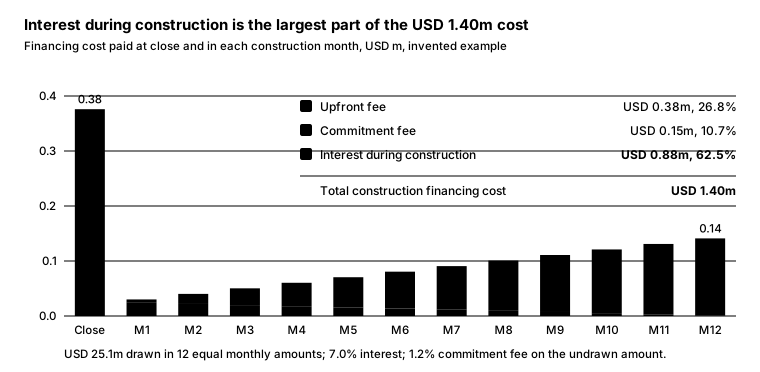
Interest grows each month as the loan is drawn, while the commitment fee shrinks with the undrawn amount. The upfront fee is one payment at close on the whole facility.
What the term sheet says. It states whether interest during construction is paid in cash or capitalised, which means added to the loan balance. Either way it is a use of funds. In the example it is paid in cash each month from loan and equity drawings.
What it changes in the model. These costs are part of the funding requirement, so they raise the amount to be funded. That makes the calculation circular: the loan size sets the interest, and the interest sets the loan size. A modelling tutorial on Chandoo.org puts it as "My loan changes interest and interest changes loan".
The common mistake. Leaving fees and interest during construction out of the funding requirement, which leaves the project short of cash before it earns any revenue.
How does an interest rate swap change the cost?
An interest rate swap replaces the floating base rate with a fixed rate on the hedged part of the loan. The borrower pays a fixed swap rate to a hedging bank and receives the floating rate. That receipt offsets the floating rate owed to the lenders.
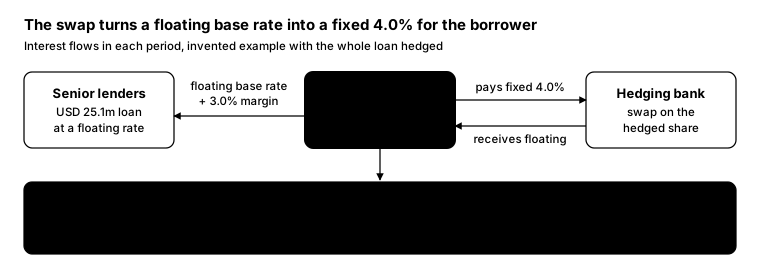
The loan itself stays floating. The fixed cost comes from adding the swap to it, so the swap needs its own sheet in the model.
What the term sheet says. BlueGamma notes that project finance lenders typically make hedging a condition of the loan. The term sheet sets the minimum hedged share and the hedge period. One practitioner's 2017 note, from Verdigris, cites a usual minimum of 50% of the interest rate exposure, but practice varies.
The swap rate. On a repaying loan the swap rate is a weighted average of forward rates, so it depends on the repayment profile. BlueGamma's formula weights each period by its discount factor and the outstanding notional. A CFA Institute article on Saudi Arabian projects adds that the project company bears the cost of any margin the hedge providers make.
What remains floating. The example treats the 4.0% base rate as the swap rate on a fully hedged loan. Suppose only 75% were hedged (an invented share) and the base rate rose by 1.0 percentage point. Year 1 interest would rise from USD 1.755m to USD 1.817m and the DSCR would fall from 1.30x to 1.28x.
With no hedge at all, year 1 interest would be USD 2.005m and the DSCR 1.21x. That is just above the 1.20x lock-up level described in "The cover ratio ladder". Both figures hold principal repayments unchanged.
Break costs. Ending a swap early has a cost or a gain. BlueGamma states that a swap's breakage cost is its mark-to-market, and that the bank's quote adds an unwind charge. Model it in any prepayment or refinancing case.
The common mistake. Modelling the whole loan as fixed for its whole life when the term sheet hedges only part of it, or only some years.
Which cost risks sit outside the rate?
Default interest, the tax gross-up and increased costs raise the cost of debt only if a trigger occurs. They are not base case lines, but they belong in the risk review and the sensitivities.
- Default interest. This is a higher rate charged on amounts not paid when due, for as long as they stay unpaid. The term sheet states the uplift. It matters only in downside cases.
- Tax gross-up. FE Training says the gross-up protects a lender from withholding tax on the borrower's interest payments. The Association of Corporate Treasurers describes it as the borrower increasing its payments to a grossed-up amount.
- Increased costs. FE Training describes a provision that lets the lender claim for a rise in its funding cost caused by a change in the law. It cannot be given a number in advance, so record it as a risk.
If a withholding tax at rate w applies and the borrower must gross up, the cost of interest becomes:
With an invented withholding tax of 10%, the 7.0% headline rate would cost the borrower 7.78%. This is our own arithmetic. Whether any withholding applies depends on the countries and lenders involved.
How do you compute the all-in rate?
The all-in rate is the discount rate at which the lender's cash flows have a net present value of zero. Drawdowns are outflows. Fees, interest and principal are inflows.
In the example the lender advances USD 25.07m in 12 equal monthly drawings. It receives the USD 0.38m upfront fee at close, then interest and commitment fee each month of construction. It then receives 12 annual debt service payments, each with the USD 40,000 agency fee.
The rate r that solves the equation is 7.64%, against a headline rate of 7.0%. The upfront fee adds 0.28 percentage points, the commitment fee 0.11 and the agency fee 0.22. Monthly payment of interest during construction adds the last 0.02.
Two assumptions sit behind this figure. The agency fee is paid at the end of each of the 12 operating years, as part of operating costs. The swap, legal costs and the reserve account are left out, so this is the cost of the loan alone.
How do you compare two term sheets?
Compare two offers on the all-in rate, computed on the same loan amount, drawdown profile and repayment profile. Change only the pricing terms, so that the difference in the result is the difference in price.
Offer A is the example and Offer B is invented for this comparison. Its margin is 2.75% in place of 3.0%, and its upfront fee is 3.0% in place of 1.5%. All other terms are the same.
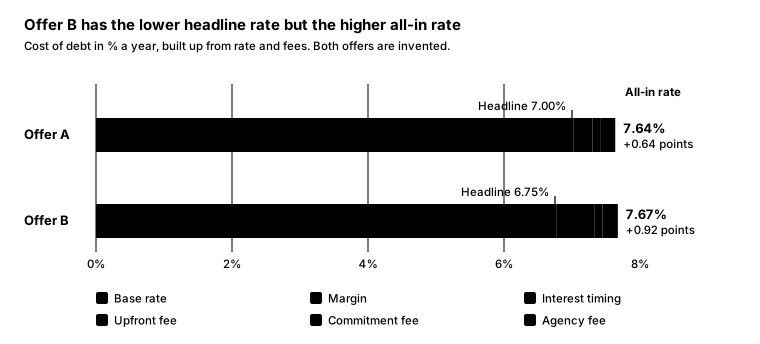
Offer B looks 0.25 percentage points cheaper on the headline, but it is 0.04 points dearer once fees are counted. "Interest timing" in the chart is the small effect of paying construction interest monthly.
In cash, Offer B costs USD 0.38m more in fees at close and saves USD 0.48m of interest over the loan's life. It is still dearer, because the fee is paid on day one and the saving arrives over 13 years. The upfront fee at which the two offers tie is about 2.8%.
The answer also depends on how long the loan lasts. If the loan is refinanced at the end of year 6, Offer B's all-in rate is 7.81% against 7.69% for Offer A. A front-loaded fee is spread over fewer years, so it weighs more.
One limit, in our reading: the all-in rate ranks price only. A lower margin also supports slightly more debt under a DSCR sizing, and offers can differ on tenor, covenants and reserves.
How do you model it?
Give every cost term its own input and its own line, then add one lender cash flow line that collects them all.
- Enter the base rate as a curve by period and the margin as a time series, with any step between construction and operations.
- Enter the hedged share, the swap fixed rate and the hedge period. Interest is the hedged balance at swap rate plus margin, plus the unhedged balance at floating rate plus margin.
- Compute the upfront fee as its rate times the whole facility. Place it in uses of funds at financial close.
- Compute the commitment fee each construction period as its rate times the undrawn commitment times the length of the period.
- Compute interest during construction on the drawn balance. Add it and the fees to the funding requirement, and solve the circular link with iteration or a macro.
- Add the agency fee as a flat annual line for the life of the loan, in operating costs or as a senior fee.
- Build the lender cash flow line: drawdowns as negatives, then every fee, interest and principal payment as positives. Its IRR on dated flows is the all-in rate.
- Run the sensitivities: a base rate rise on the unhedged share, an early refinancing with its break cost, and a tax gross-up.
Check the result in step 7 against the headline rate. If the two are equal, a fee is missing from the line.
What are the common mistakes?
- Quoting the margin as the cost of debt. The margin is one of at least five price terms. In the example it is 3.0% of a 7.64% all-in rate.
- Charging the upfront fee on the drawn amount. The fee is charged on the whole facility at close, before most of it is drawn.
- Charging the commitment fee on the whole facility. It applies to the undrawn amount only, so it falls as the loan is drawn.
- Treating a small flat fee as noise. The USD 40,000 agency fee adds 0.22 percentage points on a USD 25.1m loan.
- Comparing offers on different loan sizes or lives. Hold the loan, the drawdowns and the repayment profile constant, and test an early refinancing.
- Ignoring the swap in a prepayment case. Ending the swap early has a break cost or gain that sits outside the loan's own prepayment fee.
Frequently asked questions
What is the difference between the headline rate and the all-in rate?
The headline rate is the base rate plus the margin, charged on the drawn balance. The all-in rate also counts the upfront, commitment and agency fees, and when each is paid. In the example the headline rate is 7.0% and the all-in rate is 7.64%.
Does hedging reduce the cost of debt?
Hedging fixes the cost. It does not reduce it by design. In our reading, the swap rate reflects forward rates over the life of the loan. It can sit above or below the floating rate on the day of signing.
What is the difference between SOFR and Term SOFR?
SOFR is an overnight rate published each business day by the New York Fed. CME Term SOFR is a set of forward-looking rates for 1, 3, 6 and 12 month tenors. The term sheet names which one the loan uses and how it is applied to each interest period.
Why compare on IRR and not on total cash cost?
Total cash cost ignores timing. In the comparison above, the offer with the lower total cash cost has the higher all-in rate. Its larger fee is paid at close. The IRR weighs each payment by its date.
Sources
Pages opened on 4 October 2026 and checked again on 5 October 2026. The example project is invented and has no source.
- Secured Overnight Financing Rate Data, Federal Reserve Bank of New York. Definition of SOFR and its daily publication.
- Transition from LIBOR, Alternative Reference Rates Committee (ARRC), convened by the Federal Reserve Board and the New York Fed. The ARRC's 2017 selection of SOFR as its recommended alternative to USD LIBOR.
- CME Term SOFR Rates, CME Group. Description of CME Term SOFR as forward-looking rates for 1, 3, 6 and 12 month tenors.
- Commitment Fees, Financial Edge Training. Definition of a commitment fee, and a general bank lending example in which the fee is about half of the spread.
- Commitment Fee, Corporate Finance Institute. Formula for the commitment fee on the unused amount of a credit line.
- Leveraged loan glossary, PitchBook LCD. Description of the administrative agent fee in leveraged loans as an annual fee typically paid to administer the loan.
- Credit Facility Agreement, Financial Edge Training. Margin over a benchmark rate, the tax gross-up and the increased costs provision.
- Gross up, Association of Corporate Treasurers. Definition of a gross-up clause in loan documentation.
- Interest Rate Hedging & Renewable Energy, BlueGamma. Lenders typically require hedging, and how a swap converts a floating rate loan to fixed.
- Swap Rate Calculation in Project Finance: How to Get It Right, BlueGamma. Swap rate formula for a repaying notional.
- We're refinancing: what's the breakage on the existing swap?, BlueGamma. Break cost as the swap's mark-to-market plus the bank's unwind charge.
- Project finance principles, Verdigris Project Finance. The section "A typical project finance term sheet", dated 2017: one practitioner's statement of a usual 50% minimum hedge.
- Splitting the Risk: How to Manage Interest Rate Risk in Project Finance, CFA Institute Enterprising Investor. In a piece on Saudi Arabian projects, the project company bears the cost of the hedge providers' margin.
- Modeling Interest During Construction (IDC): Excel Project Finance, Chandoo.org. The circular link between loan size and interest during construction.