Conditions precedent as a roadmap to financial close: what a solar project must deliver before the first drawdown
By SolarQuant Editorial. Published 2026-10-05. Last updated 2026-10-05.
The conditions precedent list in a term sheet looks like legal boilerplate. Read as a schedule, it is the project's work plan to financial close. It tells the modeller when the first drawdown can realistically happen and what costs the sponsors carry until then.
What is a condition precedent?
A condition precedent is a requirement that must be satisfied or waived before a party has to perform. In a loan, the lenders need not advance money until every condition on the list is cleared. LexisNexis defines them as requirements "that must be satisfied or waived before a contract becomes effective or a party may exercise a right".
Lenders use the list to test their own assumptions. Pinsent Masons says the conditions ensure that "the legal and commercial assumptions which the bank has based its lending decisions on are satisfied". The list usually sits in a schedule to the facility agreement, and the agent receives the documents for a lending group.
Yescombe calls the list "effectively a checklist of documents the lenders require as the basis for their financing" (Principles of Project Finance, section 13.8). He adds that it often runs to "several hundred documents and certificates". Our reading is that each line is a task with an owner and a duration, so the list is a schedule.
The pillar article, How to read a solar project finance term sheet: a modeller's guide, places this clause among the others. This article turns it into dates and costs.
What is the difference between conditions to financial close and conditions to each drawdown?
Conditions precedent come in two sets. The first set must be cleared once, before the first drawdown, and clearing it is financial close. The second set is tested again before every drawdown.
Pinsent Masons describes the split as conditions "to the making of the facility agreement" and conditions "to each drawing of each loan facility". The APMG PPP Guide states the consequence. Financial close means the documents are signed and "the prior conditions for the availability of financing have been fulfilled".
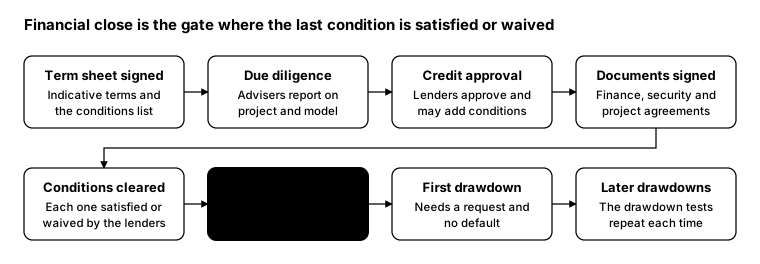
Signing the documents is not financial close. The close date is the day the last initial condition is satisfied or waived.
The drawdown set is shorter: one practitioner note lists a formal request, cost certification, milestone verification, no default and a proportional equity contribution. In the model, the first set fixes when the construction draw schedule starts. The second set fixes how each draw is split between debt and equity.
What are the main groups of conditions precedent, and who delivers each?
The conditions fall into about twelve groups, and each group has a different owner. The borrower answers for the whole list, but most items depend on an authority, a counterparty, an adviser or a law firm.
The groups below follow the lists in Pinsent Masons, Yescombe and the practitioner note cited above. The owner and model columns are our reading. Practice varies by lender and country.
| Condition group | What the lenders ask for | Who delivers it | Effect on the model |
|---|---|---|---|
| Corporate documents and approvals | Constitutional documents, board resolutions, shareholder agreement | Project company and sponsors | No number. A missing approval moves the close date |
| Project documents | Signed power purchase agreement, construction and operations contracts, land rights, grid connection, direct agreements | Project company with the offtaker, contractors, landowner and grid operator | Fixes tariff, contract price, operating costs and key dates |
| Permits and licences | Every consent needed to build and operate | Project company, from the authorities | In our reading, often the longest lead item, so it can set the earliest close date |
| Finance and security documents | Facility agreement, security, intercreditor, hedging and accounts agreements | Lenders' and borrower's lawyers draft, all parties sign | Final margin, fees, ratios and reserve terms |
| Due diligence reports | Technical, legal and insurance reports, and the model audit letter | Lenders' advisers, usually paid by the borrower | Lender's case yield, costs and degradation. Adviser fees enter the funding requirement |
| Financial model and base case | The agreed model with the lenders' assumptions | Sponsors' modeller, lenders, model auditor | Final debt amount, cover ratios and repayment schedule |
| Equity | Signed equity commitments and evidence of funds | Sponsors | Timing of equity: before debt, alongside it, or after it |
| Insurance | Policies in place and the insurance adviser's confirmation | Borrower's broker and lenders' insurance adviser | Premiums in construction and operating costs |
| Environmental and social | Approved impact assessment and an agreed action plan | Project company and its consultants | Action plan costs in the budget |
| Accounts | Project and reserve accounts opened | Borrower and account bank | The cash waterfall must match the accounts agreement |
| Legal opinions | Opinions on capacity, validity and enforceability | Lenders' lawyers, and other counsel as needed | No number. A last-week item |
| Fees and costs | Upfront fee and adviser fees paid, or paid from the first drawdown | Borrower | Upfront fee of USD 0.38m in the example is due at close |
The project documents group hides a circular problem. The World Bank PPP Resource Center notes, citing Yescombe, that a PPP contract does not become effective until funding is available, "and vice versa". Our reading is that the usual fix is to make both effective at the same moment.
Why are the financial model and its audit conditions themselves?
The agreed financial model is a condition because it is the document that turns the term sheet into numbers. The base case fixes the debt amount, the repayment schedule and the ratio levels that the covenants test later. Lenders will not fund against a model they have not accepted.
The audit is a condition because lenders rely on the output. Operis, a model audit firm, says a lender will typically require a formal model audit in the weeks before bid submission or financial close. The practitioner note lists the "Financial Model Auditor’s letter confirming the model review" among the final reports.
In the example, the base case gives senior debt of USD 25.1m from a 1.30x sizing ratio. Any late change to yield, costs or interest rate changes that figure. Our reading is that the model is the one condition the modeller owns, and the one most often reopened late.
The IFC developer's guide asks for a "detailed, bankable financial model covering the full lifecycle of the plant". It adds that commercial banks in new markets may not know solar projects, so developers should expect "a rigorous due diligence process". It tells them to allow time for it in the project schedule.
What are waivers and conditions subsequent?
A waiver removes a condition, and a condition subsequent defers it until after the loan is drawn. Both let financial close happen with an item still open. Neither is free.
Pinsent Masons explains that a waiver letter confirms the lender "no longer requires the borrower to satisfy particular conditions precedent". A conditions subsequent letter allows open items "to be satisfied at a later date, after the loan has been drawn". Failure to meet the new date "is an event of default".
LexisNexis notes that conditions subsequent also arise by design. Some items can only be completed after the transaction completes. Our reading for solar is that registering security and final insurance paperwork are common examples.
For the modeller, a condition subsequent is a dated risk. Record its deadline beside the covenant dates, because Pinsent Masons says missing it is an event of default.
How long does it take to reach financial close?
The time to financial close is the length of the longest chain of dependent conditions, not the sum of all tasks. Planners call that chain the critical path. Every other workstream has spare time, called float.
Public figures show how wide the range is. The APMG PPP Guide records three public-private partnership projects, none of them solar, that took 1, 180 and 244 days from contract signing to financial close. We found no public benchmark for solar loans, so the schedule below is invented.
In the example, the sponsors target financial close 30 weeks after signing the term sheet. First drawdown follows two weeks later.
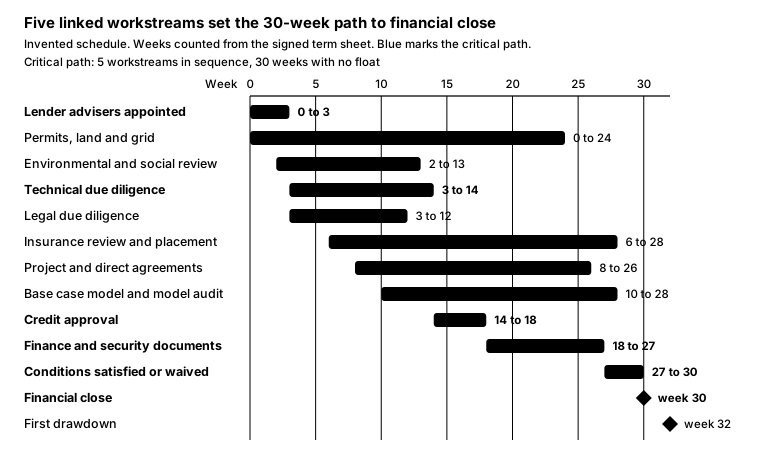
The critical path runs through adviser appointment, technical due diligence, credit approval, finance documents and the final clearing of conditions. Permits end at week 24, so they have six weeks of float. The model audit and insurance end at week 28, with two weeks of float each.
Float is not safety. A permit that slips eight weeks becomes the new critical path and moves financial close by two weeks.
What does the conditions list change in the model?
The conditions list changes four things in the model. They are the close date, the costs carried to it, rate and price validity, and long-stop dates. None appears as a number in the clause itself.
The financial close date becomes a driven input. The model should compute it from the schedule, not take it as a typed date. Construction start, first repayment and the contract end date all hang from it.
Development costs and fees are carried until close. The example assumes an invented carry of USD 120,000 a month. It is USD 60,000 for the development team, USD 45,000 for advisers and USD 15,000 for land and grid.
Over 30 weeks that is about USD 0.83m, paid by the sponsors before any debt is available. The upfront fee of USD 0.38m falls due at close.
Rates and prices have expiry dates. The interest rate is only fixed when the hedge is executed at close. The APMG PPP Guide describes this for PPP projects. In some, the procuring authority bears part or all of the risk "that base interest rates change in the period before financial close".
Our reading is that construction prices and credit approvals also carry validity dates. They belong on the same timeline.
Long-stop dates turn delay into loss. The World Bank PPP Resource Center says PPP contracts often specify a final date for meeting the conditions precedent. If it is missed, "the contract terminates, and/or a bid bond is forfeited". In our reading, a power purchase agreement can carry a similar date.
Check too when the commitment fee starts. If it runs from signing, weeks 27 to 30 cost about USD 17,000 in the example.
What does a three-month delay to financial close cost?
A delay costs the monthly carry for every month of slip. When the cover ratio sizes the debt, all of it is extra equity. In the example, three months cost USD 0.36m before any change in rates or contract terms.
The table shows the direct cost and two further effects that a slip can trigger. All figures are computed from the invented example. The rate move of 0.25% is an invented test, not a forecast.
| Effect of a three-month slip | Before | After | Change |
|---|---|---|---|
| Development and standby cost carried to close (USD m) | 0.83 | 1.19 | +0.36 |
| Senior debt, sized at 1.30x and 7.0% (USD m) | 25.07 | 25.07 | 0.00 |
| Equity (USD m) | 14.93 | 15.29 | +0.36, or 2.4% |
| Senior debt if the hedged rate is 7.25% at close (USD m) | 25.07 | 24.74 | -0.33 |
| Equity with the slip and the higher rate (USD m) | 14.93 | 15.62 | +0.69, or 4.6% |
| Cash flow lost in year 20 if the contract end date is fixed (USD m) | 0.00 | 0.95 | -0.95 |
The debt does not grow with the cost, because the cover ratio and not the gearing cap binds. The sponsors fund the whole slip. The rate line ignores the small change in construction interest.
The last line applies only where the power purchase agreement ends on a fixed calendar date. It is a quarter of year-20 cash flow available for debt service. Distributions also start three months later in every case, which lowers the equity return further.
The cover ratio ladder, another article in this series, explains why the sizing ratio caps the debt.
How do you model it?
Model the conditions list as a small schedule that drives the financial close date. Then hang every other date and every pre-close cost from it.
- Enter the term sheet signing date. List each condition group as a row with an owner, a start week, a duration and the row it depends on.
- Compute each row's end date. Set the financial close date to the latest end date, and never type it by hand.
- Link construction start, commercial operation, first repayment and the contract end date to financial close.
- Add a monthly carry line that runs from today to financial close. Add the costs due at close, such as the upfront fee and adviser fees.
- Put every validity date on the same timeline: credit approval, construction price, rate quotes and long-stop dates. Flag any that financial close would pass.
- Add a delay input in months. Run three months and report the change in funding requirement, debt and equity.
- Freeze the model for audit. Log every later change, and rerun the base case on final rates at close.
The example uses annual periods for simplicity. Real deals usually use six-month periods, and a pre-close schedule works best in weeks or months.
How do you track conditions precedent?
Track conditions in one shared list with one row per condition and one named owner per row. Our reading is that a legal checklist tracks documents, not time. The modeller should keep a copy that carries dates as well as status.
Useful columns are:
- the clause reference and the wording of the condition
- the owner, and the third party it depends on
- the status: not started, draft, agreed form, delivered, satisfied, waived or deferred
- the target date and the date it feeds in the model
- the float in weeks against financial close
Satisfaction is the lenders' call, not the borrower's. In a syndicated loan the agent receives the documents and approves them for the lenders, according to Pinsent Masons. Review the list weekly and recompute the close date each time a row moves.
What are the common mistakes?
- Typing the close date. A hard-coded date hides the schedule behind it. Drive it from the slowest chain of conditions.
- Treating signing as close. Signed documents do not oblige lenders to fund. In the example, three weeks separate signing from close.
- Leaving out pre-close costs. Carry and adviser fees are real cash. In the example they reach USD 0.83m before the first drawdown.
- Assuming delay is shared with lenders. When the cover ratio sizes the debt, extra cost is all equity.
- Treating a waiver as free. A deferred condition comes back as a deadline, and missing it is an event of default.
- Changing the model after the audit freeze. Each late change reopens the audit, which sits two weeks from the critical path in the example.
- Forgetting the drawdown conditions. Each later draw has its own conditions. The practitioner note cited above lists no default and a proportional equity contribution among them.
- Ignoring validity dates. A slip can outlast a price, a rate quote or a credit approval.
Frequently asked questions
Is financial close the same as signing the loan agreement?
No. Signing creates the commitment, but lenders need not fund until the initial conditions are satisfied or waived. Financial close is the day the last of those conditions is cleared. The two can fall on the same day or months apart.
Who decides whether a condition precedent is satisfied?
The lenders decide, usually acting through the agent and on the advice of their lawyers. The borrower delivers the documents, but form and content must be acceptable to the lenders. This is why agreeing the form of each document early saves time.
Can lenders waive a condition precedent?
Yes. Lenders can waive a condition in writing, or defer it as a condition subsequent with a new deadline. A deferred condition that is then missed is an event of default. In our reading, whether all lenders or a majority must agree depends on the finance documents.
Why is the model audit finished so late?
The auditor signs off the final model, and the model is only final when the documents and assumptions are settled. Any change after the freeze must be reviewed again. Our reading is that an early first review and a short list of late changes keep the audit off the critical path.
What happens if the conditions are not met by the long-stop date?
The consequence depends on the contract. The World Bank notes that a PPP contract can terminate, or a bid bond can be forfeited. Under a loan, our reading is that the lenders' commitment and approved terms can lapse, so the terms may need to be approved again.
How much does one month of delay cost?
It depends on the project's own carry. The example assumes an invented USD 120,000 a month, so three months cost USD 0.36m. Add any loss from rate moves, expired prices or a fixed contract end date.
Sources
Pages opened on 4 October 2026 and checked again on 5 October 2026. The example project is invented and has no source.
- Achieving Contract Effectiveness and Financial Close, World Bank PPP Resource Center. Used for the circular effectiveness problem, which the page attributes to Yescombe, and the final date for meeting conditions precedent. The page is about PPP contracts and does not use the term long-stop date.
- 13. The Financial Close, APMG PPP Certification Guide. Used for the definition of financial close, the 1, 180 and 244 day PPP examples and interest rate risk before close.
- Key terms in project finance funding agreements, Pinsent Masons, 22 December 2011. Written about PFI projects. Used for the two categories of conditions and examples of conditions.
- Pre-conditions to lending, Pinsent Masons, 30 August 2011. A general lending guide. Used for why lenders require conditions, the agent's role, waivers and conditions subsequent.
- Project finance conditions precedent: documentary and factual requirements, drawdown mechanics, satisfaction and sign-off, waivers and conditions subsequent, LexisNexis. Used for the definition of conditions precedent. Only the public preview was read.
- How to deal with conditions subsequent in a loan transaction, LexisNexis. Used for how conditions subsequent arise. Only the public preview was read.
- Principles of Project Finance, section 13.8: Financial close, conditions precedent, E. R. Yescombe, excerpt hosted by GlobalSpec. Used for the checklist description, the length of the list and corporate and project document conditions.
- From Debt Structuring to Financial Close, Notes on Project Development. A practitioner's Substack note. Used for the conditions to later drawdowns and the model auditor's letter.
- Utility-Scale Solar Photovoltaic Power Plants: A Project Developer's Guide, International Finance Corporation. Used for the bankable financial model and the time needed for lender due diligence in new markets.
- Model Auditing: the why and the how, Operis, 10 December 2021. Used for the point that lenders require a formal model audit before financial close.