Reserve accounts in project finance: DSRA, maintenance reserve and their alternatives
By SolarQuant Editorial. Published 2026-10-05. Last updated 2026-10-05.
A reserve account clause is a few lines in a term sheet, but it changes the funding requirement, the order of payments and the equity return. This article explains the debt service reserve account and the maintenance reserve account. It compares three ways to provide the first: cash, a standby facility and a letter of credit. It also shows how to model reserves so that they do not distort the cover ratios.
What is a reserve account, and why do lenders require one?
A reserve account is a project company bank account that holds cash for one stated purpose, under the control of the loan documents. Lenders require reserves because a project company has no other business to fall back on when cash is short.
Forvis Mazars describes the debt service reserve as "a cash reserve that works as an additional security measure for the lender". The same logic applies to maintenance. The Renewables Valuation Institute says the reserve means a project "can be maintained without raising further capital" in years with "lumpy capital expenditures".
Every reserve clause answers four questions: the target balance, when the account is first funded, how it is topped up, and when cash is released. Those four answers are the inputs the model needs.
What is a debt service reserve account (DSRA)?
A debt service reserve account (DSRA) holds enough cash to pay a set number of months of upcoming senior debt service. If cash flow available for debt service (CFADS) falls short of a payment, the project draws on the account instead of defaulting.
What the term sheet typically says. FE Training describes it as principal and interest "over the next six months". It says the target is typically 6 to 12 months, or sometimes a fixed amount. The account is commonly "funded at the end of a construction period", in full or in part, or built up from cash flows.
What it changes in the model. The target moves with the debt schedule, so the model recalculates it every period. Cash goes in when the balance is below target and comes out when it is above. Forvis Mazars notes that the balance "should be zero at the end of the loan life".
The example. The example uses annual periods for simplicity; real deals usually use six-month periods. The target at each year end is half of the next year's debt service.
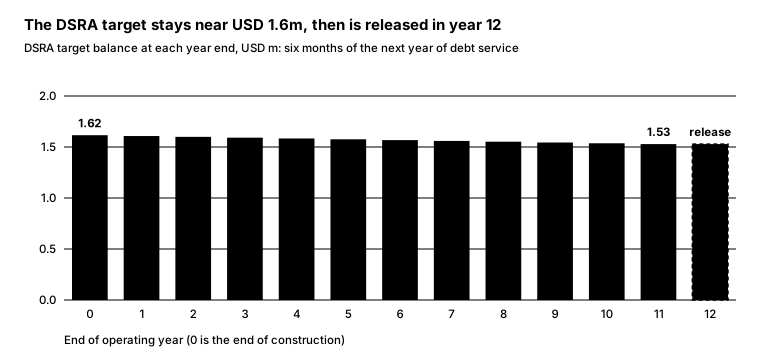
The target starts at USD 1.62m and drifts down, because sculpted debt service falls with CFADS. About USD 0.008m is released each year, and the last USD 1.53m is released at the end of year 12.
On the level annuity alternative of USD 3.156m a year, the target would be flat at USD 1.58m.
The common mistake. Sizing the reserve on the current period's debt service instead of the next period's. With sculpted debt the two differ in every period.
What is a maintenance reserve account (MRA)?
A maintenance reserve account (MRA) saves cash in advance for large, infrequent maintenance costs, so that no single period carries the whole cost. It is also called a major maintenance reserve account (MMRA). The Renewables Valuation Institute notes that solar parks "typically require an exchange of inverters during the asset's lifetime".
What the term sheet typically says. The funding profile looks forward. It states what share of an upcoming cost must be in the account by each date before the cost falls due. The Renewables Valuation Institute says a technical adviser typically recommends how much to set aside in each period.
The example. The inverters are replaced in year 11 at a cost of USD 2.4m. The project reserves USD 0.6m a year over years 7 to 10. As a look-forward profile, that is 25%, 50%, 75% and 100% of the cost held four, three, two and one years ahead.
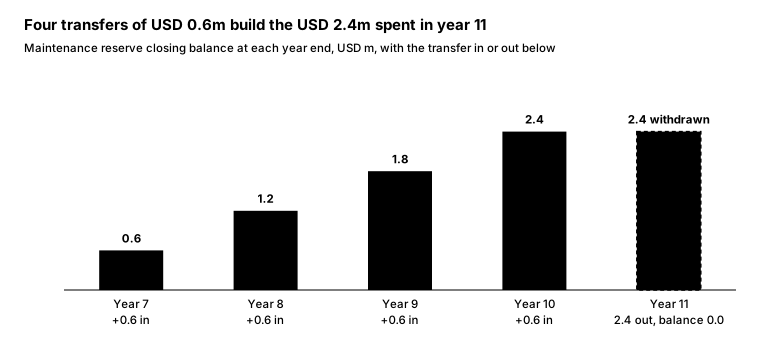
The transfers come out of cash that would otherwise be distributed. Cash left for shareholders in years 7 to 10 falls from about USD 0.93m to about USD 0.33m a year.
What it changes in the model. The table shows year 11 with and without the reserve. Without it, the full cost is paid from that year's operating cash flow.
| Year 11 (USD m) | With the reserve | Without the reserve |
|---|---|---|
| CFADS | 3.99 | 1.59 |
| Senior debt service | 3.07 | 3.07 |
| DSCR | 1.30x | 0.52x |
| Cash short of debt service | nil | 1.48 |
Without the reserve, year 11 is a payment default, far below the 1.10x default level. With it, the cost has already been saved and the ratio is untouched.
The common mistake. Leaving the replacement cost in operating costs and also funding a reserve for it. That counts the same USD 2.4m twice.
What other reserves appear in a term sheet?
Other reserves follow the same pattern: a target, a funding rule, a top-up rule and a release rule. Term sheets may also ask for reserves for tax, insurance premiums or the cost of removing the plant at the end of its life. That list is our own summary of common practice, not taken from a cited source.
Cash held back by a failed lock-up test behaves like a reserve too. It sits in an account until the ratio recovers, as described in "The cover ratio ladder".
Model each of these with the same four rows used for the DSRA. Only the target formula changes.
Cash, standby facility or letter of credit: which costs least?
A debt service reserve can be provided in three ways: cash, a standby facility from the lenders, or a bank letter of credit. In the example, cash costs about six times as much as the standby facility over 12 years, on the assumptions stated below.
What the term sheet typically says. FE Training notes that a bank letter of credit is sometimes permitted in place of cash. The Renewables Valuation Institute defines a debt service reserve facility as "a credit facility designed to provide a financial safety net for debt service payments". This is the standby facility: it charges a fee on the undrawn amount and interest only when drawn.
What it changes in the model. A cash reserve is paid in at the end of construction, so it is part of the funding requirement. The example's USD 40.0m includes a cash-funded DSRA of USD 1.62m, about 4% of the total. The pillar article, "How to read a solar project finance term sheet: a modeller's guide", uses the same figure.
A standby facility or a letter of credit removes that USD 1.62m, so the requirement falls to about USD 38.4m. We assume senior debt stays at USD 25.1m, because the 1.30x sizing ratio still binds. The whole saving is then equity, which falls from about USD 14.9m to about USD 13.3m, or 11%.
The example. For cash, we measure the cost as the return given up on the equity held in the account. We assume an equity target return of 12.0% and deposit interest of 3.0%, both invented. The net cost is 9.0% a year.
| Cash funded (base case) | Standby facility | Letter of credit | |
|---|---|---|---|
| Funding requirement (USD m) | 40.0 | 38.4 | 38.4 |
| Equity at close (USD m) | 14.9 | 13.3 | 13.3 |
| Annual cost rate on the target balance | 9.0% net opportunity cost | 1.5% availability fee | 2.5% fee |
| Cost in year 1 (USD) | 145,000 | 24,000 | 40,000 |
| Cost over 12 years (USD m) | 1.70 | 0.28 | 0.47 |
| If the reserve is used | The balance falls and is topped up from later cash flow | The drawing becomes a loan at a 3.75% margin, 7.75% all-in | The bank pays and must be reimbursed |
The totals are simple sums of the yearly cost on the target balance, not discounted. Cash stays the dearest method whenever its net cost is above the 2.5% letter of credit fee. At the 7.0% senior rate less 3.0% interest, cash would still cost USD 0.75m.
Cost is not the only test. Our reading is that lenders decide whether a substitute is allowed and which banks may issue it. A drawn standby facility is new debt that must be repaid before distributions resume.
The common mistake. Leaving the fee out of the model. A USD 24,000 fee takes the year 1 DSCR from 1.30x to about 1.29x unless the debt is resized. Check whether the term sheet counts the fee as an operating cost or as debt service.
Where do reserve transfers sit in the waterfall?
Reserve top-ups are paid after senior debt service and before distributions to shareholders. Forvis Mazars puts it this way: "the DSRA ranks below debt service but takes precedence over equity".
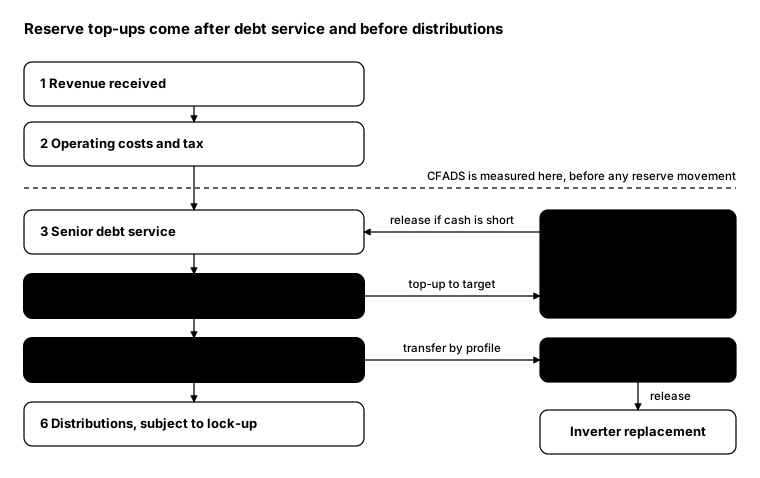
Releases run the other way. A DSRA release in a short period goes straight to debt service, and a maintenance release pays the invoice it was saved for. Any balance above target, including the final DSRA release, flows down to distributions.
The order between the two reserves, and the place of the maintenance reserve, varies by deal. Read the accounts clause and copy its order exactly. The full order is covered in "The cash flow waterfall in project finance: the order of payments and how to model it".
The common mistake. Paying distributions before the top-up. If the DSRA has been drawn, every dollar of spare cash refills it first.
Why do reserve movements stay out of CFADS?
Reserve movements stay out of CFADS because CFADS measures the cash that operations produce, not cash moved between the project's own accounts. Breaking Into Wall Street states the rule directly: "Reserve Deposits and Withdrawals are not part of the CFADS calculation".
The reason is our reading, and it has two sides. If a DSRA release counted as CFADS, a weak period would show a healthy DSCR and hide the shortfall the ratio exists to reveal. If a top-up counted, the periods spent refilling the account would look worse than operations really were.
Forvis Mazars explains that with sculpted debt the DSRA can create a circular calculation. The link is interest earned on cash balances, which feeds back into CFADS. Our reading is that keeping reserve transfers below the CFADS line confines that loop to the interest line.
Maintenance is the case to check. In the example, the USD 0.6m transfers sit below CFADS, so the DSCR stays at 1.30x in years 7 to 10. If the term sheet deducted them, the same debt would show about 1.11x, under the 1.20x lock-up level.
Definitions differ between deals, so settle this before sculpting. Debt sized on one definition and tested on another will fail its own covenants.
How do you model it?
Model each reserve as a control account with four rows: target, opening balance, transfer and release. FE Training describes the same layout of opening balance, inflows, outflows and closing balance.
- Set the inputs. Months of cover, the first funding date, the funding method and its fee, and the maintenance cost, date and funding profile.
- Compute the target. For the DSRA, sum the debt service due over the look-forward window. For the maintenance reserve, multiply each future cost by the profile share for that period.
- Fund the opening balance. If the DSRA is cash funded at the end of construction, include the target in the funding requirement. It does not pass through the operating waterfall.
- Calculate the transfer. Take the gap between target and opening balance, limited to the cash left after debt service.
- Calculate the release. Release any balance above target. Add any amount drawn to cover a debt service shortfall, or to pay the maintenance cost.
- Close the account. Closing balance equals opening balance plus transfer less release. Carry it to the balance sheet as restricted cash.
- Place the rows. Put transfers after debt service and before distributions. Compute the DSCR from CFADS above those rows.
- Model a substitute as a commitment. For a standby facility or letter of credit, hold no cash. Charge the fee rate on the target each period.
- Check. The balance is never negative, equals the target in the lender's case, and is nil after final maturity.
In year 12 of the example the target is nil, so the release formula returns the whole USD 1.53m. No separate rule is needed for maturity.
What are the common mistakes?
- Putting reserve movements inside CFADS. A release then flatters the DSCR in the period that most needs an honest ratio.
- Leaving the initial DSRA out of the funding requirement. In the example that understates the requirement, and the equity, by USD 1.62m.
- Sizing the target on the wrong period. The target looks forward to the next debt service, not back at the last one.
- Forgetting the final release. Cash left in the account after year 12 is equity cash that never reaches the shareholders in the model.
- Treating a substitute as free. A standby facility and a letter of credit both carry a fee in every period.
- Counting maintenance twice. A cost paid from the reserve must not also sit in that year's operating costs.
- Sculpting on one definition and testing on another. Decide whether maintenance transfers are above or below CFADS before sizing the debt.
- Letting the balance go negative. A release can never exceed the opening balance plus the period's transfer.
Frequently asked questions
How many months of debt service does a DSRA hold?
The term sheet sets the number. Forvis Mazars says the target is typically six to twelve months of debt service, or a fixed amount. FE Training gives the same range. The example uses six months, which is USD 1.62m at the end of construction.
Who pays for the DSRA?
In the example, equity pays, and the USD 1.62m sits inside the USD 40.0m funding requirement. Debt is already at the limit set by the 1.30x sizing ratio. Where the term sheet allows it, the account can instead be built up from project cash flows after construction.
Does a DSRA reduce the equity return?
Yes, if it is funded in cash. Shareholders put in the money at the start and get it back only when the loan is repaid. Breaking Into Wall Street makes the same point: the reserve "delays or reduces distributions of earlier cash flows to the equity investors".
Is a standby facility always cheaper than cash?
Only while it is undrawn. On our assumptions it costs USD 0.28m over 12 years against USD 1.70m for cash, and frees USD 1.62m of equity. If it is drawn, the drawing carries a 3.75% margin and must be repaid before distributions resume.
What happens to the DSRA when the loan is repaid?
The target falls to nil and the balance is released. In the example USD 1.53m is released at the end of year 12. Whether it can be applied to the last instalment depends on the release wording.
Does the maintenance reserve change the debt size?
It depends on the CFADS definition. If transfers sit below CFADS, as in the example, the debt size is unchanged and distributions carry the cost. If the term sheet deducts them from CFADS, the debt that years 7 to 10 can support is lower.
Sources
Pages opened on 4 October 2026 and checked again on 5 October 2026. The example project is invented and has no source.
- Debt Service Reserve Account (DSRA), Forvis Mazars. Definition of the DSRA, the 6 to 12 month target, the nil balance at the end of the loan, its rank below debt service and above equity, and the circular calculation with sculpted debt.
- Debt Service Reserve Account, Financial Edge Training (FE Training). The six-month look-forward target, funding at the end of construction, the letter of credit alternative and the control account layout.
- How to model a Major Maintenance Reserve Account (MMRA)?, Renewables Valuation Institute. Purpose of the maintenance reserve, inverter replacement in solar parks, and the technical adviser's role in the funding profile.
- How to Model a Debt Service Reserve Facility (DSRF), Renewables Valuation Institute. Definition of the standby facility and its fee on undrawn amounts and interest on drawings.
- The Debt Service Reserve Account (DSRA) in Project Finance: Save the Lenders, Save the World, Breaking Into Wall Street. Reserve deposits and withdrawals sit outside CFADS, and the effect of the reserve on equity returns.