Mini-perm versus full-tenor debt: refinancing risk in the solar project model
By SolarQuant Editorial. Published 2026-10-05. Last updated 2026-10-05.
A term sheet can offer the same loan with a full tenor or as a mini-perm with a short legal maturity. The mini-perm leaves a large balance due early, so the sponsor carries the risk of replacing it. The model must show that risk as an explicit refinancing case and a no-refinancing case, not hide it in one base case assumption.
What are tenor, amortisation profile and legal maturity?
Tenor is the period over which a loan is outstanding. The amortisation profile is the schedule of principal repayments within it. Legal maturity is the date on which any balance still outstanding must be repaid.
In a full-tenor loan the three line up: the profile reaches zero on the legal maturity date. In the example, USD 25.1m of senior debt is sculpted over 12 years at a 1.30x DSCR and is fully repaid at the end of year 12. The example uses annual periods, while Forvis Mazars notes that a debt service period is typically a quarter or a half-year.
A mini-perm separates them. The profile is still drawn over 12 years, but the loan falls due at the end of year 6. The unpaid balance on that date is the balloon: USD 14.8m, or 59% of the loan.
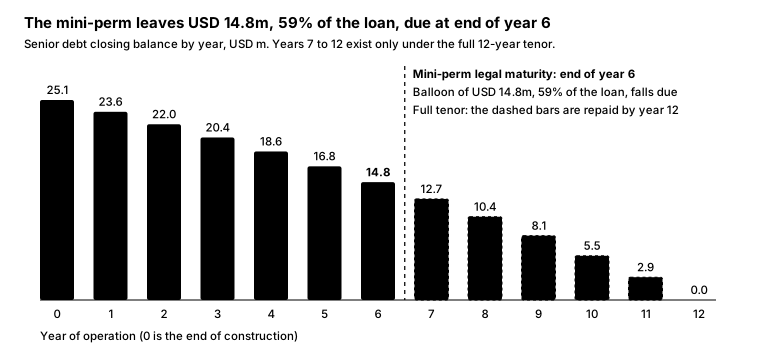
Six years of scheduled repayments clear only 41% of the loan, because sculpted principal is back-loaded. The dashed bars are the part of the profile that a full-tenor lender funds and a mini-perm lender does not.
What is a mini-perm?
A mini-perm is a project loan whose legal maturity is much shorter than the period needed to repay it from project cash flow. It funds construction and the first years of operation, and then it must be refinanced. Norton Rose Fulbright describes it as "basically shorter-term borrowing from a bank".
The term sheet typically states a short final maturity date and a repayment schedule that ends in a balloon. The Renewables Valuation Institute notes that mini-perms typically carry a balloon at the end of their term, which needs refinancing.
Maturities vary. Norton Rose Fulbright, writing on the Middle East in 2012, cites eight to 10 years including construction. A 2023 CFA Institute article on Saudi projects cites five to seven years after drawdown.
In the model, the debt sheet needs two things that a full-tenor loan does not: a balloon repayment line and a source of funds to meet it.
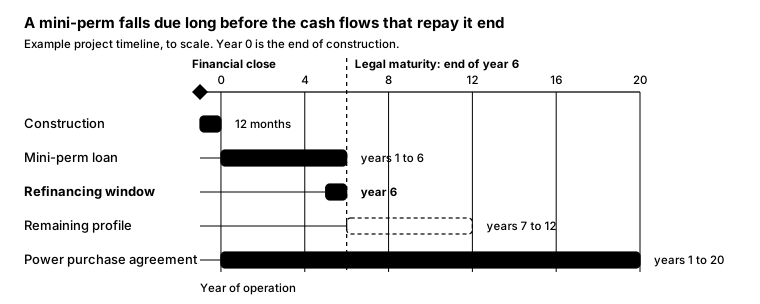
In the example the loan matures 14 years before the PPA ends, so the cash flows exist but the lender has left. We assume the refinancing window is year 6: the prepayment fee is nil after year 5, and the balloon falls due at the end of year 6.
What is the difference between a hard and a soft mini-perm?
A hard mini-perm must be refinanced before maturity, and failure to refinance is an event of default. A soft mini-perm has a long legal tenor, but its terms turn against the sponsor if the loan is not refinanced by a target date. Both definitions follow Norton Rose Fulbright.
| Feature | Hard mini-perm | Soft mini-perm |
|---|---|---|
| Legal maturity | Short: the balloon falls due | Long: the loan can run on |
| If not refinanced | Event of default | Not an event of default |
| What the lender gets | Enforcement rights (our reading) | Margin step-up and cash sweep |
| What the sponsor risks | The project itself (our reading) | Distributions until the loan is repaid |
| In the example | USD 14.8m due at end of year 6 | Margin up 1.0% and 100% sweep from year 7 |
| What the model must show | A refinancing case, and proof that the balloon can be raised | A refinancing case and a no-refinancing case |
Real term sheets can blend the two. Norton Rose Fulbright describes a 2009 deal with an eight-year hard maturity. Missing a year 5 refinancing target would also bring a 50 basis point margin increase and a 100% cash sweep.
The common mistake is to read "mini-perm" as one product. The modeller must find which of the two consequences applies, and from which date.
Why do lenders offer mini-perms, and why do sponsors accept them?
Lenders offer mini-perms because long loans are costly for banks to hold. A 2017 IJGlobal article on Gulf deals reports that Basel III made long-term debt more expensive for banks to hold. Norton Rose Fulbright adds that the structure allows an early exit and avoids a long-tenor commitment.
Sponsors accept them for price and for the chance of a gain. A sponsor quoted by IJGlobal says the initial margin on a soft mini-perm is lower than for plain long-term debt, giving bidders an edge. The CFA Institute article adds that better performance and creditworthiness can lower the credit spread at refinancing.
The trade is explicit. Norton Rose Fulbright frames it as a gamble the sponsors take when they expect to refinance on better terms. The example prices the mini-perm at the same 7.0% as the full-tenor loan, so the results below isolate refinancing risk and ignore any initial margin saving.
What is refinancing risk?
Refinancing risk is the risk that the balloon cannot be replaced on the terms the base case assumes, or cannot be replaced at all. The Renewables Valuation Institute defines it as the risk that the project may not secure sufficient funds for full refinancing at maturity. The APMG PPP guide describes refinancing under worse, or much worse, conditions than the financial plan anticipated.
In our reading, three things decide the outcome on the refinancing date:
- Rates. A higher base rate or margin on the new loan raises debt service on the same balance.
- Market access. Lenders may not be lending to the sector, the country or the offtaker on that date.
- Project performance. New lenders size on the CFADS they see in year 6, not on the forecast made at financial close.
The three combine. In the example, a new lender sizing at 1.30x and charging 8.5% would lend only USD 14.1m against the USD 14.8m balloon. The USD 0.7m gap would need new equity or a lower cover ratio.
What does refinancing cost?
Refinancing has its own costs: a prepayment fee on the old loan, fees on the new loan, and the cost or gain of breaking hedges. Each belongs in the refinancing case as a dated cash flow.
- Prepayment fee. The example charges 1.5% in years 1 to 3, 1.0% in years 4 and 5, and nil after. Refinancing at the end of year 6 pays no fee. Refinancing the USD 16.8m balance a year earlier would cost USD 0.17m.
- New loan fees. We assume an invented refinancing fee of 1.5% of the new loan, or USD 0.22m. Legal and adviser costs come on top and are left out here.
- Hedge break costs. BlueGamma states that a swap's breakage cost is its mark-to-market, and that the bank's quote adds its own charge. Ryan O'Connell's calculator page says a break is a cost when market rates have fallen below the fixed rate. It is a gain when they have risen.
Hedge tenor matters here, in our reading. A swap that ends on the mini-perm maturity date has no break cost, but it leaves the base rate open from that date. The Renewables Valuation Institute notes that some banks demand hedges that extend beyond the mini-perm maturity.
A longer swap protects the rate, but it must be dealt with when the loan is replaced. The Renewables Valuation Institute says the existing hedge is terminated at refinancing, at a mark-to-market cost or gain. BlueGamma describes swaps being terminated, novated to new banks or kept through a refinancing.
The open position is large. In the example, each 1.0% rise in the base rate on the USD 14.8m balloon adds USD 0.15m of interest in year 7. The CFA Institute article warns that projects must consider both existing hedges and unhedged exposures as rates move.
How do you model it?
Model a mini-perm as three cases on one debt sheet: full tenor, refinanced, and not refinanced. The steps below build them from the same sculpted profile.
- Keep the 12-year sculpted profile as the scheduled repayments. Add a legal maturity input that makes the closing balance fall due on that date.
- Add a refinancing block with explicit inputs: date, new base rate, new margin, new fees, new tenor and new sizing DSCR.
- Size the new loan on the CFADS forecast from the refinancing date. Compare it with the balloon, and show any shortfall as an equity injection.
- Put the refinancing costs on the refinancing date: prepayment fee, new loan fees, and any hedge break cost or gain.
- Build the no-refinancing case as a switch. For a soft mini-perm, apply the margin step-up and sweep 100% of spare cash to principal until the loan is repaid.
- Model the hedge on both sides of the maturity date. State where it ends, and treat the rate after that date as an assumption with a sensitivity.
- Report equity IRR for each case as a difference from the full-tenor case, next to the minimum DSCR after refinancing.
- Run the lender's downside case through the refinancing date. Weak years just before maturity reduce the new loan.
The balloon and the new loan size are two formulas:
Here m is the legal maturity year, P is scheduled principal, n is the new tenor and r is the new all-in rate. In the example, m is 6, n is 6 and the balloon is USD 14.8m.
The common mistake is a base case that refinances at the original rate with no fee and no test of the new loan size. That base case is the full-tenor loan under another name.
What does the example show?
In the example, the mini-perm moves equity IRR by between +0.17 and -0.35 percentage points against the full-tenor loan. The differences are the result, not the IRR level, because the simplifications below affect every case alike.
The assumptions are all invented:
- Equity of USD 14.9m is invested at the end of construction. Distributions are CFADS less debt service over 20 years, with no reserves, lock-up or change in tax.
- The mini-perm costs 7.0% until year 6, the same as the full-tenor loan.
- Refinancing happens at the end of year 6. The new loan equals the USD 14.8m balloon and is sculpted over years 7 to 12.
- The new all-in rate is 5.5% in the better case and 8.5% in the worse case.
- The refinancing fee is USD 0.22m, paid out of year 6 distributions. No prepayment fee applies after year 5, and the swap ends at maturity, so nothing is paid to break it.
- Without refinancing, the base rate stays at 4.0% and the margin rises to 4.0%, so the rate is 8.0%. All CFADS after interest prepays the loan.
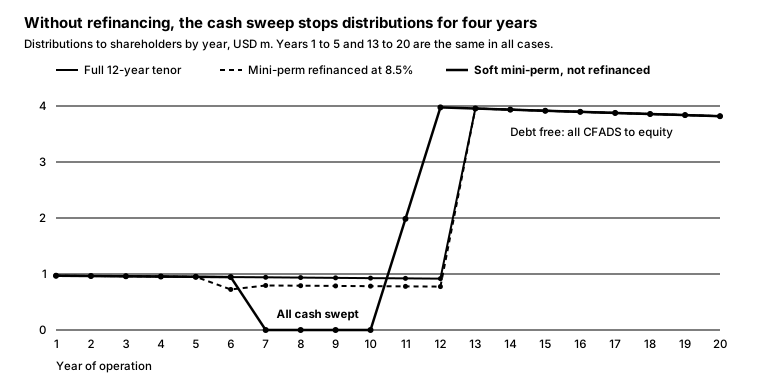
At 8.5% the refinanced case pays less in every year from 6 to 12, starting with the fee. The soft mini-perm pays nothing in years 7 to 10, clears the loan in year 11 and then catches up.
| Case | All-in rate, years 7 to 12 | DSCR, years 7 to 12 | Equity IRR versus full tenor (percentage points) |
|---|---|---|---|
| Full 12-year tenor | 7.0% | 1.30x | 0.00 |
| Refinanced at a better rate | 5.5% | 1.36x | +0.17 |
| Refinanced at the same rate | 7.0% | 1.30x | -0.09 |
| Refinanced at a worse rate | 8.5% | 1.24x | -0.35 |
| Soft mini-perm, not refinanced | 8.0% | All cash swept | -0.19 |
The fee alone costs 0.09 points, so refinancing at an unchanged rate still loses. The worse case also cuts the DSCR to 1.24x, below the 1.30x a new lender may require.
The no-refinancing case is the subtle one. The sweep repays the loan a year early and cuts interest in years 7 to 12 from USD 3.8m to USD 3.4m. Total distributions over 20 years are USD 0.4m higher, yet the IRR is lower because four years of cash arrive late.
What are the common mistakes?
Most mini-perm modelling errors hide the refinancing instead of showing it. These are the ones we see as most likely, in our reading.
- Modelling the profile and ignoring the maturity. The debt sheet runs the 12-year schedule and never shows the balloon falling due.
- Refinancing at the original terms. A base case with the same rate, no fee and no sizing test is a full-tenor loan in disguise.
- No no-refinancing case. The margin step-up and cash sweep are in the term sheet but not in the model.
- Assuming the balloon can always be raised. The new loan must be sized on the DSCR and rate of the refinancing date, and any shortfall funded.
- Hedging to the notional profile without a plan. A 12-year swap on a 6-year loan creates a break cost or a transfer question at refinancing.
- Leaving the tail unhedged without a sensitivity. A swap that ends at maturity leaves the full balloon exposed to the base rate.
- Applying the wrong prepayment fee. The fee depends on the refinancing date, so an early refinancing can cost more than a late one.
- Sweeping the wrong cash. The sweep takes cash after interest and required reserves, not CFADS before debt service.
Frequently asked questions
What is a balloon payment?
A balloon is the loan balance still outstanding on the legal maturity date, repaid in one amount. In the example it is USD 14.8m at the end of year 6. It is normally repaid with a new loan, not from project cash.
Is a mini-perm cheaper than full-tenor debt?
It can be cheaper at the start. A sponsor quoted by IJGlobal in 2017 says the initial margin on a soft mini-perm is lower than for plain long-term debt. Whether it is cheaper over the project life depends on the refinancing terms, which nobody knows at financial close.
Who bears refinancing risk?
In our reading, the sponsor usually bears it. The APMG PPP guide says the risk should generally sit with the private partner, to the extent it is free to decide its financing strategy. IJGlobal and Norton Rose Fulbright both describe deals where the procuring authority carries the risk.
What happens if a hard mini-perm is not refinanced?
Under Norton Rose Fulbright's definition, failure to refinance is an event of default. In our reading, lenders can then enforce their security. The model should therefore test whether the balloon can be raised under the downside case in "The cover ratio ladder". A lower IRR is not the worst outcome here.
Should the base case assume a refinancing?
In our reading, yes, if the assumptions are explicit and a no-refinancing case sits beside it. A base case needs a date, a rate, fees, a tenor and a sizing test. The pillar article, "How to read a solar project finance term sheet: a modeller's guide", lists the term sheet clauses that feed them.
Sources
Pages opened on 4 October 2026 and checked again on 5 October 2026. The example project is invented and has no source.
- Project Bonds and Mini-Perms: A New Era in the Middle East, Norton Rose Fulbright Project Finance NewsWire. Definition of a mini-perm, hard and soft structures, the 2009 deal terms, lender and sponsor motives, and authorities that assume refinancing risk.
- Mini-Perm Loans: The Game-Changer for Project Finance, Renewables Valuation Institute. The balloon, the definition of refinancing risk, hedges that extend beyond maturity, and hedge termination at refinancing.
- Mini-perm treatment for GCC tenors in need of a trim, IJGlobal, part of Green Street Infrastructure, 2017. Basel III as a driver, a sponsor's comment on the lower initial margin of soft mini-perms, and procurers' exposure to refinancing risk.
- Project Finance: Beware Interest Rate Miscalculations, CFA Institute. Soft mini-perm initial maturity of five to seven years after drawdown, in an article centred on Saudi Arabia, credit spread at refinancing, and hedged and unhedged exposures.
- 1.3.4 Refinancing, APMG PPP Certification Program guide. Refinancing on worse terms than planned, and who should bear the risk.
- Swap Breakage Calculator, Ryan O'Connell Finance. What a swap break cost is and when it is a cost or a gain.
- We're refinancing: what's the breakage on the existing swap?, BlueGamma. A swap's breakage cost as its mark-to-market plus the bank's charge, and swaps terminated, novated or kept at a refinancing.
- Debt Service Coverage Ratio (DSCR): formula, meaning and use in project finance, Forvis Mazars Financial Modelling. A debt service period is typically a quarter or a half-year.