Life after financial close: reporting covenants, model updates and events of default
By SolarQuant Editorial. Published 2026-10-05. Last updated 2026-10-05.
Most modelling guides stop at financial close, but the term sheet does not. It sets a reporting cycle, requires model updates and ratio tests on set dates, and lists the events that let lenders act. A model built only to close the deal cannot do that job, so build it for operations from the start.
What changes for the model after financial close?
After financial close the model stops sizing the debt and starts monitoring it. Forvis Mazars describes the DSCR shifting from a structuring tool to a monitoring tool, tracked against lock-up and default thresholds.
Forvis Mazars notes that deal models often lack the structure to take actual results and regular updates. The pillar article, "How to read a solar project finance term sheet: a modeller's guide", covers the clauses that size the debt. This article covers the clauses that run the loan afterwards.
The example is the invented 40 MWp solar project used across this series. Senior debt is USD 25.1m, repaid over 12 years, with DSCR levels of 1.30x for sizing, 1.20x for lock-up and 1.10x for default. Periods are annual for simplicity, while real deals usually test every six months.
What are information covenants?
Information covenants are the borrower's promises to send lenders set reports by set dates and to tell them promptly about problems. The law firm SANDS describes their purpose as making sure a borrower informs its lenders of matters of importance in a timely manner.
What the term sheet typically says. Pinsent Masons lists construction progress reports that cover the rate of progress, the status of the works, costs and any actual or potential overrun. Verdigris describes quarterly construction reports before the scheduled commercial operation date and annual operating reports after it.
| Report | Phase | What it tells lenders | What the model supplies |
|---|---|---|---|
| Construction progress report | Construction | Progress against programme, costs to date, forecast cost to complete | Cost-to-complete test, funding shortfall check |
| Operating report | Operation | Generation, availability, outages, operating costs | Actual columns for the period |
| Financial statements | Both | Audited annual accounts, often unaudited interim accounts | Reconciliation of model cash flow to the accounts |
| Compliance certificate | Operation | The ratios on the calculation date and a statement on defaults | Historic and forward-looking ratios |
| Annual budget | Operation | Planned operating and maintenance costs for the next year | Budget inputs for the next forecast year |
| Insurance report | Both | Policies in force, renewals, claims | Insurance cost and any claim proceeds |
| Environmental and social report | Both | Compliance with permits and the agreed action plan | Usually nothing, unless it carries a cost |
The last two rows reflect our general reading of term sheets, not a cited page. The exact list, format and deadlines are deal specific.
The common mistake. Teams treat late reports as an administrative slip. SANDS notes that a breach of information covenants will typically be an event of default, often subject to a remedy period.
What does the reporting calendar look like?
The reporting calendar is the list of dates on which each report, model update, test and payment falls due in an operating year. It repeats around every period end.
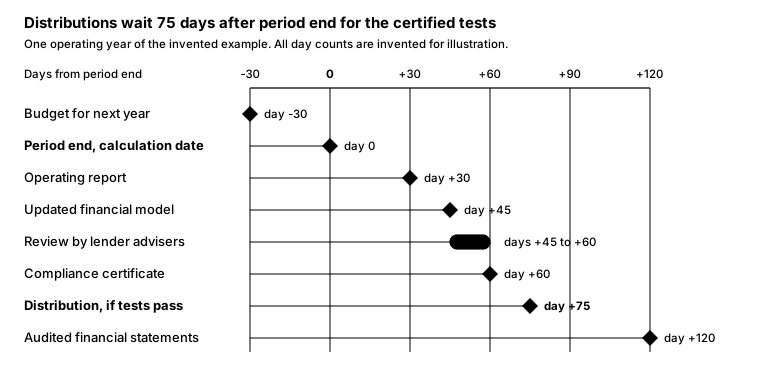
The order is the point, not the day counts. The distribution comes last, after the operating report, the model update, the advisers' review and the signed certificate.
What it changes in the model. Cash earned in a period is not paid out on the period end. In our reading, the model should hold it in the project accounts until the test is certified, then release or lock it.
How is the financial model updated after close?
A model update replaces forecast periods with actual results and refreshes the assumptions for the periods still to come. The updated model then produces the ratios for the calculation date.
What the term sheet typically says. In our reading, the borrower updates the model for each calculation date and the lenders' advisers review the assumptions. One technical adviser, SgurrEnergy, describes being retained after close for construction monitoring, drawdown verification and operational performance tracking.
What it changes in the model. Operis suggests what to ask for when commissioning an operating model. Its list includes an input for actuals in trial balance or accounts format, and lender ratios in line with the financing documentation. It also includes a reconciliation to the financial close base case and a change log.
That gives two cases to keep side by side. The base case is the model agreed at financial close and never changes. The current case is the latest update, with actuals to date and a new forecast.
The common mistake. Teams overwrite the close model with actuals and lose the base case. Operis also warns that, in a complex project, the effort of converting a close model can wipe out the expected saving.
How are ratios certified on a calculation date?
A calculation date is the date as at which the financial ratios are tested. A March 2020 Norton Rose Fulbright note on COVID-19 says scheduled calculation dates coincide with repayment dates. It adds that ratios are often tested on a backwards-looking and forwards-looking basis.
Forvis Mazars describes the same pair: historic ratios use actual results and forecast ratios rely on projected CFADS. Lenders typically assess both a 12-month look-back and a 12-month look-forward. The forward ratio depends on the updated forecast, so lenders want their advisers to review it.
The compliance certificate is the signed statement that carries these figures to the lenders. In our reading it shows the calculation, states whether each test is passed, and confirms whether any default is continuing.
The example. At the end of year 3 in the downside case, the historic DSCR is USD 3.742m / USD 3.199m = 1.17x. The updated year 4 forecast gives USD 3.724m / USD 3.183m, also 1.17x. Both sit below the 1.20x lock-up level and above the 1.10x default level.
What are general undertakings?
General undertakings are the borrower's promises about how it will run the project company while the loan is outstanding. Positive covenants say what it must do, and negative covenants say what it must not do without lender consent.
Pinsent Masons notes that the usual positive and negative covenants will be required from the project company. For corporate loans, not project finance, the ACT guide to LMA investment grade documentation describes the negative pledge and limits on disposals and mergers. SANDS adds covenants that protect the security assets.
In our reading, a solar term sheet also asks the borrower to keep permits and insurance in place and operate the plant properly. It usually bars new debt and changes to project contracts without consent. Most of this needs no formula, but the model should respect each limit, for example the conditions for paying distributions.
What is an event of default?
An event of default is a listed event that gives lenders the right to act against the borrower. It does not end the loan by itself: it opens the remedies described in the next section.
| Event | What triggers it | Where the model sees it first |
|---|---|---|
| Non-payment | Interest, principal or fees not paid when due | Cash waterfall, DSRA balance |
| Financial ratio default | A ratio below its default level on a calculation date | Covenant sheet |
| Breach of other covenants | A missed report or a broken undertaking | Reporting calendar |
| Misrepresentation | A statement to lenders that was untrue when made or repeated | Certified figures that do not tie |
| Insolvency | Insolvency of the borrower or of a key project party | Balance sheet and liquidity checks |
| Abandonment | The project is abandoned or the business is suspended | Generation actuals |
| Loss of key contracts | A project document is terminated or repudiated | Revenue and cost inputs |
| Late completion | Construction not complete by a specified date | Construction timeline |
The events come from lists published by Pinsent Masons for PFI projects, and from 2020 COVID-19 notes by Norton Rose Fulbright and Bird & Bird. The third column is our own mapping.
A potential event of default is an event that will become an event of default once a grace period ends or a notice is given. The ACT guide to LMA corporate loan documentation says a "Default" covers both an event of default and a potential one. It matters because Norton Rose Fulbright lists a continuing potential event of default among the usual draw-stop events.
Grace and cure periods give the borrower time to fix a breach before it becomes an event of default. The ACT corporate loan guide notes that parties agree grace periods, and Norton Rose Fulbright notes that some project finance facilities allow equity cures. Their length is negotiated, so we give no typical figure.
What can lenders do when a test fails?
Lenders' rights grow in steps as the breach gets worse. A lock-up only stops payments to shareholders, while an event of default lets lenders cancel, accelerate and enforce.
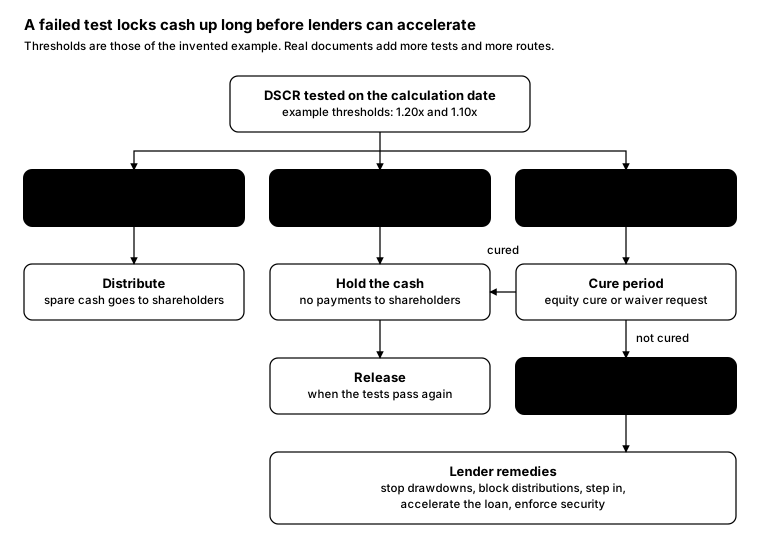
The lock-up route needs no lender decision. The right-hand route gives the borrower a chance to cure before lenders gain their remedies.
The remedies come from several sources. Norton Rose Fulbright lists the usual draw-stop events. Pinsent Masons states that lenders may cancel the facility, accelerate the loan and exercise their security rights. The World Bank describes step-in as lenders taking the project company's place in a contract when it is not performing.
Step-in is the last step. In its guidance on PPP contracts, the Global Infrastructure Hub notes that lender step-in is quite rare in practice.
Waivers and amendments. A waiver is the lenders' consent to overlook a breach, and an amendment changes the terms for the future. Trinity, writing during COVID-19, says borrowers may wish to engage early with lenders to seek consents and waivers. SANDS warns lenders against giving an implicit waiver by not reacting to information they receive.
A waiver request needs numbers. In our reading, lenders will ask for the current case, a downside on it, and a plan showing when the ratios recover.
What does the covenant dashboard show in the downside case?
A covenant dashboard is one sheet that shows every ratio, flag and cash movement for each calculation date. The compliance certificate figures are copied from it.
The example. In the shared downside case, CFADS falls 10%, 12%, 13% and 3% below the lender's case in years 3 to 6. We add one invented assumption for the forward ratio: each update carries the latest shortfall into the next year's forecast. The exception is the end of year 5, when an agreed fix cuts the forecast shortfall to 3%.
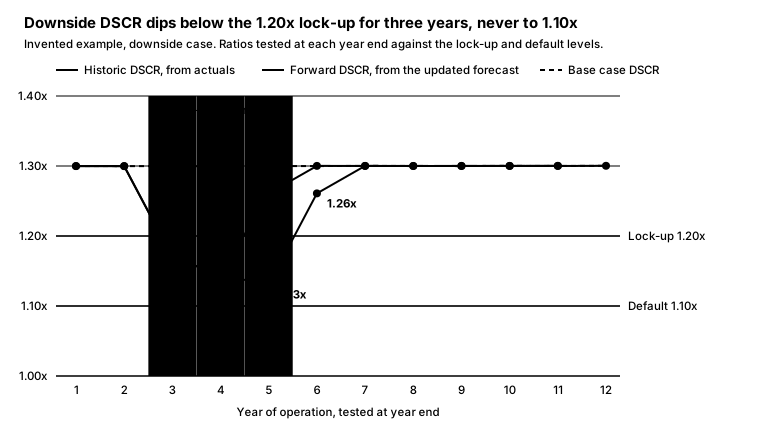
The forward ratio gave no warning at the end of year 2, because the forecast had not yet changed. At the end of year 5 it had recovered to 1.26x, but the historic ratio kept the lock-up in place.
In this example a distribution needs both ratios at 1.20x or above, and default is tested on the historic ratio alone. That rule is our assumption, and documents differ.
| Year | Lock-up flag | Default flag | Spare cash after debt service (USD m) | Held (USD m) | Released (USD m) | Paid to shareholders (USD m) | Lock-up balance (USD m) |
|---|---|---|---|---|---|---|---|
| 1 | No | No | 0.969 | 0 | 0 | 0.969 | 0 |
| 2 | No | No | 0.964 | 0 | 0 | 0.964 | 0 |
| 3 | Yes | No | 0.544 | 0.544 | 0 | 0 | 0.544 |
| 4 | Yes | No | 0.458 | 0.458 | 0 | 0 | 1.002 |
| 5 | Yes | No | 0.415 | 0.415 | 0 | 0 | 1.417 |
| 6 | No | No | 0.822 | 0 | 1.417 | 2.239 | 0 |
| 7 | No | No | 0.941 | 0 | 0 | 0.941 | 0 |
USD 1.4m is held over three years and released in year 6, when both tests pass again. Years 8 to 12 repeat year 7 with no flags. The table ignores reserve account transfers, which would rank ahead of distributions.
A related article, "The cover ratio ladder", explains how the three DSCR levels are set.
How do you explain a variance?
A variance explanation compares the base case with actual results line by line and gives a cause for each difference. Bird & Bird, writing about Dutch project finance during COVID-19, notes that any material deviation from the financial model must be justified.
The table shows year 3 of the downside case. The line items are invented for this article and tie to the shared CFADS figures. The base case assumes year 1 revenue of USD 5.6m falling 0.5% a year and operating costs flat at USD 1.0m.
| Year 3 (USD m) | Base case | Actual | Effect on CFADS | Explanation |
|---|---|---|---|---|
| Revenue | 5.544 | 5.101 | -0.443 | Generation 8% under base: weak irradiation -0.166, grid outages -0.277 |
| Operating costs | 1.000 | 1.090 | -0.090 | Unplanned inverter repairs |
| Tax paid | 0.386 | 0.269 | +0.117 | Lower taxable profit |
| CFADS | 4.158 | 3.742 | -0.416 | 10% under base |
| Debt service | 3.199 | 3.199 | 0 | Fixed schedule, rate fully hedged |
| DSCR | 1.30x | 1.17x | -0.13x | Below the 1.20x lock-up, above the 1.10x default |
The causes matter as much as the totals. Weak irradiation may reverse next year, while a grid problem may not, and that judgement drives the forward ratio.
How do you model it?
Build the operating features into the model before financial close, so the first update is a data entry job and not a rebuild. These steps are our recommended method.
- Lock the base case. Save the model agreed at financial close as a read-only file and store its key outputs as values in the working model.
- Add an actuals switch. Flag every period as actual or forecast from one input, the last closed period. Each line reads actuals when flagged.
- Add actual input rows. Mirror each forecast line with an actual line in the same layout as the accounts, so figures can be pasted in.
- Build the covenant sheet. For each calculation date, show historic CFADS, debt service, both ratios, the thresholds and the lock-up and default flags.
- Link cash to the flags. Hold spare cash in a lock-up account while a flag is on, and release the balance when the tests pass.
- Add the variance report. Compare the current case with the base case and with the last update, with a text cell for each explanation.
- Keep a version log. Record the date, author and changes for every update. Operis suggests a change log that tracks movement in the minimum forecast annual DSCR.
- Add the calendar. List each report, its due date and its status, so a late report is visible before it becomes a breach.
With the downside inputs, the covenant sheet should flag lock-up in years 3 to 5 and release USD 1.4m in year 6.
What are the common mistakes?
Most mistakes come from treating the close model as finished. This list is our own reading, with one sourced point.
- Overwriting the base case. Once actuals replace the close figures, nobody can show lenders what changed.
- Using the model's ratio, not the document's. The certified ratio follows the definitions in the loan agreement, including what counts as CFADS and debt service.
- Testing only the historic ratio. A forward test can lock cash up, or warn of trouble, a period earlier.
- Paying distributions on the period end. Cash is released after the test is certified, not on the calculation date.
- Ignoring potential defaults. A breach inside its grace period can already stop drawdowns.
- Staying silent about a problem. A Bird & Bird note on Dutch project finance says a borrower must promptly notify lenders of a default. It adds that failing to notify is itself an event of default.
Frequently asked questions
What is a compliance certificate in project finance?
A compliance certificate is a signed statement from the borrower that sets out the financial ratios on a calculation date. In our reading it also confirms whether any default is continuing.
What is the difference between a default and an event of default?
An event of default gives lenders their remedies. A default is wider. Under the ACT guide to LMA corporate loans, it also covers events that become events of default after a grace period or notice. A default alone can stop new drawdowns.
Does a lock-up mean the project is in default?
No. A lock-up only stops distributions while a ratio is below the lock-up level, and Forvis Mazars describes default as a separate, lower threshold. In the example the DSCR stays above 1.10x, so no ratio default occurs.
Can a DSCR breach be cured?
Sometimes. Norton Rose Fulbright notes that some project finance facilities allow equity cures if financial covenants are breached. Whether a cure is allowed, how often and by what date is negotiated, so read the term sheet.
Why not just reuse the financial close model?
You can, if it was built for it. Forvis Mazars notes that deal models often lack the structure for actuals, and Operis warns that conversions are sometimes abandoned.
Sources
Pages opened on 4 October 2026 and checked again on 5 October 2026. The example project is invented and has no source.
- Debt Service Coverage Ratio (DSCR): formula, meaning and use in project finance, Forvis Mazars. DSCR as a monitoring tool, lock-up and default thresholds, historic and forecast ratios.
- Why You Need an Operational Model: And How to Master It, Forvis Mazars. Why deal models are not built for actuals and regular updates.
- What to Include in an Operating Model RfP, Operis, 8 November 2022. A suggested scope for commissioning an operating model: actuals in trial balance or accounts format, lender ratios in line with the financing documentation, reconciliation to the financial close base case, change log.
- PPP Operating Models for Private Partners, Operis, 21 April 2016. Written about PPP projects. The warning about converting a financial close model, and conversions that were later abandoned.
- Simply Finance: General and Specific Covenants in Finance Agreements, SANDS, 9 October 2023. A general note on finance agreements, not specific to project finance. Purpose of information covenants, covenants protecting security assets, breach as an event of default, implicit waivers.
- Key terms in project finance funding agreements, Pinsent Masons, 22 December 2011. Written about PFI projects. Construction and operating reports, positive and negative covenants, events of default, lender remedies.
- A typical project finance term sheet, Verdigris. Now a section of the page Project finance principles, which the link redirects to. Quarterly construction reports and annual operating reports.
- COVID-19 and its impact on project finance transactions, Norton Rose Fulbright. A March 2020 note written about COVID-19. Calculation dates, backwards-looking and forwards-looking tests, draw-stop events, equity cure, events of default.
- The impact of COVID-19 on project finance in the Netherlands: keep the lenders informed at all times, Bird & Bird. Written in 2020 about the Netherlands and COVID-19. Duty to notify a default, deviations from the financial model, events of default.
- COVID-19: Key Considerations for Project Finance Documents, Trinity International. Written about COVID-19. Early engagement with lenders on consents and waivers.
- The ACT Borrower's Guide to LMA Loan Documentation for Investment Grade Borrowers, Association of Corporate Treasurers and Slaughter and May, April 2013. A guide to LMA documentation for investment grade corporate loans, not project finance. Definition of a Default, grace periods, negative pledge, disposals and merger undertakings.
- 7. Default and termination: 7.2 Guidance, Global Infrastructure Hub, PPP Contract Management tool. Guidance on managing PPP contracts. Lender step-in is quite rare in practice.
- Lender Protections and Government Support in PPPs, World Bank PPP Resource Center. Definition of step-in rights.
- Lender's Technical Advisory for Renewable Energy Projects, SgurrEnergy. The technical adviser's role after financial close.