Offtaker payment security in a solar PPA: letters of credit, guarantees and what lenders test
By SolarQuant Editorial. Published 2026-10-05. Last updated 2026-10-05.
Payment security is a back-up source of cash that pays a solar seller when the buyer does not. Public contracts and guides describe several forms, including letters of credit, guarantees, escrow and payment security funds. This article shows how to model each: the exposure, the amount, the draw trigger, what follows a draw and what lenders test.
What example does this article use?
The example is an invented 40 MWp ground-mounted solar plant in no named market. One buyer takes the power at the plant substation and pays in USD under a 20-year PPA from the commercial operation date. The buyer's bank has issued a letter of credit for 3 months of revenue.
All figures are invented. Annual periods are used for simplicity, and real deals usually use six-month periods. Other contract variants appear as separate cases on this same plant.
| Item | Figure |
|---|---|
| Plant and buyer | 40 MWp, one buyer, delivery at the plant substation |
| Contract | 20-year PPA in USD, tariff USD 80 per MWh, flat |
| Year 1 generation, P90 | 70.0 GWh |
| Year 1 revenue, lender's case | USD 5.6m |
| Average monthly revenue | USD 0.467m |
| Payment terms | Monthly invoices, paid 60 days after invoice |
| Receivable at 60 days | About USD 0.92m |
| Payment security | Letter of credit from the buyer's bank, 3 months of revenue, USD 1.4m |
| Year 1 operating costs and tax | USD 1.0m and USD 0.4m |
| Year 1 CFADS | USD 4.2m |
| Senior debt | USD 25.1m over 12 years, 7.0% all-in, sculpted to a 1.30x DSCR |
| Year 1 debt service | USD 3.231m |
| DSCR levels | Sizing 1.30x, lock-up 1.20x, default 1.10x |
What is payment security, and what exposure does it cover?
Payment security is cash outside the buyer's balance sheet that the seller can call on when a due amount goes unpaid. The exposure it covers is the receivable: energy already delivered and invoiced but not yet paid.
In the example the plant delivers about USD 0.467m of energy a month. With payment 60 days after invoice, about USD 0.92m is owed even when the buyer pays on time. If the buyer stops paying, that amount grows by one invoice a month while the plant keeps delivering.
The Power Africa and CLDP handbook on PPAs says lenders need the seller to exercise "certain rights, even up to PPA termination". That applies if the offtaker fails to pay or to deliver the required payment security. The US agencies' guide to bankable PPAs lists a short term liquidity instrument, a liquidity facility or a sovereign guaranty.
This article covers security for unpaid bills only, not termination compensation. In the example, if the PPA ended at the close of year 5, senior debt outstanding would be USD 16.75m. That is far above any security of a few months of billing.
The parent article, "How to read a solar PPA term sheet: a modeller's guide", shows where payment security sits among the other PPA terms. The sibling article, "Invoicing and payment terms in a solar PPA", covers the invoice timing that sets the size of the receivable used here.
Which instruments do public contracts use?
Public contracts and guides describe seven forms of payment security. Some PPAs use one, others rank two or three in order, and some use none. We found no source that treats any one form as standard.
| Instrument | What public sources describe | Source |
|---|---|---|
| Standby letter of credit from the buyer's bank | India: "a single, unconditional, revolving and irrevocable letter of credit" in the standard sale agreement. Mexico: the offtaker posts a standby letter of credit for its payments after the commercial operations date. | SECI, Clifford Chance |
| Letter of credit backed by a development bank guarantee | MIGA: its guarantee "backstops a commercial bank letter of credit (LC) that provides liquidity to private sector projects if government payments are delayed". Uzbekistan: an ADB concept paper pairs a standby letter of credit with an ADB partial credit guarantee. | MIGA, ADB |
| Government guarantee or undertaking | India: a State Government Guarantee, or a tripartite agreement with the central bank. South Africa: the government department undertakes to pay unpaid, undisputed amounts. Kenya: a government letter of support. Vietnam: a 2018 law firm note says credit support or a government guarantee would ease concerns, as the utility is the sole offtaker. | SECI, South Africa BW6 agreement, SEI, Jones Day |
| Escrow or cash collateral | The off-taker puts money in a bank account "jointly controlled by the off-taker and the IPP". Earlier Indian solar mission schemes linked a letter of credit to an escrow account. A Kenyan wind project used letters of credit and escrow accounts. | IRENA, CPI, SEI |
| Payment security fund | India: the buyer "may provide Payment Security Fund" supporting all projects tied to it. A government release lists letters of credit, payment security funds and a tripartite agreement as the Indian mechanisms. | SECI, PIB |
| Regional liquidity facility | Africa: a facility by KfW and African Trade Insurance provides collateral to the bank that issues a standby letter of credit. Pacific: an ADB programme offers a letter of credit facility for utility payments. | IRENA, SEI |
| Third-party guarantee, sometimes with a rating trigger | United States: a creditworthy offtaker may post credit support only "if its credit rating falls below a negotiated threshold". Norway: a state export credit agency guarantees a generator against offtaker default, with collateral required. | Stoel Rives, EIB market study |
Public documents also differ on ranking. In SECI's agreement the state guarantee is invoked only after the letter of credit and the payment security fund. In the MIGA structure the guarantee to the letter of credit bank is reachable only after a pre-determined period.
How is the amount set?
Most public sources state the amount of payment security as months of billing, not as a share of the debt. They show a wide spread, so practice varies and no figure below is a market norm.
The last column applies each basis to the example's USD 0.467m monthly revenue. It is our arithmetic, not a contract term.
| Sizing basis | Source and country | On the example (USD m) |
|---|---|---|
| 110% of average monthly billing, reset each year from the previous year's average | SECI, Article 2.5.2, India | 0.51 |
| 2.10 times average monthly billing, where there is no state guarantee or tripartite agreement | SECI, Article 2.6, India | 0.98 |
| A payment security fund "suitable to support payment of at least 3 (three) months' billing" of all projects tied to it | SECI, Article 2.7, India | 1.40 |
| A revolving letter of credit for 1 month, linked to an escrow account that could be encashed for up to 3 months of defaulted payment | CPI, on a 2013 Indian scheme | 0.47 letter of credit, escrow up to 1.40 |
| A revolving letter of credit for 6 months of payment, linked to an escrow account | CPI, on a 2011 to 2012 Indian scheme | 2.80 |
| A guarantee facility "equivalent of up to 6 months of PPA payments per project" | ADB, Uzbekistan concept paper | 2.80 |
| A regional insurance facility "covering up to a year of missed payments" | SEI, on a regional facility that Kenya joined in 2024 | 5.60 |
| A letter of credit facility "up to 24 months of power payment" | IRENA, on an ADB Pacific programme | 11.20 |
The last two rows come from development partner facilities, not from the buyer's own letter of credit. The Norwegian state guarantee in the EIB market study uses a third basis: it "must have a specified maximum amount and designated time period".
Cost explains some of the spread. IRENA says a letter of credit bank asks the off-taker for collateral that "can be as high as 100% of the LC amount".
Our reading for the example: a 1-month security is smaller than the USD 0.92m receivable that exists before any missed payment. The invented 3-month letter of credit of USD 1.4m is about 1.5 times that receivable.
What triggers a draw, and what follows?
A draw trigger is the event that lets the seller call on the security. What follows a draw is a separate set of clauses, so they are shown separately here and should be separate inputs in a model.
Triggers
| Trigger as described | Source and country |
|---|---|
| A bill unpaid after its due date. The seller "shall not draw upon such Letter of Credit prior to the Due Date" and may make no more than one draw in a month where there are no outstanding dues. The draw needs a copy of the unpaid bill and a certificate that it is correct and unpaid. | SECI, Articles 2.5.3 and 2.5.8, India |
| No payment within 30 days of the invoice, after which the letter of credit is encashed. | CPI, on two earlier Indian schemes |
| A standby letter of credit "that can be called if the off-taker does not pay in time (e.g., 15 days after the due date)". | IRENA, general description |
| An undisputed amount unpaid 30 business days after its due date, after a demand, and not recovered within 3 months. The government then pays within 40 business days of a written demand. | South Africa BW6 agreement, clause 6.3 |
| A layered case: the letter of credit is drawn first, and the guarantee behind it is reachable only after a pre-determined period. | MIGA, development bank guarantee |
| A guarantee called "if reimbursement is not paid within 12 months" by the utility or the government. | ADB, Uzbekistan concept paper |
What follows a draw
| What follows | Source and country |
|---|---|
| The buyer "shall restore such shortfall within seven (7) days". An amount outstanding beyond 90 days after the due date, and not recoverable from the letter of credit or fund, is a buyer event of default. | SECI, Articles 2.5.4 and 3.1.1, India |
| A late payment surcharge beyond 30 days after the due date. The rate rises by 0.5 percent for every month of delay, capped at 3 percent above the base rate. | SECI, Article 2.3, India |
| Failure to renew the payment guarantee gives an immediate right to terminate. Payment defaults, or failure to deliver the payment guarantees, have a 10 day cure period. | Clifford Chance, Mexico |
| The seller may sell the power in the short-term market and recover any price difference from the escrow account, or keep supplying the buyer. | CPI, on a 2011 to 2012 Indian scheme |
| The government pays the seller or the lenders, with interest as set in the PPA or direct agreement. | South Africa BW6 agreement, clause 6.3 |
| The guarantee is called and the development bank reimburses the letter of credit issuing bank. | ADB, Uzbekistan concept paper |
| After the generator rightfully stops delivery, the guarantor steps into the offtaker's position in the PPA. | EIB market study, Norway |
Our reading for the model: in the example, payment is due 60 days after invoice. The first draw therefore cannot come before day 60, plus any grace period, so the cash gap appears before the security pays.
Who can issue it, and how long must it last?
The issuer is the bank or institution that stands behind the payment, and the tenor is how long the security stays in force. Public documents set these rules in quite different ways.
| Issuer or duration rule | Source and country |
|---|---|
| The letter of credit is opened "through a scheduled bank" and has a term of 12 months, reviewed every 12 months. The buyer must renew it "not later than its expiry" and bears the costs. | SECI, Articles 2.5.2, 2.5.6 and 2.5.7, India |
| Lenders usually ask for a letter of credit from "an investment-grade bank (BBB or better)", which a local bank in a developing country "may not have" as a rating. | IRENA, general description |
| No requirement that the letter of credit comes from a creditworthy institution, or is renewed or replaced if the issuer's credit worsens. | Clifford Chance, on a Mexican auction PPA |
| The government ministries and the utility acknowledge that the letter of credit benefits from the preferred creditor status of the facility, so that recourse can be activated at short notice. | IRENA, on a regional liquidity facility |
| A commercial bank letter of credit with a World Bank Group payment guarantee behind it. | MIGA |
| A guarantee with a specified maximum amount and a designated time period, and collateral required. | EIB market study, Norway |
| A rating trigger: the buyer posts credit support only if its credit rating falls below a negotiated threshold. | Stoel Rives, United States |
Cost allocation also differs. The SECI agreement puts the letter of credit costs on the buyer. IRENA says the off-taker "usually pays for the costs charged by the LC bank".
Our reading for the model: tenor matters most. A 12-month letter of credit protects one year at a time, while the example's senior debt runs 12 years. The model needs a renewal date each year and a rule for what happens if renewal fails.
What do lenders test?
Lenders test whether a late or missing payment from the buyer can still be absorbed without a missed debt payment. Public sources say little about the exact tests, so this section separates what they say from our reading.
What public sources say:
- The risk is liquidity. IRENA says the lender must be assured the loan "will still be repaid on time" if the off-taker delays payment.
- A reserve is the alternative. IRENA describes a debt service reserve of "usually 6 to 12 months". Shareholders fund it, which "reduces significantly the return of equity".
- Lenders want step-in and cure rights. The US agencies' guide asks for collateral assignment "with the right to receive notice of any default and to cure such default". The Mexican auction PPA limits the lender cure period to 180 days (Clifford Chance).
- Lenders can be the payee. In the South African agreement, the government pays "the Seller and/ or Lenders" on first written demand (BW6 agreement).
- Issuer quality matters. IRENA says lenders usually ask for an investment-grade issuing bank.
- A template assumes guaranteed offtake. The Open Solar Contracts guide says its PPA "provides for a liquidity support and, ultimately, the termination of the PPA".
Our reading, not taken from a public source:
- Size against the cycle. Lenders are likely to compare the security with the receivable and the time needed to cure and draw.
- Tenor against the loan. They are likely to check that renewal is certain for as long as the debt is outstanding.
- DSCR with and without a draw. They are likely to run the period DSCR against the 1.20x lock-up and 1.10x default levels, as the worked comparison below does.
How do you model it?
Model payment security as a small cash waterfall between the buyer's unpaid bills and CFADS. Each step below is one input, so you can switch between the variants shown above.
- Build the receivable. Monthly revenue times the payment lag. In the example, USD 0.467m a month and a 60 day lag give about USD 0.92m.
- Set the non-payment case. Choose the months the buyer stops paying. Unpaid undisputed amounts equal months times monthly revenue.
- Set the security amount. Use months of billing times any margin. Keep the basis as an input.
- Set the trigger. Enter the first possible draw date, which is the due date plus any grace period, and any limit on draws. Count undisputed amounts only.
- Apply the draw. The draw is the lower of the unpaid amount and the balance available. Add it to CFADS in the period the cash arrives.
- Set the rule after a draw. Choose replenishment, a reduced balance, suspension or termination. Make no top-up the base downside.
- Add cost and expiry. Put the issuing fee in costs if the seller pays it. Add an annual renewal date and a failure case.
- Test the ratios. Compute the period DSCR with and without the draw, and compare it with the lock-up and default levels.
The core relationship, with amounts in USD m for the period:
What happens to the example if the buyer stops paying?
If the buyer stops paying, unpaid bills grow by USD 0.467m a month. The 3-month letter of credit of USD 1.4m covers them until month 3. This section compares the example with and without it.
These assumptions are ours, and the case is a stress test. The buyer pays nothing for the stated months of year 1, and every unpaid invoice is undisputed and drawable.
The letter of credit is drawn once, receives USD 1.4m in year 1, and is not topped up.
Costs, tax and debt service stay at the base case: USD 1.0m, USD 0.4m and USD 3.231m. The base DSCR is therefore 1.30x. We ignore the 60 day lag, and tax would fall with revenue, so the no-security case is slightly too severe.
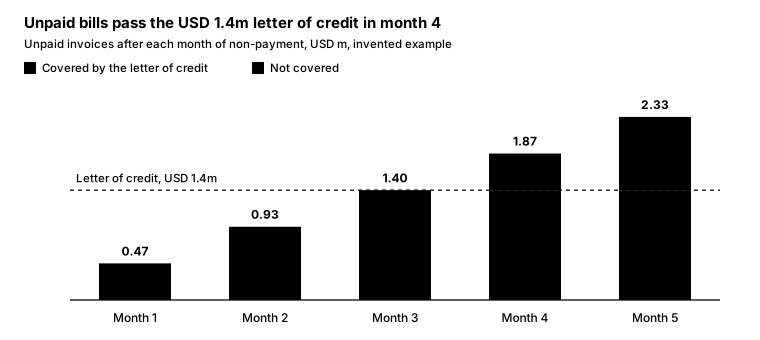
Months 1 to 3 are fully covered. In month 4, USD 0.47m is not covered, and in month 5, USD 0.93m.
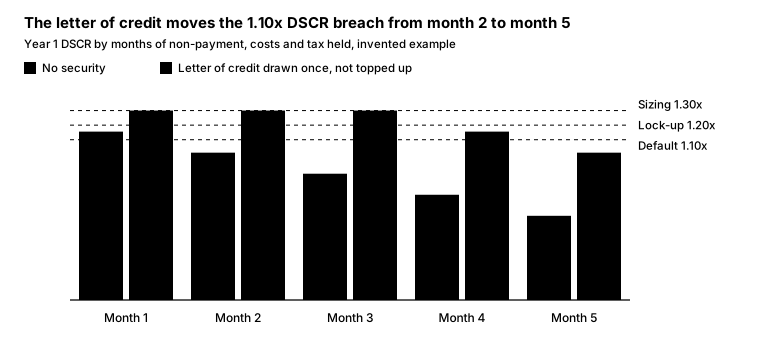
Without security the DSCR is 1.16x after one missed month, below the 1.20x lock-up, and 1.01x after two, below the 1.10x default level. With the letter of credit drawn it holds at 1.30x to month 3, then falls to 1.16x and 1.01x.
Our reading: the draw buys time, not a cure. If the buyer still does not pay next year and nothing is topped up, the exposure returns with no cover.
What are the common mistakes?
- Copying one country's sizing as a norm. Public sources show 110% of one month, 2.10 times monthly billing, 3 months and 6 months, among others. Keep the basis as an input.
- Ignoring the receivable already owed. About USD 0.92m is outstanding before any payment is missed, which is more than a 1-month security.
- Assuming the draw is instant. Draws follow the due date, any grace or cure period and a set of documents.
- Assuming a top-up. SECI asks the buyer to restore a shortfall within 7 days, but a buyer that is not paying may not. Run the case with no top-up.
- Counting disputed amounts. The South African agreement pays only amounts "not in dispute". Treat the rest as uncovered.
- Forgetting expiry and issuer quality. A 12-month letter of credit needs yearly renewal. The Mexican PPA makes failure to renew a termination ground and does not require a creditworthy issuer.
- Mixing up payment security and termination compensation. In the example, senior debt at the close of year 5 is USD 16.75m.
- Treating a draw as a cure. The DSCR recovers only for the months the letter of credit covers.
Frequently asked questions
What is the difference between a letter of credit and a payment guarantee?
A letter of credit is issued by a bank at the buyer's request and pays the seller against documents, such as the unpaid bill. A guarantee is a promise by a government, development bank or other party to pay if the buyer does not. Public documents use either or both: MIGA describes a guarantee that backstops a bank letter of credit.
How many months of billing should payment security cover?
Practice varies. Public sources show 110% of one month, 2.10 times monthly billing, 3 months and 6 months, among others. In a model, use the PPA term sheet and test it against the receivable and the cure period.
Does a draw count as CFADS?
Our reading is that cash from a draw replaces the missed payment in the period it arrives, so it raises CFADS then. The finance documents define CFADS, so check them. No public source we opened states this rule.
What is a payment security fund?
In India's standard SECI agreement the buyer "may provide Payment Security Fund" for at least 3 months' billing of all projects tied to it. It sits behind the letter of credit and ahead of the state guarantee.
Why do some buyers resist providing a letter of credit?
IRENA says the issuing bank asks the buyer for collateral that "can be as high as 100% of the LC amount". Many off-takers lack that cash or do not want to use it for this purpose.
What if the unpaid amount is larger than the security?
The excess is uncovered. In the example, USD 0.47m is uncovered in month 4 and the year 1 DSCR is 1.16x. Public documents then point to a second layer, such as a state guarantee, a development bank guarantee or termination rights.
Sources
Pages opened on 5 October 2026. The example project is invented and has no source.
- Renewable Energy Finance Brief 01: Sovereign guarantees, IRENA, January 2020. Sovereign guarantee scope, standby letter of credit trigger, issuing bank rating, collateral cost, escrow, regional liquidity facility, ADB Pacific letter of credit, debt service reserve.
- Power Sale Agreement for Sale of Solar Power on Long Term Basis, Solar Energy Corporation of India. India: letter of credit amount, tenor, draw conditions, replenishment, payment security fund, state guarantee ranking, late payment surcharge, event of default.
- Addressing Off-Taker Risk in Renewable Projects in India: A Framework for Designing a Payment Security Mechanism as a Credit Enhancement Device, Climate Policy Initiative, May 2018. Earlier Indian schemes with letters of credit and escrow, 30 day draw trigger, and the 12 month estimate.
- Mexico's second auction: PPA features and bankability considerations, Clifford Chance, January 2017. Mexico: standby letter of credit, issuer and renewal gaps, termination and cure rules, lender cure period.
- REIPPPP Bid Window 6 request for proposals, Volume 2, Appendix M: Implementation Agreement, Department of Mineral Resources and Energy, South Africa. Government payment undertaking, undisputed amounts, 30 business days and 3 month conditions.
- Examining the role of risk mitigation and transfer for renewable energy investments: case studies in East Africa, Stockholm Environment Institute, December 2025. Kenya: letters of credit, escrow accounts, letter of support, and a regional liquidity facility covering up to a year of missed payments.
- Uzbekistan Solar Public-Private Partnership Program: Concept Paper, Asian Development Bank, June 2020. Standby letter of credit with partial credit guarantee, 6 month facility size, 12 month reimbursement call.
- Project-Based Payment Guarantee for the Private Sector, MIGA. Payment guarantee that backstops a bank letter of credit, reachable after a pre-determined period.
- Understanding Power Purchase Agreements, Power Africa and CLDP, hosted by the World Bank PPP Knowledge Lab. Lenders' need for seller remedies if payment or payment security fails.
- 10 Important Features of Bankable PPAs, US agencies (OPIC, Department of Commerce, USAID and USTDA). Offtaker payment support and lender cure rights.
- A Guide to Open Solar Contracts, IRENA and TWI, 2019. Assumption that offtake is guaranteed in some form, and liquidity support in the PPA.
- Commercial Power Purchase Agreements: A Market Study, Baringa Partners for the EIB, March 2022. Norwegian state export credit guarantee for a generator: maximum amount, time period, collateral, step-in.
- Power Purchase Agreements: Utility-Scale Projects, Stoel Rives LLP, The Law of Solar. United States: rating trigger for buyer credit support.
- Vietnam's New Solar PPA: Strong Developer Interest Despite Bankability Concerns, Jones Day, January 2018. Vietnam: sole offtaker and credit support.
- Major payment security mechanisms in place to de-risk investments in renewable energy, Press Information Bureau, Government of India. List of Indian mechanisms: letters of credit, payment security funds, tripartite agreement.