Environmental attributes under a solar PPA: who owns the certificates and what they change
By SolarQuant Editorial. Published 2026-10-05. Last updated 2026-10-05.
A solar PPA sells electricity, but the plant also creates certificates and other environmental attributes. They can go to the buyer, go to someone else, or stay with the seller. That choice decides who may make renewable claims and whether the project has a second revenue line.
What example does this article use?
The example is a 40 MWp ground-mounted solar plant in no named market. One buyer takes the power at the plant substation, which is the delivery point, and pays in USD. The PPA runs for 20 years from the commercial operation date, and construction takes 12 months.
The tariff is USD 80 per MWh and flat. In the lender's case (P90), year 1 revenue is USD 5.6m and CFADS is USD 4.2m. Senior debt is sized so that debt service equals CFADS divided by 1.30. We use annual periods for simplicity; real deals usually use six-month periods. The base example has no certificate revenue. Every figure below is invented.
| Item | Example figure |
|---|---|
| Plant | 40 MWp, ground-mounted, one buyer, delivery at the plant substation |
| Contract | 20-year PPA from the commercial operation date, paid in USD |
| Year 1 generation | P90 70.0 GWh; P50 76.0 GWh; degradation 0.5% a year |
| Tariff | USD 80 per MWh, flat for 20 years |
| Year 1 revenue, P90 | USD 5.6m (20-year total USD 106.8m) |
| Year 1 operating costs and tax | USD 1.0m and USD 0.4m |
| Year 1 CFADS | USD 4.2m, falling by 0.5% a year |
| Total funding requirement | USD 40.0m |
| Senior debt | USD 25.1m over 12 years, all-in rate 7.0%, 62.7% gearing, equity USD 14.9m |
| Year 1 debt service | USD 3.231m, so DSCR 1.30x |
| DSCR levels | Sizing 1.30x, lock-up 1.20x, default 1.10x |
| Certificate price (invented) | USD 2.0 per MWh; year 1 P90 volume worth USD 0.14m; 20-year P90 total about USD 2.67m |
What are environmental attributes in a solar PPA?
An environmental attribute is the non-power value that each megawatt-hour of solar generation carries, which a registry can record as a certificate. The power and the certificate are separate products. A contract can sell them together or apart.
Certificates have different names by region, but the common unit is one megawatt-hour.
- Renewable energy certificate (REC), United States. The Federal Renewable Energy Certificate Guide says a REC "is a tradable commodity created when a renewable energy source generates one megawatt-hour (MWh) of electricity."
- REC, India. The national registry states that one REC is "equivalent to 1 Megawatt-hour (MWh) of electricity generated and injected into the grid from renewable energy sources".
- Large-scale generation certificate, Australia. A law firm summary describes accredited power stations creating "one certificate per megawatt hour of eligible electricity".
- Guarantee of origin (GO), Europe. Energy Traders Europe writes that "the size of a GoO is set in legislation and corresponds to 1MWh of produced energy."
- I-REC, international. Independent issuers register production devices in a country or region. The I-TRACK issuer list names countries in Africa, Asia, Latin America, the Middle East and Australasia.
Carbon credits are a different instrument. They record an emission outcome, which the Article 6 Observatory says can be measured in tCO2e, not in megawatt-hours. We return to them below.
Who owns the environmental attributes under a PPA?
The contract decides who holds the certificates, and public sources show several arrangements. We show three as separate cases on the same plant.
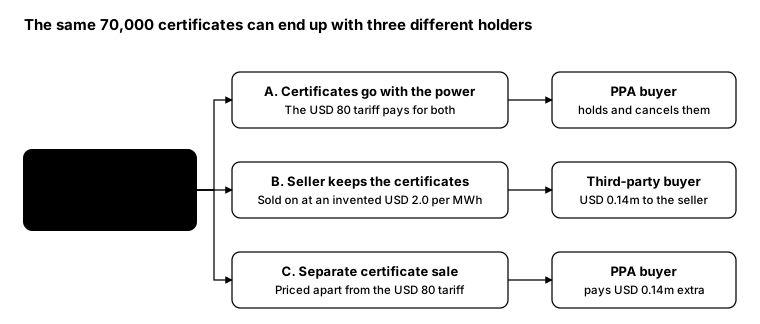
The power, the 70,000 MWh and the USD 80 tariff are the same in every row. Only the holder of the certificates and the payment for them change. The USD 2.0 per MWh price is invented.
- A. Certificates go to the buyer with the power. An Australian law firm summary says corporate buyers use certificates to back renewable claims "typically through Power Purchase Agreements (PPAs) that bundle electricity supply with certificate transfer." The GHG Protocol also names "RECs conveyed through a power purchase agreement (PPA)" as a category that buyers report.
- B. The seller keeps the certificates and sells them on. India's registry says generators "will have two options - either to sell the renewable energy as green energy or to sell the electricity generation and environmental attributes associated with RE generation separately." The US Federal guide states: "Electricity and RECs are distinct products."
- C. A separate certificate sale sits beside the energy sale. The Edison Electric Institute RECs Annex says "A RECs Transaction may be entered into in connection with a Transaction for Energy." It adds that "Delivery of RECs Product can be with or independent of delivery of the Energy with which the RECs Product is associated if so permitted under the Applicable Program."
- D. The programme may issue no certificate at all. Energy Traders Europe notes that "Member States may choose (and some have done so) not to issue GoOs to renewable energy producers receiving financial support." India's REC framework makes a plant that has availed concessional network charges ineligible.
What is the difference between bundled and unbundled certificates?
A bundled certificate is sold together with the electricity. An unbundled certificate is sold on its own. The US Federal guide puts it this way: "They can be sold separately as unbundled products; or together as a bundled product."
The split changes where the money appears in the model. The table shows the three cases from the diagram on the example, using the invented USD 2.0 per MWh and year 1 P90 volume of 70,000 MWh.
| Case | Year 1 revenue to the seller | Where certificate value sits |
|---|---|---|
| A. Bundled in the PPA | USD 5.60m | Inside the USD 80 tariff, with no separate line |
| B. Seller keeps and sells on | USD 5.74m (5.60 plus 0.14) | A separate line paid by a third party |
| C. Separate sale to the PPA buyer | USD 5.74m (5.60 plus 0.14) | A separate line paid by the PPA buyer |
In case C the price is its own term. The Edison Electric Institute annex says tariffs "do not apply to RECs Transactions unless specifically so stated in the RECs Confirmation."
How do certificates affect what the buyer can claim?
The party that holds and cancels the certificate makes the renewable claim, not simply the party that receives the electricity. Energy Traders Europe says that "the final owner (or a party acting on behalf of the final owner) can then 'cancel' the GoOs and claim the environmental benefit." The US Federal guide, citing earlier guidance, says "once a REC is sold the original holder can no longer make claims associated with the renewable electricity that generated the REC."
Three points follow for the contract.
- One certificate per megawatt-hour. An Australian law firm summary says only one certificate type can be created for a given megawatt hour. A contract therefore needs to say who holds that single certificate.
- No double sale. The Edison Electric Institute annex has the seller warrant that it has not "sold to any other person or entity, retired for its own benefit, or represented as part of any Energy sale the RECs Product".
- Accounting rules decide what a claim is worth. The GHG Protocol says the market-based method "reflects the emissions from the electricity that a company is purchasing". It also says its framework is "based on attributional accounting", which allocates emissions to end users and does not prove that a purchase caused new capacity.
Our reading is that in case B of the diagram, the PPA buyer receives the power but not the certificate. It would then not hold the instrument that supports a renewable claim for those megawatt-hours.
How are carbon credits different from certificates?
A certificate records one megawatt-hour of renewable generation. A carbon credit records an emission outcome and follows its own rules. The two instruments differ in unit, in who must approve them and in how they are tested.
| Instrument | Unit | What the public sources say |
|---|---|---|
| REC or guarantee of origin | 1 MWh | The final holder cancels it and claims the renewable electricity (Energy Traders Europe, US Federal guide) |
| Internationally transferred mitigation outcome (ITMO), Article 6.2 | tCO2e or another permitted metric | Needs host country authorisation and a corresponding adjustment (Article 6 Observatory) |
For Article 6, the Article 6 Observatory defines an ITMO as "A mitigation outcome that has been authorised and first transferred under a cooperative approach." A corresponding adjustment keeps "the same mitigation from being counted by both" the transferring and the receiving country.
For the voluntary market, the Integrity Council for the Voluntary Carbon Market (ICVCM) states that credits issued under existing renewable energy methodologies "will not be able to use its high-integrity CCP® (Core Carbon Principles) label." Its additionality test asks that reductions "would not have occurred in the absence of the incentive created by carbon credit revenues."
Our reading is that these tests make carbon credit revenue harder to rely on than certificate revenue. A PPA still has to say which party may register the plant for credits and sell them.
How do you model it?
You model certificates as a revenue line that exists only when the seller holds them, and you test it with the price at zero. The steps below follow that order.
- Read which party holds the certificates: the buyer with the power (case A), the seller (case B), or the buyer under a separate sale (case C).
- In case A, keep the tariff as the only revenue line. Do not add certificate income on top, because the tariff already pays for it.
- In cases B and C, add a separate line using the same degradation as generation, with year 1 P90 volume in MWh and the certificate price in USD per MWh:
- Mark the line as contracted (case C, a fixed price in the contract) or uncontracted (case B). Ask the lender whether it counts in CFADS for sizing. Our reading is that a lender may give no credit to an uncontracted line.
- Run the price down to zero and read the DSCR against the 1.30x sizing, 1.20x lock-up and 1.10x default levels.
- Check that the plant can be issued certificates under the programme rules, since some programmes do not issue them to plants that receive support or concessions.
- Leave carbon credits out of the base case until authorisation and buyer terms are settled.
The table shows year 1 for cases B and C with costs and tax held at the base case, which is a simplification. Debt service is held at USD 3.231m in the DSCR column. The prices are invented.
| Certificate price (invented), USD per MWh | Year 1 certificate revenue, USD m | Year 1 CFADS, USD m | DSCR on base debt service | DSCR-sized debt, USD m |
|---|---|---|---|---|
| 0 | 0.00 | 4.20 | 1.30x | 25.1 |
| 1 | 0.07 | 4.27 | 1.32x | 25.5 |
| 2 | 0.14 | 4.34 | 1.34x | 25.9 |
| 4 | 0.28 | 4.48 | 1.39x | 26.7 |
At USD 2.0 per MWh, the 20-year P90 certificate total is about USD 2.67m. Only about USD 1.63m of that falls inside the 12-year debt tenor.
Now take a what-if on price terms. Suppose the PPA tariff is USD 78 per MWh for power alone, and the seller expects USD 2.0 per MWh from certificates, so USD 80 in total. If the certificate sale fails, year 1 revenue is USD 5.46m, CFADS is USD 4.06m and DSCR is 1.26x. DSCR-sized debt would be about USD 24.2m, not USD 25.1m. This case is invented.
What are the common mistakes?
- Counting certificate income twice. In case A the tariff already pays for the certificates. Adding a certificate line on top overstates revenue by USD 0.14m in year 1 of the example.
- Assuming the power carries the renewable claim. The claim goes to the holder that cancels the certificate. A buyer in case B gets the energy without it.
- Treating uncontracted certificate income as certain. At USD 2.0 per MWh the line adds 0.04x of DSCR in year 1. A price of zero removes it, so test that case.
- Assuming the plant will be issued certificates. Some programmes do not issue them to plants that receive support or concessions, so check eligibility first.
- Selling the same certificate twice. The Edison Electric Institute annex includes a seller warranty against a prior sale. Our reading is that a second sale would breach it.
- Mixing up certificates and carbon credits. They have different units, approvals and tests. Revenue from one does not stand in for the other.
- Counting certificate revenue beyond the debt tenor in sizing. Only about USD 1.63m of the USD 2.67m 20-year total falls within the 12-year debt tenor.
Frequently asked questions
Does a certificate change the PPA tariff?
It can. In case A the tariff pays for both power and certificates, so it is one price. In case C the certificate has its own price. The Edison Electric Institute annex says the energy tariff does not apply to a certificate sale unless the confirmation says so.
Can the buyer claim renewable power if the seller sells the certificates elsewhere?
Sources point the other way. The US Federal guide says the original holder can no longer claim once a REC is sold. Energy Traders Europe says the final owner cancels the certificate and claims the benefit.
Are RECs and guarantees of origin the same thing?
They do the same job under different rules. Both are sized at one megawatt-hour. A guarantee of origin is set in European legislation, while a REC is the certificate name used in the US and India, while Australia uses its own certificate name.
Do carbon credits conflict with certificates?
They are separate instruments with separate rules. Article 6 outcomes need host country authorisation and a corresponding adjustment. Our reading is that the PPA should say who may register and sell each instrument.
What happens to certificates when the grid cannot take the power?
The US Federal guide says a REC is created when a source generates one megawatt-hour. Our reading is that power that is never generated creates no certificate. Take or pay and deemed energy in a solar PPA: who pays when the power is not taken covers the energy payment side.
Sources
Pages opened on 5 October 2026. The example project is invented and has no source.
- Federal Renewable Energy Certificate Guide, Office of Federal Sustainability (United States). REC unit of one MWh, bundled and unbundled sales, claims after a REC is sold.
- Renewable Energy Certificates Annex to the EEI Master Power Purchase & Sale Agreement, Edison Electric Institute (United States). Certificate sale with or apart from energy, tariff not applying, seller warranty against prior sale.
- EFET Insight into the EU Guarantees of Origin System, Energy Traders Europe (Europe). Size of a guarantee of origin, cancellation and claim, non-issue for supported producers.
- Australia's new renewable energy certificate regime: what your organisation needs to know (part 1), Holding Redlich (Australia). Certificate per MWh, one certificate per MWh, PPAs that bundle certificate transfer.
- Renewable Energy Certificate Registry of India: About REC Framework, Government of India (India). REC unit, separate sale of attributes, eligibility condition on concessional charges.
- Top ten questions about the Scope 2 Guidance, GHG Protocol. Market-based method, PPA certificate category, attributional accounting.
- I-TRACK issuers, International Tracking Standard Foundation. Role of I-REC issuers and the countries they cover.
- Article 6 of the Paris Agreement, explained, Article 6 Observatory. ITMO definition, authorisation, corresponding adjustment, tCO2e metric.
- Renewable Energy Credits Do Not Meet High-Integrity Assessment, Integrity Council for the Voluntary Carbon Market. CCP label and additionality for renewable energy carbon credits.