Take or pay and deemed energy in a solar PPA: who pays when the power is not taken
By SolarQuant Editorial. Published 2026-10-05. Last updated 2026-10-05.
Take or pay and deemed energy decide who bears the risk when a plant could deliver power that the buyer or grid cannot take. Public contracts and guides allocate that risk in different ways, so each element of the clause has to be modelled as its own choice. On the example plant below, the same 5% curtailment leaves the year 1 DSCR at 1.30x or 1.21x, depending only on who pays.
What example does this article use?
The example is an invented 40 MWp ground-mounted solar plant selling all its power to one buyer at the plant substation, the delivery point. The buyer pays in USD under a 20-year PPA that starts at the commercial operation date. Every other case in this article is a "what if" on this same plant, and all figures are invented. Annual periods are used for simplicity, although real deals usually use six-month periods.
| Item | Example figure |
|---|---|
| Plant and contract | 40 MWp, one buyer, 20-year PPA, USD |
| Year 1 generation, lender's case (P90) | 70.0 GWh (1,750 kWh per kWp) |
| Degradation | 0.5% a year |
| Tariff | USD 80 per MWh, flat for 20 years |
| Year 1 revenue, P90 | USD 5.6m |
| Revenue over 20 years, P90 | USD 106.8m |
| Year 1 operating costs and tax | USD 1.0m and USD 0.4m |
| Year 1 CFADS | USD 4.2m |
| Senior debt | USD 25.1m over 12 years at 7.0%, sculpted to a DSCR of 1.30x |
| Year 1 debt service | USD 3.231m |
| DSCR levels | Sizing 1.30x, lock-up 1.20x, default 1.10x |
| Curtailment case | The grid cannot take 5% of year 1 P90 output: 3.5 GWh, worth USD 0.28m |
In every curtailment case below, operating costs and tax are held at the base case. That is a simplification, because tax would fall a little when revenue falls.
What do take or pay and take and pay mean?
Take or pay and take and pay are two ways to promise payment, and public sources use both labels in more than one sense. Deemed energy is the volume that counts as delivered, and is paid for, although it was never delivered.
Four public sources show how far the labels differ:
- US agencies, "10 Important Features of Bankable PPAs". Take or pay is a fixed tariff with a capacity charge paid for available capacity, plus an output charge, with no dispatch required. Take and pay means the offtaker must take and pay a fixed tariff for all energy delivered.
- IRENA and Terrawatt Initiative, Open Solar Contracts. The PPA is drafted on a take or pay basis. Deemed energy payments are payable if the seller can produce but the buyer is unable to or does not take the power.
- RCREEE user's guide. Many agreements are called take or pay: the purchaser pays for energy delivered and for available capacity that would have been generated during curtailment.
- Stoel Rives, The Law of Solar. In a distributed generation chapter, take or pay means a minimum payment each year regardless of whether the installation produces output. The firm says such contracts have not found a place in that market.
The label alone therefore does not tell you what is paid. In our reading, Clifford Chance labels Mexico's second auction PPA take or pay although payment follows delivery. Read the payment trigger in the clause, not the heading.
Why does deemed energy matter for the revenue line?
Deemed energy matters because it makes revenue depend on what the plant could have delivered, not only on what it delivered. A lender's revenue line then needs an available energy series and a lost energy series, not a single generation number.
In our reading, the revenue line becomes the formula below. Delivered energy is always paid. Deemed energy enters the formula only to the extent the contract says it is paid.
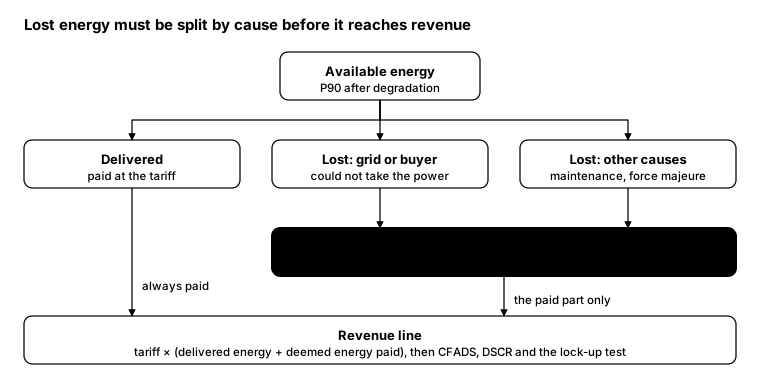
The rule differs by cause, so the next sections treat the trigger, exclusions, measurement and limits as separate choices.
In the example, the grid cannot take 5% of year 1 P90 output, which is 3.5 GWh or USD 0.28m. Because costs are held, a payment of zero removes the full USD 0.28m from CFADS of USD 4.2m.
Who triggers it, and what is excluded?
The trigger is the event that makes the buyer pay for undelivered energy. The exclusions are the causes carved out of that duty. Public sources treat these as two separate choices, so this section gives each its own table.
First, the trigger. Each row below is one variant from one source.
| Variant of the trigger | What the page says | Source and country or region |
|---|---|---|
| The buyer cannot or does not take the power | Payment is due if the seller can produce but the buyer is "unable to or does not take" the power | IRENA and Terrawatt Initiative, Open Solar Contracts (model contracts) |
| Only a discretionary curtailment by the purchaser | Some agreements pay only where the purchaser used a discretionary right to curtail, not in an emergency | RCREEE user's guide (Arab states model) |
| Temporary transmission unavailability | Compensation applies where power is not evacuated for reasons not attributable to the developer, backed by documents from the competent authority | SECI standard solar PPA (India) |
| A curtailment imposed by the utility | The developer is entitled to deemed dispatch if the utility imposes a curtailment | ETP analysis of MEMR Regulation No. 5 of 2025 (Indonesia) |
| A defined system event or a buyer breach | Deemed energy is the output that would have been available but for a system event or a buyer breach, such as failure to pay | Onshore wind PPA, sixth bid window (South Africa) |
| No deemed payment | Jones Day found no deemed availability payment if the utility cannot take the electricity | Jones Day on the 2017 model PPA (Vietnam) |
| Left to other rules | The PPA does not directly address the consequences of a curtailment in transmission | Clifford Chance on the second auction (Mexico) |
Next, the exclusions. Again each row is one variant from one source.
| Variant of the exclusion | What the page says | Source and country or region |
|---|---|---|
| Events caused by the seller, and system maintenance | Seller-caused events are outside the system event definition, and the curtailment definition leaves out constraints from planned or unplanned system maintenance | Onshore wind PPA, sixth bid window (South Africa) |
| Energy oversupply | Compensation rules for curtailment leave out oversupply, which the government treats as a market risk assumed by generators | pv magazine on Brazil's compensation rules (Brazil) |
| Emergency curtailment | In one variant described, an emergency curtailment is not paid | RCREEE user's guide (Arab states model) |
| Force majeure, paid by the buyer | Where a governmental force majeure prevents the project company's performance, the buyer is liable for deemed energy payments | IRENA and Terrawatt Initiative, Open Solar Contracts (model contracts) |
| Force majeure, excusing the producer | Force majeure excuses the power producer from performing | US agencies, 10 Important Features of Bankable PPAs (United States) |
In the model, each excluded cause needs its own row in the lost energy series. A single "curtailment" row hides which cause is paid and which is not.
How is the deemed volume measured?
The deemed volume is the energy that counts as delivered for payment, and contracts set it in different ways. Four variants appear in the public pages.
- A formula on offered capacity. In India's standard solar PPA, generation compensation is the tariff times the MW offered but not scheduled, times the hours of grid unavailability. For reduced offtake, the developer must follow the scheduling process and sell in the power exchange as a price taker to claim compensation.
- A schedule in the contract. In the South African onshore wind PPA, deemed energy is the output otherwise available to the buyer, determined under a schedule. The pages we read name the schedule but do not show its method, so this article does not describe it.
- Virtual or deemed energy for curtailment. The RCREEE guide describes calculating defined quantities of virtual or deemed electric energy that could have been generated during curtailment.
- A deemed delivered basis. The US agencies say curtailed energy is paid on a deemed delivered basis, whereas a capacity charge needs no volume estimate.
In our reading, the modelling consequence is a counterfactual output series. An hourly formula needs the plant's output profile in the lost hours, because an outage at night costs nothing. A schedule or a capacity charge needs a different input, so check which one the clause uses before building the row.
Are there limits on what is paid?
Yes, in some public contracts the payment starts only after a threshold or a waiting period, and this is separate from the exclusions above. We found no public page that gives a cap on total deemed payments, so none is used here.
Three variants of a limit appear in the pages we opened:
- An hours threshold. In India's standard solar PPA, compensation for grid unavailability applies to unavailability beyond 175 hours in a contract year. Articles 4.10.2 to 4.10.4 set a similar test for reduced offtake.
- An allowance defined in hours. The South African onshore wind PPA defines an allowed grid unavailability period of 175.2 hours a year (transmission) and 438 hours (distribution). It defines an energy allowance from those hours. The pages we read do not show how the allowance affects payment, so this article does not say.
- A grace period. In Indonesia, as analysed by the Energy Transition Partnership, the utility pays for undelivered electricity based on the grace period in the PPA. The analysis does not state its length.
These figures are examples from two named contracts, not market norms. The two figures are also a share of hours, not of energy. The 175.2 hours are 2.0% of the 8,760 hours in a year, but solar plants produce only by day, so the energy share differs.
In the example, we use an invented allowance: the first 2% of annual output lost is unpaid and the rest is paid. In our reading, a real model converts an hours threshold into energy using the plant's output profile, then tests the result against lock-up.
What happens to the contract term and the price after a curtailment?
Public pages say little about the term after a curtailment. For the price, they show at least three bases for deemed energy.
On the term, the variants are:
- Payment, not extension. In India's standard solar PPA, grid unavailability leads to a compensation payment. The extensions we found in Article 4.5 relate to other events, and we did not find an extension attached to the compensation. For a force majeure event that lasts beyond nine months from the notice, termination is caused solely at the discretion of SECI.
- Deferral. In Mexico's second auction PPA, Clifford Chance describes energy not delivered on the system operator's instruction as deferred, not a deficiency.
On the price, the variants are:
- The contract tariff. India's compensation formula uses the applicable tariff.
- The contract price or a market price. Brazil's compensation rules use the contract price where a specific provision exists, and the settlement price of differences for uncontracted energy.
- A price built into the tariff. The Open Solar Contracts guide says the cost of any non-sale risk is integrated into the price offered.
In our reading, an extension adds revenue only after the original term, so it cannot cure a DSCR breach in the debt years.
How do you model it?
You model it by adding a lost energy series to the revenue line and paying only the part the contract pays. These steps are our reading of how to do that; the clause variants above are what the public pages describe.
- Build the available energy series. Take the P90 year 1 output, apply degradation of 0.5% a year, and keep it before any curtailment.
- Add a lost energy row for each cause. Use separate rows for buyer or grid constraints, system maintenance, force majeure, seller-caused events and oversupply.
- Set a rule for each row. Choose paid, unpaid or deferred, using a switch so you can run the variants side by side.
- Apply any threshold or grace period. Convert an hours threshold into energy using the plant's output profile, and treat the first part as unpaid if the clause says so.
- Price the paid part. Use the tariff, the contract price or another basis that the clause names.
- Add paid deemed energy to delivered energy. Revenue is the price times that sum.
- Run CFADS, DSCR and the lock-up test in every period. Report the headroom to the lock-up level as lost revenue, so the reader sees how much more curtailment the case can absorb.
- Check debt sizing. Decide whether lenders size debt on the case with expected unpaid curtailment, and show the debt capacity of each case.
The headroom in step 7 comes from one line of algebra. You can add it to the model as a check:
What does the example show for each treatment?
Three cases on the example show how far one clause moves the lender's ratios. In each, the grid cannot take 5% of year 1 P90 output, 3.5 GWh or USD 0.28m, and costs and tax are held.
- Paid in full. Deemed energy is paid for all 3.5 GWh, so revenue is unchanged.
- First 2% unpaid. This is an invented allowance. The unpaid 1.4 GWh costs USD 0.112m of revenue and the remaining 2.1 GWh is paid.
- Nothing paid. The full USD 0.28m of revenue is lost.
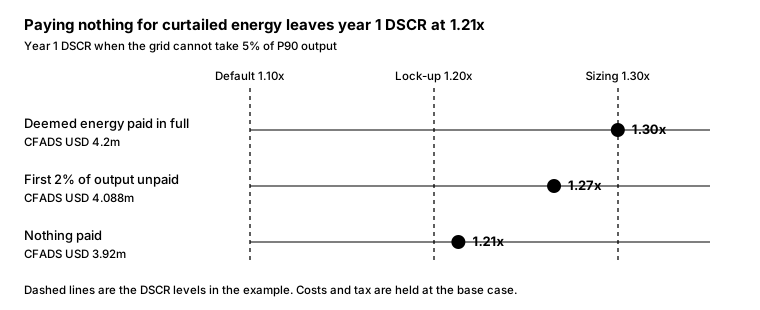
Paying nothing still passes the lock-up test in year 1, but only just. CFADS can fall by a further USD 0.043m before DSCR reaches 1.20x. That is 0.77% of year 1 revenue. So unpaid curtailment of about 5.8% of output trips the lock-up, and about 11.5% reaches the 1.10x default.
The cases also change how much debt the revenue line supports. In the chart below, the same 5% curtailment repeats every year (an invented extension) and lenders size debt on that case.
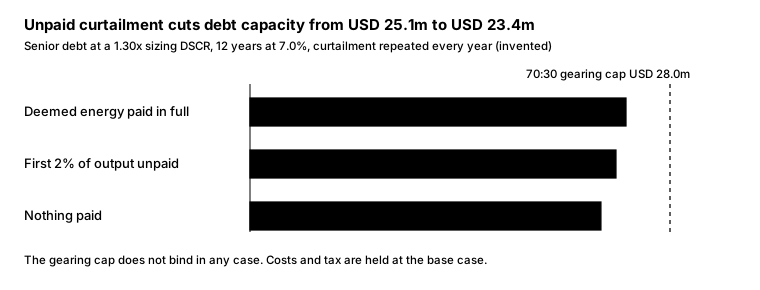
Repeated for 20 years, the 5% removes USD 5.3m of the USD 106.8m revenue if nothing is paid, and USD 2.1m with the allowance. Equity fills the debt gap, about USD 1.7m between the first and last case, because total funding stays at USD 40.0m.
What are the common mistakes?
- Trusting the label. Take or pay can mean a capacity charge, a minimum yearly payment or payment for what was delivered, so read the payment trigger.
- Treating deemed energy as generation. Keep available energy, delivered energy and paid deemed energy as three rows, or the P90 case and the DSCR checks blur together.
- Turning hours into a share of energy without a profile. Hours of unavailability and energy lost differ, because solar output is concentrated in daylight.
- Assuming force majeure and maintenance are paid. The public pages treat force majeure in at least three ways, and one definition leaves out maintenance.
- Ignoring the buyer's ability to pay. Deemed energy is only as good as the buyer's credit, so say whether deemed invoices carry the same payment security as delivered energy.
- Skipping the lock-up test. In the example a case that looks safe at 1.21x is 0.77% of revenue away from lock-up.
Frequently asked questions
Is take or pay the same as take and pay?
No. The US agencies describe take or pay as a fixed tariff with a capacity charge for available capacity plus an output charge. They describe take and pay as a fixed tariff for all energy delivered. Other sources use the labels differently, so check the clause.
Does deemed energy mean the buyer pays the full tariff?
Not always. India's compensation formula uses the applicable tariff. Brazil's compensation rules use the contract price where a provision exists and a market settlement price otherwise. Check the price basis for each cause of loss.
Who bears curtailment risk?
It depends on the contract. The RCREEE guide says a right to curtail at will concerns lenders and should carry compensation. A study by Cruce, O'Shaughnessy and Xu found that fixed payment and time of delivery contracts tend to shift curtailment risk to buyers.
What if the PPA says nothing about curtailment?
In our reading, the developer then carries the risk unless other rules pay. Clifford Chance says the Mexican second auction PPA does not directly address curtailment in transmission. Jones Day found no deemed availability payment in Vietnam's 2017 model PPA, which leaves fixed costs exposed.
Sources
Pages opened on 5 October 2026. The example project is invented and has no source.
- A Guide to Open Innovation: Open Solar Contracts, IRENA and Terrawatt Initiative, 2019. Used for the take or pay basis, the deemed energy trigger, force majeure and the price effect of non-sale risk.
- User's Guide for the Power Purchase Agreement (PPA) Model for Electricity Generated From Renewable Energy Facilities, RCREEE, March 2012. Used for take or pay as available capacity, deemed energy during curtailment and the discretionary and at will curtailment variants.
- 10 Important Features of Bankable Power Purchase Agreements for Renewable Energy Power Projects, OPIC, US Department of Commerce, USAID and USTDA. Used for the take or pay and take and pay definitions, the deemed delivered basis and force majeure.
- Power Purchase Agreements and Renewable Energy Certificates: Distributed Generation Projects, Stoel Rives LLP. Used for the minimum yearly payment meaning of take or pay in distributed generation.
- Standard Power Purchase Agreement for Procurement of MW Solar Power on Long Term Basis, Solar Energy Corporation of India (SECI). Used for the transmission unavailability trigger, the generation compensation formula, the 175 hour threshold, the price taker condition and force majeure termination.
- Vietnam's New Solar PPA: Strong Developer Interest Despite Bankability Concerns, Jones Day, January 2018. Used for the absence of a deemed availability payment under Circular No. 16/2017/TT-BCT.
- Mexico's Second Auction: PPA Features and Bankability Considerations, Clifford Chance, January 2017. Used for the silence on transmission curtailment, deferral of undelivered energy and the payment for delivered energy.
- REIPPPP sixth bid window, Volume 2, Appendix K2, Onshore Wind PPA, Department of Mineral Resources and Energy, South Africa, copy hosted by Oxpeckers. Used for the definitions of deemed energy, curtailment, system event and buyer breach, and the allowed grid unavailability period.
- Analysis of Power Purchase Agreement Terms for Solar PV in the JAMALI Region, Report 3, Energy Transition Partnership, May 2025. Used for deemed dispatch and the grace period in Indonesia.
- Brazil sets compensation rules for wind and solar curtailment, pv magazine, 23 July 2026. Used for the compensated causes, the oversupply exclusion and the compensation price.
- Rethinking Solar PV Contracts in a World of Increasing Curtailment Risk, Cruce, O'Shaughnessy and Xu, Energy Economics, 2021. Used for the shift of curtailment risk under fixed payment and time of delivery contracts.