Performance guarantees in a solar PPA: availability, output and shortfall damages in the model
By SolarQuant Editorial. Published 2026-10-05. Last updated 2026-10-05.
A performance guarantee puts a floor under the seller's output and sets a price for any shortfall. In the example it costs the project USD 0.078m in a year of 62.0 GWh. In our reading that is a downside cost to stress in the model, not protection for the lenders' revenue.
What example does this article use?
The example is an invented 40 MWp ground-mounted solar plant in no named market. One buyer takes the power at the plant substation and pays in USD under a 20-year PPA from the commercial operation date. Construction takes 12 months, and the tariff is USD 80 per MWh, flat.
The lender's case uses P90 generation. Senior debt is sculpted so that debt service in each year is CFADS divided by 1.30. The seller guarantees 85% of P50 output, with damages for any shortfall. Every figure below is invented, and we use annual periods for simplicity (real deals usually use six-month periods).
| Item | Figure |
|---|---|
| Plant | 40 MWp, ground-mounted |
| Year 1 generation | P90 70.0 GWh, P50 76.0 GWh |
| Degradation | 0.5% a year, so generation in year t = year 1 x 0.995^(t-1) |
| P90 generation | 66.2 GWh in year 12, 63.6 GWh in year 20 |
| Tariff | USD 80 per MWh, flat for 20 years |
| Year 1 revenue, lender's case | USD 5.6m |
| Year 1 operating costs and tax | USD 1.0m and USD 0.4m |
| Year 1 CFADS | USD 4.2m |
| Senior debt | USD 25.1m over 12 years at 7.0%, 62.7% gearing |
| Year 1 debt service | USD 3.231m |
| DSCR levels | Sizing 1.30x, lock-up 1.20x, default 1.10x |
| Output guarantee (invented) | 85% of P50 = 64.6 GWh in year 1 |
| Damages (invented) | USD 30 per MWh of shortfall |
| Example guarantee year | 62.0 GWh delivered, shortfall 2.6 GWh, damages USD 0.078m |
What is a performance guarantee in a solar PPA?
A performance guarantee is a seller promise that the plant will deliver a stated level of output or availability, with money payable by the seller if it does not. It protects the buyer, not the lenders.
Stoel Rives, a US law firm, writes that "An output guarantee requires the seller to pay the buyer if the project's output over a specified period fails to meet a specified level", after taking into account output lost because of force majeure, curtailments or maintenance. Pexapark, a European market analytics firm, describes the same idea from the buyer's side: a guarantee covers the case where "the production at COD does not meet the contractually agreed-upon expected production".
The tariff already pays the seller only for energy delivered. A guarantee therefore adds a second loss on top of the lost revenue. In the example, that second loss is the USD 0.078m of damages.
What kinds of guarantee do public PPA sources describe?
Public sources describe an output guarantee, a minimum annual energy quantity and an availability guarantee, and contracts differ in which they use. Each is a separate variant, and the table keeps them apart.
| Variant | What is measured | What the source says | Source |
|---|---|---|---|
| Output guarantee | Energy delivered over a test period against a set level | The seller pays the buyer if output over a specified period fails to meet a specified level | Stoel Rives, US |
| Minimum annual energy, with compensation | Energy in each contract year against a stated quantity | Compensation applies where the shortfall is "solely attributable to the SPD". The first contract year after commercial operation is excluded | SECI standard rooftop PPA, India |
| Minimum annual energy, with a collar | Annual generation against a floor, inside a collar of ceiling and floor | The seller could be accountable for losses in procuring alternative supply if generation is below the annual minimum | RCREEE user guide, Middle East and North Africa |
| Availability guarantee in the PPA | Mechanical availability, or a percentage of the guaranteed volume | Mechanical-availability percentages usually range from 90 to 95 percent. Another guide defines guaranteed availability as a percentage of the volume guaranteed in the contract | Stoel Rives, US; Pexapark, Europe |
| Penalty on technical metrics | Capacity excess, availability factor, performance ratio or other agreed metrics | Penalties apply for underperformance on those metrics | Energy Transition Partnership, Indonesia |
| Availability in the O&M agreement | Equipment reliability only | Guarantees in reviewed O&M contracts ranged between 97% and 99%, and should be separate from any performance guarantee | Sandia National Laboratories, US |
The example uses the first variant, an output guarantee. Its level of 85% of P50 is invented. For the model, the kind of guarantee fixes the unit (GWh or a share of time) and whether the payer is the project company or its O&M contractor.
How are shortfall damages priced?
Shortfall damages are the energy shortfall multiplied by a price per MWh. Stoel Rives writes that the price is "determined by reference to an agreed-on index or a fixed price". Other public sources set it as a share of the tariff or as the buyer's cost of replacement supply.
The table applies three variants to the example shortfall of 2.6 GWh (64.6 less 62.0). Only the first rate is the example's own. The others are shown as separate what-if cases.
| Variant | Rate on the example | Damages on 2.6 GWh | Share of year 1 P90 revenue |
|---|---|---|---|
| Fixed price per MWh (example, invented) | USD 30 per MWh | USD 0.078m | 1.4% |
| Share of tariff, as in the SECI rooftop template (India), which sets compensation at 50% of the PPA tariff | USD 40 per MWh | USD 0.104m | 1.9% |
| Index or replacement cost, with an invented index price | USD 55 per MWh | USD 0.143m | 2.6% |
The spread is USD 0.065m between the lowest and highest case. That is small against year 1 CFADS of USD 4.2m. The price matters more in a deep shortfall, which the lender chart below shows.
How does a guarantee test work?
A guarantee test compares measured output, after agreed adjustments, with the guaranteed level and prices the gap. The five steps are the same whichever variant a contract uses.
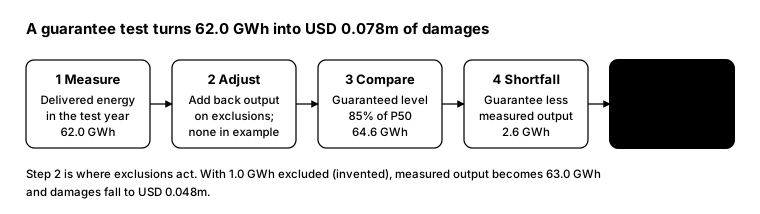
Only step 5 turns energy into money. The rate, and the adjustments in step 2, are where contracts differ.
How do measurement periods and exclusions change the result?
The measurement period sets how often output is tested, and the exclusions set which lost energy does not count against the seller. Together they decide how often damages are payable and how large they are.
Public sources show these variants for the period:
- Annual, biannual or seasonal. Stoel Rives writes that "The period is typically annual or biannual (although there are occasionally seasonal guarantees in today's PPA market)".
- Contract year, with a start-up year left out. The SECI rooftop template (India) tests each contract year but excludes the year ending on 31 March after commercial operation.
Public sources show these variants for exclusions:
- Listed events. Stoel Rives lists output lost because of force majeure, curtailments, or maintenance or other agreed-on subtractors.
- Force majeure and seller fault only. The SECI template applies compensation only where the shortfall is solely attributable to the seller, and not in force majeure events.
- Grid events in O&M availability. Sandia National Laboratories lists "Interruptions due to grid disturbances and grid outages" among exclusions, where the plant may be available but the grid cannot take the energy.
In the example, the test is annual and nothing is excluded, so damages are USD 0.078m. Two what-if cases change this. If 1.0 GWh of the lost output fell under an exclusion (invented), measured output is 63.0 GWh, the shortfall is 1.6 GWh and damages are USD 0.048m.
If instead the test ran over two years (invented case), the guarantee would be 129.2 GWh, which is 64.6 GWh twice. Year 2 delivering 68.0 GWh (invented) gives 130.0 GWh over the two years, and no damages are due. A longer period lets a good year offset a bad one.
Excluded output may still be unpaid under the tariff. Take or pay and deemed energy in a solar PPA: who pays when the power is not taken covers that revenue side.
How does degradation interact with the guaranteed level?
A guarantee fixed in year 1 does not fall with panel degradation unless the contract says so. The SECI rooftop template shows one variant: it sets a minimum energy for the first ten years and a different quantity for the rest of the term.
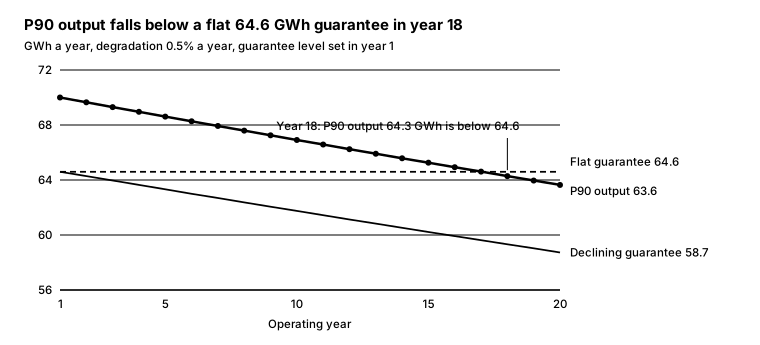
The chart compares a flat 64.6 GWh with a declining level that follows 0.5% degradation. The declining level is our what-if case, not a clause we found. At USD 30 per MWh, the flat level costs nothing at P90 until year 18. It then costs about USD 0.010m in year 18 and USD 0.029m in year 20.
How do lenders look at a performance guarantee?
In our reading, a guarantee is a cost that falls on the project and a floor that tells lenders how far output can drop. The RCREEE user guide says "Lenders will wish to ensure that the predicted power output for RE facility falls comfortably above the floor." Stoel Rives notes that the PPA will contain provisions authorizing the seller to assign it as collateral for project debt.
In the example, year 1 P90 output of 70.0 GWh is 7.7% above the 64.6 GWh floor. In year 20 it is 1.6% below. In our reading, the base case therefore carries no damages until year 18, and the guarantee is tested as a downside.
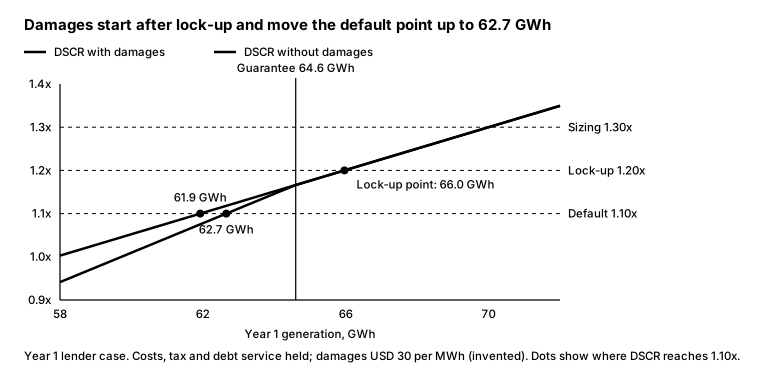
Lock-up is reached at about 66.0 GWh, before any damages are due. Damages then move the default point from 61.9 GWh to 62.7 GWh. The 62.0 GWh year in the example gives a DSCR of 1.08x with damages, against 1.10x without them. Both runs hold costs, tax and debt service at the base case.
So the guarantee does not cause the covenant problem. It makes a bad year slightly worse. To judge how far output can fall, look at the P90 headroom above the floor, not at the damages.
How do you model a performance guarantee?
Model it as a test that runs each measurement period and feeds a damages line into CFADS. The formula for one period is:
Here G is the guaranteed energy, E is measured energy, X is output added back under exclusions, and Price is the rate per MWh. In the example, 30 x (64,600 less 62,000) MWh is USD 78,000.
- Enter the guaranteed level by year. Use the contract quantity in GWh, and decide whether it is flat or stepped. The example uses a flat 64.6 GWh.
- Set the measurement period. Annual is the simplest. If the contract tests over a longer period, sum output and guarantee over that period first.
- Add back excluded output. Take each listed exclusion from a loss log or a stress input, and add it to measured output before the comparison.
- Compute the shortfall. Take the larger of zero and the guarantee less adjusted output. Do not let a good year create a negative shortfall unless the contract nets years.
- Price the shortfall. Use the contract variant: a fixed rate, a share of the tariff, or an index. Keep the rate as its own input.
- Deduct damages in CFADS. Treat them as a cost in the test year. Revenue already falls with energy, so do not reduce it twice.
- Test DSCR against lock-up and default. Run the lender case, then a downside year such as 62.0 GWh, and read the DSCR against 1.20x and 1.10x.
- Keep O&M availability payments separate. Availability damages owed to the project by an O&M contractor are a different line, and they may not match the PPA test.
What are the common mistakes?
- Treating the guarantee as revenue protection. Damages are paid by the project, not to it. A shortfall already cuts revenue, and damages come on top.
- Holding the level flat while output degrades. In the example a flat 64.6 GWh is above P90 output from year 18.
- Assuming one pricing rule. Public sources show a fixed rate, a share of the tariff and an index. On the example shortfall they give USD 0.078m, USD 0.104m and USD 0.143m.
- Ignoring exclusions. Excluding 1.0 GWh (invented) cuts the example damages from USD 0.078m to USD 0.048m.
- Mixing the PPA test with the O&M test. Sandia National Laboratories argues that an O&M availability guarantee should be entirely separate from any performance guarantee.
- Charging damages in the base case. At P90 in year 1 the output is above the floor, so the base case shows none.
Frequently asked questions
Is an availability guarantee the same as an output guarantee?
No. An availability guarantee tests equipment reliability or a share of volume, and an output guarantee tests energy delivered. Read the definition in the contract before you choose the model input.
Who pays shortfall damages?
In the output guarantee Stoel Rives describes, the seller pays the buyer. In the example, that seller is the project company, so the damages reduce its CFADS.
Do damages count against the DSCR?
Yes, if the model treats them as a cost in the test year. In the example, a 62.0 GWh year gives a DSCR of 1.08x with damages and 1.10x without. Costs and tax are held at the base case.
Can a longer measurement period help the seller?
It can, because a strong year offsets a weak one. In the invented two-year case, 62.0 GWh then 68.0 GWh meets a two-year guarantee of 129.2 GWh, so no damages are due.
Can I use the percentages in public contracts as market norms?
No. Each figure belongs to one document: a 90 to 95 percent mechanical availability range in Stoel Rives, 50% of tariff in the SECI rooftop template, and 97% to 99% in reviewed O&M contracts from Sandia. Treat them as examples, and take the real figure from the term sheet.
Sources
Pages opened on 5 October 2026. The example project is invented and has no source.
- Utility-Scale Solar Power Purchase Agreements, The Law of Solar Guide, Stoel Rives LLP (US). Output guarantee definition, measurement period, exclusions, shortfall price, mechanical-availability range and assignment to lenders.
- A Best Practice for Developing Availability Guarantee Language in Photovoltaic (PV) O&M Agreements, Sandia National Laboratories, November 2015 (US). Availability in O&M contracts, the 97% to 99% range and the grid-outage exclusion.
- Standard Power Purchase Agreement (PPA) for rooftop solar, template, Solar Energy Corporation of India. Minimum energy clause, compensation at 50% of tariff, force majeure carve-out and start-up year exclusion.
- User's Guide for the Power Purchase Agreement (PPA) Model for Electricity Generated from Renewable Energy Facilities, RCREEE, hosted by the World Bank PPP Resource Center (Middle East and North Africa). Annual minimum, collar and lender view of the floor.
- What is a PPA? The Guide to Power Purchase Agreements, Pexapark (Europe). Performance guarantee and guaranteed availability definitions.
- Analysis of Power Purchase Agreement Terms for Solar PV in the JAMALI Region, Southeast Asia Energy Transition Partnership, hosted by UNOPS (Indonesia). Penalties for underperformance on technical metrics.