Solar PPA glossary: standard terms from tariff to termination in plain words
By SolarQuant Editorial. Published 2026-10-05. Last updated 2026-10-05.
A solar PPA glossary lists the standard terms a modeller meets between a power purchase agreement and a lender's cash flow. This one defines 45 terms in one line each, grouped by the part of the model they touch. Each entry points to the article in this series that works it through.
What example does this article use?
The example is an invented 40 MWp ground-mounted solar plant in no named market. One buyer takes the power at the plant substation, which is the delivery point, and pays in USD under a 20-year PPA that runs from the commercial operation date. Every figure below is invented, and annual periods are used for simplicity (real deals usually use six-month periods).
When a glossary entry shows a what-if case, it changes one thing on this same plant and holds costs and tax at the base case.
| Item | Example figure (all invented) |
|---|---|
| Plant | 40 MWp ground-mounted, construction 12 months |
| Buyer and delivery point | One buyer, power taken at the plant substation, paid in USD |
| PPA term | 20 years from the commercial operation date |
| Year 1 generation | P90 70.0 GWh (1,750 kWh per kWp); P50 76.0 GWh (1,900 kWh per kWp) |
| Degradation | 0.5% a year, so P90 is 66.2 GWh in year 12 and 63.6 GWh in year 20 |
| Tariff | USD 80 per MWh (USD 0.08 per kWh), flat for 20 years |
| Lender's case (P90) revenue | USD 5.6m in year 1, USD 5.30m in year 12, USD 5.09m in year 20, USD 106.8m over 20 years |
| P50 revenue, year 1 | USD 6.08m |
| Payment | Monthly invoices, paid 60 days after invoice; average monthly revenue USD 0.467m; receivable at 60 days about USD 0.92m |
| Payment security | Letter of credit from the buyer's bank covering 3 months of revenue, USD 1.4m |
| Year 1 costs and tax | Operating costs USD 1.0m, tax USD 0.4m |
| CFADS | USD 4.2m in year 1, then 4.2 x 0.995^(t-1) in year t |
| Funding requirement | USD 40.0m, with a 70:30 gearing cap (USD 28.0m of debt allowed) |
| Senior debt | USD 25.07m over 12 years at 7.0% all-in, sculpted so debt service = CFADS / 1.30; year 1 debt service USD 3.231m |
| Gearing and equity | 62.7% gearing, so the DSCR binds, not the cap; equity USD 14.9m |
| DSCR levels | Sizing 1.30x, lock-up 1.20x, default 1.10x |
What do the volume and price terms mean?
Volume and price terms decide how many megawatt hours are paid for and at what price, so they set the revenue line of the model. Public contracts handle each of them in more than one way.
| Term | Plain definition | In the example | Worked through in |
|---|---|---|---|
| Power purchase agreement (PPA) | A contract in which a buyer agrees to buy a seller's electricity on stated terms and for a stated period. | One buyer, 20 years from COD | How to read a solar PPA term sheet: a modeller's guide |
| Offtaker | The buyer of the power, whose ability to pay lenders rely on. | The one buyer, paying in USD | Utility, corporate and trader offtakers compared |
| Pay-as-produced | A volume structure where the buyer takes whatever the plant produces, whenever it produces it. | Year 1 P90 volume of 70.0 GWh is all taken | How to read a solar PPA term sheet: a modeller's guide |
| Delivery point | The place where the energy is treated as delivered and risk of loss passes to the buyer. | The plant substation | Delivery point, metering and grid charges |
| Metering | Measuring the energy delivered at the delivery point, which sets the quantity on each invoice. | The meter at the substation sets the billed MWh | Delivery point, metering and grid charges |
| Tariff | The price paid for each unit of energy delivered. | USD 80 per MWh, flat | Tariff and escalation in a solar PPA: flat, escalating and indexed prices in the model |
| Escalation (indexation) | A rule that moves the tariff over time, by a fixed percentage or by an index such as inflation. | 2.0% a year case: USD 99.47 per MWh in year 12 | Tariff and escalation in a solar PPA: flat, escalating and indexed prices in the model |
| Contract for difference (CfD) | A price structure where the buyer pays the gap between a strike price and a market price, and the seller pays it back if the market price is higher. | Not used: the example pays a fixed tariff | Tariff and escalation in a solar PPA: flat, escalating and indexed prices in the model |
| Take or pay | A volume term under which the buyer pays for available capacity even when it does not take the power. | See deemed energy below | Take or pay and deemed energy in a solar PPA: who pays when the power is not taken |
| Deemed energy | Energy the plant could have delivered but could not, which the contract treats as delivered for payment. | 5% curtailment case: 3.5 GWh worth USD 0.28m | Take or pay and deemed energy in a solar PPA: who pays when the power is not taken |
| Curtailment | An order or event that reduces or stops deliveries, for example from grid congestion or an emergency. | The grid cannot take 5% of year 1 P90 output | Take or pay and deemed energy in a solar PPA: who pays when the power is not taken |
| P50 | An output level with a 50% chance of being exceeded. | 76.0 GWh in year 1; DSCR 1.45x in a P50 year | How to read a solar PPA term sheet: a modeller's guide |
| P90 | A cautious output level with a 90% chance of being exceeded, the basis lenders usually ask for. | 70.0 GWh in year 1, the lender's case | How to read a solar PPA term sheet: a modeller's guide |
| Degradation | The slow fall in a solar plant's output each year as the panels age. | 0.5% a year: 66.2 GWh P90 in year 12 | How to read a solar PPA term sheet: a modeller's guide |
Public sources show three ways to set the price. An Indian standard rooftop PPA fixes one tariff for the whole term, a US commercial template lists the contract price year by year, and an Alberta programme summary adjusts part of the strike price with consumer prices.
They also treat lost output differently. An Indian standard PPA deems output at the average of the preceding twelve months of operation for a disruption period, while a guide for the Arab region describes deemed or virtual energy for curtailment under a take or pay structure.
What do the timing and delay terms mean?
Timing terms fix when the plant must start selling power and what happens if it is late. They decide when the first revenue arrives and when interest during construction stops.
| Term | Plain definition | In the example | Worked through in |
|---|---|---|---|
| Commercial operation date (COD) | The date the plant has been tested and commissioned and can deliver power, which usually starts the term. | Construction takes 12 months, then the 20-year term starts | The commercial operation date, longstop dates and delay damages |
| Target COD (scheduled completion date) | The date the contract sets for COD. | 3 months late loses USD 1.4m of year 1 revenue | The commercial operation date, longstop dates and delay damages |
| Delay damages | A payment from the seller to the buyer for each day COD is late, usually a fixed daily amount. | Invented: USD 6,000 a day, capped at 180 days (USD 1.08m) | The commercial operation date, longstop dates and delay damages |
| Longstop date | The final date for COD, after which the buyer can end the contract or the seller is in default. | Invented: 6 months after the target date | The commercial operation date, longstop dates and delay damages |
| Term | How long the PPA lasts, often counted from COD. | 20 years from COD | How to read a solar PPA term sheet: a modeller's guide |
| Event of default | A serious breach, such as missing the longstop date, that lets the other party end the contract. | Missing the invented longstop date would be a seller default | Events of default, cure periods and the direct agreement |
Public sources define COD in different ways. A US law firm guide ties it to testing, commissioning and authorisation to operate. An Indian standard PPA ties it to successful tests and injection of power at the delivery point, and a US commercial template ties it to the seller's notice that the system is mechanically complete.
They also remedy delay in different ways. A US law firm guide and a guide for the Arab region describe a daily amount owed by the seller. A Spanish-law synthetic PPA published by the World Bank makes failure to reach commercial operation by the longstop date a seller event of default. An Alberta programme summary lets the buyer terminate if COD misses a deadline, and shortens the support period day for day for a late start.
What do the payment and security terms mean?
Payment and security terms decide how fast the seller is paid and what backs the payment if the buyer fails. They feed the receivable in the model and the cover that lenders test.
| Term | Plain definition | In the example | Worked through in |
|---|---|---|---|
| Monthly settlement | The regular calculation and payment of the amount due for each month of energy. | Monthly invoices, paid 60 days after invoice | Invoicing and payment terms in a solar PPA |
| Receivable | Money earned but not yet paid, whose size depends on the days between invoice and payment. | About USD 0.92m at 60 days | Invoicing and payment terms in a solar PPA |
| Settlement risk | The risk that the seller is not paid for energy it has delivered. | With no security, 2 missed months take year 1 DSCR to 1.01x | Offtaker payment security in a solar PPA: letters of credit, guarantees and what lenders test |
| Credit support | Security posted to back a payment obligation, such as a letter of credit, a guarantee or cash. | A letter of credit | Offtaker payment security in a solar PPA: letters of credit, guarantees and what lenders test |
| Letter of credit | A bank's undertaking to pay the seller if the buyer fails to pay, up to a stated amount. | USD 1.4m, 3 months of revenue; DSCR holds at 1.30x to month 3 | Offtaker payment security in a solar PPA: letters of credit, guarantees and what lenders test |
| Payment guarantee | A promise by a creditworthy third party to pay if the buyer does not. | Not used: the example uses a letter of credit | Offtaker payment security in a solar PPA: letters of credit, guarantees and what lenders test |
A US law firm guide lists letters of credit, cash or guarantees from creditworthy entities as forms of credit support. A guide for the Arab region says credit enhancement may be needed where the buyer's credit strength is an issue, and names guarantees, letters of credit or cash collateral.
The settlement cycle also differs. A Spanish-law synthetic PPA published by the World Bank has a monthly settlement amount payable by whichever party owes it, while a US commercial template has the buyer pay monthly for electricity delivered.
What do the cash flow and debt terms mean?
Cash flow and debt terms turn the revenue line into a loan amount and a set of cover tests. They come from the lender's term sheet, not the PPA, but the PPA feeds every one of them.
| Term | Plain definition | In the example | Worked through in |
|---|---|---|---|
| CFADS | Cash flow available for debt service: cash left after operating costs and tax, before debt payments. | USD 4.2m in year 1 | Debt sizing for solar projects: gearing cap versus DSCR sculpting |
| Debt service | Principal plus interest due to lenders in a period. | USD 3.231m in year 1 | Debt sizing for solar projects: gearing cap versus DSCR sculpting |
| DSCR | Debt service cover ratio: CFADS divided by debt service in a period, shown as a multiple. | 4.2 / 3.231 = 1.30x in year 1 | The cover ratio ladder: sizing, lock-up and default DSCR explained |
| Sculpting | Shaping repayments period by period so debt service follows projected cash flow. | Debt service in year t = CFADS / 1.30 | Debt sizing for solar projects: gearing cap versus DSCR sculpting |
| Sizing DSCR | The cover ratio used to work out how much debt the cash flow can support. | 1.30x, giving USD 25.07m of debt | The cover ratio ladder: sizing, lock-up and default DSCR explained |
| Lock-up | A cover level below which cash cannot be paid to shareholders and is kept in the project. | 1.20x | The cover ratio ladder: sizing, lock-up and default DSCR explained |
| Default DSCR | A lower cover level which, if breached, lets lenders act on the loan. | 1.10x | The cover ratio ladder: sizing, lock-up and default DSCR explained |
| Gearing | Debt as a share of total funding. | 62.7% (USD 25.07m of USD 40.0m), under the 70% cap | Debt sizing for solar projects: gearing cap versus DSCR sculpting |
| Debt service reserve account (DSRA) | A reserve that covers shortfalls when cash flow falls below scheduled debt service. | Not used in the example | The cover ratio ladder: sizing, lock-up and default DSCR explained |
| Loan life cover ratio (LLCR) | The present value of CFADS over the remaining loan life divided by debt outstanding. | 1.30x at financial close | Debt sizing for solar projects: gearing cap versus DSCR sculpting |
| Minimum and average DSCR | The lowest ratio in the loan life, and the average of the ratios over it. | Both 1.30x, because the debt is sculpted to 1.30x every year | The cover ratio ladder: sizing, lock-up and default DSCR explained |
Sources agree on the formula but differ on remedies. One financial modelling guide says a default breach lets lenders demand repayment or take control. A UK modelling training page says it signals that a restructuring should be considered.
The same UK page notes that average DSCR has two calculation methods: the mean of the period ratios, or total CFADS divided by total debt service. They give different answers whenever the ratio changes over time.
What do the risk, termination and certificate terms mean?
These terms say who carries the cost when something goes wrong, and who owns the certificates the plant creates. Each can move CFADS or the cover that lenders see.
| Term | Plain definition | In the example | Worked through in |
|---|---|---|---|
| Force majeure | An event beyond a party's control that it cannot mitigate, which excuses performance until it ends. | Invented 60-day outage in year 3: DSCR 1.02x, below the 1.10x default level | Force majeure in a solar PPA |
| Change in law | A change in law after signing, which some contracts treat as a reason for relief. | Invented levy of USD 1.50 per MWh: DSCR 1.27x in year 1 | Change in law in a solar PPA |
| Performance guarantee | The seller's promise that the plant will meet a performance standard, with damages if it does not. | Invented: 85% of P50, 64.6 GWh in year 1; USD 30 per MWh of shortfall | Performance guarantees in a solar PPA |
| Termination payment | The amount the defaulting party pays the other after early termination, worked out under a schedule. | PPA ends at close of year 5: debt outstanding USD 16.75m, one year of revenue USD 5.49m | PPA termination payments |
| Balancing (imbalance) | The cost that arises when delivered output differs from scheduled output. | Invented 8% forecast error at USD 12 per MWh: USD 0.067m, DSCR 1.28x | Forecasting and scheduling under a solar PPA |
| Environmental attributes | The renewable claims of the energy, often traded as certificates, which the PPA says who owns. | Invented USD 2.0 per MWh: USD 0.14m in year 1; none in the base case | Environmental attributes under a solar PPA |
| I-REC | An exchangeable certificate that carries information on the production of a unit of renewable electricity; one certificate stands for 1 MWh. | 70,000 certificates for 70.0 GWh of year 1 P90 output | Environmental attributes under a solar PPA |
| Guarantee of origin (GoO) | The European certificate that labels electricity as renewable and passes the renewable benefit from seller to buyer. | No certificate revenue in the base example | Environmental attributes under a solar PPA |
Termination payments differ. A Spanish-law synthetic PPA published by the World Bank says the defaulting party pays an amount worked out under a schedule. A US commercial template calculates it differently depending on which party terminates, and a US law firm guide describes a seller-default payment that can be liquidated damages capped at development security.
Change in law also varies. A US commercial template includes changes to permit conditions and utility rate schedules, while an Alberta programme summary gives financial relief for designated changes and excludes carbon-related ones.
How do the terms connect?
The terms connect as one chain from output to the cover ratio: volume times price gives revenue, revenue less costs and tax gives CFADS, and CFADS divided by debt service gives the DSCR.
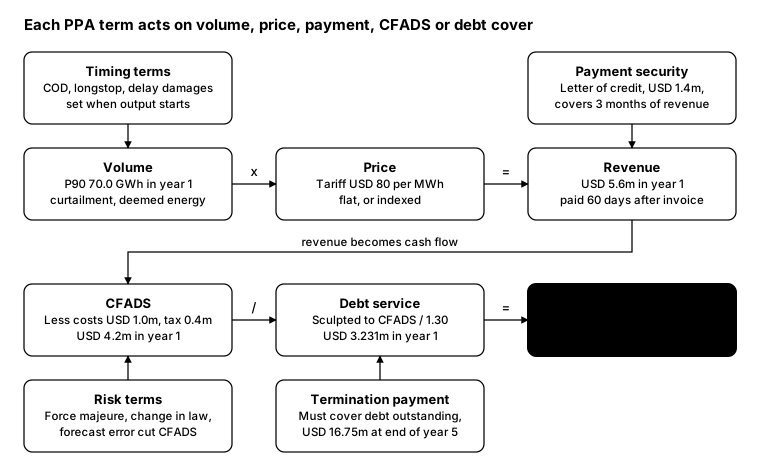
Timing and payment security act on revenue, risk terms act on CFADS, and the termination payment is compared with the debt that would still be outstanding. Lenders test the end of the chain, so every term in the glossary matters only through what it does to that ratio.
How do you use the glossary when you model a PPA?
Use the glossary as a checklist: place every term in the term sheet on the chain from volume to cover ratio, and give each one an input or a test.
- Sort each term in the term sheet into volume, price, timing, payment, risk or termination.
- Set the base volume at P90, apply degradation, and decide whether curtailed energy is paid as deemed energy.
- Apply the tariff, and add escalation or indexation only if the contract has it.
- Start revenue at COD, and run delay damages and the longstop date as separate what-if cases.
- Build the receivable from the payment period, and test the letter of credit against months of revenue.
- Subtract costs and tax to reach CFADS, size debt at the sizing DSCR, and check lock-up and default levels each year.
- Run force majeure, change in law and forecast error as cases, and compare the termination payment with debt outstanding.
What are the common mistakes?
- Mixing P50 and P90. Lenders size on P90, so a P50 revenue line overstates debt. In the example P90 gives DSCR 1.30x and a P50 year gives 1.45x.
- Assuming curtailed energy is paid. Deemed energy may be paid in full, in part or not at all. If nothing is paid for 5% curtailment in the example, DSCR falls from 1.30x to 1.21x.
- Treating the tariff as revenue. Revenue is tariff times paid volume, less any energy the contract does not pay for.
- Blurring the three DSCR levels. Sizing at 1.30x, lock-up at 1.20x and default at 1.10x do different jobs.
- Counting security as income. A letter of credit pays only on non-payment, and in the example it covers 3 months of revenue, USD 1.4m.
- Forgetting termination. A termination payment below debt outstanding leaves lenders short, for example USD 16.75m at the close of year 5.
- Assuming one template fits every contract. Public templates define COD, delay remedies and change in law differently, so read the clause before using the term.
Frequently asked questions
What is the difference between COD and the longstop date?
COD is the date the plant is ready to deliver power, and the target COD is the date the contract expects. The longstop date is the last date for COD, after which the buyer can end the contract or the seller is in default. In the example the invented longstop date is 6 months after the target date.
What is the difference between take or pay and deemed energy?
Take or pay is the buyer's duty to pay for available capacity even when it does not take the power. Deemed energy is the quantity of energy the contract treats as delivered for that payment. In the 5% curtailment case, 3.5 GWh is worth USD 0.28m a year.
Is DSCR the same as LLCR?
No. DSCR compares CFADS with debt service in one period, while LLCR compares the present value of CFADS over the loan life with debt outstanding. In the example both are 1.30x at financial close because the debt is sculpted to 1.30x.
What is the difference between P50 and P90?
P50 is the output level with a 50% chance of being exceeded, and P90 is the cautious level with a 90% chance. Lenders usually size debt on P90. In the example year 1 P50 is 76.0 GWh and P90 is 70.0 GWh.
Does a letter of credit remove payment risk?
No. It covers a fixed amount, so the buyer's non-payment is covered only for the months it was sized for. In the example the USD 1.4m letter of credit holds DSCR at 1.30x for 3 missed months, then it falls to 1.16x in month 4.
Sources
Pages opened on 5 October 2026. The example project is invented and has no source.
- PPA Glossary: Your PPA Knowledge Library, Pexapark. Used for pay-as-produced, P50, P90, COD, settlement risk, balancing and guarantee of origin.
- Utility-Scale Solar Power Purchase Agreements, Stoel Rives (United States). Used for COD, delay damages, term, curtailment, credit support, performance guarantee, termination payment and delivery point.
- SEIA C&I PPA, version 2.0, Solar Energy Industries Association (United States). Used for COD, contract price, termination payment, change in law and the optional performance guaranty.
- User's Guide for Power Purchase Agreements for Renewable Energy Facilities, Regional Center for Renewable Energy and Energy Efficiency (Arab region), hosted by the World Bank PPP Resource Center. Used for take or pay, deemed energy, curtailment, delay damages, credit support, force majeure, delivery point and metering.
- Standard Power Purchase Agreement (PPA), Solar Energy Corporation of India. Used for COD, delivery point, tariff, deemed generation and force majeure in a rooftop PPA with a government buyer.
- Standardised Synthetic PPA, Sample 1, World Bank PPP Resource Center (Spanish-law template). Used for longstop date, termination payment, change in law, force majeure and monthly settlement amount.
- Key Provisions of the Renewable Electricity Support Agreement, Round 3, Alberta Electric System Operator (Canada). Used for the COD deadline, termination right, day-for-day shortening of the support period, contract for difference payments, part-indexed strike price and designated change in law.
- I-REC and I-TRACK Certificates: Understanding the difference, I-TRACK Foundation (Netherlands). Used for the I-REC definition and the one MWh unit.
- Debt Service Coverage Ratio (DSCR): formula, meaning and use in project finance, Forvis Mazars. Used for DSCR, CFADS, lock-up, default, DSRA and LLCR.
- PF Basics Part 3: An overview of the DSCR, Numeritas (United Kingdom). Used for debt service, sculpting, default level, minimum and average DSCR.