How to read a solar PPA term sheet: a modeller's guide
By SolarQuant Editorial. Published 2026-10-05. Last updated 2026-10-05.
Every clause of a solar power purchase agreement term sheet is either a revenue input or a bankability test. This guide reads the clauses in the order a revenue model is built, and asks what each one changes in the model. It uses one invented 40 MWp plant throughout.
What example does this article use?
The example is an invented 40 MWp ground-mounted solar plant in no named market. One buyer takes the power at the plant substation, which is the delivery point, and pays in USD. The PPA runs for 20 years from the commercial operation date, after 12 months of construction.
Every figure below is invented. The model uses annual periods to keep the arithmetic visible; real deals usually use six-month periods.
| Item | Example figure |
|---|---|
| Plant | 40 MWp, ground-mounted, 12 months of construction |
| Contract | One buyer, 20-year PPA from the commercial operation date, USD |
| Delivery point | Plant substation |
| Year 1 generation, P90 | 70.0 GWh (1,750 kWh per kWp) |
| Year 1 generation, P50 | 76.0 GWh (1,900 kWh per kWp) |
| Degradation | 0.5% a year |
| P90 generation in year 12 and year 20 | 66.2 GWh and 63.6 GWh |
| Tariff | USD 80 per MWh (USD 0.08 per kWh), flat for 20 years |
| Revenue, lender's case (P90) | USD 5.6m in year 1, USD 5.30m in year 12, USD 5.09m in year 20 |
| Revenue over 20 years, P90 | USD 106.8m |
| Revenue in year 1, P50 | USD 6.08m |
| Payment terms | Monthly invoices, paid 60 days after invoice |
| Average monthly revenue | USD 0.467m |
| Receivable at 60 days | About USD 0.92m |
| Payment security | Letter of credit for 3 months of revenue, USD 1.4m |
| Year 1 operating costs and tax | USD 1.0m and USD 0.4m |
| Year 1 CFADS (cash flow available for debt service) | USD 4.2m, falling 0.5% a year |
| Total funding requirement | USD 40.0m |
| Gearing cap | 70:30, which allows USD 28.0m of debt |
| Senior debt | USD 25.1m over 12 years at 7.0%, sculpted to a 1.30x DSCR |
| Year 1 debt service | USD 3.231m |
| Gearing and equity | 62.7% and USD 14.9m |
| DSCR levels | Sizing 1.30x, lock-up 1.20x, default 1.10x |
The debt is sized by the debt service cover ratio (DSCR), not by the gearing cap. That is why every revenue clause in this guide moves the debt amount.
What is a PPA term sheet, and how binding is it?
A PPA term sheet, also called heads of terms, records the main commercial terms agreed in principle before the full contract is drafted. Pexapark describes term sheets as initial offers that hold only core commercial conditions: at least a price, a tenor and a PPA structure. Standard forms use a similar split: the EFET corporate PPA has individual terms and general provisions.
A fuller heads of terms goes further. One practitioner list covers the parties, start date, duration, volume and price type. It also covers the delivery point, conditions precedent, construction milestones and the commercial operation date.
Most of a term sheet is usually not legally binding. A UK guide to heads of terms says they are normally "subject to contract". Clauses on confidentiality, exclusivity, costs and governing law are often made binding.
A US law firm presentation adds that unclear drafting can still oblige the parties to negotiate in good faith. For the modeller, a term sheet figure is an assumption until the signed PPA confirms it. Record the document version and date beside every input.
Who are the parties, and why does the buyer's credit matter?
The parties are the seller, usually a project company, and the buyer, also called the offtaker or purchaser. The buyer's credit matters because the PPA is the project's main source of revenue. The handbook Understanding Power Purchase Agreements says lenders require other credit support where the offtaker is not creditworthy enough.
Public sources describe three broad buyer types. The table compares them on the same points; the last column is our reading.
| Buyer type | How public sources describe it | What lenders look at | What it changes in the model |
|---|---|---|---|
| Utility | Often a state-owned utility buying under the main project contract (World Bank). Around 20 years has been the typical term for US utility PPAs (Stoel Rives). | The utility's own credit, and support such as a letter of credit or a sovereign guarantee (IRENA). | Late payment cases, and whether payment security covers them. |
| Corporate buyer | A large energy user, such as heavy industry or a large corporation (EIB market study). Corporate buyers increasingly ask for terms of 15, 12 or 10 years (Stoel Rives). | Whether the buyer is investment grade, which the EIB study says banks require. Guarantees, letters of credit or cash collateral where credit is an issue (RCREEE). | A contract shorter than the plant's life, so later revenue is an assumption. |
| Trader or retailer | A company that buys and sells power on wholesale markets, or sells it to end users (EIB market study). | The same credit test, plus the volume structure: pay as produced or baseload (Pexapark). | Under baseload the seller carries the volume risk and must cover shortfalls. |
The example has one buyer and needs no buyer type. What matters is that the lender's case tests late payment against a letter of credit of USD 1.4m. The planned article "Utility, corporate and trader offtakers compared" takes the comparison further.
When does revenue start and stop?
Revenue starts at the commercial operation date and stops when the term ends or the contract is terminated early. Stoel Rives notes that this date often starts the delivery term and decides whether delay damages are owed.
Public contracts count the term in different ways. The Mexican auction PPA described by Clifford Chance sells electricity for 15 years from the commercial operations date. India's SECI standard PPA expires 25 years from the scheduled supply date. Our reading is that a late start can then shorten the paid period, unless that date is extended.
Delay has a price. The Open Solar Contracts guide describes liquidated damages for each day of delay, and a longstop date that triggers a seller default if missed. Stoel Rives describes delay damages capped at an agreed amount, and the SECI form allows at most 6 months of delay.
The handbook Understanding Power Purchase Agreements says deadlines are extended for force majeure, connection delay and the buyer's own breach.
In the example, a start 3 months late means USD 1.4m of revenue is not earned on time. Interest on the full loan for those months costs about USD 0.44m. Invented delay damages of USD 6,000 a day add USD 0.54m for 90 days.
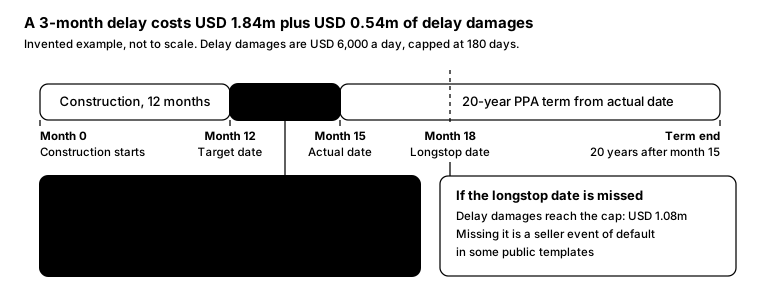
The invented longstop date sits 6 months after the target date, close to the 180-day damages cap of USD 1.08m. A 3-month delay uses half of that window. The planned article "The commercial operation date, longstop dates and delay damages" covers the clauses in detail.
How much energy is sold?
The energy sold is the metered output at the delivery point, up to any limit the contract sets. The model needs four inputs: the yield case, the degradation rate, the delivery point and any cap on the energy the buyer must take.
The yield comes from the energy study, not from the term sheet. NREL defines a P50 estimate as the annual generation met or exceeded in 50% of years, and P90 as the 90% level. It notes that banks often ask for these estimates to judge the risk to debt service.
The delivery point decides who bears losses and grid charges. Stoel Rives says title and risk of loss pass there, usually at the high side of the plant transformer in a busbar sale. The SECI form puts charges and losses up to the delivery point on the seller, who also installs the main and check meters there.
Some contracts cap the energy bought. The SECI form does not oblige the buyer to take energy above 110% of the declared capacity factor.
In the example, the lender's case uses P90: 70.0 GWh in year 1, falling to 66.2 GWh in year 12. A P50 year gives 76.0 GWh, revenue of USD 6.08m, CFADS of USD 4.68m and a DSCR of 1.45x. The delivery point is the plant substation, so no grid losses or grid charges sit between the meter and the invoice.
The planned article "Delivery point, metering and grid charges" covers losses and charges.
What price is paid?
The price is the tariff per MWh. The term sheet should say whether it is flat, escalating or indexed, and in which currency it is set and paid. The RCREEE user's guide notes that prices may stay flat, escalate or de-escalate over the life of the project.
| Variant | Public example | Model inputs |
|---|---|---|
| Flat | The SECI form fixes one tariff for the entire term. | One price. |
| Escalating | A price that steps up at the start of each contract year (Stoel Rives). An NREL checklist from 2009 cites escalators of usually 2% to 5% for US public sites. | Start price, rate, date of first step. |
| Indexed | The Mexican auction PPA pays in pesos, with an option to index to the peso to US dollar rate or to inflation (Clifford Chance). | Index, share indexed, reference date. |
| Corporate structures | A fixed price rising with inflation, or a floating price with a cap and floor (Norton Rose Fulbright). | Price curve, cap and floor. |
The handbook says PPA payments are most often made in the currency of the debt. Otherwise the project needs hedging, or indexation with a true-up. The earlier article "Currency risk in a solar power purchase agreement: denominated versus paid, local-currency security and the FX true-up" covers this.
In the example, the tariff is USD 80 per MWh, flat for 20 years. Each USD 1 per MWh changes year 1 revenue by USD 0.07m. The chart holds costs and tax at the base case, which is a simplification.
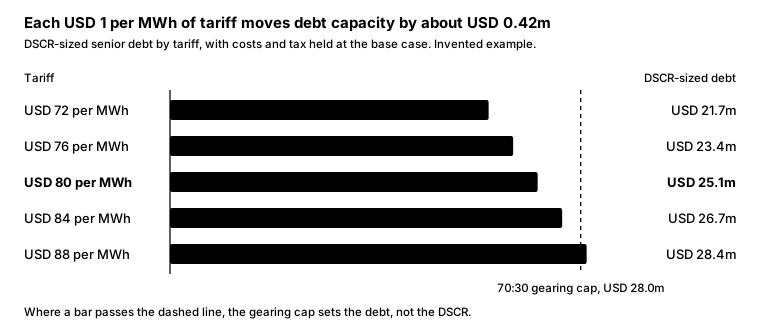
Debt capacity follows the tariff until the 70:30 gearing cap binds, above about USD 87 per MWh. Below that level, a tariff concession in negotiation is also a debt concession.
An escalating variant changes the shape. Starting at USD 80 and rising 2.0% a year, the tariff reaches USD 99.47 in year 12 and USD 116.54 in year 20. P90 revenue is then USD 6.59m in year 12 and USD 129.4m over 20 years, against USD 106.8m flat.
With costs and tax held, DSCR sizing would support about USD 28.4m, so the USD 28.0m gearing cap binds. The earlier article "Debt sizing for solar projects: gearing cap versus DSCR sculpting" explains that switch. The planned article "Tariff and escalation in a solar PPA" covers the price clauses.
What happens when the buyer or the grid cannot take the power?
The term sheet should say whether the buyer pays for energy the plant could have produced but could not deliver. Public guides call the structure take or pay, and the payment for undelivered energy a deemed energy payment. Without it, the seller carries the curtailment risk.
A US government guide to bankable PPAs describes two structures. Under take or pay, the buyer pays a capacity charge for available capacity, dispatched or not. Under take and pay, the buyer pays for energy delivered, and for curtailed energy on a deemed delivered basis.
| Variant | Where it is described |
|---|---|
| Paid whenever the plant could produce | The Open Solar Contracts guide: deemed energy payments are due if the seller can produce and the buyer cannot or does not take the power. |
| Paid only for the buyer's own choice | The RCREEE user's guide: some contracts pay whatever the reason, others only when the purchaser used a discretionary curtailment right. |
| Paid above an allowance | The SECI form: compensation only for grid unavailability beyond 175 hours in a contract year. Stoel Rives: buyers often negotiate some uncompensated curtailment. |
| Carve-outs | The SECI form: no compensation where output is backed down for grid security or safety. Stoel Rives: congestion beyond the delivery point is often allocated to the seller. |
| Not paid | Jones Day on Vietnam's 2017 model solar PPA: no deemed availability payment if the buyer cannot take the electricity. |
The deemed volume also needs a method. The RCREEE guide says parties usually calculate it from resource data for the curtailment period and the plant's power curve.
In the example, the grid cannot take 5% of year 1 P90 output: 3.5 GWh, worth USD 0.28m. If deemed energy is paid in full, revenue is unchanged; if nothing is paid, CFADS falls to USD 3.92m. Under an invented allowance, where the first 2% of annual output lost is unpaid, the loss is USD 0.112m.
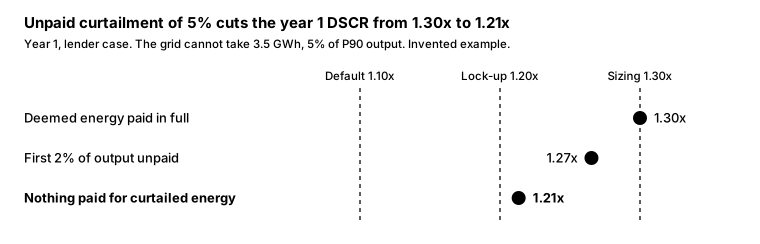
Unpaid curtailment of 5% leaves the DSCR just above the 1.20x lock-up level, so a slightly worse year would block distributions. The earlier article "The cover ratio ladder: sizing, lock-up and default DSCR explained" covers those levels. The planned article "Take or pay and deemed energy in a solar PPA" covers the clause.
When is cash actually received?
Cash arrives after the invoice period plus the payment days, and only if the buyer pays. The handbook Understanding Power Purchase Agreements says billing should be frequent enough, monthly or even every two weeks, to limit unpaid energy. That also keeps debt service on schedule.
Payment days differ between public forms. The RCREEE model makes payment due within 30 days of the invoice date, and notes that billing dispute procedures are often included. The SECI form sets the due date at the 45th day after the bill is received, then adds a late payment surcharge.
Payment security stands behind the invoice. Public sources describe several instruments.
| Instrument | How public sources describe it |
|---|---|
| Letter of credit | A bank pays if the buyer does not. The SECI form uses a revolving letter of credit of 110% of average monthly billing, drawn for undisputed unpaid bills. IRENA notes the bank may ask the buyer for collateral of up to 100% of the amount. |
| Escrow account | The buyer places money in an account controlled jointly with the seller (IRENA). |
| Sovereign guarantee | A government guarantees that the obligation will be met if the buyer defaults (IRENA). In the Mexican auction PPA, the buyer's obligations were not guaranteed by the federal government (Clifford Chance). |
| Liquidity facility or fund | A third party provides the collateral behind the letter of credit (IRENA). The SECI form adds a payment security fund. |
In the example, invoices are monthly and paid 60 days after invoice. Average monthly revenue is USD 0.467m, so the receivable at 60 days is about USD 0.92m. The model must fund that receivable before the first cash arrives.
The letter of credit covers 3 months of revenue, USD 1.4m. Our reading is that this roughly matches the exposure. When the first invoice falls overdue, about three months of energy has been delivered and not paid.
The planned articles "Invoicing and payment terms in a solar PPA" and "Offtaker payment security in a solar PPA" cover both clauses.
What does the seller promise?
The seller usually promises a level of output or availability, and pays damages if the plant falls short. Stoel Rives describes an output guarantee as a payment to the buyer when output over a set period misses a set level. Output lost to force majeure, curtailment and agreed maintenance is excluded first.
Stoel Rives describes availability guarantees, with mechanical availability usually set at 90 to 95 percent, and output guarantees priced per MWh of shortfall. The SECI form sets a minimum annual energy starting at 85% of the declared capacity factor. Its penalty is 1.5 times the tariff on the shortfall.
Stoel Rives also notes that some PPAs let the buyer terminate if output stays below a stated minimum for several years.
In the example, an invented guarantee covers 85% of P50 output: 64.6 GWh in year 1. Damages are USD 30 per MWh, so a year at 62.0 GWh costs USD 0.078m on a 2.6 GWh shortfall. P90 output of 70.0 GWh is above the guaranteed level, so the lender's case pays nothing.
Our reading is that the guarantee must be tested against degradation. If the guaranteed level did not step down, P90 output of 63.6 GWh in year 20 would fall below 64.6 GWh. The planned article "Performance guarantees in a solar PPA" covers the variants.
Who bears events outside the parties' control?
Force majeure and change in law clauses decide who bears events that neither party controls. They matter to the model because each remedy lands on a different line: time, tariff or termination.
Force majeure normally excuses performance. The World Bank notes that the project company is typically relieved of its obligations, and of damages, for disruption caused by force majeure. A World Bank sample clause excludes payment obligations from that relief.
Templates often split the events by cause. The Open Solar Contracts guide divides them into governmental force majeure and other force majeure, and values a termination differently for each. Jones Day noted that the examples in Vietnam's 2017 model PPA did not cover political force majeure.
Change in law clauses protect the price. The World Bank says a PPA should address the tariff effect of a change in law and the mechanism for adjusting it. The US government guide to bankable PPAs adds that lenders typically expect the buyer to carry this risk.
| Remedy | What public sources describe | Model line |
|---|---|---|
| Relief | No breach and no damages while the event lasts (World Bank, RCREEE). | Revenue stops, penalties do not apply. |
| Extension | Deadlines extended for force majeure (handbook). RCREEE notes extensions need not be day for day. | Start date or end date moves. |
| Tariff adjustment | Financial terms modified to restore the initial equilibrium (Open Solar Contracts). The Mexican auction PPA adjusted the price only once costs passed 2% of the annual fixed price (Clifford Chance). | Tariff, or a cost the seller absorbs up to a threshold. |
| Termination | Either party may end the contract after prolonged force majeure (World Bank sample clause). | Termination payment test. |
The example has no force majeure case, but our reading is that the model should test one long outage. Revenue stops, debt service continues, and the term either extends or does not. The planned articles "Force majeure in a solar PPA" and "Change in law in a solar PPA" cover each clause.
What happens if the contract ends early?
If the PPA ends early, the project loses its revenue, so lenders ask what the buyer must pay on termination. The World Bank calls the availability and calculation of an early termination payment central to bankability.
Termination follows an event of default that is not cured. Stoel Rives lists the usual events: failure to pay, other material defaults, insolvency and failure to provide credit support. Cure periods differ; the Mexican auction PPA gave 10 days for a payment default (Clifford Chance).
Lenders get their own protection through a direct agreement between the buyer, the project company and the lenders. The handbook says it covers the buyer's consent to the lenders' security over the PPA, and their step-in rights. The World Bank's project finance page adds notice requirements and cure periods; the Mexican form gave lenders up to 180 days to cure.
The payment depends on the cause.
| Cause | Variants in public sources |
|---|---|
| Seller default | Debt outstanding plus termination costs, less account balances and insurance proceeds (Hunton, on sub-Saharan Africa). Or no payment to the seller: the buyer instead receives a penalty equal to the seller's performance guarantee (Mexican auction PPA). |
| Buyer default | The same, plus the sponsors' equity and a return on it, less distributions (Hunton). Or one year of payments, then the present value of the remaining payments (Mexican auction PPA). Or the value of the past year's output (Vietnam's 2017 model PPA, per Jones Day). |
| Prolonged force majeure | Some of the buyer default elements, as negotiated (Hunton). Debt and termination costs, with equity added only for governmental force majeure (Open Solar Contracts). Or no payment by the buyer (Mexican auction PPA). |
In the model, compare the termination payment with senior debt outstanding at each period end. In the example, debt outstanding at the end of year 5 is USD 16.75m. A payment of one year of revenue, one of the weaker variants above, would be USD 5.49m.
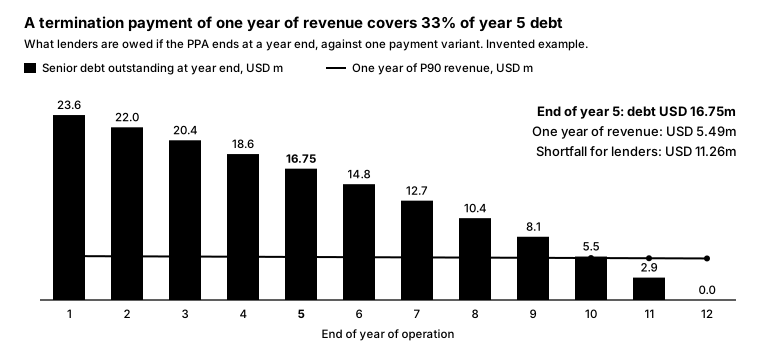
One year of revenue covers the debt only from the end of year 11. A payment built on debt outstanding covers lenders in every year. The planned articles "PPA termination payments" and "Events of default, cure periods and the direct agreement" go further.
Who owns the environmental attributes?
Environmental attributes are the credits and benefits that arise because the plant avoids emissions, such as renewable energy certificates and offsets. The term sheet should say whether they pass to the buyer with the energy or stay with the seller.
The RCREEE user's guide says green credits and renewable energy credits can be allocated between the parties. An NREL checklist for US public sites says certificates generally stay with the system owner unless the host negotiates to buy them. Norton Rose Fulbright notes that a corporate buyer usually needs the certificates to show its power is renewable.
The Mexican auction PPA sold clean energy certificates for 20 years, against 15 years for electricity (Clifford Chance). The Open Solar Contracts leave green rights and credits outside their scope. Stoel Rives adds that sellers usually warrant title to the attributes, not their future value.
In the model, our reading is this. If the attributes pass with the energy, the tariff is the whole price and no extra line is needed. If the seller keeps them, they are a separate revenue line with its own price risk.
The example models no certificate or carbon revenue. The planned article "Environmental attributes under a solar PPA" covers the clause.
What should you check before you model?
Before building anything, read the term sheet for gaps. This section is our reading, not a sourced rule. Early term sheets tend to carry three kinds of problem.
- Blanks. Figures are left in square brackets or marked "to be agreed". They are often the ones that matter most: the tariff, the delay damages rate, the security amount.
- Broken cross-references. A clause points to a schedule, definition or clause number that is missing or has been renumbered.
- Limits that overlap or conflict. A damages cap, a longstop date and a curtailment allowance may be stated in different units or periods.
The example shows the third kind. The invented delay damages cap is 180 days, and the invented longstop date is 6 months after the target date. The two nearly coincide, but 180 days and 6 months are not the same count.
List every gap as an open question, with the assumption the model uses meanwhile. Check the conditions precedent too: the handbook notes that some PPAs only take effect once preset conditions are met. The planned article "PPA conditions precedent" covers them.
How do you turn the term sheet into model inputs?
Read the clauses in the order the revenue line is built, and give each one an input cell and a source reference. Seven steps cover a solar PPA term sheet.
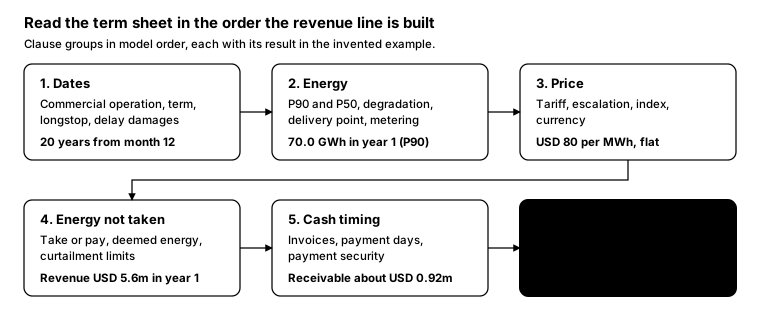
The first three groups give contract revenue. The next two decide how much of it becomes cash, and when. The last group tests what the lenders can lose.
- Set the dates. Enter the target commercial operation date, the term, the event it runs from and the longstop date.
- Set the energy. Use P90 for the lender's case, then add degradation, losses to the delivery point and any cap on energy bought.
- Set the price. Build a tariff for every year from the start price, the escalation or index, and the currency.
- Compute contract revenue. Multiply energy by tariff: 70.0 GWh at USD 80 per MWh gives USD 5.6m in year 1.
- Adjust for energy not taken. Add deemed energy payments where the contract grants them, and deduct unpaid curtailment in a downside case.
- Time the cash. Apply the invoice period and payment days to get the receivable. Treat payment security as cover for late payment, not as revenue.
- Run the tests. Test delay, a low yield year, curtailment, late payment, guarantee damages, and termination at each period end.
Revenue less operating costs and tax gives CFADS, which sizes the debt. The first pillar of this series covers that half: "How to read a solar project finance term sheet: a modeller's guide".
Which clauses belong on the checklist?
Sixteen items cover a solar PPA term sheet. Each row gives the model input, the bankability test and the planned article in this series that covers it.
| Clause | Model input | Bankability test | Article in this series |
|---|---|---|---|
| Parties and buyer credit | Late payment and default cases | Is the buyer creditworthy, or supported? | Utility, corporate and trader offtakers compared |
| Conditions precedent | Date the contract takes effect | Can every condition be met in time? | PPA conditions precedent |
| Commercial operation, longstop, delay damages | First revenue date, damages per day, cap | Does the longstop leave room for a realistic delay? | The commercial operation date, longstop dates and delay damages |
| Delivery point and metering | Losses and charges up to the meter | Who bears grid losses and charges? | Delivery point, metering and grid charges |
| Forecasting and scheduling | Deviation or imbalance costs | Who pays when output differs from the schedule? | Forecasting and scheduling under a solar PPA |
| Tariff and escalation | Price per MWh for each year | Does P90 revenue cover debt service? | Tariff and escalation in a solar PPA |
| Take or pay and deemed energy | Paid share of curtailed energy | Is curtailment paid, and above what allowance? | Take or pay and deemed energy in a solar PPA |
| Invoicing and payment | Payment days and receivable | Does cash arrive before debt service dates? | Invoicing and payment terms in a solar PPA |
| Payment security | Amount and months covered | Does it cover the unpaid exposure? | Offtaker payment security in a solar PPA |
| Performance guarantees | Guaranteed level and damages rate | Do damages bite in a low yield case? | Performance guarantees in a solar PPA |
| Force majeure | Outage case and term extension | Is the term extended, and is a long event paid out? | Force majeure in a solar PPA |
| Change in law | Tariff adjustment and threshold | Is the seller made whole? | Change in law in a solar PPA |
| Default, cure and direct agreement | Cure periods | Do lenders get notice, time to cure and step-in rights? | Events of default, cure periods and the direct agreement |
| Termination payments | Payment by cause and by year | Does the payment cover debt outstanding? | PPA termination payments |
| Environmental attributes | Separate revenue line, or none | Who owns the certificates and credits? | Environmental attributes under a solar PPA |
| Defined terms | Labels that match the contract | Do the model and the term sheet use the same terms? | Solar PPA glossary |
Forecasting and scheduling has no section above. Our reading is that it adds a cost and rarely changes the revenue line. The SECI form makes the seller responsible for scheduling and for deviation charges. Pexapark describes balancing risk as the cost of the gap between scheduled and actual output.
What are the common mistakes?
Seven mistakes recur when a PPA term sheet is turned into a model.
- Treating the term sheet as the contract. Its figures are assumptions until the signed PPA confirms them.
- Starting the term on the wrong date. A term that runs from a scheduled date can lose paid months when operation is late.
- Sizing debt on P50 energy. Lenders size on P90. In the example, a P50 year lifts the DSCR to 1.45x, which is cushion and not debt capacity.
- Assuming all curtailment is paid. Allowances and carve-outs leave part of the loss with the seller.
- Booking revenue as cash. With 60-day terms, the example carries a receivable of about USD 0.92m.
- Counting payment security as revenue. A letter of credit covers a delay; it does not replace a buyer who stops paying.
- Ignoring the termination payment. A payment below debt outstanding leaves lenders short, whatever the tariff.
Frequently asked questions
Is a PPA term sheet legally binding?
Usually only in part. Public guides on heads of terms say the commercial terms are normally "subject to contract". Clauses on confidentiality, exclusivity, costs and governing law are often made binding.
What is the difference between take or pay and take and pay?
Under take or pay, the buyer pays for available capacity whether or not it takes the power. Under take and pay, the buyer pays for energy delivered. Curtailed energy is then paid on a deemed delivered basis, if the contract provides for it.
Why do lenders use P90 and not P50?
P90 is the annual generation the plant should meet or exceed in 90% of years, so it is the more cautious case. In the example, P90 is 70.0 GWh and P50 is 76.0 GWh in year 1. Debt sized on P90 shows a 1.30x DSCR in a P90 year and 1.45x in a P50 year.
What is a direct agreement?
A direct agreement is a contract between the buyer, the project company and the lenders. Public sources say it records the buyer's consent to the lenders' security over the PPA. It also gives lenders notice of a default, time to cure it, and step-in rights.
How long is a solar PPA?
Practice varies. Public sources cite around 20 years for US utility PPAs and 25 years in India's SECI form. A Mexican auction PPA sold electricity for 15 years, and corporate buyers often ask for shorter terms.
Sources
Pages opened on 5 October 2026. The example project is invented and has no source.
- Power Purchase Agreements (PPAs) and Energy Purchase Agreements (EPAs), World Bank PPP Resource Center. Definition of a PPA, force majeure relief, change in law and the role of termination payments.
- Key Issues in Developing Project Financed Transactions, World Bank PPP Resource Center. Direct agreements, step-in rights and cure periods.
- Sample Force Majeure Clauses, World Bank PPP Resource Center. Relief that excludes payment obligations, and termination after prolonged force majeure.
- Understanding Power Purchase Agreements, second edition, US Commercial Law Development Program with Power Africa and the African Legal Support Facility. Buyer credit support, billing frequency, currency, deadline extensions, conditions for effectiveness and the direct agreement.
- A Guide to Open Solar Contracts, IRENA and Terrawatt Initiative. Take or pay and deemed energy payments, delay damages, the longstop date, the two kinds of force majeure, change in law and purchase price by cause.
- User's Guide for the PPA Model for Electricity Generated from Renewable Energy Facilities, Regional Center for Renewable Energy and Energy Efficiency (RCREEE). Curtailment payment variants, price shapes, the 30-day payment term, credit support and ownership of green credits.
- 10 Important Features of Bankable Power Purchase Agreements for Renewable Energy Power Projects, Overseas Private Investment Corporation and other US agencies. Take or pay against take and pay, and who carries change in law risk.
- Power Purchase Agreements: Utility-Scale Projects, Stoel Rives, The Law of Solar. Term, commercial operation date, delivery point, pricing, curtailment, output and availability guarantees, defaults and environmental attributes.
- Standard Power Purchase Agreement for procurement of solar power on a long term basis, Solar Energy Corporation of India. Term, fixed tariff, energy limits, the 175-hour threshold, the due date, the letter of credit, metering and scheduling.
- Mexico's Second Auction: PPA Features and Bankability Considerations, Clifford Chance. Term, indexation, cure periods, change in law threshold, termination payments and clean energy certificates.
- Calculating Termination Payments and Purchase Prices, Hunton Andrews Kurth. Termination payment components by cause.
- Vietnam's New Solar PPA: Strong Developer Interest Despite Bankability Concerns, Jones Day. A model PPA with no deemed payment, a limited termination payment and no political force majeure.
- Commercial Power Purchase Agreements: A Market Study, Baringa Partners for the European Investment Bank. Buyer types and the investment grade requirement.
- Corporate renewable PPAs: A framework for the future?, Norton Rose Fulbright. Corporate price structures and green certificates.
- What is a PPA? The Guide to Power Purchase Agreements, Pexapark. Term sheets, pay as produced and baseload structures, and balancing risk.
- EFET Power Purchase Agreement, European Federation of Energy Traders. The standard corporate PPA and its two parts.
- Renewable Energy Finance Brief 01: Sovereign Guarantees, IRENA. Letters of credit, escrow accounts, sovereign guarantees and liquidity facilities.
- Power Purchase Agreement Checklist for State and Local Governments, National Renewable Energy Laboratory. Price escalators and ownership of renewable energy certificates.
- Capturing Inter-Annual Variability of PV Energy Production in South Asia, National Renewable Energy Laboratory. Definitions of P50 and P90.
- PPA Head of Terms, Future Energy Go. Contents of a PPA heads of terms.
- Head of Terms Meaning, Sprintlaw UK. Which heads of terms clauses are usually binding.
- Term Sheets, Letters of Intent and Other "Non-Binding" Pre-Deal Documents, WilmerHale for the Association of Corporate Counsel. The risk of a duty to negotiate in good faith.