Force majeure in a solar PPA: who bears the risk when events stop deliveries
By SolarQuant Editorial. Published 2026-10-05. Last updated 2026-10-05.
Force majeure clauses decide who carries the cost when events outside a party's control stop a solar plant selling power. For a modeller the questions are whether the buyer still pays, whether the term is extended, and when the contract can end. Lenders test the same clause, because an unpaid outage can push cover ratios below the default level.
What example does this article use?
The example is an invented 40 MWp ground-mounted solar plant in no named market. One buyer takes the power at the plant substation, which is the delivery point, and pays in USD under a 20-year PPA that starts at the commercial operation date. Construction takes 12 months. Every figure below is invented, and the 60 day outage is a what-if case added for this article.
Senior debt is sized so that debt service in each year equals CFADS divided by 1.30x. We use annual periods for simplicity. Real deals usually use six-month periods.
| Item | Example figure (all invented) |
|---|---|
| Plant and contract | 40 MWp, one buyer, 20-year PPA, USD tariff of USD 80 per MWh, flat |
| Year 1 generation | P90 70.0 GWh; degradation 0.5% a year |
| Year 3 generation | P90 69.30 GWh |
| Revenue, lender's case (P90) | Year 1 USD 5.6m; year 3 USD 5.544m |
| Payment | Monthly invoices, paid 60 days after invoice |
| Payment security | Letter of credit from the buyer's bank, 3 months of revenue, USD 1.4m |
| Year 1 costs | Operating costs USD 1.0m, tax USD 0.4m |
| CFADS | Year 1 USD 4.2m; year 3 USD 4.158m |
| Funding | Total USD 40.0m; senior debt USD 25.1m (62.7% gearing); equity USD 14.9m |
| Senior debt | 12 years, 7.0% all-in rate, sculpted at 1.30x |
| Debt service, year 3 | USD 3.198m |
| Debt outstanding | End of year 3 USD 20.371m; end of year 5 USD 16.75m |
| DSCR levels | Sizing 1.30x, lock-up 1.20x, default 1.10x |
| What-if case (invented) | A 60 day interruption to deliveries in year 3 |
Later sections refer to this as the example. Costs and tax are held at the base case in every what-if.
What is force majeure in a solar PPA?
Force majeure in a solar PPA is a clause that excuses a party from an obligation when an event beyond its reasonable control prevents performance. The clause excuses performance. Whether payment continues is a separate drafting choice.
The feed-in tariff solar PPA of the Long Island Lighting Company (LIPA) in the United States defines force majeure as an event that prevents a party from performing and is not in that party's reasonable control. The New Jersey Division of Purchase and Property form says a party using commercially reasonable efforts that cannot perform "shall be excused from the performance affected by the Force Majeure event".
Public forms define the term in different ways:
- A list of examples plus a catch-all. The LIPA form lists acts of nature, war, terrorism, epidemic and strikes, and adds other similar causes beyond the party's control.
- A general test split into two named groups. The Jordanian standard solar PV PPA defines force majeure as any circumstance, event or condition beyond the reasonable control of the affected party. It then sorts events into Government Force Majeure and Other Force Majeure.
The same forms say what does not count. The LIPA form excludes financial incapacity, a better price elsewhere, and the seller's inability to obtain financing, permits or equipment. The Jordanian form says "a reduction in solar irradiation or the occurrence of other meteorological conditions shall not be considered a Force Majeure".
A UK legal guide to renewable PPAs warns of a tension when predictable weather downtime is not clearly carved out of an availability guarantee. In our reading, this is why a modeller should check the carve-outs before treating any outage as force majeure. Ordinary weather is already inside the P90 generation estimate, so it is not an outage event.
What is the difference between political and natural force majeure?
Natural force majeure covers acts of nature such as floods, earthquakes and storms. Political force majeure covers war, civil unrest and similar events with a political cause. Public documents draw the line in different places, so the table shows each one separately.
| Source and region | How events are grouped | What it adds |
|---|---|---|
| World Bank force majeure checklist, global guidance | Natural events (earthquakes, floods, fire, plague, Acts of God) and political and special events (terrorism, riots, war, strikes, contamination) | Says special risks are generally uninsurable under normal commercial conditions, and that change of law is often dealt with separately |
| World Bank Group recommended PPP provisions, global guidance | Natural events (storm, earthquake, flood, drought and others) and political events such as war and terrorism, in each case occurring outside the country | Keeps events inside the country out of the political group |
| Model PPA for cross-border electricity trade (IRADe), South Asia | Article 10.3.1 lists political events (war, riot, terrorism, sabotage) and natural events (lightning, flood, earthquake, epidemic) | Both groups sit inside one force majeure definition |
| Standard solar PV PPA of Jordan, Middle East | Government Force Majeure and Other Force Majeure as separate defined terms | Government Force Majeure includes acts of war within Jordan and nationwide strikes of a political nature |
| Vietnam solar PPA rules (Circular 16, as analysed by Jones Day), Asia | Any unforeseeable and objectively non-remediable event | The listed examples do not cover political force majeure |
The split matters because some contracts treat the two groups differently for payment, as the next section shows. Where the examples omit political events, as in the Vietnam rules, the general test has to carry them.
In the example, the cause of the 60 day outage decides which payment case applies. A flood is natural. A blockade of the delivery point by the state is political. We would record the cause as an input to the model, not assume it.
Does the buyer keep paying during force majeure?
That depends on the contract, and public guidance says it must be written down. The World Bank force majeure checklist asks "to what extent (if any) should the contractor continue to be paid even where it is unable to perform its obligations" and says the answer should be expressly stated.
Public documents show three ways to answer:
- No payment for the lost output. The World Bank Group recommended PPP provisions say a force majeure event should not let the private partner claim for the costs it incurs. Consequences are to be shared between the parties.
- Payment for energy that could not be delivered, for some causes only. In the Jordanian standard solar PV PPA, the buyer pays for each kWh not received where its own breach, Government Force Majeure or a grid failure stops delivery to the delivery point.
- A reduced payment to keep the project alive. For availability-based contracts, the World Bank Group provisions say the authority may consider reducing payments to an amount equal to debt service plus an amount sufficient to cover fixed operating costs, but not variable cost or profit.
One model contract also protects what is already owed. The cross-border model PPA from IRADe says neither party is relieved of liabilities accrued before the event began. In our reading, invoices already issued stay payable, so cash from the lost period falls away only after the 60 day payment lag.
The example shows what the first two answers do to the 60 day outage in year 3. Both cases are invented what-ifs on the same plant.
| Payment case (invented what-if) | Year 3 revenue | CFADS | DSCR |
|---|---|---|---|
| Base case, no outage | USD 5.544m | USD 4.158m | 1.30x |
| No payment for the 60 days | USD 4.633m, loss of USD 0.911m | USD 3.247m | 1.02x, below the 1.10x default level |
| Energy not delivered is paid in full | USD 5.544m | USD 4.158m | 1.30x |
The sibling article "Take or pay and deemed energy in a solar PPA: who pays when the power is not taken" covers how deemed energy is measured. The reduced-payment variant needs a split of costs into fixed and variable, which the example does not make.
When can a party end the PPA for prolonged force majeure?
A prolonged force majeure clause lets a party end the PPA when an event has lasted beyond a set period. The period, and what counts towards it, differ between public documents.
- Continuous period. The IRADe cross-border model PPA treats force majeure lasting a continuous period of 12 consecutive months as Extended Force Majeure. Either party may then end the agreement on seven days written notice.
- Days within a year. The New Jersey solar PPA form allows termination if an event continues for 180 days or more within a twelve month period and prevents a material part of performance. The party not claiming force majeure holds the right.
- Complete prevention. The LIPA form lets the party not claiming force majeure terminate if an event completely preventing delivery continues for more than one year.
- A range left to negotiate. The World Bank Group recommended PPP provisions bracket a period of 180 to 360 calendar days and a notice that takes effect 30 calendar days after receipt. Either party may terminate.
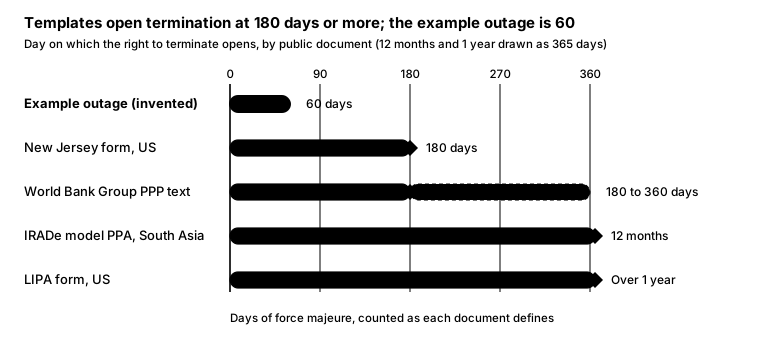
All four documents place the right to terminate at 180 days or later. The 60 day outage in the example opens no right to end the PPA under any of them, yet it still strains cover ratios.
Term extension is a separate question. The LIPA form extends the target commercial operation date day for day while force majeure continues. The IRADe model extends the expiry date one day for each day only if the event takes place before the scheduled delivery date. The RCREEE user's guide for Arab states says extensions for force majeure delay should not necessarily be day for day, because a short delay can cost a construction window.
In our reading, an extension helps lenders little once the plant operates. In the example, a one-for-one extension adds revenue only after year 20, long after the 12 year senior debt is repaid. It does not restore the cash lost in year 3.
What the buyer pays on termination is a third variant:
- Nothing beyond accrued amounts. The IRADe model ends the agreement "without any further liability to either Party". The New Jersey form says "without fault or further liability to either Party (except for amounts accrued but unpaid)".
- Debt and part of the equity. The World Bank Group provisions have the contracting authority pay outstanding senior debt, a bracketed percentage of initial equity and subordinated debt, redundancy costs and sub-contractor breakage costs.
In the example, if the PPA ended at the close of year 5, senior debt outstanding would be USD 16.75m. Under the first variant nothing in the PPA repays it. Under the second, that debt is paid first. The sibling articles "PPA termination payments" and "Events of default, cure periods and the direct agreement" cover this in more depth.
How do lenders treat force majeure?
Lenders treat force majeure as a source of uncertainty and test it in two places: the wording of the clause and the cover ratios. The World Bank force majeure checklist says "Lenders do not like force majeure as it creates a level of uncertainty for them." It adds that lenders "will want to ensure that the definition and treatment of force majeure is identical in each of the project contracts."
Lender rights over the PPA sit in a direct agreement. The World Bank Group recommended PPP provisions say lenders "will still want to see a clear undertaking from the Contracting Authority to agree and enter into a Direct Agreement and a recognition of their step-in rights." Jones Day's note on Vietnam's solar PPA rules says Circular 16 does not contemplate lenders' step-in rights, which have to be negotiated separately.
The cover ratio test follows the payment case from the earlier section. We use the three levels from "The cover ratio ladder: sizing, lock-up and default DSCR explained": 1.30x, 1.20x and 1.10x.
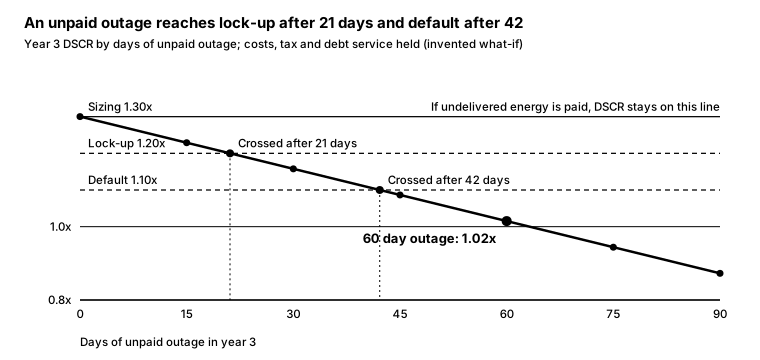
With no payment for lost energy, year 3 cover falls below the 1.20x lock-up level after about 21 days of outage. It falls below the 1.10x default level after about 42 days. The 60 day outage in the example ends at 1.02x, while payment for undelivered energy keeps the ratio at 1.30x.
Insurance may fill part of the gap, but not all of it. The World Bank checklist says special risks "generally represent those risks which are uninsurable under normal commercial conditions" and that political risk insurance "may be available" from private insurers, multilateral organisations such as the World Bank and MIGA, or export credit agencies. The example has no insurance income, so any such cash would be a separate input with its own timing.
How do you model force majeure?
Model force majeure as a downside case with its own switches, not as a line in the base case. The steps below follow the example.
- Record the clause variants. Note the list of events, whether political events form a separate group, and the exclusions such as weather and financial inability.
- Set the cause as an input. Use a switch for natural or political, because the payment rule may differ between the two.
- Choose the payment case for each cause. Pick one of: nothing paid, undelivered energy paid, or a reduced payment.
- Compute the lost revenue and the stressed cover ratio. In year t, with an outage of d days, use the formula below. In the example, year 3 revenue R is USD 5.544m and 60 days costs USD 0.911m.
- Solve for the outage length at each cover level. Set the stressed ratio equal to k, where k is 1.20x or 1.10x, and solve for d. In the example this gives about 21 and 42 days.
- Shift the cash. With invoices paid 60 days after issue, the cash shortfall in our reading arrives about 60 days after the outage, so check it against the liquidity of the period it lands in.
- Test the termination threshold. Compare the outage length with the threshold in the term sheet, and compare any termination payment with senior debt outstanding, USD 16.75m at the end of year 5.
- Keep any term extension out of debt capacity. An extension adds revenue only after the debt has been repaid.
Here p is the share of lost revenue the buyer pays: 0 when nothing is paid and 1 when undelivered energy is paid in full. Costs and tax are held at the base case. Real deals test six-month periods, so a 60 day outage weighs more heavily in the period it falls in than the annual figure shows.
What are the common mistakes?
- Treating every outage as force majeure. The LIPA form says a forced outage is not force majeure unless an event of force majeure caused or worsened it. The Jordanian form excludes low irradiation and other weather conditions.
- Assuming the buyer keeps paying. The World Bank checklist says the extent of continued payment should be expressly stated. A model that pays revenue through an outage assumes a clause the contract may not contain.
- Using one payment case for every cause. The Jordanian form ties payment for undelivered energy to named causes. Model the cause, then the rule.
- Counting a term extension as recovery. In the example, extra days land after year 20, long after the 12 year debt is repaid.
- Ignoring how the threshold counts days. One document counts a continuous period, another counts days within a year, and a third needs complete prevention of delivery.
- Forgetting the termination gap. Under two of the variants, nothing beyond accrued amounts is due. At the close of year 5, USD 16.75m of senior debt would be outstanding.
- Reading the annual ratio only. In our reading, a 60 day outage inside one six-month period weighs more on that period than on the year.
Frequently asked questions
Is a pandemic force majeure?
Often it is listed. The LIPA form, the IRADe model PPA and the New Jersey form all name epidemics, and the World Bank Group provisions list plague and epidemic among natural events. A UK legal guide says pandemics and cyber events are increasingly common additions to the list.
Does a poor sunshine year count as force majeure?
The Jordanian standard form says a reduction in solar irradiation or other meteorological conditions is not force majeure. In our reading, ordinary weather sits inside the P90 estimate, so the model should not treat it as an outage event.
Can a grid failure be force majeure?
It can, depending on the wording. The LIPA form includes interruption of transmission or distribution caused by a physical emergency condition, and excludes congestion-related or economic curtailment. The Jordanian form pays for energy not received where a grid failure stops delivery.
Is the buyer's inability to pay force majeure?
Not under the two United States forms. The LIPA form excludes a party's financial incapacity, and the New Jersey form excludes financial inability from its catch-all cause. Payment risk is handled by security, covered in "Offtaker payment security in a solar PPA: letters of credit, guarantees and what lenders test".
Who can terminate after a prolonged event?
Practice varies. The New Jersey and LIPA forms give the right to the party not claiming force majeure, while the IRADe model and the World Bank Group provisions let either party terminate.
Is change in law the same as force majeure?
Not always. The World Bank checklist lists change of law among political events but notes it is often dealt with separately. See "Change in law in a solar PPA" in this series.
Sources
Pages opened on 5 October 2026. The example project is invented and has no source.
- Force Majeure Checklist, World Bank PPP Resource Center. Natural and political event groups, the open question on payment during force majeure, maximum period, lender views, insurance.
- World Bank Group Report on Recommended PPP Contractual Provisions, World Bank Group. External political events, no cost claims, reduced payments, prolonged force majeure termination period and compensation, direct agreements.
- Power Purchase Agreement for Cross-Border Electricity Trade, IRADe, South Asia. Political and natural events, accrued liabilities, term extension, Extended Force Majeure after 12 months.
- Power Purchase Agreement between the National Electric Power Company and a project company, Ministry of Energy and Mineral Resources, Jordan. Government and Other Force Majeure, weather exclusion, payment for energy not received.
- Feed-in Tariff Solar Power Purchase Agreement, Long Island Lighting Company (LIPA), United States. Definition, exclusions, day for day extension of the target commercial operation date, termination after one year of complete prevention.
- Solar Power Purchase Agreement form, State of New Jersey Division of Purchase and Property, United States. Excuse from performance, financial inability, termination after 180 days within twelve months.
- Vietnam's New Solar PPA: Strong Developer Interest Despite Bankability Concerns, Jones Day, Vietnam. Definition without political examples, lender step-in rights.
- User's Guide for the Power Purchase Agreement (PPA) Model for Electricity Generated from Renewable Energy Facilities, RCREEE, Arab region. Force majeure extensions of milestones.
- Renewable Energy PPAs (Power Purchase Agreements): A Legal Guide, Michael Edwards, United Kingdom. Typical force majeure events and the weather and availability guarantee tension.