Invoicing and payment terms in a solar PPA: invoice cycle, late interest, set-off and working capital
By SolarQuant Editorial. Published 2026-10-05. Last updated 2026-10-05.
Invoicing terms decide when revenue becomes cash. In the example, a 60 day payment period leaves about USD 0.92m owed to the plant at any time. Read as cash, that gap alone takes year 1 cover to about 1.02x. This article sets out the variants seen in public contracts and what each changes in the model.
What example does this article use?
The example is an invented 40 MWp ground-mounted solar plant in no named market. One buyer takes all the power at the plant substation, the delivery point, and pays in USD under a 20-year PPA from the commercial operation date. Construction takes 12 months.
The buyer is invoiced monthly and pays 60 days after the invoice. A letter of credit from the buyer's bank covers 3 months of revenue. Lenders size senior debt at a 1.30x DSCR. The example uses annual periods for simplicity; real deals usually use six-month periods. All figures are invented and are lender's case (P90) unless stated.
| Item | Example figure |
|---|---|
| Plant and contract | 40 MWp, one buyer, delivery at the substation, 20-year PPA from the commercial operation date |
| Year 1 generation | P90 70.0 GWh; P50 76.0 GWh |
| Degradation | 0.5% a year |
| Tariff | USD 80 per MWh, flat for 20 years |
| Revenue, lender's case | USD 5.6m in year 1; USD 106.8m over 20 years |
| Payment terms | Monthly invoices, paid 60 days after invoice |
| Average monthly revenue | USD 0.467m |
| Receivable at 60 days | About USD 0.92m |
| Payment security | Letter of credit for 3 months of revenue, USD 1.4m |
| Year 1 costs and tax | Operating costs USD 1.0m; tax USD 0.4m |
| CFADS, year 1 | USD 4.2m (later years: 4.2 x 0.995 to the power of year minus 1) |
| Funding | Total USD 40.0m; senior debt USD 25.1m (62.7% gearing, so the DSCR binds, not the 70:30 cap of USD 28.0m); equity USD 14.9m |
| Senior debt | 12 years, 7.0% all-in, sculpted to CFADS divided by 1.30; year 1 debt service USD 3.231m |
| DSCR levels | Sizing 1.30x; lock-up 1.20x; default 1.10x |
Later sections refer to this case as the example.
What does the invoice cycle look like?
The invoice cycle is the sequence from metered delivery to cash: meter reading, invoice, payment period and receipt. Sources vary on the length of each step, as the next sections show.
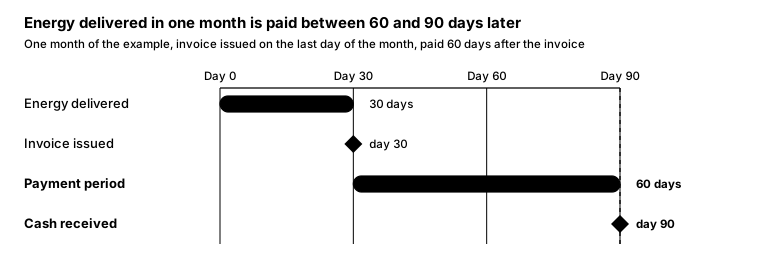
The first energy delivered in a month waits about 90 days for cash, and the last waits 60. This assumes the invoice goes out on the last day of the month; a later invoice lengthens the wait day for day.
The SECI power sale agreement bills on provisional energy of the preceding month, so a final reading can leave a correction for a later invoice. The model should show the metered quantity as the invoice basis.
How many days does the buyer have to pay?
The payment period is the time between the invoice and the date cash is due. Public contracts and laws set it in different ways, so the model should take it from the contract, not from habit.
| Source | Scope | When the invoice is issued | When payment is due |
|---|---|---|---|
| World Bank PPA template | Generic model for public-private power projects | Within 25 days after the end of each month | Within 21 days of receipt of each monthly invoice |
| SECI power sale agreement | India, central buyer | First business day of the month, for the preceding month | Within 30 days of presentation of the bill |
| FirstEnergy form of PPA | United States, utility solar tender | Seller invoices by the 15th of the month | Invoices are accumulated over a 60 day period and settled on the first business day of the month after it |
| Directive 2011/7/EU | European Union, commercial transactions in general, not a PPA | Not specified | 30 calendar days after receipt of the invoice; a contract period above 60 days only if expressly agreed |
Some contracts also pay for speed. The SECI agreement gives the buyer a rebate of 1.5% for payment within five days of the bill and 1% up to the due date. A rebate trades revenue for earlier cash.
What it changes in the model. The receivable is revenue multiplied by the days outstanding, divided by 365. In the example, each extra day of payment period adds about USD 0.015m of receivable (USD 5.6m divided by 365).
The rebate in the example. Suppose the buyer paid within five days and took a 1.5% rebate. This is a what-if using the SECI rebate and day count. The plant would give up USD 0.084m of year 1 revenue to bring cash forward by about 55 days from the 60 day case.
The common mistake. Counting the payment days from the end of the delivery month when the contract counts them from the invoice. Any delay in issuing the invoice then adds to the wait, which is why the invoice timing belongs in the model beside the payment days.
What happens to a disputed amount?
A disputed amount is the part of an invoice that one party challenges in writing. The contract says how long the challenge may take to raise and whether the rest of the invoice must still be paid. Public sources show three different answers.
- Short notice, disputed part withheld. The World Bank PPA template asks for a dispute notice within 14 days of receiving the invoice. It states that "Neither Party shall be required to pay a disputed amount pending resolution of the dispute."
- Short notice, silence is final. The SECI power sale agreement (India) gives the buyer 15 days. A bill not disputed in that time is "conclusive and binding", and the buyer pays the undisputed amount.
- Long window, undisputed part paid. The FirstEnergy form of PPA (United States) lets either party dispute an invoice within twelve months of its date. Each party "shall remain obligated to pay any undisputed amounts pending resolution".
What it changes in the model. The first variant can hold back cash for the disputed part. The long window means a paid invoice can be reopened up to a year later, so an invoice is not final cash on the day it is paid.
The example. Take an invented case where 12% of one monthly invoice is disputed. That is USD 0.056m held back, while USD 0.411m of the USD 0.467m invoice is paid on the due date. This is small beside the receivable, but it compounds if the same issue recurs each month.
The common mistake. Treating the whole invoice as unpaid during a dispute. Most variants above leave the undisputed part payable.
How is late payment interest set?
Late payment interest is the charge on an amount not paid by its due date. Sources set the rate as a spread over a benchmark, with or without a ceiling or a step-up.
| Source | Scope | How the rate is set |
|---|---|---|
| World Bank PPA template | Generic model | Daily interest at the greater of a rate left in brackets or the maximum lawful rate |
| FirstEnergy form of PPA | United States | 2% over the prime lending rate published in the Wall Street Journal, never above the maximum lawful rate |
| SECI power sale agreement | India | Base rate tied to a State Bank of India lending rate plus five percent; rises 0.5 percent for every month of delay, and never more than 3 percent above the base rate |
| Pakistan energy purchase agreement | Pakistan, wind project template | KIBOR or LIBOR plus 4.5% a year, compounded semi-annually |
| Directive 2011/7/EU | European Union, commercial transactions in general | Simple interest at the reference rate plus at least eight percentage points |
What it changes in the model. Little, in the base case. Late interest compensates a breach, so a base case should not count it as revenue. Its value is as a deterrent, and a payment that stays unpaid also points to the default terms in Events of default, cure periods and the direct agreement.
The example. Take one invented late payment: the USD 0.467m monthly invoice paid 18 days late at an invented 10% a year. Interest is about USD 0.0023m. At the 7.0% senior debt rate the same delay costs the plant about USD 0.0016m, so that invented rate more than covers the funding cost.
The common mistake. Treating late interest as protection against non-payment. It covers the cost of a short delay, not a missed month. With no security, one missed month already moves year 1 cover from 1.30x to 1.16x, which is why Offtaker payment security in a solar PPA: letters of credit, guarantees and what lenders test matters more than the interest rate.
What is set-off, and does the buyer have it?
Set-off lets one party deduct an amount the other owes it from an amount it owes the other. Two public templates take opposite positions.
- No set-off. The World Bank PPA template says that "Payments for electrical energy provided by either Party to the other Party shall not be subject to any set-off."
- Set-off of undisputed amounts. The FirstEnergy form of PPA says each party "shall have the right to set-off any undisputed amounts owed by the other Party" against undisputed amounts it owes.
What it changes in the model. With set-off, the cash received in a month can be lower than the invoice, because the buyer nets other charges against it. Without set-off, the invoice is paid in full and the other charge is settled separately.
The example. Use the output guarantee damages from the example: an invented USD 30 per MWh on a 2.6 GWh shortfall, USD 0.078m. With set-off, the buyer could net this against a USD 0.467m invoice and pay USD 0.389m. Without set-off, the plant pays the damages separately and the invoice is paid in full. See Performance guarantees in a solar PPA.
The common mistake. Modelling every invoice as paid in full on the due date. Where set-off exists, the model should net known charges, such as damages, against the invoice that is open when they arise.
Which currency are invoices paid in?
The payment currency is the currency in which the buyer settles each invoice. It may be the tariff currency, a hard currency or the local one, and public sources show both ends.
- One agreed currency for all payments. The World Bank PPA template says all payments "shall be calculated and paid in [agreed currency]", leaving the currency to the parties.
- Local currency. The SECI power sale agreement (India) states that "All Tariff Payments by the Buying Entity shall be in Indian Rupees."
The example is simpler: the buyer pays in USD. Currency risk then sits in the buyer's ability to find USD, which is a credit question covered in Currency risk in a solar power purchase agreement: denominated versus paid, local-currency security and the FX true-up.
What it changes in the model. If invoices were paid in local currency without a true-up, the receivable would carry exchange rate risk for every day it is outstanding. In the example, an invented 5% weaker local currency would cut USD revenue by USD 0.28m a year, and the same move would cut the USD 0.92m receivable by about USD 0.046m.
The common mistake. Running the whole model in USD while the contract pays in local currency. The invoice date and the payment date then sit in different exchange rates.
What does the payment period do to working capital?
Working capital here is the cash the plant carries between delivering energy and being paid. The receivable is revenue not yet received: revenue multiplied by the payment days, divided by 365.
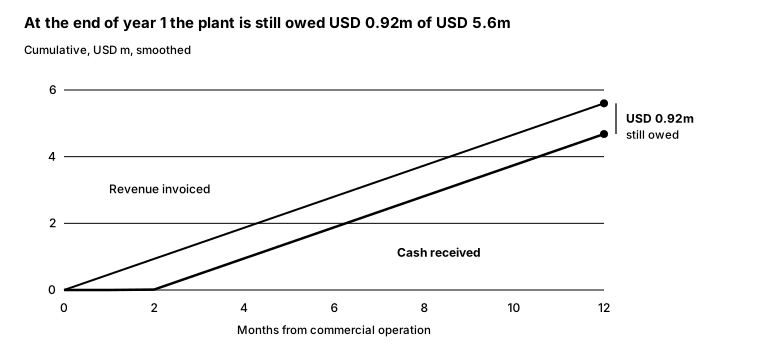
In year 1 the plant invoices USD 5.6m but has received only USD 4.68m, because cash lags invoices by about two months. The lines are smoothed; real invoices arrive monthly.
The year 1 cash view. The 60 day receivable is about USD 0.92m (USD 5.6m x 60 / 365). Our reading: if year 1 CFADS is tested as cash received, with no opening receivable, it falls from USD 4.2m to USD 3.28m. Against debt service of USD 3.231m that is 1.02x, below the 1.10x default level.
Whether lenders test cash or invoiced revenue is a term sheet point. A working capital line funded by equity or a facility can cover the build. The table varies the payment period as invented what-ifs on the same plant. Costs, tax and debt service are held at the base case, and the receivable starts at zero.
| Payment period (days, invented what-ifs) | Receivable (USD m) | Year 1 CFADS read as cash (USD m) | Year 1 DSCR on that cash | Cost of funding the receivable at 7.0% (USD m a year) |
|---|---|---|---|---|
| 30 | 0.46 | 3.74 | 1.16x | 0.03 |
| 45 | 0.69 | 3.51 | 1.09x | 0.05 |
| 60 (the example) | 0.92 | 3.28 | 1.02x | 0.06 |
| 90 | 1.38 | 2.82 | 0.87x | 0.10 |
Later years. The build happens once. After that the receivable moves with revenue, so with 0.5% degradation it releases only about USD 0.005m in year 2.
Link to payment security. Our reading: just before the oldest invoice is paid, the buyer owes two invoices and the month in progress, about 3 months of revenue or USD 1.4m. That is the cover of the letter of credit in the example.
How do you model it?
Model invoicing as a timing layer between revenue and cash, with each contract variant as a separate switch. Work in this order.
- Set the invoice basis. Use metered energy times the tariff for each month, and enter the days from month end to the invoice.
- Set the payment period. Enter the days from the invoice to the due date. Treat any early payment rebate as a deduction from revenue, with its own switch.
- Build the receivable. Compute it as revenue times payment days divided by 365, and lag cash receipts by the invoice and payment days. In the example the receivable is about USD 0.92m.
- Choose the test basis. Decide whether the DSCR uses invoiced revenue or cash received. If cash, show the first receivable build as a use of funds, covered by equity, a working capital line or first-year cash.
- Add the optional flows, off in the base case. These are late interest, disputed amounts held back and set-off of known charges such as damages.
- Match the currency. Keep invoices, tariff and debt in the currency the contract pays, and add an exchange rate line if they differ.
- Test the security. Compare the peak amount owed, payment days plus the month in progress, with the letter of credit. In the example that is about 3 months against a 3 month letter of credit.
What are the common mistakes?
- Copying one template's terms. The public sources in this article give payment periods from 21 to 60 days and dispute windows from 14 days to 12 months. The signed contract decides, not a template.
- Letting the letter of credit fall behind the payment period. In an invented 90 day what-if, the buyer could owe three invoices plus the month in progress, about 4 months or USD 1.87m, against the 3 month letter of credit of USD 1.4m.
- Ignoring the last receivable. Revenue in year 20 is USD 5.09m, so about USD 0.84m is still unpaid when the PPA ends. That cash arrives after the term, so the final cash flows lag.
- Counting the receivable build as a loss. The USD 0.92m is delayed revenue, not lost revenue. It reverses when the PPA ends, but it must be funded in the meantime.
- Netting everything. Apply set-off only where the contract grants it, and only to amounts that are undisputed.
Frequently asked questions
What is the usual payment period in a solar PPA?
Public sources show no single period. The World Bank template uses 21 days from receipt, the SECI agreement 30 days from the bill, and the FirstEnergy form a 60 day accumulation period. Take the number from the signed contract.
Is late payment interest part of project revenue?
No, not in a base case. It compensates a late payment, so the model can show it as an optional flow that is off by default. In the example, a late invoice at an invented 10% a year earns about USD 0.0023m.
Can the buyer withhold part of an invoice?
It depends on the variant. The World Bank template says no party must pay a disputed amount pending resolution. The SECI and FirstEnergy documents require the undisputed part to be paid.
Does a longer payment period reduce debt capacity?
Our reading: only if the lenders test cash, or if the first receivable build is not funded elsewhere. In the invented what-ifs, moving from 30 to 90 days takes year 1 cash cover from 1.16x to 0.87x. The effect is a one-off build, not a permanent loss of revenue.
How do payment days relate to the letter of credit?
Our reading: the peak amount owed is the payment days plus the month in progress. In the example that is about 3 months, the same as the 3 month letter of credit. See Offtaker payment security in a solar PPA: letters of credit, guarantees and what lenders test for how lenders test it.
Where does set-off appear in the model?
It appears as a deduction from cash receipts when the contract allows set-off of undisputed amounts. Where the contract bars set-off, the model keeps the invoice whole and shows the charge as a separate payment.
Sources
Pages opened on 5 October 2026. The example project is invented and has no source.
- Power purchase agreement template, World Bank Public-Private Partnership Group. Invoice timing, payment days, dispute notice, set-off, late interest and currency clauses.
- Power Sale Agreement for sale of solar power on long term basis, Solar Energy Corporation of India. Monthly bill timing, due date, early payment rebate, late payment surcharge, 15 day dispute window and payment in rupees.
- Form of Power Purchase Agreement, Appendix 1, FirstEnergy (United States solar tender). Invoice date, accumulation period, interest rate, set-off and 12 month dispute window.
- Pakistan power purchase agreement, wind project, World Bank Public-Private Partnership Group. The delayed payment rate only.
- Directive 2011/7/EU on combating late payment in commercial transactions, European Union, via legislation.gov.uk. Payment period and statutory late interest.