PPA termination payments: debt-based, fair-value and lost-revenue approaches
By SolarQuant Editorial. Published 2026-10-05. Last updated 2026-10-05.
A termination payment is the sum one party pays when a solar PPA ends early. Public contracts set it in different ways, and the choice decides whether lenders are repaid in full. In the example below, ending the PPA at the close of year 5 leaves USD 16.75m of senior debt against one year of P90 revenue of USD 5.49m.
What example does this article use?
The example is an invented 40 MWp ground-mounted solar plant in no named market. One buyer takes the power at the plant substation and pays in USD under a 20-year PPA that starts at the commercial operation date. Senior debt is sized so that debt service equals cash flow available for debt service (CFADS) divided by 1.30x, and we ask what happens if the PPA ends at the close of year 5.
| Item | Figure (all invented) |
|---|---|
| Plant | 40 MWp, ground-mounted, one buyer at the substation, paid in USD |
| PPA term | 20 years from commercial operation; construction takes 12 months |
| Year 1 generation | P90 70.0 GWh; P50 76.0 GWh |
| Degradation | 0.5% a year, so generation in year t = year 1 x 0.995^(t-1) |
| Tariff | USD 80 per MWh, flat for 20 years |
| Revenue, lender's case (P90) | USD 5.6m in year 1; USD 5.49m in year 5; USD 5.09m in year 20; USD 106.8m over 20 years |
| Year 1 costs | Operating costs USD 1.0m; tax USD 0.4m |
| CFADS | USD 4.2m in year 1; CFADS in year t = 4.2 x 0.995^(t-1) |
| Funding | USD 40.0m in total; a 70:30 gearing cap would allow USD 28.0m of debt |
| Senior debt | USD 25.1m (62.7% gearing), repaid over 12 years after construction at an all-in rate of 7.0%; debt service in year t = CFADS / 1.30 |
| Equity | USD 14.9m |
| DSCR levels | Sizing 1.30x; lock-up 1.20x; default 1.10x |
| Senior debt at the close of year 5 | USD 16.75m |
| One year of P90 revenue at the close of year 5 | USD 5.49m |
Periods are annual for simplicity. Real deals usually use six-month periods.
What is a termination payment in a solar PPA?
A termination payment is the sum one party pays the other when a PPA ends before its full term. It stands in for the tariff payments that the early end cuts off, or for the loss that the early end causes. Public contracts and guides set it in different ways, so the clause matters more than the label.
Three kinds of event lead to it: buyer default, seller default and no-fault termination, such as a prolonged force majeure event. The World Bank Group's recommended provisions for public-private partnership (PPP) contracts give each case its own compensation clause. That template is general, not solar specific, but its structure is widely copied.
For the list of default events and cure periods, see Events of default, cure periods and the direct agreement. For no-fault events, see Force majeure in a solar PPA and Change in law in a solar PPA.
Who pays when a solar PPA ends early?
The direction of payment depends on who caused the end. Usually the defaulting party compensates the other, and a no-fault end shares the loss. Public sources differ on how far each rule goes, so we show them as separate variants.
Buyer default. In the standard rooftop solar PPA published by India's Solar Energy Corporation (SECI), the seller may end the contract and choose between two remedies. In the World Bank Group template, the contracting authority pays the private partner a sum that starts with outstanding senior debt. Egypt's model PPA between a generator and a purchaser instead nets the non-defaulting party's losses against its gains.
Seller default. Under the SECI model, the seller pays the buyer damages worth six months of charges, or the balance of the PPA period if that is shorter. In the World Bank Group template, the contracting authority still pays the private partner, but only a percentage of outstanding senior debt. A California utility PPA filed with the state regulator applies the same losses-and-gains test to either party.
No-fault termination. The World Bank Group template covers prolonged force majeure with its own clause: outstanding senior debt plus a share of initial equity and some costs. It explains that the risk of a force majeure event is beyond the control of the parties and should not be allocated to a single party. The same template pays a change in law termination like an authority default.
How do debt-based, fair-value and lost-revenue approaches differ?
Public sources set the termination amount in three main ways: from the debt outstanding, from the market value of the contract, or from the revenue the seller loses. Each variant below comes from a different page, and they are not one package. A real PPA picks its own mix, so read the clause, not the label.
| Approach | Public source | What the clause pays | Who it protects |
|---|---|---|---|
| Debt-based, full | India, SECI rooftop PPA, buyer default, option (i) | Debt Due plus 110% of Adjusted Equity, less insurance; buyer takes the assets | Lenders and sponsor |
| Debt-based, full | World Bank Group PPP template, authority default | Outstanding senior debt, costs, initial equity, subordinated debt and an equity return | Lenders and sponsor |
| Debt-based, haircut | World Bank Group PPP template, private partner default | [80 to 85]% of outstanding senior debt | Lenders, in part |
| Losses and gains | California utility PPA | Present value of economic loss or gain over the remaining delivery term | Non-defaulting party |
| Losses and gains | Egypt, model PPA | Losses less Gains, plus unpaid amounts | Non-defaulting party |
| Lost revenue, damages | Vietnam, FiT 2 model PPA | Actual and direct loss up to the end of the contractual term | Seller |
| Lost revenue, fixed | India, SECI rooftop PPA, buyer default, option (ii) | Six months of charges, or the balance of the term if shorter; seller keeps the assets | Seller |
| Lost revenue, penalty | Colombia, 2018 draft long-term PPA | 20% of contracted energy multiplied by its price | Seller |
What is a debt-based termination payment?
A debt-based termination payment is sized to repay senior lenders, usually from the debt outstanding at the termination date. Three variants appear in the public sources.
In the SECI rooftop PPA, the seller may serve a fifteen day notice and require the buyer to take over the project assets. The buyer then pays "the amount of the Debt Due and 110% (one hundred and ten per cent) of the Adjusted Equity less Insurance Cover, if any" (clause 12.2(b)). Debt Due is the principal and other sums outstanding on the transfer date.
In the World Bank Group template, a contracting authority default pays outstanding senior debt, redundancy payments, sub-contractor breakage costs, initial equity and subordinated debt. It then adds equity compensation, with three alternatives: an amount that delivers the base case equity IRR, the open market sale value of the shares, or the NPV of forecast distributions.
When the private partner defaults, the same template pays only "[80 to 85]% of the Outstanding Senior Debt". It gives this reason: "The haircut on Outstanding Senior Debt is used to ensure that Lenders will have an interest in conducting proper due diligence and monitoring the PPP Project." The percentage sits in square brackets, so the template leaves it open.
What is a fair-value or losses-and-gains termination payment?
A losses-and-gains payment values the contract at the termination date. The non-defaulting party calculates what it lost or gained over the remaining term, and the net amount is paid.
A California utility PPA, filed with the state regulator, defines Losses as "an amount equal to the present value of the economic loss to it, if any (exclusive of Costs), resulting from the termination of the Transaction for the remaining Delivery Term, determined in a commercially reasonable manner". Gains are defined in mirror words. In our reading, the result moves with market prices and not with the loan balance.
Egypt's model PPA sets the termination amount as Losses less Gains, increased by any unpaid amounts owed to the non-defaulting party. It defines Gains as the present value of the economic benefit to the non-defaulting party, determined in a commercially reasonable manner.
What is a lost-revenue termination payment?
A lost-revenue payment compensates the seller for income that the early end removes. The three public variants differ widely in reach.
The SECI rooftop PPA offers the seller a second option on buyer default: "damages, equivalent to 6 (six) months, or balance PPA period whichever is less, of charges for its contracted capacity", with the seller keeping the project assets. A law firm note on Vietnam's FiT 2 model PPA says the amount is "the damages (i.e., the actual and direct loss) incurred by the power seller accumulated until the 'end of contractual term.'" The same note warns that such a limited payment "may not be able to cover the power seller's investment costs, outstanding debts, as well as expected return on equity capital."
A 2018 article on the Colombian ministry's first draft of a long-term PPA says the energy buyer pays "una cláusula penal equivalente al 20 % del valor que resulte de multiplicar la energía contratada por el precio de esta". That is, a penalty of 20% of the value of contracted energy multiplied by its price.
What does a termination payment mean for lenders?
For lenders, a termination payment is the cash that repays senior debt if the PPA ends early. What matters is whether the payment at each date is at least the debt then outstanding.
In the example, the loan balance falls slowly because debt service is sculpted to CFADS. One year of P90 revenue would cover only about 33% of the debt at the close of year 5, leaving USD 11.26m short.
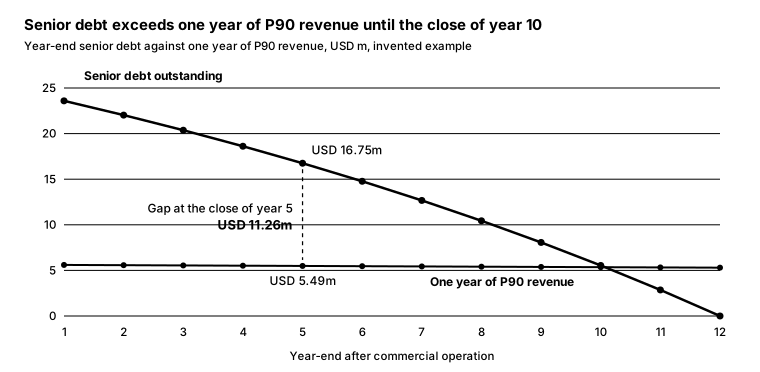
A payment of one year of revenue would not cover the debt until the close of year 11. Early termination is the costly case, because the balance is still high and the plant has run for only a few years.
The second chart applies each public variant to the same date. The 80% and 85% haircuts are applied to USD 16.75m of debt, which leaves shortfalls of USD 3.35m and USD 2.51m. Six months of revenue is applied by analogy, as six months of year 5 P90 revenue, because the SECI wording refers to charges for contracted capacity.
For the Colombian variant, we apply 20% to the remaining P90 revenue of years 6 to 20, which is USD 79.1m. That base is our assumption.
For losses and gains, we multiply P90 energy for years 6 to 20 by the tariff minus an invented market price. We discount at an invented 7.0%, the same as the loan rate.
For the Vietnamese variant, we read the end of the contractual term as the end of year 20. We discount the lost CFADS at the same 7.0%.
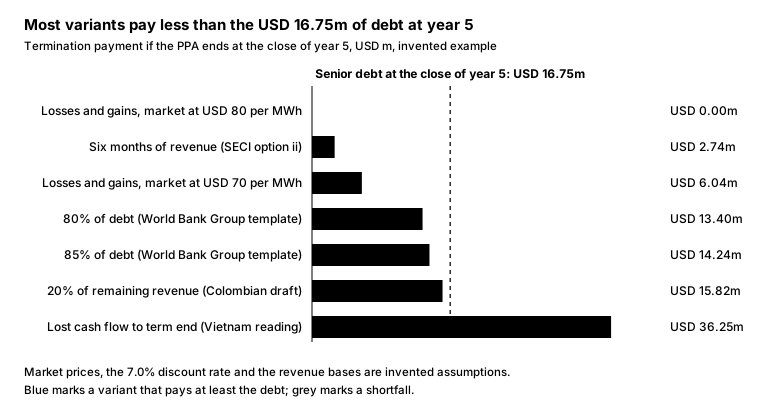
Debt-based clauses track the loan balance, so the shortfall is nil or a chosen haircut. Losses-and-gains clauses track the market, so the payment can be zero when the market price equals the tariff. A lost-revenue clause can fall far short or far above the debt, depending on the period it covers.
Payment security matters as much as the formula. A 2018 article on the Colombian draft says that, after consulting international banks, a guarantee covering four months of energy supply looked insufficient. It adds that the guarantee should also cover the eventual termination payment to the generator. For the security side, see Offtaker payment security in a solar PPA: letters of credit, guarantees and what lenders test.
A 2024 article on bankability in Kazakhstan states that the PPA "should list early termination events and a clear methodology for determining termination payments." Lenders read that methodology line by line, because it decides how much of the loan balance a default leaves unpaid.
How do you model a termination payment?
Model the payment as a row beside the debt balance, one value per period end, so the shortfall is visible at every date.
- Name the variant for each trigger. Record the clause for buyer default, seller default and no-fault termination separately, and note whether it is debt-based, losses and gains, or lost revenue.
- Build the debt balance. Take the senior debt closing balance at each period end, plus any accrued interest and costs that the clause's debt definition adds. In the example, the balance at the close of year 5 is USD 16.751m.
- Apply the clause formula at each date. For a debt-based clause, multiply the balance by the stated percentage. For a lost-revenue clause, take the stated months or share of revenue. For losses and gains, discount the price gap times P90 energy over the remaining term.
- Compute the shortfall. Subtract the payment from the debt at each date and mark the largest gap. In the example, a payment of one year of P90 revenue leaves USD 17.99m short at the close of year 1 and USD 11.26m short at the close of year 5.
- Stress the market-based variants. Run a low, a central and a high market price, because a gain can reduce the payment to zero. Label these prices as assumptions.
- Report it with the DSCR results. Show the shortfall row beside the cover ratios, so a reader sees both the cash flow test and the exit test.
The two formulas below use year t as the termination date and 20 as the last year of the PPA.
In the second formula, E is P90 energy in year s and r is the discount rate. A negative result is a gain to the seller.
What are the common mistakes?
- Reading the label as the formula. The SECI rooftop PPA gives the seller two different remedies on buyer default, one debt-based and one a fixed share of revenue. "Termination payment" alone tells a modeller nothing.
- Treating one year of revenue as enough. In the example it covers about 33% of the debt at the close of year 5.
- Assuming a market-based payment covers the debt. When the market price equals the tariff, the loss in a losses-and-gains clause is zero, while the debt is USD 16.75m.
- Forgetting the seller default haircut. A template that pays [80 to 85]% of outstanding senior debt leaves lenders USD 2.51m to USD 3.35m short in the example.
- Reading the end of the term loosely. The Vietnamese note says it is unclear whether the end of the contractual term means the termination date or the original end of the term.
- Leaving the termination payment out of the security. The Colombian article says a guarantee should cover the eventual termination payment, not only the periodic price.
- Using one date only. The shortfall changes every period, so test every period end, not just the year the sponsor expects to be at risk.
Frequently asked questions
Is a termination payment the same as liquidated damages?
Not always. Egypt's model PPA calls the sum a Termination Amount, and the Colombian draft uses a penalty clause. The name matters less than the formula, which can be debt-based, market-based or a share of revenue.
Does a termination payment always cover the senior debt?
No. The SECI rooftop PPA offers a debt-based option and a six-month revenue option. In the example, six months of year 5 revenue is USD 2.74m against USD 16.75m of debt.
Why would a template pay lenders less than the full debt?
The World Bank Group template gives a reason for its haircut on private partner default. It says the haircut ensures that lenders have an interest in conducting proper due diligence and monitoring the project. The percentage is left in square brackets for negotiation.
How is a termination payment secured?
A letter of credit or guarantee can cover it, but only if its terms say so. The Colombian article says a guarantee should cover the eventual termination payment, not only the periodic price. See Offtaker payment security in a solar PPA: letters of credit, guarantees and what lenders test.
How does a termination payment relate to the DSCR?
The DSCR tests whether cash flow covers debt service in each period. The termination payment tests whether one sum covers the debt balance when the contract ends. A loan sized at 1.30x can still be exposed on termination, as the year 5 gap shows. See The cover ratio ladder: sizing, lock-up and default DSCR explained.
Sources
Pages opened on 5 October 2026. The example project is invented and has no source.
- Standard Power Purchase Agreement (PPA) for rooftop solar, Solar Energy Corporation of India, India. Buyer default options in clause 12.2(b), the six month damages wording and the Debt Due and Adjusted Equity definitions.
- World Bank Group Report on Recommended PPP Contractual Provisions, World Bank Group, international. Compensation on authority default, private partner default and force majeure termination, and the haircut rationale.
- Ivanpah Unit I power purchase agreement, filed with the California Public Utilities Commission, United States. Definitions of Losses and Gains.
- Model Power Purchase Agreement, Egyptian Electric Utility and Consumer Protection Regulatory Agency, Egypt. Clause 11.2 on the Termination Amount and the definitions of Losses and Gains.
- Vietnam: New circular revising model power purchase agreements (PPAs) for FiT 2 solar farms and rooftop solar, Lexology, Vietnam. Termination payment on buyer default and the ambiguity in the end of the contractual term.
- Bancabilidad del Proyecto de Contrato PPA para proyectos de energía renovable, Ámbito Jurídico, by Juan Fernando Gaviria, 27 September 2018, Colombia. The 20% penalty clause and the view that a guarantee should cover the termination payment.
- Financing Renewable Energy Projects - Bankability of PPA, Chambers, by Saniya Perzadayeva and Raushana Chaltabayeva, 9 December 2024, Kazakhstan. The need for a clear termination payment methodology.