Utility, corporate and trader offtakers compared: how the buyer changes credit risk, security and lender asks
By SolarQuant Editorial. Published 2026-10-05. Last updated 2026-10-05.
The buyer in a solar PPA is the plant's only source of revenue, so who the buyer is sets how lenders read the contract. A state utility, a corporate buyer and a power trader each bring a different credit risk, a different security package and a different set of lender questions. This article shows each as a separate option on the same 40 MWp plant.
What example does this article use?
The example is an invented 40 MWp ground-mounted solar plant in no named market. One buyer takes the power at the plant substation (the delivery point) and pays in USD under a 20-year PPA from the commercial operation date. Construction takes 12 months. Every variant below is a separate "what if" on this same plant, never a second buyer added to it.
We use annual periods for simplicity. Real deals usually use six-month periods.
| Item | Example figure (all invented) |
|---|---|
| Plant and contract | 40 MWp, one buyer, delivery at the plant substation, USD payment, 20-year PPA, 12 months of construction |
| Year 1 generation | P90 70.0 GWh, P50 76.0 GWh |
| Degradation | 0.5% a year, so year t generation = year 1 x 0.995^(t-1) |
| Tariff | USD 80 per MWh, flat for 20 years |
| Lender's case (P90) revenue | USD 5.6m in year 1, USD 5.30m in year 12, USD 5.09m in year 20, USD 106.8m over 20 years |
| Payment terms | Monthly invoices paid 60 days after invoice; average monthly revenue USD 0.467m; receivable at 60 days about USD 0.92m |
| Payment security | Letter of credit from the buyer's bank covering 3 months of revenue, USD 1.4m |
| Year 1 costs and CFADS | Operating costs USD 1.0m, tax USD 0.4m, CFADS USD 4.2m (CFADS in year t = 4.2 x 0.995^(t-1)) |
| Funding | Total requirement USD 40.0m; 70:30 gearing cap would allow USD 28.0m of debt |
| Senior debt | USD 25.1m (62.7% gearing), 12 years after construction, all-in rate 7.0%, sculpted so debt service = CFADS / 1.30; year 1 debt service USD 3.231m |
| Equity | USD 14.9m |
| DSCR levels | Sizing 1.30x, lock-up 1.20x, default 1.10x |
| Debt outstanding | USD 25.07m at the start of operations, USD 16.75m at the end of year 5, USD 5.54m at the end of year 10, nil at the end of year 12 |
What does the buyer type change in a solar PPA?
The buyer type changes who stands behind the payments, not the revenue arithmetic. In the example the tariff, the volumes and the USD 5.6m of year 1 revenue are the same for every buyer. What differs is how likely that revenue is to arrive on time, and what lenders ask for before they lend.
The European Investment Bank's advisory paper says the buyer may be a "utility, trader or large electricity consumer". It adds that the offtaker's credit risk usually consists of "termination risk, payment default risk, and bankruptcy/solvency risk". We use those three sub-risks as the lens for the rest of this article.
We show the public evidence as separate options. Each option comes from one country or one report, and none is a complete package of terms. Offtaker payment security in a solar PPA: letters of credit, guarantees and what lenders test covers the instruments in depth. Here we ask how the buyer type changes which instrument is used.
How does a state utility buyer change credit risk and security?
A state utility buyer is a utility owned or controlled by government that buys the plant's output. Its credit risk is tied to the state's finances, its retail tariff policy and its willingness to support the utility. IRENA notes that investors, and even more their lenders and insurers, have "routinely" requested a sovereign guarantee.
IRENA also describes a guarantee as "a contingent liability, and potentially it accrues to the national debt". It gives this among the reasons guarantees have become hard to obtain. Public sources therefore show several different utility variants, set out below as separate options.
Variant A: escrow or fund backed by government (India). A CSIS analysis of Indian solar payment security describes a 2011 mechanism with "an escrow account with six months' worth of payments, which can be invoked in the event of nonpayment". It says a proposed Payment Security Fund "essentially makes the Indian government a guarantor". On the example, six months of revenue is USD 2.8m, twice the USD 1.4m letter of credit (our arithmetic).
Variant B: standby letter of credit and no sovereign guarantee (Mexico). Clifford Chance's note on Mexico's second auction says the state-owned buyer's obligations "are not guaranteed by the federal government". The buyer posts a standby letter of credit, but there is "no requirement for such letter of credit to be issued by a creditworthy financial institution". The same note gives a term of 15 years from the commercial operations date for electricity and capacity sales, which on the 12-year loan of the example would leave a 3-year tail instead of 8 (our arithmetic).
Variant C: sole utility buyer, no deemed availability, capped termination payment (Vietnam). Jones Day's 2018 analysis says the utility was the sole off-taker, so "providing credit support or a government guarantee would ease risk-allocation concerns". It adds there is "no deemed availability" if the utility cannot take the electricity. Take or pay and deemed energy in a solar PPA: who pays when the power is not taken covers deemed energy.
On utility default, the termination payment "is limited to the value of the seller's actual electricity output during the past year". In the example, one year of P90 revenue at the end of year 5 is USD 5.49m against USD 16.75m of debt, a USD 11.26m shortfall (our reading of the cap).
Variant D: rated utility that posts no security (United States). A Stoel Rives guide says "the utility offtaker almost never posts security in favor of the seller". Our reading is that the lender then relies on the utility's credit rating, not on a letter of credit.
How does a corporate buyer change credit risk, security and term?
A corporate buyer is a company that buys the power for its own use under a PPA. The lender looks at that company's balance sheet, because no state stands behind it. Nishimura's note on Thai corporate PPAs says "unlike State-owned Utilities, a corporate offtaker often cannot rely on financial support from the government".
Bird & Bird notes that for unsubsidised projects "the Corporate PPA will represent almost 100% of total project revenues". The EIB paper says "Lenders to RE projects typically require Offtakers to have a strong investment grade credit rating to consider a cPPA-dependent project bankable". It adds that offtaker credit worthiness is "a major barrier in most sectors, particularly in heavy industry and manufacturing".
Variant A: security only if the rating falls. A Stoel Rives guide says "a creditworthy or credit rated offtaker will not agree to post credit support up-front but may be obligated to do so if its credit rating falls below a negotiated threshold". Our reading is that the model then carries no payment security input until the trigger is hit.
Variant B: further security from the corporate. Bird & Bird says a project finance lender "may require further security from the corporate: e.g. direct agreement or parent company guarantees". Events of default, cure periods and the direct agreement covers the direct agreement.
Variant C: bank letter of credit. The example carries a letter of credit from the buyer's bank for 3 months of revenue, USD 1.4m. That is the invented base case, not a market norm.
Variant D: a shorter term. Bird & Bird says corporate PPAs typically run for 10 to 20 years. Stoel Rives says offtakers, "particularly corporate offtakers, are increasingly requesting shorter terms, such as 15, 12, and even 10 years". On the 12-year loan of the example, a 15-year PPA leaves a 3-year tail, a 12-year PPA ends as the loan does, and a 10-year PPA ends early.
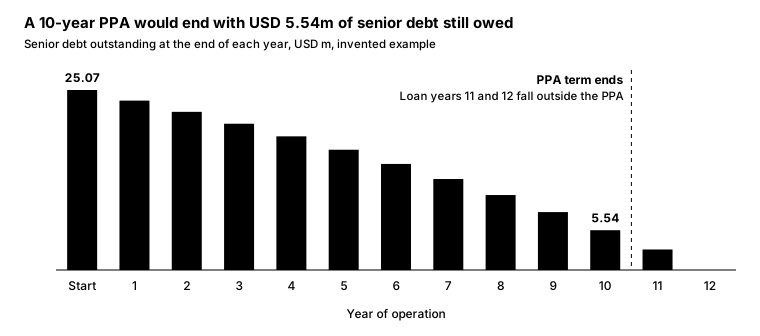
If the PPA ended at year 10, USD 5.54m of debt would still be owed. Debt service for years 11 and 12 would be USD 6.13m (our arithmetic), with no contracted revenue behind it.
What changes when a trader or intermediary is the buyer?
A trader or intermediary buyer takes the plant's power under the PPA and passes it on to other buyers. The plant's credit exposure is then to the intermediary, to several end buyers, or to a utility, depending on how the contracts are built. Public sources describe at least three structures, and we show them as separate options.
Variant A: one project-facing buyer with back-to-back contracts. Norton Rose Fulbright says that under the consortium model "the project-facing single buyer is responsible for the full cost of the electricity, even if some of the secondary buyers with whom it has back-to-back PPAs default". Our reading is that the lender tests the project-facing buyer, not the secondary buyers.
Variant B: several buyers, each with its own PPA. Norton Rose Fulbright says lenders "may actually like the diversification of credit risk", provided none or only a small portion of revenue is tied to weak credit. It adds that lenders will finance multiple buyers if each has "an adequate credit rating or credit support". The other route is for the developer to let part of the revenue serve as a cushion that is not taken fully into debt sizing.
Variant C: sleeved or synthetic structures (Europe). Bird & Bird describes a sleeved PPA as one where the offtaker signs with the generator and, in parallel, with a separate intermediary that transports the energy to the offtaker's site and tops up if needed. It describes a synthetic PPA, also called virtual or financial, in which "the generator sells power to a utility company in a conventional utility PPA who then supplies electricity to the end-user". Our reading is that the plant's contract is with the corporate in the first case and with the utility in the second.
Variant B gives a modelling test on the example. Suppose lenders leave 20% of year 1 revenue out of debt sizing (an invented share). Holding costs and tax at the base case, CFADS falls from USD 4.2m to USD 3.08m.
Debt scales with CFADS under sculpting, so it falls from USD 25.1m to about USD 18.4m. Gearing drops to 46% and equity rises by about USD 6.7m (all invented, our arithmetic).
How do the three buyer types compare?
The table sets the public evidence side by side. Each cell names its source and country or report, and the cells are alternatives, not one package.
| Question | State utility | Corporate | Trader or intermediary |
|---|---|---|---|
| Whose credit the lender tests | The utility, often with the state behind it (IRENA) | The company's own balance sheet and rating (EIB, Nishimura) | The project-facing intermediary, or each end buyer if there are several (Norton Rose Fulbright) |
| Security seen in public sources | Escrow or fund backed by government (India); standby letter of credit with no sovereign guarantee (Mexico); none from a rated utility (United States) | Security only if the rating falls (United States); parent guarantee or direct agreement (Europe) | End-buyer rating or credit support, or a revenue cushion kept outside sizing (Norton Rose Fulbright) |
| What lenders ask for | A sovereign guarantee, routinely requested (IRENA); credit support or a guarantee where the utility is sole buyer (Vietnam) | A strong investment grade rating (EIB); further security such as a parent guarantee (Bird & Bird) | Adequate rating or credit support for each buyer, or a cushion (Norton Rose Fulbright) |
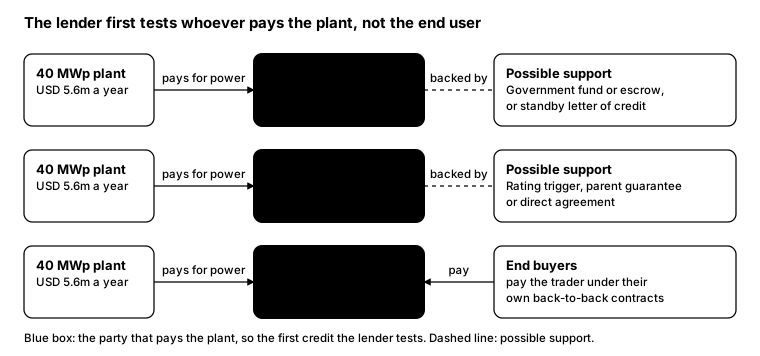
In all three cases the plant sends the same USD 5.6m of invoices. What changes is the first party that must pay them, and what sits behind that party.
How do you model the buyer type?
You model the buyer type by turning each credit and security feature into an input that the debt sizing and the stress cases can read. The steps below use the example and keep each variant separate.
- Name the first payer. Find the party that signs as buyer and receives the invoices. If that is a trader or intermediary, it is the credit the lender tests first (our reading).
- Record the credit evidence. Note the rating, any parent, and any support instrument with its issuer. Leave blank what the contract does not give.
- Set payment security as months of revenue. The example's letter of credit covers 3 months, USD 1.4m. A six-month escrow, as in the Indian variant, would be USD 2.8m.
- Stress a missed payment. With no security, DSCR is 1.16x after one missed month and 1.01x after two. With the 3-month letter of credit drawn, it holds at 1.30x to month 3, then 1.16x in month 4. Compare each result with the 1.20x lock-up and 1.10x default levels.
- Compare the PPA term with the loan. If the contract ends before the final maturity, show the debt still owed. In the example that is USD 5.54m at the end of year 10.
- Tag each revenue share with its support. For several buyers or a trader, run a sensitivity that leaves the unsupported share out of sizing, using the formula below.
- Check termination cover against debt. At the end of year 5 the debt is USD 16.75m, while one year of P90 revenue is USD 5.49m. PPA termination payments covers the formulas.
For the invented 20% cushion, this gives 25.07 x 3.08 / 4.2, or about USD 18.4m. Costs and tax are held at the base case, which is a simplification. Debt sizing for solar projects: gearing cap versus DSCR sculpting and The cover ratio ladder: sizing, lock-up and default DSCR explained set out the sizing and the ratio levels.
What are the common mistakes?
- Testing the end user, not the first payer. When a trader is the project-facing buyer, the end buyers' ratings do not protect the plant if the trader fails to pay.
- Counting a letter of credit at face value. In the Mexican variant there is "no requirement" for a creditworthy issuer. IRENA notes a lender may ask for an issuer of investment grade, "BBB or better".
- Assuming a state utility comes with a sovereign guarantee. The Mexican note says the buyer's obligations "are not guaranteed by the federal government". Check the contract, not the buyer's ownership.
- Treating a rating trigger as security from day one. In Variant A for corporates, support arrives only if the rating falls below the threshold. Until then there is nothing to draw.
- Ignoring a term shorter than the loan. A 10-year PPA on the example's 12-year loan leaves USD 5.54m owed at the end of the contract.
- Mixing variants into one package. The table cells are alternatives from different countries and reports. Model one at a time.
Frequently asked questions
Is a state utility always a weaker credit than a corporate buyer?
No. IRENA says a state-owned offtaker may not be creditworthy, yet a Stoel Rives guide says rated utilities almost never post security. Nishimura notes that a corporate cannot count on government support. Compare each buyer's own rating and support.
Do lenders always need a sovereign guarantee for a state utility?
Practice varies. IRENA says lenders and insurers have "routinely" requested one, while the Mexican note describes a buyer whose obligations are not guaranteed by the federal government. The Vietnam analysis says credit support or a guarantee would ease concerns.
What rating do lenders want from a corporate buyer?
The EIB paper says lenders typically require "a strong investment grade credit rating". The Stoel Rives guide says the rating threshold that triggers support is negotiated. We give no threshold because the public pages we opened give none.
Can lenders finance a trader PPA on the end buyers' credit?
Only if the contracts allow it. Under the consortium model described by Norton Rose Fulbright, the project-facing buyer owes the full cost even if secondary buyers default. Where several buyers each sign a PPA, lenders look for an adequate rating or credit support from each.
Why does the buyer type affect the term?
Stoel Rives says corporate offtakers are increasingly asking for shorter terms, such as 15, 12 and even 10 years. A term shorter than the loan leaves debt outstanding when the contract ends. In the example, a 10-year term leaves USD 5.54m owed.
Sources
Pages opened on 5 October 2026. The example project is invented and has no source.
- Aggregated PPAs, Norton Rose Fulbright. Used for the consortium model, back-to-back contracts, lender views on multiple buyers and the revenue cushion.
- Utility-Scale Solar Power Purchase Agreements, Stoel Rives (United States). Used for utility buyers that do not post security, rating-triggered support and shorter corporate terms.
- Renewable Energy Finance Brief 01: Sovereign guarantees, IRENA. Used for lender requests for sovereign guarantees, the contingent liability point and the investment grade bank requirement for letters of credit.
- Payment Security Mechanism for Solar Power in India, Center for Strategic and International Studies (India). Used for the escrow of six months of payments and the proposed government-backed fund.
- Vietnam's New Solar PPA: Strong Developer Interest Despite Bankability Concerns, Jones Day (Vietnam). Used for the sole utility buyer, absence of deemed availability and the capped termination payment.
- Mexico's second auction: PPA features and bankability considerations, Clifford Chance (Mexico). Used for the absence of a federal guarantee, the standby letter of credit and the 15-year term.
- Developing potential financial instruments and advisory solutions to stimulate more investment in renewable energy generation by means of commercial power purchase agreements, European Investment Bank advisory (Europe). Used for the types of offtaker, the sub-risks and the investment grade rating requirement.
- 2024 Corporate PPAs: An international perspective, Bird & Bird. Used for corporate share of revenue, lender security requests, sleeved and synthetic structures and corporate term.
- The Future of Renewable Energy Corporate PPAs in Thailand, Nishimura & Asahi (Thailand). Used for corporate offtakers lacking government support.