Events of default, cure periods and the direct agreement: what lenders need from a solar PPA
By SolarQuant Editorial. Published 2026-10-05. Last updated 2026-10-05.
An event of default lets one side end a power purchase agreement (PPA), and a direct agreement lets lenders stop that ending from destroying their loan. A modeller needs both, because they decide whether revenue can be cut off and whether lenders get time to fix the problem. This article explains the clauses as public sources show them and tests them on one invented plant.
What example does this article use?
The example is an invented 40 MWp ground-mounted solar plant in no named market. One buyer takes the power at the plant substation, the delivery point, and pays in USD under a 20-year PPA that starts at the commercial operation date. Construction takes 12 months.
Invoices are monthly and paid 60 days after invoice. A letter of credit from the buyer's bank covers 3 months of revenue. Senior debt runs 12 years and is sculpted so that debt service equals CFADS divided by 1.30. We use annual periods for simplicity; real deals usually use six-month periods.
| Item | Figure (all invented) |
|---|---|
| Plant and contract | 40 MWp, one buyer at the delivery point, 20-year PPA, 12 months of construction |
| Year 1 P90 generation | 70.0 GWh |
| Tariff | USD 80 per MWh, flat |
| Year 1 revenue, lender's case (P90) | USD 5.6m |
| Average monthly revenue | USD 0.467m |
| Year 1 revenue per day (revenue divided by 365) | USD 15,342 |
| Payment | Monthly invoices, paid 60 days after invoice |
| Payment security | Letter of credit, 3 months of revenue, USD 1.4m |
| Year 1 operating costs and tax | USD 1.0m and USD 0.4m |
| Year 1 CFADS | USD 4.2m |
| Total funding requirement | USD 40.0m |
| Senior debt | USD 25.1m over 12 years, all-in rate 7.0%, sized at 1.30x |
| Equity and gearing | USD 14.9m, 62.7% gearing |
| Year 1 debt service | USD 3.231m |
| DSCR levels | Sizing 1.30x, lock-up 1.20x, default 1.10x |
| Senior debt outstanding at the end of year 5 | USD 16.75m |
| Cure period for buyer non-payment, after notice | 12 days (invented for this article) |
| Cure period for a seller material breach | 45 days (invented for this article) |
| Extra lender window after the seller cure period | 37 days (invented for this article) |
The last three periods are invented. We use non-round figures so that no reader takes them for a market norm.
What is an event of default in a solar PPA?
An event of default is a listed failure by the seller or the buyer that lets the other party end the PPA, usually after notice and a cure period. Stoel Rives, a US law firm, lists the usual triggers:
- Failure by any party to pay an amount when due.
- Other specified material defaults.
- Bankruptcy, reorganisation, liquidation or a similar proceeding of any party.
- Failure to provide or replace credit support within an agreed time.
The RCREEE user's guide, written for the Arab region, adds a useful split: "Many events of default are curable, which means there is an opportunity to resolve the issue." It also says "Some events of default may be considered incurable and allow for immediate termination rights."
For a modeller, an event of default decides whether revenue can be switched off. Lenders therefore read these clauses as closely as the tariff. The 1.10x default level in The cover ratio ladder: sizing, lock-up and default DSCR explained is a loan test. It is not a PPA event of default, and the two sit in separate contracts.
Which events of default can the seller and the buyer trigger?
Seller events and buyer events usually cover insolvency, payment and material breach, plus commissioning for the seller. Some contracts give each side its own list. Others apply one list to "a Party". The table shows the variants as published.
| Source | Seller events | Buyer events | Periods stated |
|---|---|---|---|
| Standard PPA, Solar Energy Corporation of India, India | Insolvency; failure to achieve commissioning within the tender period; uncured material breach | Insolvency; uncured material breach; failure to pay an undisputed amount (for a disputed amount, a sum based on the last three undisputed invoices) | 60 days after notice for a curable material breach, longer if a cure is started and pursued; 60 days after notice for payment |
| Model PPA, Circular 02/2019, Vietnam (wind model) | Failure to reach commercial operation within a 3 month period; failure to comply with the contract for 60 days | Failure to comply for 60 days; undisputed payment unpaid for more than 90 days | 60 days; 90 days; 3 months |
| SEIA C&I PPA v2.0, US | Either party: unpaid amount not in good faith dispute; failure to perform a material obligation; insolvency | Same list as the seller | 10 days after notice for payment; 30 days for other obligations, extendable by a period not above 90 days; 5 days' prior written notice to terminate |
| Stoel Rives guide, US | Failure to pay when due; other material defaults; insolvency; failure to provide or replace credit support | Same list as the seller | The contract should say how long; no figure given |
The Vietnamese entries are our translation of the model's Vietnamese text. The model is for wind projects, but its default clauses are generic.
Two points matter to a modeller. In the Indian and US templates the payment clock starts at receipt of a notice, not on the due date. The Vietnamese model counts 90 days from the due date.
In the example, payment falls due 60 days after invoice. Take the invented 12 day cure period after notice, with notice sent on the due date. The seller's earliest right to end the PPA for non-payment then arrives 72 days after the first invoice.
By then three monthly invoices exist, assuming one every 30 days (our assumption). They total USD 1.4m, the size of the letter of credit. Offtaker payment security in a solar PPA: letters of credit, guarantees and what lenders test covers how that security is drawn.
Failure to reach commercial operation is a seller event in the Indian and Vietnamese templates. The commercial operation date, longstop dates and delay damages covers it.
What is a cure period and how long does it run?
A cure period is the time a defaulting party has to fix a breach, after notice, before the other party may terminate. Public templates set it in days, and the lengths differ. We see three variants:
- Fixed, with more time if a cure is under way. The Indian standard PPA gives 60 days, and more if a longer cure is needed and the seller has started and diligently pursues it.
- Short, with a capped extension. The US SEIA template gives 30 days for a material obligation. If the party shows it is pursuing the cure, the period is extended "for a further reasonable period of time, not to exceed ninety (90) days". Payment has its own 10 days.
- Different periods by type of default. The Vietnamese wind model uses 60 days for failure to comply, but 90 days for an unpaid undisputed amount.
The Stoel Rives guide leaves the length to the contract and says only that the default clause "should specify how long the defaulting party has to cure a default".
A cure period changes the model because each day is a day of revenue at risk if deliveries have stopped. In the example, year 1 revenue per day is USD 15,342. Take the invented 45 day seller cure period, with deliveries stopped throughout.
Revenue lost is USD 0.69m. CFADS falls from USD 4.2m to USD 3.51m, and DSCR falls from 1.30x to 1.09x, below the 1.10x default level. We hold costs, tax and debt service at the year 1 base case. About 21 days of lost revenue reach the 1.20x lock-up level, and about 42 days reach 1.10x.
Where a clause lets the cure run longer while a fix is under way, the exposure is open ended unless something caps it. We therefore model the longest period the clause allows.
What happens after an event of default?
After an event of default the usual order is notice, a cure period, any lender window, then a right to terminate. The Indian standard PPA adds a step: the buyer sends a "Buying Entity Preliminary Default Notice" stating its intention to terminate, with a copy to the lenders' representative. The SEIA template lets the non-defaulting party terminate on five days' prior written notice.
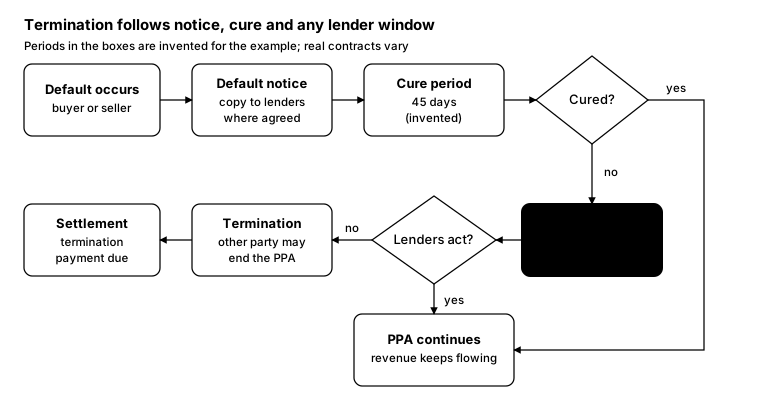
Here "Lenders act?" means the lenders cure the default, step in, or propose a substitute seller. In the example, the invented 45 day seller cure period plus the invented 37 day lender window puts the earliest termination 82 days after notice. At USD 15,342 of revenue a day, that is USD 1.258m at risk. If deliveries stopped throughout, year 1 DSCR would be 0.91x, with the same base case assumptions as before.
What is a direct agreement, and what are lender step-in rights?
A direct agreement is a contract between the lenders and a project counterparty, here the buyer, that lets the lenders protect the project if the seller defaults. The World Bank PPP Resource Center says direct agreements "will set out step‑in rights, notice requirements, cure periods and other issues intended to maintain the continuity of the project where the project company defaults and/or falls away."
Step-in is the lenders' chance to take over or fix the project before the buyer ends the contract. The same page says cure rights "allow the lenders to cure a breach of an obligation by the project company under one of the project documents".
Public sources show several forms of lender protection. They are separate variants, not one package.
| Variant | What the source says | Source |
|---|---|---|
| Lender cure rights | Lenders may cure the project company's breach of a project document | World Bank PPP Resource Center |
| Substitution by a selectee | After an uncured seller default, lenders may seek substitution of the seller by a Selectee for the rest of the term; the buyer's default notice is copied to the lenders' representative | Standard PPA, India |
| Notice before buyer step-in | The buyer gives the seller and the lenders 14 Business Days' notice before operating the plant itself; lenders may take possession and operate it | Sample PPA, World Bank PPP Resource Center |
| Consent with step-in terms | The buyer signs consents to assignment that may include notice, cure, attornment and step-in rights; the seller's right to terminate needs financing party consent | SEIA C&I PPA v2.0, US |
| Direct agreements before financial close | Direct agreements with the lenders, in the form of a schedule, are signed before financial close | Standard PPA, Jordan |
| Recognition by agreement | Lenders want their step-in rights explicitly recognised by the buyer in an agreement between the two | RCREEE user's guide |
In the example, senior debt outstanding at the end of year 5 is USD 16.75m, above the USD 14.9m of equity. If the buyer terminates for a seller default and lenders have no window, they face a stopped revenue stream with that debt unpaid.
A step-in or substitution that keeps the PPA alive keeps the revenue that repays the loan. PPA termination payments covers what lenders receive when the PPA does end.
What is consent to assignment, and why do lenders need it?
Consent to assignment is the buyer's agreement that the seller may pass its PPA rights to lenders as security. Stoel Rives says the PPA "will therefore contain provisions authorizing the seller to assign the PPA as collateral for project debt". It also describes provisions "requiring the buyer to provide consents, estoppels, or other documents needed in connection with financing".
Public templates handle the seller's side in three ways:
- Consent needed, not to be unreasonably withheld. The Indian standard PPA lets the seller assign to any third party, including a lender, "with the consent of the Buying Entity. The Buying Entity shall not unreasonably withhold such consent."
- No prior consent for lenders, but the buyer must sign. The SEIA template lets the seller assign to any Financing Party "without the prior written consent of Purchaser". The buyer must also "timely execute any consents to assignment".
- Written consent in every case. The Vietnamese wind model says that if the seller assigns or delegates performance, it must obtain the buyer's written consent.
The buyer's own assignment matters too. The RCREEE guide says a seller and its lenders will worry about assignment by the buyer to a party without the same credit strength. It calls a condition of "demonstrated credit strength of the assignee commensurate to the original Purchaser" critical from a lender perspective. The Indian template, by contrast, lets the buyer assign to an affiliate or successor without the seller's consent.
Consent is a gate before debt can be drawn. In the example, if lenders will not fund without it, the full USD 40.0m requirement would fall on equity. That is USD 25.1m more than the USD 14.9m in the base case. PPA conditions precedent covers how such gates are tracked.
How do you model it?
We treat default clauses as time windows with a cash cost, not as legal text. Six steps turn them into inputs and tests.
- List every seller and buyer event of default from the term sheet, with its notice period and cure period in days. Keep the two sides separate.
- Turn each window into revenue at risk: annual revenue divided by 365, times the days. In the example, 45 days is USD 0.69m.
- Stress the DSCR for each window, holding costs, tax and debt service at the base case:
- Compare the result with the lock-up and default levels. In the example, 82 days of lost revenue gives 0.91x, against 1.20x and 1.10x.
- Add the lender window as its own input, switched on only if the term sheet or a signed direct agreement grants it. Then check whether the seller and lender windows add together or overlap.
- Compare the invoices outstanding when a termination right arises with the payment security. In the example, the USD 1.4m letter of credit matches the three invoices billed by day 72.
Finally, flag the consent to assignment and the direct agreement as conditions precedent. If either is missing, the debt input in the model is not yet available.
What are the common mistakes?
- Treating the cure period as free time. Each day of a stopped plant costs revenue. In the example, a 45 day cure period takes DSCR below the 1.10x default level.
- Starting the payment clock on the due date. The Indian and US templates count from receipt of a notice, so the real window is longer than the payment terms suggest.
- Assuming lenders have step-in rights without a document. Public sources place them in a direct agreement or a consent. Without one, the model should not assume a lender window.
- Mixing loan defaults with PPA defaults. The 1.10x default DSCR is a loan trigger. It does not let the buyer end the PPA.
- Ignoring how disputed amounts are tested. The Indian template tests a disputed amount by a sum based on the last three undisputed invoices, so a dispute does not stop the payment clock.
- Forgetting that the seller's own right to terminate may need lender consent. The SEIA template makes it subject to the prior written consent of any Financing Party.
Frequently asked questions
Do the seller and the buyer get the same cure periods?
Sometimes. The SEIA template applies one 30 day period to either party. The Vietnamese wind model gives the buyer 60 days for failure to comply but 90 days before an unpaid undisputed amount becomes a default. The Indian standard PPA uses 60 days on both sides.
Can lenders cure a seller default?
The World Bank PPP Resource Center says cure rights allow lenders to cure a breach of a project document. In the Indian template, lenders may instead seek substitution of the seller by a Selectee. Either right usually needs to be written into the PPA, a direct agreement or a consent.
Is a direct agreement the same as a consent to assignment?
They overlap. The SEIA template says a consent to assignment may include notice, cure, attornment and step-in rights. The RCREEE guide calls the lender and buyer agreement a "lender consent agreement". Other sources use the term direct agreement for the same ground.
Does breaching the default DSCR end the PPA?
No. A DSCR of 1.10x is a test in the loan agreement. It lets lenders act against the borrower, but the buyer's right to terminate comes only from the PPA's own events of default.
How big is the gap if the PPA ends in year 5?
In the example, senior debt outstanding at the end of year 5 is USD 16.75m. One year of P90 revenue at that point is USD 5.49m, about 33% of the debt, a shortfall of USD 11.26m. The size of any termination payment depends on the PPA, as PPA termination payments explains.
Sources
Pages opened on 5 October 2026. The example project is invented and has no source.
- Standard Power Purchase Agreement (PPA) for Procurement of Solar Power on Long Term Basis, Solar Energy Corporation of India. Events of default, 60 day periods, lender substitution by a Selectee, consent to assignment.
- Circular 02/2019/TT-BCT, wind power project development and power purchase agreement, Ministry of Industry and Trade of Vietnam (text on Thu Vien Phap Luat). Model PPA default periods and seller consent to assignment.
- SEIA C&I PPA, version 2.0, Solar Power Purchase Agreement, Solar Energy Industries Association, US. Default events, cure periods, termination notice, financing party consent and estoppels.
- Power Purchase Agreements: Utility-Scale Projects, Stoel Rives LLP, US. Default triggers, cure period, lender protections, collateral assignment.
- Key Issues in Developing Project Financed Transactions, World Bank PPP Resource Center. Direct agreements, cure rights and step-in rights.
- Power Purchase Agreement (sample, January 2007), World Bank PPP Resource Center. Step-in notice to lenders and the Direct Agreement.
- User's Guide for the Power Purchase Agreement (PPA) Model for Electricity Generated from Renewable Energy Facilities, RCREEE. Curable and incurable defaults, lender step-in recognition, buyer assignment and credit strength.
- Power Purchase Agreement between the National Electric Power Company (NEPCO) and a project company, Ministry of Energy and Mineral Resources, Jordan. Definition of Lenders' Direct Agreements.