Change in law in a solar PPA: who bears new laws, taxes and levies
By SolarQuant Editorial. Published 2026-10-05. Last updated 2026-10-05.
A change in law clause decides who pays when a new law, tax or levy raises a plant's costs after the PPA is signed. Public sources split such changes into general ones, which the seller usually bears, and discriminatory ones, which the buyer side is often asked to cover. For the model, the test is simple: if the cost is not compensated, it lowers CFADS and the cover ratios.
What example does this article use?
The example is an invented 40 MWp ground-mounted solar plant in no named market. One buyer takes the power at the plant substation and pays in USD under a 20-year PPA. All figures are invented, and the same plant is used across this series.
The lender's case uses P90 generation. Debt is sized so that debt service in each year equals CFADS divided by 1.30. We use annual periods for simplicity, although real deals usually use six-month periods.
| Item | Figure |
|---|---|
| Plant | 40 MWp, construction 12 months |
| Contract | One buyer, 20-year PPA from commercial operation, paid in USD |
| Year 1 generation | P90 70.0 GWh, P50 76.0 GWh |
| Degradation | 0.5% a year |
| Tariff | USD 80 per MWh, flat for 20 years |
| Year 1 revenue (P90) | USD 5.6m |
| Year 1 operating costs | USD 1.0m |
| Year 1 tax | USD 0.4m |
| Year 1 CFADS | USD 4.2m, falling 0.5% a year |
| Total funding requirement | USD 40.0m |
| Senior debt | USD 25.1m over 12 years at 7.0% all-in, 62.7% gearing |
| Year 1 debt service | USD 3.231m |
| Equity | USD 14.9m |
| DSCR levels | Sizing 1.30x, lock-up 1.20x, default 1.10x |
What is a change in law in a solar PPA?
A change in law is a legal or regulatory change after the PPA is signed that raises the seller's costs and may entitle it to relief. The clause says what counts, who bears each type, and how the seller is made whole.
Public sources show three ways of setting the trigger.
- A broad list of legal acts. One published US PPA (New York) covers any case where, after the effective date, applicable law is "enacted, amended, modified, interpreted, nullified, suspended, repealed, found unconstitutional or unlawful, or changed or affected in any material respect".
- A defined scope, authority and date. The Council on Energy, Environment and Water (CEEW, India) recommends a clear definition. It should state the scope of the applicable law, what constitutes a change, the authorities that can authorise it, and the date after which the event must occur.
- A link to the project's own permits. A UAE law-firm article treats "changes in the licence, approvals, or specific regulatory consents for the project" as a project-specific change in law.
For the model, the definition sets the trigger. A change that falls outside it is a plain cost to the seller, whatever its size.
What is the difference between a general and a discriminatory change in law?
A general change in law affects businesses broadly, while a discriminatory change is aimed at the project or its type. The split decides who bears the cost.
The World Bank puts it this way: the private partner "typically has to deal with the risk of a general change in law that affects any business and bear the costs of such changes". If the change applies to the project only, the contracting authority "may have to grant relief from the breach or compensate the private partner for additional expenses".
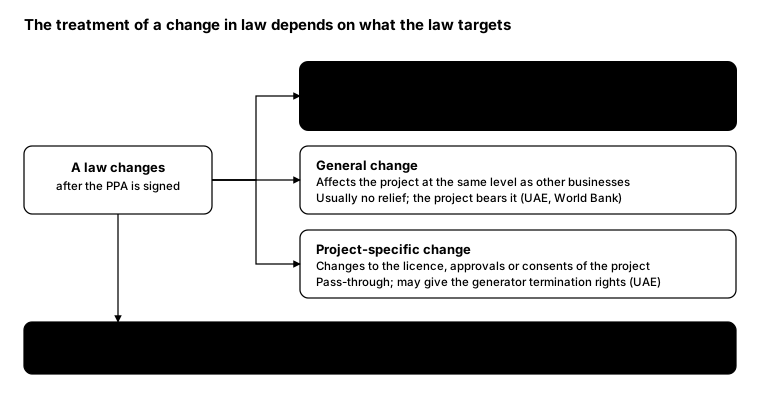
The UAE article draws the same line and adds the project-specific category. The World Bank sample wording defines a discriminatory change as one that applies expressly to the project and not to similar projects.
The same sample treats a general change as qualifying only in certain cases: one that involves capital expenditure and was not foreseeable at the date of the contract. Other contracts leave all general changes with the seller.
How are tax and tariff changes treated?
Tax and duty changes are a change in law in some PPAs and an ordinary business cost in others. In this section, tariff means a customs duty on equipment, not the PPA price.
Public sources show three treatments.
- Named as a trigger. The New York PPA lists "the imposition of and/or increase in the amount of any import tariff or similar charges on the physical equipment". It also lists a government decision to require a payment in lieu of taxes.
- Left to the general category. In the UAE article, a general change in law affects the project at the same level as other businesses and usually does not trigger relief. The article lists the federal corporate tax regime among current sources of exposure.
- Adjustable within limits. A report on Indonesia's 2025 PPA regulation, from the Southeast Asia Energy Transition Partnership, lists price adjustment "due to tax/regulatory changes, subject to agreed caps".
The World Bank's change of law checklist poses the issue as a question: "Should a change in tax law or foreign investment law be treated differently?" CEEW notes that India's renewable sector has faced uncertainty from new taxes and duties, such as GST and safeguard duties.
In the model, a duty before commercial operation raises the funding requirement. Debt is sized by DSCR, so the extra cost lands on equity. For example, an invented duty of USD 0.8m (2.0% of the USD 40.0m requirement) leaves debt at USD 25.1m and lifts equity from USD 14.9m to USD 15.7m.
A tax rise after operation lowers CFADS instead. An invented rise of USD 0.1m in year 1 tax gives CFADS of USD 4.1m and a year 1 DSCR of 1.27x.
What compensation routes do PPAs use?
A compensation route is the mechanism that returns the seller to its prior economic position after a qualifying change in law. Public sources show several routes, and each source shows only some of them. We keep them separate.
| Route | How it works | Source |
|---|---|---|
| Tariff pass-through | Discriminatory changes typically trigger a pass-through of the cost into the tariff | UAE law-firm article |
| Restore the economic position | Parties are restored to the same economic position as if the change had not occurred | CEEW recommendation, India |
| Negotiate, then exit | Seller gives notice with the cost and a proposed adjustment. Parties negotiate in good faith for 30 days. Either party may terminate without further liability if they cannot agree | Published PPA, New York, US |
| Price or time relief above a threshold | Contractor gets an adjustment to the price or tariff and/or more time once net cost exceeds an amount, left blank in the sample | World Bank sample wording |
| Funding of capital expenditure | Contractor tries to raise funding. If it cannot do so within a bracketed 60 days, the authority pays the amount | World Bank sample wording |
| Permit changes | Changes to a licence or approvals trigger pass-through and may give the generator termination rights | UAE law-firm article |
The 60 days and the threshold in the World Bank wording are drafting placeholders in a sample, not market data. The 30 days comes from one US contract.
Process matters as much as the route. CEEW recommends a time-bound procedure to discuss the impact and reach a preliminary understanding before going to the regulator. The UAE article says a claim is won by "serving the contractual notice within the window, documenting the cost, attributing it specifically to the change in law".
An Australian law-firm note adds one distinction. A clause should separate regulatory compliance costs from changes that affect certificate value, because they need different remedies. Environmental Attributes under a solar PPA covers certificate revenue.
How do lenders view change in law risk?
Lenders want change in law risk to be either compensated or small, because their forecast has no room for a new cost with no recovery. Public sources show that the concern is shared, and that the answer depends on the contract and on the buyer.
- Cash flow protection. A World Bank page says private project proponents and their lenders "will be anxious to ensure that the cash flows of the project are appropriately protected against changes in law".
- A clause must exist. The World Bank checklist says lenders are "going to be concerned that the Contract provides for the possibility of a change in law".
- Long terms cannot be priced. The UAE article says PPAs include detailed provisions "because Generators and Lenders cannot price every regulatory eventuality across a 25-year term".
- A missing clause leaves a gap. An article on Chambers.com says Kazakhstan's model PPA lacks a change of law clause, so nothing says who reimburses the seller for extra expenses or lower revenues.
The buyer matters too. The World Bank page notes that a private offtaker has significantly less ability and appetite to absorb change in law risks than a public one. Utility, corporate and trader offtakers compared looks at that difference.
Our reading for the model is that lenders will test the case where a change is not compensated. A termination right after failed talks, as in the New York PPA, also turns a cost problem into a debt problem. PPA termination payments covers that case.
What does an unrecovered levy do to the example?
An unrecovered levy lowers CFADS one for one, so year 1 DSCR falls by about 0.02x for each USD 1 per MWh. This case is invented: a new levy of USD 1.50 per MWh on energy sold, with nothing passed to the buyer.
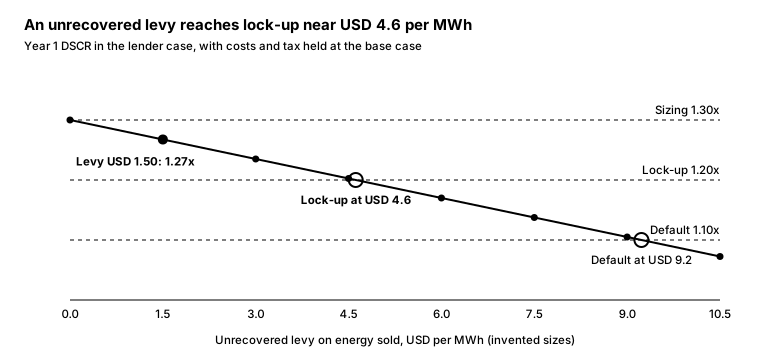
The levy costs USD 0.105m in year 1, which is 1.9% of revenue. CFADS falls to USD 4.095m and DSCR to 1.27x, still above lock-up.
Over the 12 debt years, at a 1.30x sizing basis, the lost debt capacity would be about USD 0.63m. If the buyer instead pays USD 1.50 more per MWh, CFADS is restored. A larger levy matters: about USD 4.6 per MWh reaches lock-up, and about USD 9.2 reaches the default level.
How do you model change in law?
In the model, change in law is a stress case, not a base case input. These steps follow our reading of the clause variants above.
- Read the trigger. List which events qualify: general, discriminatory and project-specific changes, and whether taxes and duties are named.
- Add a cost line set to zero. Put a change in law cost in operating costs or tax. The base case stays as it is.
- Add a compensation switch. Offer three settings: none, pass-through into the tariff, and a lump sum. Add a lag for notice and talks.
- Run the uncompensated case. Compare DSCR with the lock-up and default levels in each year, not only year 1.
- Treat duties before operation separately. Add them to the funding requirement. If the DSCR binds, equity absorbs them.
- Test the exit. If the clause lets a party terminate after failed talks, run the termination case. In the example, USD 16.75m of senior debt is outstanding at the close of year 5.
- Record the simplification. State that costs and tax are held at the base case, apart from the change being tested.
What are the common mistakes?
- Treating every tax change as compensable. The UAE article and the World Bank page both say a general change usually stays with the seller.
- Reading tariff two ways. A customs duty on equipment is a capital cost. The PPA tariff is the price. Keep them apart.
- Assuming relief is immediate. One US PPA gives 30 days of talks after notice. Our reading is that relief arrives with a lag, so model one.
- Ignoring the exit. A right to terminate after failed talks can matter more than the cost itself.
- Copying one source as the standard. The routes in this article come from different jurisdictions and sample documents. They do not form one design.
- Missing the permit link. A change to the plant's licence or approvals may be a separate category with its own relief.
Frequently asked questions
Is a new tax a change in law?
It depends on the definition. The New York PPA names import tariffs and payments in lieu of taxes. In the UAE article, a broad tax that hits all businesses is a general change and usually brings no relief.
Who bears a general change in law?
The World Bank page says the private partner typically bears it. Its sample wording lets a general change qualify only where it involves capital expenditure and was not foreseeable at the contract date.
Does change in law affect debt sizing?
Only if the model treats the cost as uncompensated. In the example, a levy of USD 1.50 per MWh would cut debt capacity by about USD 0.63m at a 1.30x sizing basis.
What happens if the parties cannot agree on an adjustment?
In the New York PPA, either party may terminate without further liability after 30 days. CEEW instead recommends a time-bound discussion before the matter goes to the regulator.
What should a change in law notice contain?
The New York PPA asks for written notice of the change, how it materially increases costs, and the proposed adjustment. The UAE article stresses serving notice within the window and documenting the cost.
How is it different from force majeure?
Force majeure covers events that stop or limit delivery. Change in law covers legal changes that raise cost. Force majeure in a solar PPA covers the first.
Sources
Pages opened on 5 October 2026. The example project is invented and has no source.
- Appraising the Change in Law Clause, Council on Energy, Environment and Water (India). Recommended definition, compensation principle, time-bound procedure, and tax and duty uncertainty.
- Power Purchase Agreement between Abundant Solar Power Inc. and the Buyer, published on the New York State Department of Public Service document site (US). Definition of change in law, import tariffs, notice, 30-day negotiation and termination right.
- UAE Power Purchase Agreement disputes: tariff, availability, and termination claims (2026), Kayrouz & Associates (UAE). General, discriminatory and project-specific categories, pass-through, notice, lenders and long terms.
- Change of Law - Checklist and Sample Wording, World Bank PPP resources. Sample definitions, threshold and capital expenditure wording, tax question, lender concern.
- Adjustments in Exceptional Situations, World Bank PPP resources. General versus discriminatory allocation.
- Power Purchase Agreements (PPAs) and Energy Purchase Agreements (EPAs), World Bank PPP resources. Lender concern for cash flows and the private offtaker point.
- Solar PV Mapping and Development Plan: analysis of PPA, Southeast Asia Energy Transition Partnership (Indonesia). Price adjustment for tax and regulatory changes.
- Financing Renewable Energy Projects - Bankability of PPA, Chambers.com (Kazakhstan). Effect of a missing change of law clause.
- Australia's new renewable energy certificate regime: changes to Power Purchase Agreements (part 2), Holding Redlich (Australia). Compliance costs versus certificate value in a change in law clause.