PPA conditions precedent: what must happen before a solar PPA takes effect
By SolarQuant Editorial. Published 2026-10-05. Last updated 2026-10-05.
Conditions precedent decide when a solar PPA starts to bind and by when the seller must show permits, financing and security. Public templates differ: some make the PPA effective only once conditions are met, others bind on signature and add milestones or termination rights. A modeller treats each condition as a dated test, because in several templates a missed long-stop date ends the revenue contract before financial close.
What example does this article use?
The example is an invented 40 MWp ground-mounted solar plant in no named market. One buyer takes the power at the plant substation and pays in USD under a 20-year PPA that starts at the commercial operation date. Construction takes 12 months, and senior debt is sized on the lender's P90 case.
Every figure below is invented. Cases that change a clause are shown as separate "what if" cases on this same plant.
| Item | Example figure |
|---|---|
| Plant | 40 MWp, one buyer, delivery at the plant substation |
| PPA term and build | 20 years from commercial operation, 12 months construction |
| Tariff | USD 80 per MWh, flat |
| Year 1 P90 generation | 70.0 GWh |
| Year 1 P90 revenue | USD 5.6m (about USD 0.467m a month) |
| Year 1 CFADS, lender's case | USD 4.2m |
| Senior debt | USD 25.1m over 12 years, 7.0% all-in, DSCR sized at 1.30x |
| Gearing and equity | 62.7% gearing, USD 14.9m equity |
| Lock-up and default DSCR | 1.20x and 1.10x |
| Delay (invented) | Commercial operation 3 months late loses USD 1.4m of year 1 revenue |
| Delay damages (invented) | USD 6,000 a day, capped at 180 days (USD 1.08m) |
Simple models use annual periods. Real deals usually use six-month periods.
What are conditions precedent in a PPA?
Conditions precedent are events or documents that must be in place before a PPA, or some of its terms, becomes effective. The World Bank PPP resource page says: "The PPP contract typically includes completion of (some of) these elements as Conditions Precedent, which must be met for the contract to become effective."
Public templates show three ways of handling the idea.
- Conditions precedent with partial effectiveness. The Jordan standard PV PPA hosted by the energy ministry makes only listed articles effective on signing. All other rights and obligations are "conditional upon the fulfilment of the Conditions Precedent". A Pakistan standard energy purchase agreement (a wind template) also brings only a few articles into force on execution, and the whole agreement becomes effective later.
- Conditions subsequent. A solar PPA template published by PwC Australia lets the agreement run from signing. Either party may terminate it if listed conditions are not satisfied or waived by a longstop date.
- Effective on signing, with milestones. A law firm guide on US utility-scale PPAs says the PPA "will be binding on the date it is signed" and adds a schedule of milestones. A US industry template (SEIA) and a standard rooftop template from India's Solar Energy Corporation (SECI) also take effect from the date of signing, then test progress against dates.
In each case the modeller needs the same thing: a list of conditions, a date for each, and a rule for what happens if a date is missed.
What conditions do public PPA templates list?
The conditions fall into a few groups: permits and approvals, financing, land and construction contracts, grid connection, regulator approvals and security. No template lists all of them. The table shows what each public page names, so a modeller can build a checklist and drop what the signed PPA does not contain.
| Condition | What the template says | Template and region |
|---|---|---|
| Permits and approvals | Seller receives "all regulatory and governmental permits, consents and approvals required to construct and operate the Projects" | World Bank standardised synthetic PPA (global template) |
| Permits and approvals | Owner notifies the buyer that all Government Authority approvals have been obtained | PwC solar PPA template (Australia) |
| Permits and approvals | Seller obtains zoning, land use and building permits at its sole cost | SEIA C&I PPA (United States) |
| Debt financing | Seller receives "firm commitments from one or more Finance Parties" for the total debt for construction | World Bank synthetic PPA (global template) |
| Debt financing | Owner notifies the buyer that it has entered into a financing agreement | PwC solar PPA template (Australia) |
| Financial close notice | Purchaser receives notice from AEDB, the agency named in the template, that financial closing has occurred | Standard energy purchase agreement, wind (Pakistan) |
| Land and construction | Land lease for the site and the EPC contract are executed and valid | PwC solar PPA template (Australia) |
| Grid connection | Connection agreement is executed and valid (shown in square brackets, so optional) | PwC solar PPA template (Australia) |
| Grid connection | Interconnection agreement in place by a milestone date | Law firm guide to utility-scale PPAs (United States) |
| Grant funding | Receipt of the named grant funding is notified to the buyer | PwC solar PPA template (Australia) |
| Regulator approval | Seller delivers the benchmark energy table approved in writing by the regulator, only if it elects to revise the table | Standard energy purchase agreement, wind (Pakistan) |
| Regulator approval | Failure of a utility commission to approve the PPA or its cost pass-through is a common early termination ground | Law firm guide to utility-scale PPAs (United States) |
| Security | Seller delivers its letter of credit to the purchaser | Standard energy purchase agreement, wind (Pakistan) |
Our reading, for the example: lenders usually want a signed and effective PPA before first drawdown. The World Bank page says financial close happens only when "all conditions on those agreements have been met". So the model checklist for the 40 MWp plant should carry permits, land, the construction contract, grid connection, financing and the buyer's USD 1.4m letter of credit as dated lines.
Who satisfies the conditions, and who can waive them?
In most public templates the seller satisfies the conditions, and the buyer receives proof. Waiver rights differ, and they matter because a waived condition can bring the PPA into force before a lender is ready.
- Seller satisfies, buyer alone may waive. In the World Bank synthetic PPA, permits and debt commitments are seller conditions. Satisfaction of those conditions "may be waived by the Buyer only, in its sole discretion".
- Each party satisfies its own items, both must agree to waive. In the PwC template, parties "shall use reasonable endeavours to ensure that each of the above Conditions Subsequent for which it is responsible are satisfied promptly". A condition "may only be waived by written agreement of the Parties".
- Both parties certify. In the Jordan standard PV PPA, the utility (NEPCO) and the project company "shall each certify in writing the occurrence of the Financial Closing within five (5) Business Days after the fulfilment of such Conditions Precedent".
- A third party gives the signal. In the Pakistan template, the purchaser waits for notice from the agency AEDB that financial closing has happened. The seller separately delivers its letter of credit.
What it changes in the model: the party that satisfies a condition carries the cost of a late date. In the example, if the seller is late on a permit and commercial operation slips by 3 months, the seller loses USD 1.4m of year 1 revenue.
What is a long-stop date for conditions?
A long-stop date is the last day by which the conditions must be satisfied. After it, the contract falls away or a party may end it. The World Bank page says: "PPP contracts often specify a final date by which the contract terminates, and/or a bid bond is forfeited, if the Conditions Precedent are not met."
The templates differ on how long the period is, who can extend it and who can terminate.
| Template and region | Long-stop | Who can end the contract |
|---|---|---|
| Jordan standard PV PPA | Financial Close Longstop Date: "six (6) months after the signing date", or an extension approved by NEPCO | Agreement is "cancelled" and the parties release each other |
| Pakistan standard energy purchase agreement (wind) | The date required for financial closing in the Letter of Support, as extended by AEDB | The purchaser, by written notice effective on delivery |
| World Bank standardised synthetic PPA (global) | CP Longstop Date, left blank for the parties to fill | Either party, with immediate effect, by written notice |
| PwC solar PPA template (Australia) | Condition Longstop Date, set as a date or a number of days after commencement, or a later date agreed in writing | Either party, by written notice |
| SEIA C&I PPA (United States) | Commencement of installation within a blank number of days after the effective date | The purchaser, on "thirty (30) days' prior written notice", unless the seller starts installation within that notice period |
In the Jordan, Pakistan and World Bank templates the parties are released from further obligations. In the World Bank synthetic PPA, the parties are discharged "without prejudice to any rights, obligations or liabilities that have accrued up to the date of termination".
For the example we use an invented long-stop of nine months after signing. We also assume, as an invented planning case, that conditions are met and financial close happens at month 6. That leaves three months of float before the PPA can be ended.
How do conditions precedent affect financial close?
Financial close moves when a condition moves. The World Bank page defines it: "Financial close occurs when all the project and financing agreements have been signed, all conditions on those agreements have been met, and the private party to the PPP can start drawing down the financing to start work on the project."
The order of events differs by template. In the Jordan standard PV PPA, financial close is itself the long-stop test. In the World Bank synthetic PPA, firm debt commitments are a condition, so they come first. In the Pakistan template, the whole agreement takes effect only after notice of financial closing and delivery of the seller's letter of credit.
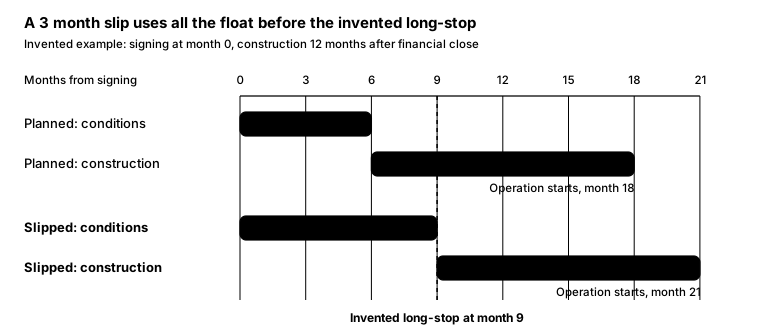
In the planning case, conditions are met and financial close falls at month 6, so construction runs to month 18. A slip of 3 months puts financial close on the long-stop itself, with no float left, and operation starts at month 21.
What it changes in the model: our reading is that the build clock starts at financial close, so the slip moves operation by 3 months. In the example that loses USD 1.4m of year 1 revenue. If the PPA also keeps a fixed target date for commercial operation, the seller would owe the invented delay damages of USD 6,000 a day, or USD 0.54m for 90 days. The sibling article "The commercial operation date, longstop dates and delay damages" covers those terms.
How do you model it?
Treat conditions precedent as a dated checklist that sets the financial close date, then test the gap to the long-stop. Financial close cannot come before the last condition, and the float is the time left before the PPA can be ended.
- List the conditions. Take them from the signed PPA, not from a template. Note who satisfies each one and who may waive it.
- Date each condition. Give each a planned date from the sponsor's programme. In the example, all conditions are met by month 6.
- Set financial close. Use the latest condition date, plus the lenders' own conditions. In the example, financial close is at month 6.
- Start the build clock. In our reading, construction starts at financial close. Operation starts at month 18, so first revenue moves with any slip.
- Test the float. Subtract the planned financial close from the long-stop. The example has 3 months of float against the invented nine month long-stop.
- Run a slip case. Move the latest condition by the float. A 3 month slip loses USD 1.4m of year 1 revenue and moves the debt schedule by 3 months.
- Price what the PPA charges for delay. Add delay damages only if the signed PPA fixes a target date for operation. The invented USD 6,000 a day for 90 days is USD 0.54m.
- Show the exit. Past the long-stop, revenue is zero in the model and development spend is at risk, if the PPA lets a party terminate.
What are the common mistakes?
- Treating signing as the start of revenue. Some templates are effective on signing, but others, such as the Jordan and Pakistan ones, switch most terms on later.
- Assuming one design. Conditions precedent, conditions subsequent and milestone dates have different consequences. Read which one the signed PPA uses.
- Copying a long-stop from a template. The Jordan template sets six months for financial close, while others leave the date blank. Use the signed date.
- Leaving no float. If planned financial close equals the long-stop, one late permit ends the contract. The example keeps 3 months of float, and a 3 month slip uses all of it.
- Ignoring who can extend or waive. In the Jordan template the utility approves any extension. In the World Bank synthetic PPA the buyer alone may waive the seller's permit and financing conditions.
- Mixing PPA conditions with lender conditions. In our reading, the loan agreement has its own conditions to first drawdown. The later of the two sets financial close.
Frequently asked questions
What is the difference between a condition precedent and a condition subsequent?
A condition precedent must be met before the contract, or part of it, becomes effective. A condition subsequent is checked after the contract is already running. In the PwC template, the agreement runs from signing and may be terminated if the listed conditions are not met by the longstop date.
Does a PPA always become effective on signing?
No. The US law firm guide, the SEIA template and the SECI rooftop template take effect on signing. The Jordan and Pakistan templates bring only some articles into force on signing and the rest later.
How long is the period to satisfy conditions?
Practice varies. The Jordan template gives six months from signing for financial close, with extensions approved by the utility. The World Bank synthetic PPA and the PwC template leave the date blank. The nine month period in our example is invented.
Who can waive a condition?
It depends on the template. The World Bank synthetic PPA lets only the buyer waive the seller's permit and financing conditions. The PwC template requires written agreement of both parties.
What happens if the long-stop date passes?
In the templates we opened, the contract can end or is cancelled. The Jordan template cancels it automatically, while the Pakistan template lets the purchaser terminate by notice. The World Bank synthetic and PwC templates let either party terminate.
Sources
Pages opened on 5 October 2026. The example project is invented and has no source.
- Achieving contract effectiveness and financial close, World Bank PPP resource site. Definition of conditions precedent, long-stop dates and financial close.
- Standardised Synthetic PPA, Sample 1, World Bank PPP resource site. Clause 2.2: seller permit and financing conditions, buyer-only waiver, CP Longstop Date and termination.
- Power Purchase Agreement, solar template (March 2016), PwC Australia. General conditions 2.1 to 2.5: conditions subsequent, reasonable endeavours, waiver and longstop termination.
- Power Purchase Agreement between the National Electric Power Company (NEPCO) and the project company, standard PV, hosted by Jordan's Ministry of Energy and Mineral Resources. Partial effectiveness, six month Financial Close Longstop Date and certification of financial closing.
- Standardized Energy Purchase Agreement (wind), Pakistan template hosted on the World Bank PPP resource site. Section 2.1: conditions to the effective date and termination.
- Standard Power Purchase Agreement for rooftop solar, Solar Energy Corporation of India. Section 2: effective from signing.
- Power Purchase Agreements: Utility-Scale Projects, Stoel Rives, The Law of Solar (United States). Binding on signing, milestone schedule and utility commission approval.
- SEIA C&I PPA, version 2.0, Solar Energy Industries Association (United States). Seller permits at its own cost and the commencement of installation termination right.