Tariff and escalation in a solar PPA: flat, escalating and indexed prices in the model
By SolarQuant Editorial. Published 2026-10-05. Last updated 2026-10-05.
The tariff in a solar power purchase agreement (PPA) is rarely just one number. It is a starting price plus a rule for changing it, and each choice moves revenue, the debt service cover ratio (DSCR) and debt size. This article sets out the shapes seen in public contracts and guides, and shows how each one feeds a cash flow model.
What example does this article use?
The example is an invented 40 MWp ground-mounted solar plant in no named market. One buyer takes the power at the plant substation and pays in USD under a 20-year PPA that starts at the commercial operation date. We use the same plant as in the article Debt sizing for solar projects: gearing cap versus DSCR sculpting, seen from the revenue side, and every figure below is invented.
| Item | Figure |
|---|---|
| Plant and contract | 40 MWp, one buyer, USD payments, 20-year PPA, 12-month construction |
| Year 1 generation | P90 70.0 GWh, P50 76.0 GWh |
| Degradation | 0.5% a year (year 12 P90: 66.2 GWh, year 20: 63.6 GWh) |
| Base tariff | USD 80 per MWh, flat for 20 years |
| Base P90 revenue | USD 5.60m in year 1, USD 5.30m in year 12, USD 5.09m in year 20, USD 106.8m over 20 years |
| Year 1 costs and cash flow | Operating costs USD 1.0m, tax USD 0.4m, CFADS USD 4.2m |
| Funding and debt | Total funding USD 40.0m, gearing cap 70:30 (USD 28.0m), senior debt 12 years at 7.0% all-in |
| Sculpting | Debt service in year t = CFADS in year t / 1.30 |
| Base case result | Senior debt USD 25.07m (62.7% gearing), equity USD 14.9m, year 1 debt service USD 3.231m |
| DSCR levels | Sizing 1.30x, lock-up 1.20x, default 1.10x |
| Escalation variant | USD 80 per MWh in year 1, rising 2.0% a year |
| Partial indexation variant | 30% of the price tied to an inflation index rising 3.0% a year, from year 2 |
CFADS is cash flow available for debt service. We use annual periods for simplicity, while real deals usually use six-month periods. Where we change the tariff, operating costs and tax stay at the base case, which is a simplification.
What is the tariff, and what does a PPA price cover?
The tariff is the price per unit of energy that the buyer pays the project company, usually quoted per kWh or per MWh. For non-dispatchable technologies such as solar, the Power Africa handbook says bidders typically quote an energy price per kWh or per MWh in a stated currency.
The Open Solar Contracts guide from IRENA and the Terrawatt Initiative describes the PPA as an exclusive supply agreement on a take or pay basis. In our reading, revenue is then tariff times paid energy, so any rule that changes the tariff changes every later year of revenue.
Berkeley Lab only includes a PPA in its sample when it is confident of key variables. Examples are execution date, starting date, starting price, escalation rate (if any), time-of-day factor (if any) and term. We use these as a checklist, and the sections below take each element in turn.
Which price shapes do public contracts use?
Public guides and programme documents show at least six shapes: flat, fixed escalation, a stepped profile, indexation, market-linked pricing and time-of-day shaping. Stoel Rives puts it simply: the price may be flat, escalate over time, or contain other features. Practice varies by country and by buyer, so the table lists what each page says and nothing more.
| Shape | What the public page says | Source and country |
|---|---|---|
| Flat | Tariff in rupees per kWh, fixed for the entire term of 25 years (rooftop PPA) | SECI standard PPA, India |
| Fixed escalation | Price increases at a predetermined rate, usually 2 to 5%; some owners escalate for a period, such as 10 years, then hold the price fixed | NREL checklist, United States, public-sector buyers |
| Stepped profile | A higher rate in the first 10 years and a lower rate in the later 10 years, given as a state requirement | RCREEE user guide, citing Minnesota, United States |
| Inflation indexation | Contracts in reals, adjusted annually for domestic inflation | Oxford Institute for Energy Studies, Brazil |
| Inflation indexation | Prices are indexed to inflation, based on the consumer price index | Eberhard and Naude review, South Africa |
| Exchange rate adjustment | Feed-in tariff in VND, adjusted for the VND and USD exchange rate | Decision 13/2020, Vietnam |
| Commodity indexation | Contracts indexed to a series of financial parameters, including fossil fuel prices at reference locations | Reus, Munoz and Moreno, Chile |
| Market-linked | Physical PPA price usually fixed; financial PPA settles the difference between a fixed price and the market price | DLA Piper, corporate PPAs |
| Market-linked | A stepped PPA whose price rises or falls with time or drivers such as the power price, and a reverse collar with a floor and a cap | Bartolini and others, working paper on corporate PPAs |
| Time-of-day shape | A time-of-day factor appears in the variables Berkeley Lab needs for its PPA sample | Berkeley Lab report, United States |
One caution: the SECI document is a standard PPA for grid-connected rooftop projects, so it shows one buyer type, not all Indian practice.
What does the escalation rule say?
The escalation rule says how the tariff moves after the starting price. Public sources show three variants.
- No escalation. The SECI rooftop PPA fixes the tariff for the entire term. In the model the price is a constant, so revenue falls only with degradation.
- A fixed percentage step. The NREL checklist describes a price that increases at a predetermined rate, usually 2 to 5%. It also describes a variant that escalates for a period and then stays fixed. The RCREEE guide adds that prices may also deescalate over the life of the project.
- Indexation. Brazilian contracts are adjusted annually for domestic inflation, and the South African programme indexes prices to inflation. The Power Africa handbook says the fixed operating cost part of a capacity price is usually indexed to inflation. That passage concerns capacity-based tariffs, not solar energy prices.
In our reading, a flat nominal price falls in real terms every year, while an escalation rate near expected inflation holds the real price roughly level.
When does the first adjustment apply, and from which reference date?
The first adjustment date is when the price first moves, and the reference date is the date from which an index or an exchange rate is measured. Public sources describe four timings.
- Each contract year. Stoel Rives says an escalating price is often set to escalate at the beginning of each new contract year. It adds that this encourages the seller to reach commercial operation early, to lock in the initial price and escalation rate.
- Each invoice. Vietnam's Decision 13/2020 adjusts the grid-connected feed-in tariff for the VND and USD rate. It uses the State Bank rate on the day the seller issues the invoice.
- Each year, from a year-end rate. For rooftop systems the same decision uses the rate published on the last day of the year to calculate invoices for the following year.
- At financial close. The South African request for proposals, as Eberhard and Naude review it, permits adjusting the bid tariff at financial close. The adjustment follows the spot rate used at bid submission and applies to capital expenditure.
The pages we opened give no index reference month and no lag between index and price, so we quote none. Make both inputs in the model.
Two events can reset price outside the formula: a change in law and the renewal term. The RCREEE guide says a renewal option may repeat the initial price and terms or provide an indexed price. Change in law is covered in the parent article, How to read a solar PPA term sheet: a modeller's guide.
Are there floors, caps or partial indexation?
Partial indexation means only a share of the price is adjusted and the rest stays constant. Floors and caps limit a price, and public sources show them on bids and on market prices.
- Partial indexation. In the South African programme, bidders submitted fully indexed prices and partially indexed prices. In the partially indexed price, the request for proposals required 20% to 50% of the price to be indexed at the CPI rate. The remainder was held constant.
- A later change of approach. A White & Case note says bid window 6 no longer required both a partial and a full CPI indexation offer.
- Caps on bids, not on adjustments. The same review says price caps were first set for each technology. They were removed for onshore wind and solar PV in bid window 4.
- Floors and caps on market price. A corporate PPA paper describes a reverse collar, where the offtaker guarantees a floor price and the producer gives a cap price.
On the example, we add one invented case. In it, 30% of the price follows an inflation index rising 3.0% a year from year 2, and 70% stays at USD 80 per MWh. The 30% share sits inside the South African range, and the 3.0% rate is invented. The tariff reaches USD 89.22 per MWh in year 12 and USD 98.08 in year 20.
How do currency and tariff interact?
The currency of the tariff decides which index, if any, belongs in the price rule. Sources show three variants: USD pricing, local currency with inflation indexation, and local currency adjusted for the exchange rate.
Egypt's second feed-in tariff round was quoted in US cents per kWh. Brazilian contracts are in reals and adjusted for domestic inflation, and the Oxford paper says developers carry the currency risk. Vietnam quotes a VND tariff and adjusts it for the exchange rate.
The Power Africa handbook says PPA payments are most often made in the currency needed to repay the debt. Otherwise it expects hedging or exchange rate indexation with a true-up. The example pays in USD, so it needs no currency step.
The sibling article, Currency risk in a solar power purchase agreement: denominated versus paid, local-currency security and the FX true-up, covers denomination, payment currency and the true-up.
How do you model it?
Build one price path with a selector for the shape, then feed it to revenue and the debt tests. The same formula covers the shapes above, which keeps the model auditable.
Here P is the tariff, s the share adjusted, K the index or exchange rate, and K_ref its value at the reference date. E is paid energy and d is degradation.
A flat price has s = 0. A fixed escalator has s = 1 and an index growing at the escalation rate g, so P_t = P_1 (1+g)^(t-1).
- Enter the starting price and its currency. Keep USD per MWh and USD per kWh apart, and take the currency from the PPA.
- Select the shape. Offer flat, fixed escalation, indexed and partly indexed, and show the active choice on the inputs sheet.
- Set the first adjustment date and the reference date. Make both inputs, and count contract years from commercial operation.
- Set the share adjusted, and any floor or cap. Leave floor and cap empty unless the contract has them.
- Multiply by paid energy. Use P90 energy for the lender case and P50 for the sponsor case.
- Size the debt. Take the lower of the DSCR-sized amount and the gearing cap, as in the debt sizing article, Debt sizing for solar projects: gearing cap versus DSCR sculpting.
- Run the ratio tests. Check each year against the 1.20x lock-up and 1.10x default levels, for every shape.
- Keep real and nominal apart. Set the model's inflation path once, so that an indexed price and the cost lines use the same one.
What happens to revenue and debt on the example?
An escalating tariff leaves year 1 unchanged and pulls revenue away from the flat case every year after. The comparison below holds the P90 case, operating costs and tax at the base case, so only the tariff changes.
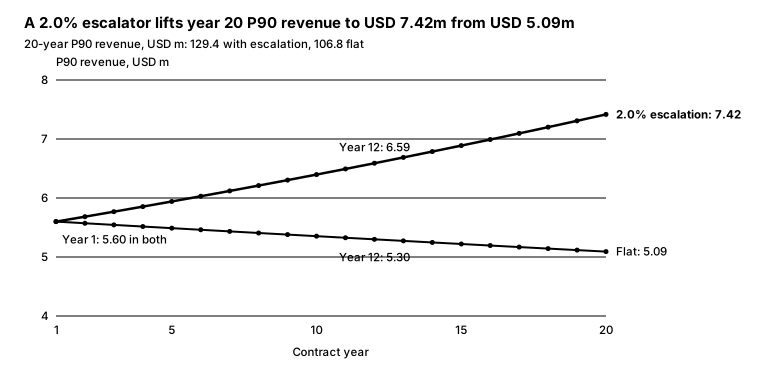
With 0.5% degradation, flat revenue falls every year, while a 2.0% escalator more than offsets it and revenue rises.
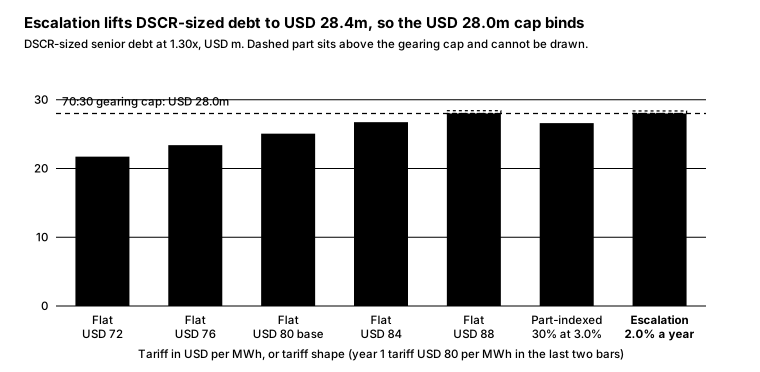
Each USD 1 per MWh adds about USD 0.42m of debt. The 2.0% escalator would support USD 28.4m, but the USD 28.0m gearing cap limits borrowing to USD 28.0m.
A higher tariff raises CFADS and, with sculpting, debt service. Equity then funds less of the cost. The table sizes each case on its own tariff and applies the 70:30 cap.
| Case | Year 12 tariff (USD per MWh) | Senior debt (USD m) | Equity (USD m) | Limit that binds | Cash after debt service, 20 years (USD m) | Simple equity IRR, change against flat |
|---|---|---|---|---|---|---|
| Flat USD 80 | 80.00 | 25.07 | 14.93 | DSCR | 42.4 | Base |
| 30% indexed at 3.0% | 89.22 | 26.60 | 13.40 | DSCR | 50.5 | +2.4 points |
| 2.0% escalation | 99.47 | 28.00 | 12.00 | Gearing cap | 59.7 | +5.0 points |
The IRR is a simple annual figure with equity paid at the start, and costs and tax held at the base case. Tax would rise with revenue, so the gaps are overstated, and only the order is reliable.
What does the lender view look like?
The public sources we opened do not say how lenders size debt on an escalating tariff. In our reading, lenders often size on the flat or lower case, and treat escalation as headroom. The next table tests both choices against both outcomes.
| Debt sized on | Senior debt (USD m) | DSCR in years 1, 6 and 12 if the tariff escalates | DSCR in years 1, 6 and 12 if the tariff stays flat |
|---|---|---|---|
| Flat case | 25.07 | 1.30x, 1.48x, 1.72x | 1.30x, 1.30x, 1.30x |
| Escalation case, capped at 70:30 | 28.00 | 1.32x, 1.32x, 1.32x | 1.32x, 1.16x, 0.99x |
With USD 28.0m of debt and no escalation, DSCR drops below the 1.20x lock-up level in year 5 and below the 1.10x default level in year 8. Sizing on the flat case holds at least 1.30x either way, and the sponsor still keeps the escalation upside, with a simple equity IRR about 4.1 points above the flat case.
What are the common mistakes?
- Comparing starting prices. A flat USD 80 and an escalating USD 70 cannot be compared at year 1. Berkeley Lab levelises PPA prices over the full term, after any escalation rates. A model should do the same before ranking offers.
- Starting the escalator too early. Count contract years from commercial operation and apply the first adjustment on the date the contract gives, not in year 1 by default.
- Forgetting the gearing cap. On the example the escalator supports USD 28.4m on DSCR alone, but the cap holds debt at USD 28.0m. Always take the lower of the two.
- Treating partial indexation as full. Only the indexed share moves. In the example, 30% indexed at 3.0% gives USD 89.22 in year 12, not USD 110.74 as full indexation would give.
- Sizing debt on the upside. An escalation case that is not certain can push DSCR below lock-up if the escalator is lost. Test the flat case against the debt as well.
- Mixing currency and index. A USD tariff adjusted by a local inflation index, or a local tariff with no exchange rate step, is a modelling choice to confirm in the contract, not a default.
Frequently asked questions
What escalation rate do solar PPAs use?
Practice varies by country and buyer. The NREL checklist says fixed escalators for US public-sector buyers usually run 2 to 5%, and we found no comparable public range for other markets. Use the rate in the contract, not a market norm.
What share of a tariff is indexed?
It depends on the programme. In the South African request for proposals, the partially indexed offer indexed 20% to 50% of the price at the CPI rate. The rest stayed constant, and other contracts index all of the price or none of it.
Does an escalator always raise debt size?
No. It raises CFADS and DSCR-sized debt, but the gearing cap can stop the extra borrowing. On the example the cap binds, so the escalator lowers equity by USD 2.9m rather than raising debt to USD 28.4m.
Should lenders see the escalation case or the flat case?
Both. In our reading, lenders often size on the flat or lower case and use the escalating case for headroom tests. Check the term sheet for the case that sets debt size.
Sources
Pages opened on 5 October 2026. The example project is invented and has no source.
- Power Purchase Agreement Checklist for State and Local Governments, NREL, October 2009. Fixed escalators of usually 2 to 5%, and the escalate-then-fix variant, for US public-sector buyers.
- Utility-Scale Solar Power Purchase Agreements, The Law of Solar, Stoel Rives LLP. Price may be flat, escalate or contain other features, and escalation at the start of each contract year.
- User's Guide for the Power Purchase Agreement (PPA) Model for Electricity Generated from Renewable Energy Facilities, RCREEE, March 2012. Flat, escalating or deescalating prices, the stepped profile example, and renewal term pricing.
- Understanding Power Purchase Agreements, second edition, US Department of Commerce, CLDP, for Power Africa. Energy price per kWh or MWh, inflation indexation of capacity price parts, and currency and true-up.
- A Guide to Open Solar Contracts, IRENA and Terrawatt Initiative, 2019. The PPA as an exclusive take or pay supply agreement.
- Standard Power Purchase Agreement for procurement of solar power on a long term basis (grid-connected rooftop), Solar Energy Corporation of India. Tariff fixed for the entire 25-year term.
- The South African Renewable Energy IPP Procurement Programme: Review, Lessons Learned and Proposals to Reduce Transaction Costs, Eberhard and Naude, University of Cape Town Graduate School of Business. CPI indexation, 20% to 50% partial indexation, spot rate adjustment at financial close, and bid price caps.
- REIPPPP Bid Window 6 Request for Proposals: Key Takeaways, White & Case, 17 May 2022. Price subject to indexation and no dual CPI submission in bid window 6.
- Renewable Auction Design in Theory and Practice: Lessons from the Experiences of Brazil and Mexico, Hochberg and Poudineh, Oxford Institute for Energy Studies, April 2018. Brazilian contracts in reals, adjusted annually for domestic inflation.
- Decision No. 13/2020/QD-TTg on mechanisms to promote solar power projects in Viet Nam, Prime Minister of Viet Nam, as hosted by the Asia Pacific Energy policy database. Exchange rate adjustment of the feed-in tariff and its timing.
- Egypt Solar Feed-in Tariff Round 2, Clifford Chance, February 2018. Tariff quoted in US cents per kWh.
- Retail consumers and risk in centralized energy auctions for indexed long-term contracts in Chile, Reus, Munoz and Moreno, Energy Policy, 2018. Abstract only: indexation to fossil fuel prices at reference locations.
- Utility-Scale Solar, 2022 Edition, Lawrence Berkeley National Laboratory. PPA variables including escalation rate and time-of-day factor, and levelised prices.
- Corporate Power Purchase Agreements, DLA Piper Intelligence. Fixed physical PPA price and the financial PPA structure.
- Beyond the Fixed Price: Valuation and Risk of Non-Standard Renewable PPAs, Bartolini, Romagnoli and Santini, arXiv working paper. Stepped PPA and reverse collar with floor and cap.