The commercial operation date, longstop dates and delay damages: what a late solar plant costs the model
By SolarQuant Editorial. Published 2026-10-05. Last updated 2026-10-05.
A PPA starts paying only from the commercial operation date, so every month of delay is a month without revenue while the loan still accrues interest. Delay damages add a payment from the seller on top of that loss, and a longstop date decides when the buyer may walk away. In the example, the lost revenue and interest are larger than the damages, and the longstop date is the real limit on the project.
What example does this article use?
The example is an invented 40 MWp ground-mounted solar plant in no named market. One buyer takes the power at the plant substation and pays in USD under a 20-year PPA that runs from the commercial operation date. Construction takes 12 months, and a senior loan of USD 25.1m is sized so that debt service equals CFADS divided by 1.30x. Annual periods are used for simplicity; real deals usually use six-month periods.
| Item | Figure |
|---|---|
| Plant and contract | 40 MWp, one buyer, delivery at the plant substation, USD payments, 20-year PPA from commercial operation |
| Year 1 generation | P90 70.0 GWh (1,750 kWh per kWp); P50 76.0 GWh (1,900 kWh per kWp) |
| Degradation | 0.5% a year |
| Tariff | USD 80 per MWh, flat for 20 years |
| Lender's case (P90) revenue | USD 5.6m in year 1; USD 106.8m over 20 years |
| Payment | Monthly invoices, paid 60 days after invoice; average monthly revenue USD 0.467m |
| Payment security | Letter of credit from the buyer's bank, 3 months of revenue, USD 1.4m |
| Year 1 costs and CFADS | Operating costs USD 1.0m, tax USD 0.4m, CFADS USD 4.2m |
| Funding | Total USD 40.0m; senior debt USD 25.07m (62.7% gearing) over 12 years at 7.0% all-in; equity USD 14.9m |
| Year 1 debt service | USD 3.231m, so DSCR 1.30x (lock-up 1.20x, default 1.10x) |
| Delay case (invented) | Commercial operation 3 months late loses USD 1.4m of year 1 revenue; interest on the full loan for 3 months is about USD 0.44m |
| Delay damages (invented) | USD 6,000 a day, capped at 180 days (USD 1.08m) |
| Longstop date (invented) | 6 months after the target date |
All figures are invented for illustration. The delay terms are one case on this plant, not a market norm.
What are the commercial operation date and the longstop date?
The commercial operation date (COD) is the date the plant is ready to deliver power, and it is the start of the PPA's paid term. One public guide says the term of a renewable energy purchase agreement is "usually measured in the number of years from the commercial operation date" (World Bank, 2012). A US legal guide says the date also decides "whether the project has avoided liquidated damages by achieving its 'guaranteed commercial operation date'" (Stoel Rives).
A longstop date is the last date by which COD must happen before the buyer may end the contract. In a public Jordanian standard PPA it is defined as "the date falling three (3) months after the Required Commercial Operation Date". The target date and the longstop date therefore sit apart, and delay damages usually run between them.
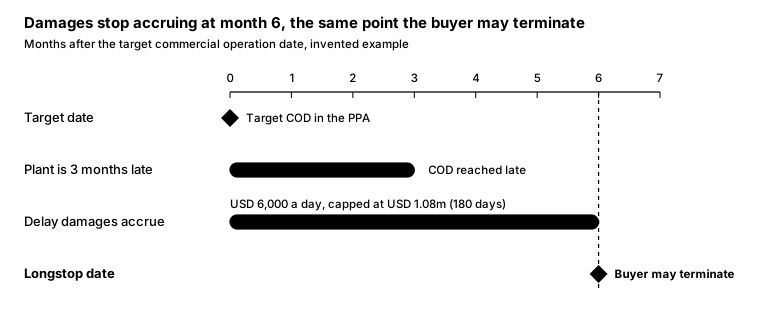
In the example the target date is month 0, damages run for 180 days, and the longstop date falls at month 6. The two clocks end together here only because the invented terms were set that way.
How do contracts set delay damages?
Delay damages are an agreed payment from the seller to the buyer for each day COD is late, in place of proving the buyer's actual loss. Public sources show three main variants, and a single PPA may use only one.
| Variant | Public example | How it works |
|---|---|---|
| Daily amount up to a maximum | World Bank guide (global); Stoel Rives (US); a model solar PPA for a US utility RFP; Indonesia (as reported in a 2025 study) | A fixed sum for each day of delay. The World Bank guide says damages are often calculated "by multiplying a dollar amount by the number of MWs of contracted capacity" for each day of delay. The US model PPA sets its cap at the daily damages multiplied by 180 days. The Indonesian study reports a maximum of 180 calendar days. |
| Pre-estimated damages set outside the PPA | India, standard solar PPA | The seller or its contractor pays "genuine pre-estimated liquidated damages", with the rate taken from the tender document attached as a schedule. |
| Penalty on payments, energy or security | Latin American auctions (Mexico, Chile, Peru, Brazil), per an IDB study | Mexico: a penalty of 5% of the monthly payments under the PPA. Chile: a fine per GWh for postponing a project. Peru: penalties deducted from the guarantee. Brazil: a 5% construction bond. |
In the example, the invented damages of USD 6,000 a day are a daily amount, and the 180-day cap equals USD 1.08m. The figure of 180 days is the example's choice, not a market norm.
What it changes in the model: delay damages are a cost line for the project company, paid to the buyer, and they are capped. Our reading is that the cap, and not the daily rate, sets the most the project can owe, so the model should carry the cap as an input.
What extends the commercial operation date?
An extension moves the target or longstop date, or switches off damages, when the delay is not the seller's fault. Public sources show three treatments.
- Excused delay. India's standard solar PPA makes the seller pay damages for delay "other than for the reasons specified in Article 11 and 12.2 (Force Majeure or Buying Entity's Default)". A WBCSD review says Australian longstop dates are "extendable for force majeure", with limited excuse events.
- Deemed commissioning. The Jordanian standard PPA deems the plant commissioned if specified circumstances delay it, and the buyer then pays under a schedule "until the actual date the PV Facility has been Commissioned". An Indonesian study reports a similar deemed COD payment for delays caused by the buyer, outside force majeure.
- A buffer before damages. The WBCSD review says that in the Netherlands "delay damages after a buffer period have been included on some deals".
The World Bank guide adds that extensions for force majeure "should not necessarily be day for day", because a short delay can cost a whole construction window.
What it changes in the model: an excused delay switches off damages but does not bring the revenue back. In the example, if the 3-month delay were excused, the USD 0.54m of damages would not be payable, yet the USD 1.4m of lost revenue and the USD 0.44m of interest would still fall on the project. Under deemed commissioning the buyer pays for the electricity deemed supplied, so that case differs sharply.
What does a delay cost the project?
A delay costs the project the revenue it does not receive, the interest on the loan while the plant earns nothing, and any delay damages it owes. In the example, 3 months of delay loses USD 1.4m of year 1 revenue, adds about USD 0.44m of interest on the full loan, and costs USD 0.54m in damages (90 days at USD 6,000).
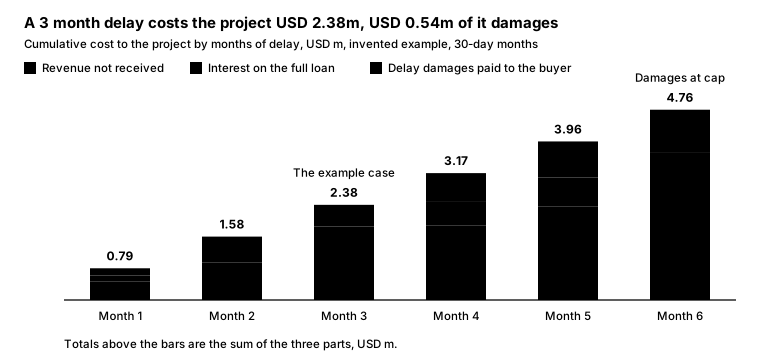
Damages are the smallest of the three parts: USD 6,000 a day against about USD 20,000 a day of lost revenue and interest. Our reading is that the cap, USD 1.08m, matters less to the project than the months of lost revenue, because revenue keeps being lost after the cap is reached. The chart holds costs at the base case and ignores extra construction costs, lender fees and any change in the tariff.
What happens at the longstop date?
At the longstop date the buyer gains a right to end the PPA if COD has not happened. Public sources show three ways of reaching that point.
- A fixed date after the target. The Jordanian standard PPA says that if COD "does not occur by the Longstop Date", as extended under named articles, the buyer "may terminate this Agreement".
- Damages reach their maximum. A model solar PPA for a US utility RFP defines the COD termination deadline as "the first date on which the aggregate Daily COD Delay Damages equal or exceed the COD Delay Damages Cap". An Indonesian study reports that PLN "reserves the right to terminate" once the liquidated damages reach the maximum. An Argentine briefing lists termination for a "delay in achieving COD beyond 180 days after the required deadline".
- Termination with a further payment. Stoel Rives says that after the maximum delay period one or both parties may terminate, and the seller may owe either liquidated damages, "typically capped at development period security", or a termination payment calculated with the seller as the defaulting party.
Stoel Rives also says construction period security is "usually required in an amount equal to the per diem amount of any delay damages" multiplied by the days between the target date and the drop-dead date. In the example that sum would be 180 days at USD 6,000, or USD 1.08m.
What it changes in the model: the longstop date is a cliff, not a slope. In the example, a PPA ended at month 6 would leave a built plant, USD 25.1m of senior debt and no contract, so lenders look at it before they look at the damages. See "PPA termination payments" for what is owed when a PPA ends later in life, and "PPA conditions precedent" for the conditions that must be met first.
How do you model it?
- Enter the target COD, the construction period and the longstop date as inputs, with the longstop date as a number of days after the target.
- Add a delay input in days. Move the start of revenue, the PPA tariff and the PPA term by that number of days.
- Keep the loan drawn and the interest running during the delay. In the example, 3 months adds about USD 0.44m of interest.
- Add delay damages as a cost line, limited by the cap, using the formula below.
- Add a switch for an excused delay that sets damages to zero but leaves the revenue and interest losses in place.
- Add a test that flags the case when days late exceed the longstop date, because the buyer may then terminate and the case should stop.
- Show who funds the extra cost. In the example, the 3-month cost of USD 2.38m is about 16% of the USD 14.9m of equity; this ratio is our own calculation from the example.
For the example, the damages are USD 6,000 × min(90, 180), which is USD 0.54m.
What are the common mistakes?
- Treating damages as the whole cost of delay. In the example, damages are USD 0.54m of a USD 2.38m cost at 3 months.
- Counting damages as income. Under the PPA variants above the seller pays the buyer, so the line is a cost for the project.
- Stopping the interest. The loan is drawn and accrues interest while the plant earns nothing.
- Assuming an excused delay restores revenue. An extension removes the damages. It does not pay for the months without sales, unless the contract deems the plant commissioned.
- Ignoring the longstop date. A model that runs a 9-month delay with damages stopped at the cap shows a project the buyer may already have left.
- Copying the example's terms. The USD 6,000 a day, the 180-day cap and the 6-month longstop are invented. Read them from the PPA.
Frequently asked questions
What is the difference between the target COD and the longstop date?
The target date is the date the seller aims for, and damages usually start after it. The longstop date is the later date after which the buyer may terminate. In the Jordanian standard PPA the longstop date is three months after the required date.
Who pays delay damages?
In the public sources opened for this article, the seller pays the buyer. The World Bank guide calls it an "obligation of Seller to pay Purchaser a fixed amount of money for each day of delay".
Are delay damages capped?
Often, according to the World Bank guide: "Liability for damages due to a delay or event of default are often capped". It adds that the cap for delay damages "may be substantially less than the cap for overall damages following an event of default".
Does a force majeure delay extend the date day for day?
Not necessarily. The World Bank guide says extensions "should not necessarily be day for day". Each contract states its own rule.
What do lenders look for in these clauses?
A WBCSD review says lenders "will want to ensure that there is limited risk of the corporate PPA falling away before a project is completed". In model terms, that points to the longstop date and its extensions.
Is the 180-day cap in the example a standard figure?
No. It is an invented figure chosen for the example. Public sources show other forms of limit, such as a percentage of monthly payments or a fine per GWh.
Sources
Pages opened on 5 October 2026. The example project is invented and has no source.
- Power Purchase Agreement between the National Electric Power Company and the Project Company (standard PV PPA), Ministry of Energy and Mineral Resources, Jordan. Longstop date definition, termination right, deemed commissioning.
- Standard Power Purchase Agreement (PPA) for Procurement of Solar Power on Long Term Basis, Solar Energy Corporation of India. Pre-estimated liquidated damages and the excused reasons for delay.
- User's Guide for the Power Purchase Agreement (PPA) Model for Electricity Generated from Renewable Energy Facilities, World Bank PPP Knowledge Lab (author Adel Beshara, 2012). COD definition, per-MW daily damages, caps, extensions.
- Utility-Scale Solar Power Purchase Agreements, Stoel Rives LLP. COD definition, delay damages up to a maximum delay period, termination and development period security.
- Appendix C Solar Model Power Purchase Agreement, 3 GW Alternative Market-Based, Entergy (US utility RFP). Damages cap defined as the daily damages times 180 days and the COD termination deadline.
- Solar PV Mapping and Development Plan (Indonesia), Phase 3 Report 3: Analysis of Power Purchase Agreement Terms, Energy Transition Partnership, prepared by a consortium led by Trama TecnoAmbiental, May 2025. Daily damages with a 180-day maximum, termination, deemed COD payment.
- Innovation in Power Purchase Agreement Structures, World Business Council for Sustainable Development, 2018 (hosted by CEBDS). Longstop dates in Australia and the Netherlands, developer and lender views.
- Clean Energy Auctions in Latin America, Inter-American Development Bank (Viscidi and Yepez, 2019). Delay penalties and guarantees in Mexico, Chile, Peru and Brazil.
- RenovAr, Argentina's Renewable Energy Program 1, Clifford Chance, August 2016. Offtaker termination for delay beyond 180 days after the required deadline.