Forecasting and scheduling under a solar PPA: who bears forecast error
By SolarQuant Editorial. Published 2026-10-05. Last updated 2026-10-05.
Forecasting and scheduling clauses decide who tells the grid how much a solar plant will deliver, and who pays when the forecast is wrong. Public contracts and rules put that cost on the buyer, on the seller or on both. In the example below, an 8% average monthly forecast error charged at an invented USD 12 per MWh costs USD 0.067m in year 1 and moves the DSCR from 1.30x to 1.28x.
What example does this article use?
The example is an invented 40 MWp ground-mounted solar plant in no named market. One buyer takes the power at the plant substation, which is the delivery point, and pays in USD under a 20-year PPA that runs from the commercial operation date. Construction takes 12 months.
The lender's case uses P90 generation. We use annual periods for simplicity; real deals usually use six-month periods. Every figure below is invented.
| Item | Figure |
|---|---|
| Plant | 40 MWp, ground-mounted |
| Contract | One buyer, delivery at the plant substation, paid in USD, 20-year PPA from commercial operation |
| Year 1 generation | P90 70.0 GWh (1,750 kWh per kWp); P50 76.0 GWh (1,900 kWh per kWp) |
| Degradation | 0.5% a year, so generation in year t = year 1 x 0.995^(t-1) |
| Tariff | USD 80 per MWh (USD 0.08 per kWh), flat for 20 years |
| Lender's case revenue (P90) | USD 5.6m in year 1, USD 5.30m in year 12, USD 5.09m in year 20, USD 106.8m over 20 years |
| P50 revenue, year 1 | USD 6.08m |
| Payment | Monthly invoices, paid 60 days after invoice; average monthly revenue USD 0.467m; receivable at 60 days about USD 0.92m |
| Payment security | Letter of credit from the buyer's bank, 3 months of revenue, USD 1.4m |
| Year 1 costs and CFADS | Revenue USD 5.6m, operating costs USD 1.0m, tax USD 0.4m, CFADS USD 4.2m (CFADS in year t = 4.2 x 0.995^(t-1)) |
| Funding | Total requirement USD 40.0m; gearing cap 70:30 (USD 28.0m of debt) |
| Senior debt | 12 years after construction, all-in rate 7.0%, sculpted so debt service = CFADS / 1.30; year 1 debt service USD 3.231m; debt USD 25.1m, 62.7% gearing, so the DSCR binds, not the gearing cap; equity USD 14.9m |
| DSCR levels | Sizing 1.30x, lock-up 1.20x, default 1.10x |
What is forecasting and scheduling under a solar PPA?
Forecasting and scheduling is the duty to estimate a plant's output ahead of delivery and to tell the grid operator or market how much will be injected. The duty can sit in the PPA, in grid or market rules, or in both.
Public sources show several ways of deciding who forecasts.
- The plant owner chooses. A 2015 amendment to India's grid code gave wind and solar generators "the option of accepting the concerned RLDC's forecast for preparing its schedule or provide the concerned RLDC with a schedule based on its own forecast". The RLDC is the regional load dispatch centre.
- The plant owner must submit. A November 2023 GIZ brief describes a decentralised system in which "the owners of solar and wind power plants are obliged to submit power forecasts to the TSO".
- The grid operator forecasts. The same brief reports that Chile's coordinator kept contracting an external provider for centralised forecasts after a pilot that began in April 2018. In Mexico, solar park operators' forecasts showed an average deviation of 9%, against 6% for a professional provider.
- A market participant submits a self-forecast. Australia's market operator describes dispatch self-forecasts that a provider submits through a web API. A provider that doubts its forecasts may suppress them.
Scheduling is the next step. The forecast becomes a schedule for each settlement period, and the grid compares delivery with it.
Who bears forecast error?
Forecast error is borne by whichever party receives the imbalance settlement, and the PPA or the market rules decide which party that is. Public texts show four different allocations. Read them as alternatives, not as one structure.
| Allocation | What the public text says | Source |
|---|---|---|
| Buyer bears it | After the commercial operation date the buyer is the scheduling coordinator, and imbalance costs, liabilities or revenues are "solely for the account of Buyer, except as expressly set forth in this Agreement" | Public utility PPA for a solar and storage facility, California, US |
| Seller bears the error of its own forecast | "Any commercial impact on account of deviation from schedule based on the forecast chosen by the wind and solar generator shall be borne by it" | India, grid code amendment, 2015 |
| Seller keeps imbalance risk in a physical PPA | "Generators may retain certain risks, such as volume and imbalance, which might require a utility PPA to manage these risks" | International corporate PPA guide, law firm |
| Cost fixed by agreement | Balancing risk "can be reduced by fixing the imbalance cost through an agreement or using intraday trading, if available" | Industry guide to solar PPAs, analytics firm |
The industry guide adds a point about price structure. In a pay-as-produced structure, the buyer carries a share of the volume risk, but the seller stays responsible for overperformance and underperformance. In a monthly baseload structure, "the volume risk will be carried by the seller".
What it changes in the model
Our reading is that each allocation puts a different line into the model. If the buyer bears the error, the seller's model has no forecast cost, but any carve-out in the clause needs its own check. If the seller bears it, the cost is a deduction before CFADS that grows with the size of the error and with the imbalance price. If the cost is fixed by agreement, it is a fee multiplied by the energy delivered.
How do day-ahead and intraday scheduling work?
Day-ahead and intraday scheduling is a cycle. The forecast becomes a schedule the day before, the schedule is revised as weather changes, and metered output is later compared with the schedule. One industry guide describes the balancing risk as "the difference between what was scheduled (usually a day ahead) and actual production".
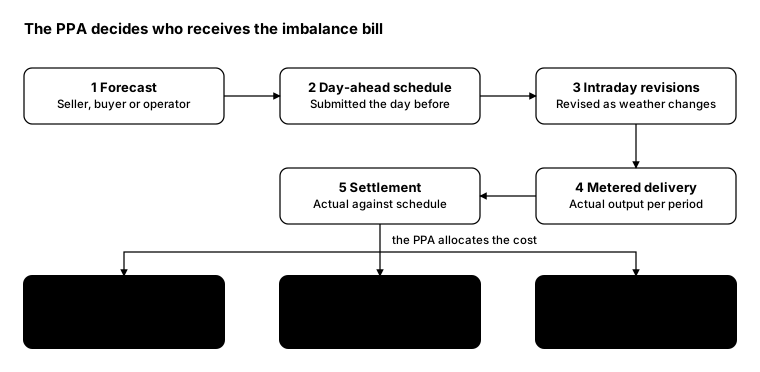
The first five steps are the same under every allocation. Only the PPA, or the market rules it sits within, changes who receives the bill at the end.
Revision rules differ by market. India's 2015 framework said revisions "shall be effective from 4th time block, the first being the time-block in which notice was given", with one revision for each time slot of one and half hours and a maximum of 16 revisions during the day.
At settlement, a TSO measures the actual physical flows, compares them with each balance responsible party's schedule and applies an imbalance price. The settlement period is fifteen minutes in the Nordics and Baltics and sixty minutes in some other markets.
What does forecast error cost in the example?
In the example, the cost depends on who receives the imbalance settlement. We test an average monthly forecast error of 8% of delivered energy, which is 5,600 MWh in year 1, charged at an invented USD 12 per MWh of deviation. We hold costs and tax at the base case, which is a simplification.
If the seller bears all of it, the cost is USD 0.067m in year 1. CFADS falls from USD 4.2m to USD 4.133m and the DSCR moves from 1.30x to 1.28x. The table sets that case beside two other allocations on the same plant.
| Case (all invented) | Year 1 cost to the seller (USD m) | Year 1 CFADS (USD m) | Year 1 DSCR |
|---|---|---|---|
| Buyer bears the error | 0 | 4.200 | 1.30x |
| Seller bears all of the error | 0.067 | 4.133 | 1.28x |
| Seller bears only error above an invented tolerance of 6% of delivered energy (2% x 70,000 MWh x USD 12) | 0.017 | 4.183 | 1.29x |
The chart shows how much room lenders leave before the error matters.
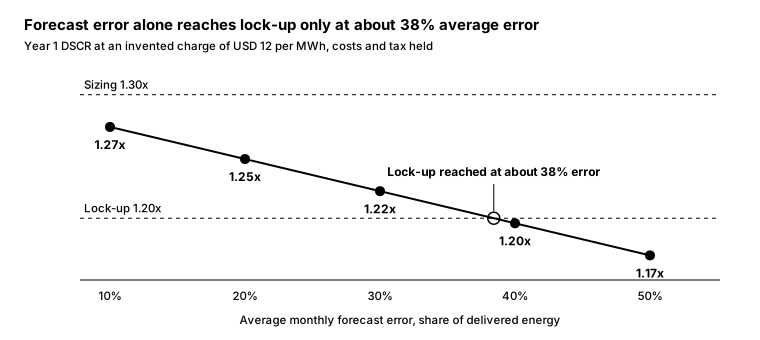
The DSCR falls by about 0.026x for each 10 points of average error at this charge. The year 1 headroom to lock-up is large, so forecast error is a small cover-ratio risk here. It matters more when the charge is higher or when it comes on top of other stresses.
How do you model it?
Model forecast error as a separate cost line that only appears when the seller receives the imbalance settlement. Work through these steps.
- Find who forecasts and who schedules, in the PPA and in the grid or market rules. These can be different parties.
- Find who receives the imbalance settlement, and whether the PPA passes it on, shares it or fixes a fee. Use the table above to place the clause.
- If the seller bears it, set an average deviation as a share of delivered energy and an imbalance price per MWh. Both are assumptions; label them.
- Calculate the cost for each period with the formula below.
- Deduct the cost from CFADS before the DSCR is calculated, and keep it on its own line so the sensitivity is visible.
- Test the lock-up level. Raise the error share until the DSCR reaches 1.20x, and note how far the base case sits from it.
Here e is the average deviation as a share of delivered energy, E_t is delivered energy in MWh in year t, and p is the imbalance charge in USD per MWh.
This cost is separate from the other revenue clauses. See Take or pay and deemed energy in a solar PPA: who pays when the power is not taken, and Performance guarantees in a solar PPA, for the clauses that deal with output that is lost or missed. See Delivery point, metering and grid charges for the metering that settlement relies on.
What are the common mistakes?
- Assuming the buyer bears imbalance because the price is pay-as-produced. One public guide says the seller stays responsible for over- or underperformance in that structure, while a public utility PPA puts imbalance on the buyer. Read the clause.
- Skipping the carve-outs. The California text says imbalance is for the buyer's account "except as expressly set forth in this Agreement". Any exception moves cost back to the seller.
- Using one fixed imbalance price for every year. In TSO systems the imbalance price is calculated from the balancing energy the TSO had to dispatch in the period, so it moves with the market.
- Burying the cost inside operating costs. A separate line shows the DSCR effect and lets you stress it.
- Copying one market's rules into another. Revision timing, settlement periods and who forecasts all differ between the sources we opened.
Frequently asked questions
What is a balance responsible party?
A balance responsible party is "a market participant that has signed a balance agreement with the TSO and accepted financial responsibility for keeping its portfolio in balance". The TSO compares actual flows with the party's schedule and applies an imbalance price. Whether the buyer or the seller holds this role is a PPA question.
Is forecast error the same as the P90 case?
No. P90 is a yearly energy estimate that lenders use for sizing. Forecast error is the gap between a short-term schedule and what the plant delivers in a settlement period, so it can be large in one month and net out over a year.
How much does forecast error cost a project?
We have no sourced market figure, and the cost depends on the rules of the market. In the example, an invented 8% average monthly error at an invented USD 12 per MWh costs USD 0.067m in year 1.
Does forecast error change the size of the debt?
Only if the seller bears it. In the example, if the USD 0.067m recurred every year at the same level, debt sized at 1.30x would be about USD 0.41m lower. We calculated that with the debt rate and tenor above and no degradation of the cost.
How is this different from curtailment or an output guarantee?
Curtailment and output guarantees deal with energy that is not produced or not taken. Forecast error deals with energy that is produced but differs from the schedule. The sibling articles on take or pay and on performance guarantees cover the other two.
Sources
Pages opened on 5 October 2026. The example project is invented and has no source.
- Resolution 2021-020: Approval of Willow Springs Solar 3 PPA (public version), Valley Clean Energy, California. Scheduling coordinator role and the imbalance clause.
- Framework on Forecasting, Scheduling and Imbalance Handling for wind and solar, Indian Electricity Grid Code (Third Amendment) Regulations, 2015, Central Electricity Regulatory Commission, India (copy on allaboutrenewables.com). Choice of forecast, revision rules and who bears the deviation.
- International Best Practices in Solar and Wind Power Forecasting, GIZ, November 2023. Decentralised and centralised forecasting; Chile and Mexico examples.
- Participant Forecasting FAQ, January 2026, AEMO, Australia. Dispatch self-forecasts.
- Balance Responsible Party (BRP): who pays for every imbalanced kilowatt-hour, Volton. Balance responsible party, settlement periods and imbalance price.
- What is a PPA? The Guide to Power Purchase Agreements, Pexapark. Balancing risk, and volume risk in pay-as-produced and baseload structures.
- Corporate PPA guide, DLA Piper. Generators retaining imbalance risk in a physical PPA.