Delivery point, metering and grid charges: where title passes and what it does to revenue
By SolarQuant Editorial. Published 2026-10-05. Last updated 2026-10-05.
The delivery point decides whose meter sets revenue, who bears energy lost on the way and who pays for grid connection. Public contracts place it at the plant, at the buyer's substation or at a point on a connecting line, and each choice changes the revenue line in a model. In the example below, a 1.5% loss before the meter lowers year 1 DSCR from 1.30x to 1.27x.
What example does this article use?
The example is an invented 40 MWp ground-mounted solar plant in no named market. One buyer takes the power at the plant substation, which is the delivery point, and pays in USD under a 20-year PPA from the commercial operation date. Construction takes 12 months.
The example is the revenue side of the plant used in the first series. Other delivery points appear below as separate what-if cases on this same plant, never as a second contract.
| Item | Example figure |
|---|---|
| Plant | 40 MWp, ground-mounted |
| Delivery point | Plant substation |
| PPA term | 20 years from commercial operation |
| Year 1 generation, P90 | 70.0 GWh (1,750 kWh per kWp) |
| Degradation | 0.5% a year |
| Tariff | USD 80 per MWh, flat |
| Year 1 revenue, lender's case | USD 5.6m |
| Year 1 operating costs | USD 1.0m |
| Year 1 tax | USD 0.4m |
| Year 1 CFADS | USD 4.2m |
| Year 1 debt service | USD 3.231m |
| Funding requirement | USD 40.0m |
| Senior debt, 12 years, 7.0% all-in | USD 25.1m (62.7% gearing) |
| Equity | USD 14.9m |
| DSCR levels | Sizing 1.30x, lock-up 1.20x, default 1.10x |
Debt service is sculpted so that it equals CFADS divided by 1.30. We use annual periods for simplicity. Real deals usually use six-month periods.
What is the delivery point, and what passes there?
The delivery point is the place where the seller hands over the power to the buyer. In public contracts, title and risk of loss pass at that point.
The point is usually named by its place on a single-line diagram. Three placements appear in the public documents we opened.
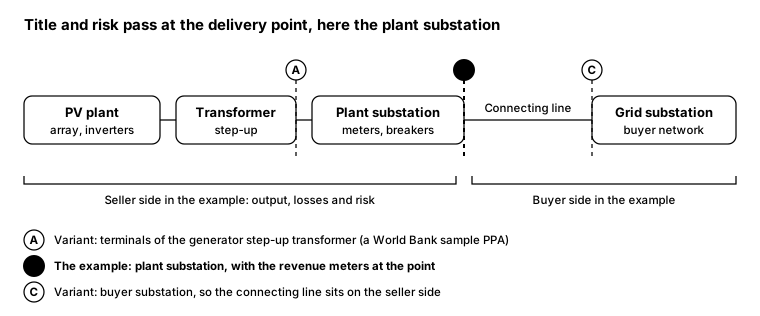
In the example the delivery point is the plant substation (point B). Points A and C are what-if placements on the same plant. They show how a different point moves the equipment and the losses between seller and buyer.
| Where the delivery point sits | What the contract text says | Source |
|---|---|---|
| High voltage side of the generator step-up transformer | Title and risk of loss pass there. Losses before the point are the seller's and losses beyond it are the buyer's. | World Bank sample PPA, Vietnam |
| Point where the seller's facilities connect with the buyer's facilities | Title and risk of loss pass there. The seller carries line losses from that point to the interconnection point. | Standard contract, California, USA |
| A point shown in a schedule to the contract | Title and risk of loss pass to the purchaser there. | SEIA C&I PPA v2.0, USA |
| Point where output is delivered to the buyer's grid, at high voltage transformer bay terminals | Defined as the point of connection where the energy output is delivered to the grid. | Standard PV PPA, Jordan |
| 11 kV side of a 33/11 kV substation of the buyer | The seller bears the charges and losses of transmission from the project up to that point. | Standard PPA, Maharashtra, India |
Placements differ, so the model starts from the contract's own definition of the point. Where the point is at the buyer's substation, the connecting line and its losses sit on the seller side. Not every public contract says where title passes, so the model should not assume a clause the contract lacks.
How is the energy metered, and how are meter disputes settled?
The revenue meter is the device whose reading becomes the invoice. Contracts say who supplies and owns it, what backs it up, how often it is tested and who decides when readings disagree.
The public documents we opened show several designs. They are separate variants and no single contract uses all of them.
| Topic | Variant seen in a public document | Source |
|---|---|---|
| Who owns the main meter | The seller's own revenue grade meter, built to a named accuracy standard. The buyer may add its own meter at the same location. | SEIA C&I PPA v2.0, USA |
| Who owns the main meter | Meters are procured by the purchaser, installed and tested by the seller, then owned and maintained by the purchaser. The seller keeps a back-up system. | Energy purchase agreement, Pakistan |
| Who pays for meters | The seller bears the cost of installation, testing, calibration, maintenance, renewal and repair of meters on its side of the delivery point. | Standard PPA, Maharashtra, India |
| Who pays for meters | Equipment cost normally falls on the buyer. A common practice is that the supplier buys, installs and runs the meters and the user covers its costs. | PPA guide, Mexico |
| Check meter | The project company installs main and check metering equipment at its own expense. | Standard PV PPA, Jordan |
| Test and recalibration | The buyer tests and recalibrates the check meter at least once every contract year. A deviation above 0.3% against the main meter triggers a meter check or recertification. | Standard contract, California, USA |
| Test and recalibration | A discrepancy above 2% over a contract year lets the purchaser ask the seller to calibrate the meter at the purchaser's cost. | SEIA C&I PPA v2.0, USA |
| Meter fails or reads wrongly | Energy for the period is taken from the check meter. If there is none, the parties agree the quantity or treat it as a dispute. | Standard PV PPA, Jordan |
| Who settles a dispute | Metering disputes that the parties cannot resolve go to an expert. | Standard PV PPA, Jordan |
The 0.3% and 2% figures are the triggers in those two templates. They are not revenue adjustments and they are not market norms.
In the model, the meter sets billed energy, so any gap between plant output and metered output is revenue the plant never invoices. A failed meter also moves cash in time, because replaced readings may be agreed after the invoice date. Our reading is that a modeller should test a year of under-read energy rather than assume a perfect meter.
Who pays for energy lost before the delivery point?
Energy lost between the generator and the delivery point is normally the seller's loss, because the meter sees only what arrives. Public contracts state this in three ways.
- By the point itself. One sample PPA says any loss of net energy before the delivery point is the loss and responsibility of the seller, and any loss beyond it is the buyer's (World Bank sample PPA, Vietnam).
- By a named line. A California standard contract makes the seller responsible for line losses from the delivery point to the interconnection point (Standard contract, California, USA). A state standard PPA in India makes the seller bear all charges and losses of transmission from the project up to the delivery point (Standard PPA, Maharashtra, India).
- By the billing quantity. A standard energy purchase agreement bills net energy delivered at the interconnection point, as measured by the metering system or the back-up system (Energy purchase agreement, Pakistan).
In the model, the yield study and the invoice must be measured at the same place. Our reading is that a P90 figure taken at the inverter output overstates billed energy when the meter sits further down the line. The model then needs a loss factor from the plant to the meter, with the factor taken from the yield study or grid study.
Energy that the grid cannot take is a separate case. It is covered in Take or pay and deemed energy in a solar PPA: who pays when the power is not taken.
Who pays for interconnection and grid charges?
Interconnection cost is the cost of the equipment and approvals that join the plant to the grid. Grid charges are the recurring network fees for moving power across it. Public documents split both between seller and buyer in different ways.
| Cost | Variant seen in a public document | Source |
|---|---|---|
| Interconnection works and upgrades | The seller carries interconnection costs, including necessary facility upgrades, and obtains and maintains the interconnection rights and agreements at its sole cost. | Standard contract, California, USA |
| Interconnection works | Each party builds the facilities on its own side of the interconnection point. | Energy purchase agreement, Pakistan |
| Interconnection works | The buyer designs, builds, owns and runs the interconnection facilities at its expense, by a date set in the contract. | Standard PV PPA, Jordan |
| Transmission charges to the delivery point | The seller bears all transmission charges and losses from the project up to the delivery point. | Standard PPA, Maharashtra, India |
| Network charges, off-site buyer | Network costs still apply in a merchant PPA. A private wire arrangement is exempt from network costs because the project does not use the public network. | Briefing note, Regen, UK |
| Grid access charges, off-site buyer | In Spain a corporate consumer must contract with the network distribution company and pay the grid access charges needed to take the power. | Corporate PPAs, Bird & Bird |
The model treats the two cost types differently. A one-off works cost paid by the seller adds to the funding requirement and so to equity. A recurring charge paid by the seller lowers CFADS in every year.
Our reading is that where the buyer builds the connection, its completion date also sets the earliest date the plant can deliver. That link is covered in The commercial operation date, longstop dates and delay damages.
How much do delivery point terms move revenue and DSCR?
A loss or charge that sits on the seller's side of the delivery point comes straight off year 1 CFADS. In the example, each case below moves DSCR by a few hundredths and none reaches the lock-up level.
All cases are invented what-ifs on the example plant. Each holds costs and tax at the base case, which is a simplification, and uses year 1 P90 energy of 70,000 MWh against debt service of USD 3.231m.
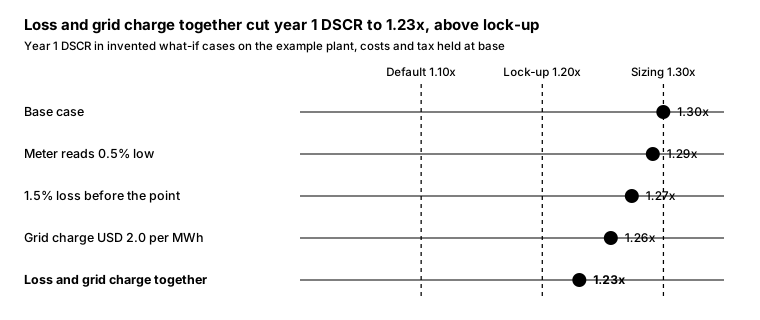
Each seller-side item lowers DSCR a little. Together the loss and the charge take 0.07x off the 1.30x sizing level and leave 0.03x before lock-up.
| Case (invented) | Input | Year 1 effect | Year 1 CFADS |
|---|---|---|---|
| Base case | None | None | USD 4.200m |
| Meter reads low | Meter reads 0.5% below true output for the year | 0.35 GWh not billed, revenue down USD 0.028m | USD 4.172m |
| Loss before the point | 1.5% of output lost on a seller line to a buyer substation | 1.05 GWh not billed, revenue down USD 0.084m | USD 4.116m |
| Grid charge | Seller pays USD 2.0 per MWh delivered | USD 0.140m of added cost | USD 4.060m |
| Loss and charge together | The two cases above combined | USD 0.224m less cash | USD 3.976m |
| Seller-funded connection works | USD 1.2m of works paid by the seller | Funding requirement USD 41.2m. Debt stays USD 25.1m, so equity rises from USD 14.9m to USD 16.1m. | USD 4.200m |
If the loss and the charge lasted for the whole debt life and scaled with output, DSCR-sized debt would fall by about USD 1.3m, from USD 25.1m to USD 23.7m. About 4.0 GWh a year, or 5.8% of year 1 P90 output, would have to go unbilled to bring DSCR down to the 1.20x lock-up level.
How do you model delivery point, metering and grid charges?
The model turns the contract's delivery point into a billed energy line, a loss line and a cost line. These steps follow the order of the revenue build.
- Mark the delivery point from the contract on a single-line diagram of the plant. Note every item of equipment and every line between the generator and that point.
- Record who owns the revenue meter, what backs it up and which tests the contract requires. Record where title and risk pass only if the contract states it.
- Place the yield study and the meter at the same point. If they differ, add a loss factor from the study point to the meter.
- Compute billed energy and revenue from that factor, as in the formula below.
- Put one-off connection works that the seller pays into the funding requirement. Put recurring grid charges into operating costs, linked to delivered or billed energy as the contract says.
- Run DSCR for the loss and the charge, and check the distance to the 1.20x lock-up level in each year.
- If the buyer builds the connection, link the earliest delivery date to its completion date and run the delay case.
The loss term is zero when the yield study already reports energy at the delivery point. In the example the delivery point is the plant substation, so the study figure of 70.0 GWh is the billed figure.
What are the common mistakes?
- Measuring yield and invoice at different points. A P90 figure taken before the transformer and substation is not the energy the meter will bill.
- Treating a meter trigger as a revenue allowance. The 0.3% and 2% figures in two public templates start a check or a calibration. They do not say that revenue is adjusted or waived.
- Assuming the buyer builds and pays for the connection. The public documents split interconnection works between seller, buyer and each party's own side.
- Leaving out a recurring charge. A per MWh charge on the seller lowers CFADS in every year, not only in year 1.
- Ignoring who carries the line to the grid. If the delivery point is at the buyer's substation, the line and its losses can sit on the seller side.
- Copying one contract's allocation into another. The variants in this article come from separate documents, and each deal has its own.
Frequently asked questions
Where does title to the power pass in a solar PPA?
In the public contracts that state it, title and risk of loss pass at the delivery point. Contracts differ on where that point is, so the model should read the definition rather than assume it.
Who owns the revenue meter?
Practice varies. One template uses the seller's meter, one has the purchaser own the main meter and the seller a back-up, and a Mexican guide says the buyer normally bears the equipment cost.
What happens if the meter fails or reads wrongly?
One public PPA takes the energy for the affected period from the check meter. If there is no check meter, it sends the quantity to agreement, and then to an expert if the parties cannot agree.
Do the 0.3% and 2% meter figures change the invoice?
In the two templates we opened, they trigger a meter check or a calibration request. They are not tariff adjustments and we do not present them as market norms.
Who pays for line losses?
It depends on the contract. Some put losses before the delivery point on the seller and losses after it on the buyer. Others name a line, such as the line from the delivery point to the interconnection point, and give its losses to the seller.
Does the delivery point change debt sizing?
Yes, through CFADS. In the example, a 1.5% loss and a USD 2.0 per MWh charge together would reduce DSCR-sized debt by about USD 1.3m.
Sources
Pages opened on 5 October 2026. The example project is invented and has no source.
- Power Purchase Agreement, Sample 1, World Bank PPP resources. Delivery point at the generator step-up transformer, title and risk, loss allocation (Vietnam).
- POWER PURCHASE AND SALE AGREEMENT, AB1613 standard contract, Southern California Edison. Title and risk at the delivery point, seller line losses and interconnection costs, check meter tests and the 0.3% trigger (California, USA).
- SEIA C&I PPA, version 2.0, Solar Energy Industries Association. Title and risk, seller revenue meter, 2% calibration trigger (USA).
- Standard Power Purchase Agreement, KUSUM A component, Maharashtra State Electricity Distribution Company. Delivery point at a buyer substation, seller meter costs, seller transmission charges and losses (India).
- Power Purchase Agreement, standard PV agreement, Ministry of Energy and Mineral Resources, Jordan. Delivery point definition, main and check meters, failed meter fallback, expert for metering disputes, buyer-built interconnection facilities.
- Standard Energy Purchase Agreement, World Bank PPP resources. Purchaser-owned main meters, seller back-up meters, billing at the interconnection point, interconnection facilities on each side (Pakistan).
- Guia: Elaboracion de Contratos de Compra de Energia (PPA), WWF Mexico and Antuko. Who normally bears metering equipment cost (Mexico).
- Power Purchase Agreements and non-commodity relief, Regen. Network costs under merchant and private wire PPAs (UK).
- Corporate PPAs: An international perspective, Bird & Bird. Grid access charges for a corporate consumer (Spain).