What the UN carbon market's new renewable electricity method is worth to a solar project
By SolarQuant Editorial. Published 2026-11-01. Last updated 2026-11-01.
When governments meet in Antalya for COP31 from 9 to 20 November 2026, the carbon market they created under Article 6.4 of the Paris Agreement will have something it lacked a year ago: a method for crediting renewable electricity fed into a grid. The Supervisory Body of the Paris Agreement Crediting Mechanism adopted the method, A6.4-AMM-003, at its twenty-second meeting, and it has been valid since 30 July 2026, so a solar developer can now register a plant with the UN mechanism and earn credits that a country may count towards its climate target or sell abroad. The COP31 presidency's fourth letter to the parties says it looks forward to "advancing high-quality implementation of Article 6, especially through the Article 6.8 work programme review" (presidency letter), and in our reading the question of what the method is worth to developers and their lenders is likely to be raised there.
Our reading of the method is that it is worth something to a narrow group of solar projects, and less than the old Clean Development Mechanism paid them. It leaves out the plants most of our readers build, which sell to named customers, and plants that won their contract in a renewable energy auction. It applies a common practice test that many African grids already fail on our reading, because solar has become what they build. For the plants that do qualify, it issues about a third fewer credits than a calculation in the CDM's style in the first year, and more than 40% fewer by the fifteenth, where that calculation counts the same plant with the CDM's grid weights and levy and with no downward adjustment.
To keep the numbers concrete we use the same invented 40 MWp plant as in our two articles on currency risk, who carries the currency risk in a dollar-priced solar project and what TCX's annual report tells solar developers about hedging. It produces 68,000 MWh in its first year, earns about USD 5.6 million of revenue and carries USD 25.1 million of senior debt sized at a cover of 1.30x, and here we place it on an invented grid in a least developed country.
Which solar projects can use the method?
The method is written for one kind of plant: a new plant that sells everything it generates into the grid, without a contract to supply any particular customer, and that a developer would not build without the credits. Each rule in the table below comes from the method's text, and the third column is our reading of the solar projects each rule leaves out.
| Rule | What the method says | Solar projects it leaves out |
|---|---|---|
| New plants only | The plant must be greenfield; expansions, retrofits, rehabilitations and replacements at existing plants are outside this version (paragraph 12 and footnote 13) | A second phase added to an operating plant, repowering |
| All output to the grid | The plant feeds all of its net generation into the electricity system (paragraph 12) | Behind-the-meter and captive plants that supply a site |
| No named customers | The participants have no agreement to supply the electricity through the grid to specific consumers, and the method does not apply to supplying end consumers (paragraph 19(a) and footnote 18) | Commercial and industrial PPAs, wheeled bilateral PPAs, mini-grids selling to households and businesses |
| No auction or quota scheme | The plant takes no part in a support scheme designed to reach a quantitative target, such as a competitive bidding process for renewable capacity, and is not subject to a penalty scheme of that kind (paragraph 28(b)(iii)) | Plants that won their tariff in a renewable energy auction or tender |
| Land | Solar plants may not sit on land classified as agricultural land or forest land (paragraph 17) | Plants on farmland, including most agrivoltaic designs |
| Battery | A battery counts only if it sits on the same site, is charged only by the plant and is installed before the meter (paragraph 14) | Batteries that also charge from the grid |
| Investment test | An investment comparison on net present value against the alternatives, including electricity from existing and new grid plants, with every input above 20% of costs or revenues varied by at least 10% (paragraph 33) | Plants that are already the most attractive option without credits |
| Common practice | Solar's share of comparable capacity must stay below 10% in least developed countries and small island states, and below 5% elsewhere (paragraph 35) | Grids where solar is already a common choice, which the next section tests |
The regulatory test is repeated for every monitoring period, and the method stops crediting on the date a new legal requirement applies (paragraph 30), so a government that later adopts a renewable energy target or obligation covering the plant can end its credits partway through.
What survives these rules is a greenfield plant on non-agricultural land that sells its whole output to the national utility or into the market, under a contract the developer negotiated with no auction involved, on a grid where little solar has been built. Our reading is that a power purchase agreement with a state utility that buys at the plant gate is not an agreement to supply specific consumers, since the utility is the buyer for the whole system, but a developer should have the validator confirm that early. The Secretariat's presentation to the twenty-second meeting records a discussion in which participation in an auction or the existence of a power purchase agreement "should not automatically make a project ineligible", yet the adopted text still shuts out any plant that participates in an auction designed to reach a capacity target, and that covers much of the utility-scale solar procured in Africa over the past decade.
Is solar already too common on the grid for the method?
The common practice test compares solar's share of comparable power plants with a limit of 10% in least developed countries and small island states and 5% elsewhere, and a plant whose share is at or above the limit is treated as common practice and therefore not additional (paragraph 41 of the common practice tool). The method asks the developer to count the plants "implemented within the reference period", which it defines as the three most recent calendar years before the plant starts operating or its design document is submitted, so our reading is that the test looks at what the grid has built in those three years.
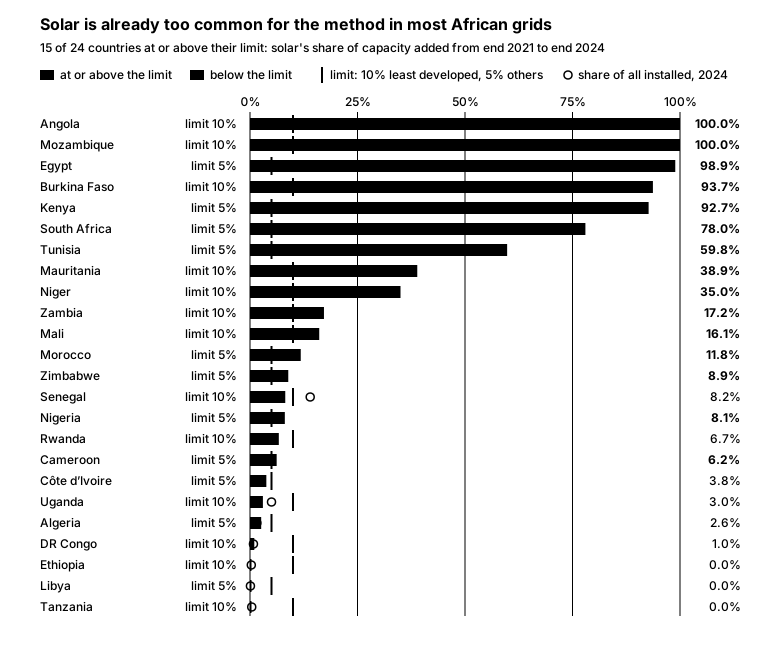
On that reading, 15 of the 24 African countries that added at least 100 MW of capacity between the end of 2021 and the end of 2024 would fail, among them Kenya, South Africa, Egypt, Zambia, Nigeria and Zimbabwe, because solar made up much of what they built. The countries that pass are mostly those whose recent additions were large hydro or gas plants, such as Ethiopia, Tanzania, the Democratic Republic of the Congo and Côte d'Ivoire, together with Senegal, Rwanda and Uganda, where the higher limit for least developed countries leaves some room. The hollow circles show the other way of counting, solar's share of everything installed, and on that measure 15 of the 24 would pass, including Egypt, Zambia, Nigeria and Zimbabwe, while Kenya, South Africa and Burkina Faso would still be at or above their limit and Senegal would newly fail. The two readings give different answers for 8 of the 24 grids, so a developer should settle which one the validator applies before paying for a design document.
The screen is ours and is only a first filter, and it uses Ember's Yearly Electricity Data, whose methodology notes that solar capacity is reported as AC or DC inconsistently across countries and which, in our reading of the data, reports capacity by country in coarse steps, may include off-grid solar, and nets retirements against new plants, whereas the test counts plants connected to the electricity system, may leave out plants already registered under the mechanism, and treats a grid with fewer than two similar plants as not common practice.
How many credits does a 40 MWp plant earn?
The plant earns credits on the electricity it feeds into the grid, multiplied by the grid's emission factor and reduced by a downward adjustment, and the developer keeps what is left after the mechanism's levy for adaptation and its cancellation for overall mitigation:
Here EG is the electricity fed into the grid in year y, in MWh, EF the grid's emission factor in tonnes of CO2 per MWh, and DA the downward adjustment, and in the first year the result is also multiplied by 0.99 (paragraph 56 of the method). Each of these terms is set more conservatively than under the CDM, and Figure 2 shows what each one removes from the first year.
The grid factor comes from the mechanism's tool for electricity emissions, A6.4-AMT-007, which combines an operating margin, the emissions of the plants that run less when solar runs, with a build margin, the emissions of the plants built most recently. For wind and solar the tool allows weights of 0.25 and 0.75 and, in the case the method uses, requires whichever pairing gives the lower factor (Table 5 and paragraph 102), where, as we understand the CDM's tool (which is not among our sources), solar had a weight of 0.75 on the operating margin. On our invented grid, with an operating margin of 0.65 and a build margin of 0.40 tonnes per MWh, that makes the factor 0.25 × 0.65 + 0.75 × 0.40 = 0.4625, against 0.5875 with the weights the CDM gave solar. The downward adjustment then starts at the larger of 10% and the lower bound of the factor's uncertainty, and rises by one percentage point a year (equations 3 to 8 of the method); we use the 10% minimum, so the real adjustment can only be larger and the credits only fewer.
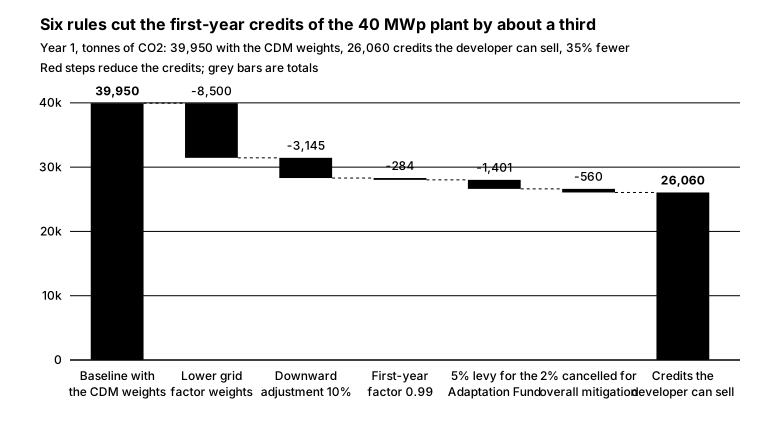
In the first year these steps take the plant from 39,950 tonnes under the CDM's weights to 26,060 credits it can sell, and the largest single step is the choice of weights, which takes more than the downward adjustment. It matters because on a grid where recent plants are cleaner than the plants that run at the margin, as wherever solar, wind or hydro has been built lately, the build margin is well below the operating margin and the method gives it three quarters of the weight.
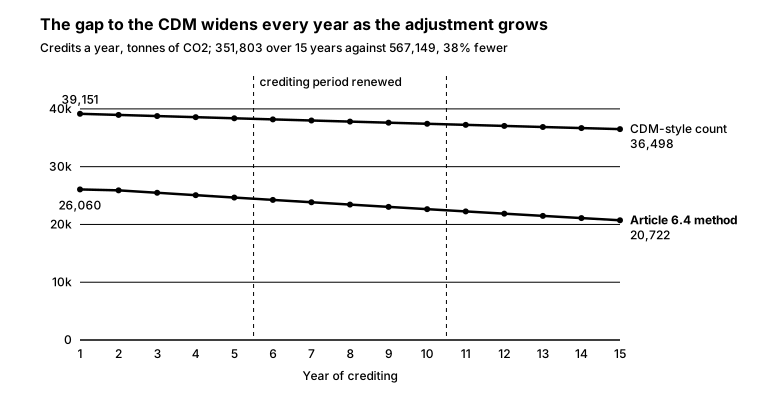
The gap widens every year because the downward adjustment grows by a point a year while the CDM-style count has none, so over 15 years of crediting the plant earns about 352,000 credits against 567,000, and in the fifteenth year it earns 43% fewer than the CDM would have given it. We have held the grid factor constant, but the tool updates the build margin every year in the first crediting period and fixes it at each renewal, so on a grid that keeps adding renewable plants the factor, and with it the credits, will fall faster than the chart shows.
What are the credits worth to the project?
There is no published price yet for credits issued to a renewable power plant under the mechanism, because the first issuance, approved on 26 February 2026, went to a cookstove programme in Myanmar, so we test three prices. The lowest, USD 10 a tonne, is close to the USD 9.95 at which Fastmarkets assessed units eligible for the first phase of the airline scheme CORSIA on 10 June 2026 (Fastmarkets), and the other two, USD 15 and USD 25, are the low and high scenarios that AlliedOffsets used (with a medium scenario of USD 20) in its analysis of host country revenues. Each price is shown with and without a host country fee of USD 4 a tonne, the middle of the USD 3 to 5 per tonne that the same analysis reports Ghana's Carbon Market Framework sets for ITMO fees.
| Price, USD per tonne | Host country fee, USD per tonne | Year 1 credit income, USD thousand | Share of year 1 revenue | Share of year 1 cash left for shareholders |
|---|---|---|---|---|
| 10 | 0 | 261 | 4.7% | 27% |
| 10 | 4 | 156 | 2.8% | 16% |
| 15 | 0 | 391 | 7.0% | 40% |
| 15 | 4 | 287 | 5.1% | 30% |
| 25 | 0 | 652 | 11.6% | 67% |
| 25 | 4 | 547 | 9.8% | 56% |
The income is before tax and before the costs of validation, verification and the mechanism's own fees, which come out of it every time the plant asks for an issuance. Against revenue it looks small, between 3% and 12%, which is the same order as the roughly 3% for solar and hydro that MSCI found across registered projects, and the Integrity Council for the Voluntary Carbon Market refused its quality label to the older renewable energy methods in 2024 on grounds of additionality.
Against what reaches the shareholders it is substantial, because the shareholders are paid from what is left after the lenders. In our example the plant's first-year cash available for debt service is USD 4.2 million and the sculpted debt service at 1.30x takes USD 3.23 million, which leaves about USD 0.97 million for the shareholders. Credit income of USD 156,000 to 652,000 adds between 16% and 67% to that, so a project whose return looks thin to the sponsor can be lifted materially by credits even though the plant's revenue barely moves, which gives the investment test in the next section more weight than its wording suggests.
Why do the investment test and the lender pull in opposite directions?
The investment test asks the developer to prove that the plant is not worth building without the credits, while the lender asks the developer to prove that the plant can repay its loan without them, and the window in which both statements are true is narrower than it looks.
Under paragraph 33 the developer compares the net present value of the plant built without registration against the alternatives, which include electricity from existing and new grid plants, and must show that the plant is not the most financially attractive of them. Every input that makes up more than 20% of costs or revenues has to be moved by at least 10% in the sensitivity analysis, unless a contract fixes it, and paragraph 34 settles any doubt against the developer: if a change within that range would make a different scenario the most attractive, the scenario with the lowest baseline emissions is chosen, and in our reading, for a solar plant, that is the plant itself, built without credits. Our reading is also that the plant must therefore stay unattractive without credits even when its yield or its capital cost moves 10% in its favour.
Set that beside the table above. In the first year the credits are worth between 3% and 12% of revenue, depending on the price and the host country's fee, and their share falls every year as the downward adjustment grows. A plant whose shortfall is small enough for credits of that size to close is likely to fall inside the 10% sensitivity band, where the method treats it as viable without credits; a plant whose shortfall is larger than the band is unlikely to be rescued by income of 3% to 12% of revenue. On our reading, at USD 10 or USD 15 a tonne the space between the two is close to empty, and only at prices nearer USD 25 without a host country fee could a plant both pass the test and become worth building because of the credits.
The lender then looks at the same plant from the other side. A bank sizing a loan wants the contracted revenue alone to cover debt service at the agreed ratio, because credit income is uncertain in volume, in price and in timing: it arrives only after each verification, the regulatory test is repeated every monitoring period, and additionality is assessed again at each renewal of the crediting period. In our currency risk article the debt was sized at 1.30x on contracted cash, and nothing in the method gives a lender reason to count credits in that sizing, so the credits improve the shareholders' return but leave the debt where it was. The developer ends up documenting for the validator that the plant fails without the credits, and documenting for the lender that the plant repays its loan without them, and the two statements are consistent on paper, though a credit committee that reads both files may find them hard to reconcile.
What do the crediting period and host country authorisation add to the risk?
The mechanism's rules, modalities and procedures give an emission reduction activity a crediting period of at most five years, renewable at most twice, or at most ten years with no renewal (paragraph 31(f)), and a host country may set a shorter one. A 25-year solar plant can therefore be credited for 15 years at most, and in the five-year option it has to pass review twice along the way, while the downward adjustment keeps growing by a point a year through all three periods. The 5% levy for the Adaptation Fund and the cancellation of at least 2% for overall mitigation are both taken at issuance (paragraphs 67(a) and 69(a)), and issuance follows each verification, so the cash arrives in lumps, months after the electricity was sold, and the first lump comes only after validation, registration and the first monitoring period.
The value of each credit then depends on what the host country does with it. A credit the host country authorises can be used towards another country's climate target or for other international purposes such as CORSIA, and the host must make a corresponding adjustment in its own emissions accounts, which is why countries charge for authorisation and ration it. A credit the host country does not authorise counts as a mitigation contribution, which the host keeps towards its own target and which buyers can use for claims that support a country's effort and cannot use to offset their own emissions, so it is generally expected to sell for less. A developer cannot assume authorisation: it needs a letter from the host country's designated authority, on terms the country sets, and the share of output the country is willing to authorise can be smaller than what the plant generates.
Article 6.2 is the other route, and it matters most for the projects the new method leaves out. Under Article 6.2 two countries agree a cooperative approach and transfer mitigation outcomes between them, and the underlying credits can come from an independent standard such as Verra or Gold Standard, provided the host country authorises them and makes the corresponding adjustment. That is how a commercial and industrial solar plant behind the meter, which AMM-003 excludes, can still sell authorised credits, as long as a standard has a method that covers it and a buying country wants that kind of credit. The price of that route is that each bilateral agreement sets its own rules on which projects qualify, and that the independent standards have tightened their own renewable energy rules too: the Secretariat's presentation notes that Verra now allows grid solar only in low and middle income countries and that Gold Standard limits renewables to low income and lower-middle income countries where they are below 5% of the grid.
What should a solar developer do with this now?
- Check eligibility before anything else, against the eight rules in the first table, starting with the two that end most solar projects: whether the plant supplies named customers, and whether it won its tariff in an auction or tender. If either applies, the new method is closed to it, and the question becomes whether an independent standard and an Article 6.2 agreement can carry the credits instead.
- Run the common practice test on the real grid, with the capacity built in the three calendar years before the plant starts or the design document is submitted, and with the threshold that applies to the host country, so that a plant does not spend money on validation in a grid where solar has already become the usual choice.
- Model the credits as the method counts them: the lower of the two weightings of the grid factor, a downward adjustment of at least 10% rising by a point a year, the 0.99 factor in the first year, the 5% levy and the 2% cancellation, a crediting period of five years renewable twice or ten years, and issuance only after each verification. SolarQuant's carbon section models credits under Verra, Gold Standard and the Article 6.4 mechanism, as well as credits a host country authorises for transfer under Article 6.2, so the issuance timing, the levies and the host country's fee flow through to the cash flow, the cover ratios and the shareholders' return in the same run.
- Prepare the investment comparison as carefully as the financial model for the lenders, because the method's 10% sensitivity band decides it: a plant that turns attractive without credits when its yield or capital cost moves 10% in its favour is not additional.
- Keep the credits out of debt sizing and say so in the lender model, while showing the shareholders' return with and without them at a low, a middle and a high price and with the host country's fee, since that is the comparison the sponsor needs.
- Ask the host country's designated authority early about authorisation, its fee, the share of output it will authorise and how long a letter of authorisation takes, because an unauthorised credit is a different product with a different price.
What should solar developers watch for in Antalya?
Three things in Antalya bear directly on the numbers above. The first is the levy and the cancellation, because the decision that set up the mechanism asked the Supervisory Body to evaluate the 5% share of proceeds for adaptation and the 2% cancellation for overall mitigation no later than 2026 (paragraphs 8 and 9 of decision 3/CMA.3), and any change to either percentage moves every credit a solar plant can sell. The second is any guidance the parties give the Supervisory Body on its future work, which in our reading is where a wider method, for expansions or for batteries charged from the grid, would first be asked for, since the current version leaves both out. The third is the wider energy agenda, where the presidency has repeated the goal of tripling renewable capacity by 2030 and launched a "35 by 35" goal for electricity to supply 35% of final energy use by 2035, both of which depend on finance reaching the countries where solar is still rare, which are also the countries where the new method's common practice test is easiest to pass.
The conference is expected to leave the method's basic design in place, which credits a narrow group of grid-connected plants conservatively and asks them to prove they need the money. For most developers in Africa the credits will add to the shareholders' return on a plant that already works for the lenders, and they should be modelled and priced as that addition to the return.
Sources
Pages opened in the week to 1 November 2026. The example project, its grid and its prices are invented and have no source.
- A6.4-AMM-003 v01.0, Electricity generation from renewable sources connected to an electricity system, UNFCCC. Used for the eligibility rules, the investment test, the downward adjustment, the first-year factor and the monitoring requirements.
- A6.4-AMT-001 v02.0, Common practice, UNFCCC. Used for the test and its limits.
- A6.4-AMT-007 v02.0, Emission factor for electricity systems, UNFCCC. Used for the weights of the operating and build margins.
- Decision 3/CMA.3, rules, modalities and procedures for the mechanism, UNFCCC. Used for the crediting period, the 5% levy, the 2% cancellation and the review due in 2026.
- Presentation to the twenty-second meeting of the Supervisory Body, UNFCCC Secretariat. Used for the debate on auctions and power purchase agreements and for the Verra and Gold Standard rules.
- UN carbon market approves first-ever issuance of credits under the Paris Agreement, UNFCCC. Used for the first issuance.
- Fourth presidency letter, COP31 Presidency. Used for the presidency's aims for Article 6.
- Voluntary carbon market report, 12 June 2026, Fastmarkets. Used for the CORSIA phase 1 price.
- What Article 6 means for host countries: the revenue case in numbers, AlliedOffsets. Used for the price scenarios and the Ghana fee.
- ICVCM axes renewable energy carbon credits from CCP label, CarbonCredits.com. Used for the share of revenue that renewable credits have earned.
- Yearly Electricity Data, Ember, licensed CC BY 4.0. Used for the capacity by country in Figure 1.
- List of least developed countries, UNCTAD. Used for the group of countries that has the 10% limit.