How a solar plant gets renewable energy certificates issued: registration, issuance and fees
By SolarQuant Editorial. Published 2026-10-10. Last updated 2026-10-10.
A solar plant earns renewable energy certificates only after an issuer has registered the plant and verified its metered output, period by period. Each step adds a fee and a delay, and a rejected month of evidence removes volume. For a modeller, issuance is a small operating cost, a working capital lag and a volume risk.
What example does this article use?
We use the same invented 40 MWp solar plant as the rest of the series. It sells power under a PPA, keeps its certificates and has registered with an issuer under a certificate system. Every figure below is invented and describes no real project, issuer, registry or market.
| Item | Example figure (invented) |
|---|---|
| Plant and power sale | 40 MWp, one 20-year USD PPA at USD 80 per MWh for power only |
| Certificates | Kept by the project and sold separately (unbundled), one per MWh of metered net output |
| Certificates, P90 | 70,000 in year 1, falling 0.5% a year to 63,641 in year 20 |
| Price | USD 2.0 per certificate, flat |
| Gross certificate revenue | USD 140,000 in year 1; USD 2.67m over 20 years |
| Issuance fee | USD 0.04 per certificate |
| Account fee | USD 1,250 a year |
| Registration fee | USD 1,850 in years 1, 6, 11 and 16 |
| Certificate costs | USD 5,900 in year 1; USD 4,036 in year 2; USD 85,818 over 20 years |
| Net certificate revenue | USD 134,100 in year 1 (3.19% of CFADS of USD 4.2m); USD 2.59m over 20 years |
| Forward sale | 52,000 a year in two batches of 26,000 at USD 2.0 |
| Timing | Issuance 64 days after each half-year ends, delivery 11 days after issuance, payment 27 days after invoice |
| Average year 1 receivable | About USD 74,000 |
| Rejected month | The issuer rejects one month of production evidence, so 2,100 certificates are missing on a delivery date; compensation to the buyer USD 1,715 |
| Model periods | Annual for simplicity; real deals usually use six-month periods |
Who can register a solar plant and hold its renewable energy certificates?
Two roles are involved: one party registers the plant and requests issuance, and an account holder receives the certificates. Some systems keep the roles separate, others combine them in one application.
- I-REC(E). The I-REC Code for Electricity says a Registrant "may be either the Production Facility Owner or appointed by the Production Facility Owner". Registrants contract with an Issuer, while Participants contract with Evident to hold accounts. "A Registrant may also be a Participant."
- Guarantees of Origin. The Swedish Energy Agency asks a new producer to submit "both an application for the production device and request for an EECS- account". Fingrid notes that an aggregator "can act as a common account holder for several producers".
- Australian large-scale generation certificates (LGCs). The Clean Energy Regulator requires "the nominated person for an accredited power station" and a registered person account in the REC Registry.
In the example, the project company registers the plant and holds its own account, so it pays both the registration and the account fee. Fingrid says aggregation "makes it possible to share the fixed costs among several operators", so a smaller plant may face a different cost line.
How is a solar plant registered for renewable energy certificates, and for how long?
The plant is registered once with documents that describe it and prove how it is metered, then checked by the issuer or a verifier. I-REC registration expires after five years unless the issuer sets an earlier date. Finnish EECS verification is valid for five years.
The I-REC Code for Electricity lists the minimum supporting evidence:
- "Unedited project photos (ideally with Production Facility location embedded)"
- "Sample metering evidence"
- a single line electrical diagram showing all network entry and exit points
- "Proof that the Registrant is the owner of the energy attributes"
The issuer then checks the application. Where it "is unable to verify the application data", a site inspection by a Verification Agent normally follows, at the Registrant's expense. The issuer also checks other registries so the plant is not earning certificates elsewhere.
Other systems use a separate verifier from the start. Fingrid accepts four types of proof that the plant meets the rules and that "reliable energy metering is used", including EECS verification. Australia's Clean Energy Regulator accredits the power station before any certificate can be created.
Registration does not last for the plant's life:
- I-REC(E). Registration "shall expire five years from the Effective Registration Date unless an earlier date is specified by the responsible Issuer". A renewal is assessed on the requirements in place at the time.
- Finnish GOs. "EECS verification is valid for five years from the date stated on the verification certificate."
The example pays USD 1,850 in years 1, 6, 11 and 16, which matches a five-year validity. It charges the full fee at each renewal; some published schedules charge less for a renewal, as the fee table below shows.
How often can a solar plant request renewable energy certificates, and how far back?
A plant requests certificates only after the electricity is produced, with metered evidence checked by an independent party. Systems differ on how often a request can be made and on the deadline for older production.
- I-REC(E). Certificates need evidence of "a production event which has occurred", for a period of up to one year "wholly within a single calendar year". Each period must also meet the Code's Residual Mix Deadline: unless otherwise communicated, 31 May of the following year for January to June output. For July to December output it is 30 September of the following year.
- Finnish GOs. GOs "are issued monthly, quarterly, or semi-annually once the commercial imbalance settlement of electricity in the months concerned has been completed". For August production, Finextra issues in mid-September.
- Australian LGCs. Claims rest on generation data "in intervals of 30 minutes or less, measured by accredited electricity meters". "All LGCs must be created by 31 December the year after the electricity was generated."
Our reading: the issuer's own review is usually the shorter part. The I-REC Code says the issuer "will normally Issue I-REC(E)s within one Business Week" of a complete request, a level it calls "indicative and non-binding". The Clean Energy Regulator says "Validation can take up to 28 days."
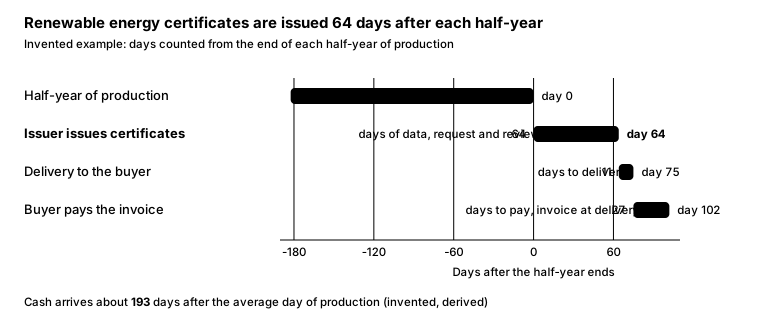
In the example, certificates for each half-year arrive on day 64 and are paid on day 102. Our reading: most of the 64 days is meter data and settlement before the request, so a faster issuer shortens it only a little.
Why can an issuer reject the evidence for renewable energy certificates?
An issuer rejects or holds back a request when it cannot confirm the volume, the period or the uniqueness of the claim. It can also stop issuing when the registrant has not paid its fees.
- Volume and period. The Clean Energy Regulator may fail LGCs when "you create more LGCs than you're eligible for" or "you create LGCs for the wrong period". It also fails them when "there is no generation data" or "your information doesn't match third-party information about your power station".
- Uniqueness. I-REC issuers check "that the measured volume has not been presented to any other system for the purposes of attribute tracking or carbon offsets". The Green Certificate Company (GCC) may "suspend (pending further evidence reasonably satisfactory to GCC) or withhold Issuing" if it cannot verify integrity.
- Evidence quality. The I-REC Code prefers electricity market settlement data. Any other evidence needs a stated reason unless Evident has approved it in advance, and an independent Production Auditor at the Registrant's cost.
- Unpaid fees. GCC's standard terms require payment within 30 days of invoice. After 45 days unpaid, issuing is suspended "for any and all Production Devices or Production Groups registered by the Registrant".
A rejection is not always final. The Clean Energy Regulator fails only the ineligible LGCs in a claim, and further claims for the same month need additional supporting information.
In the example, the issuer rejects one month of evidence and 2,100 certificates are missing on a delivery date. The project loses USD 4,200 of contract revenue and owes USD 1,715 of compensation, USD 5,915 in all (invented, derived). "Failure to deliver or accept renewable energy certificates: replacement cost and termination amounts" covers that compensation.
What do issuers and registries charge for renewable energy certificates?
Most published schedules combine a one-off registration fee, a yearly account or subscription fee, and a fee per certificate issued. The amounts and their split differ widely, so a model should take its figures from the schedule of the issuer it will actually use.
The table shows the fees each schedule sets for a large plant, using its top size band where it has one. Figures are in the schedule's own currency and are not ranked.
| System and schedule | Fixed fees | Fees per certificate |
|---|---|---|
| I-REC(E), central issuer (Green Certificate Company); Fee Structure I-TRACK(E)/I-REC(E) 2027 | Facility assessment EUR 1,000 (USD 1,255) for 3 MW and above, valid 5 years; renewal at 40% of that fee; participant account EUR 500 (USD 627.60) to open and EUR 2,000 (USD 2,510.40) a year | Issuance EUR 0.025 (USD 0.03) per MWh; redemption EUR 0.06 (USD 0.08) per MWh |
| Finnish EECS GOs, Fingrid; fees for 2026 | Power plant registration EUR 200; account holder EUR 1,500 a year | Issuance EUR 0.0015 per MWh |
| Swedish EECS GOs, Swedish Energy Agency; fees from 1 January 2026 | Special EECS account for holders with approved production devices SEK 200 a year | SEK 0.12 per issued EECS GO |
| Swiss GOs, Pronovo; List of fees 2026 | Unsupported plants above 10 MW CHF 120 a year per plant | Issuing CHF 0.013 per MWh for non-subsidised plants above 10 MW |
| North American certificates, CleanCounts; electricity registry pricing, opened 10 October 2026 | General Subscription USD 2,500 a year; Large Project Subscription USD 750 a year | Issuance USD 0.010 per certificate |
| North American certificates, NAR registry; fees effective June 2026 | Large Generator (above 10 MW) registration USD 1,000 and USD 2,000 a year; project account registration USD 250 | Issuance USD 0.03 per certificate |
| Australian LGCs, Clean Energy Regulator; pages updated August and September 2026 | Power station accreditation AUD 1,000 above 25 MW with a default or nil baseline | AUD 0.08 per LGC created, after the first 250 |
Schedules change. The Green Certificate Company's standard terms allow fee changes "no more frequently than annually, with effect 1 January each year". The I-REC(E) schedule converts euro fees to USD at the average European Central Bank rate published on 1 September. It then adds a further "10% currency fluctuation risk".
The example's fees are invented: USD 0.04 per certificate, USD 1,250 a year for the account and USD 1,850 per registration. None of them is taken from a schedule above.
How long do renewable energy certificates stay valid after issuance?
It depends on the system: some certificates expire a fixed time after production, others never expire but lose usefulness for certain claims.
- Finnish GOs. A GO "can be used within 12 months of the final production date of the corresponding electrical energy, after which it expires". Expired GOs "cannot be transferred or cancelled".
- I-REC(E). An I-REC(E) "is enduring and does not have an expiration date", but its eligibility for a given claim "may expire". The 2027 schedule adds an Extended Redemption Entitlement Service fee for older certificates. It applies once a vintage year X certificate is still in a trade account after 30 September of year X+2.
In the example, the forward batches are delivered 75 days after each half-year ends. Our reading: under a 12-month expiry, spot certificates would be tighter. Output from the first month of a half-year would have about 149 days left when issued (invented, derived).
What do registration, issuance and fees change in the model?
They add a small operating cost, a working capital lag and a volume risk. None is large against the plant's cash flow, but each sits on a different line of the model.
Fees are operating costs. Certificate costs are USD 5,900 in year 1, 4.2% of gross certificate revenue (invented, derived). Over 20 years, issuance fees total USD 53,418, account fees USD 25,000 and registrations USD 7,400: 3.2% of gross revenue.
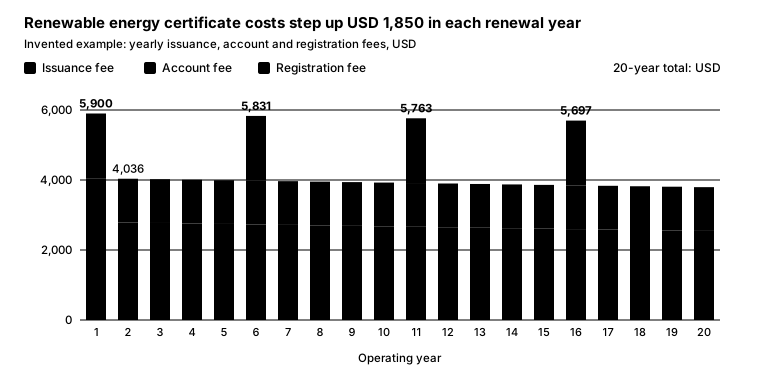
The account and registration fees are fixed, so year 1 costs USD 0.084 per certificate against USD 0.058 in year 2 (invented, derived). Our reading: fixed fees are due even when few certificates sell, so model them as operating costs, not as a deduction from the price.
Issuance lag ties up working capital. Cash arrives about 193 days after the average day of production, so the average year 1 receivable is about USD 74,000. Each extra day of lag adds about USD 384 (invented, derived).
A registration renewal is a condition as well as a cost. Under the I-REC Code, an eligible production period must "Not end later than the End Date of the associated Production Facility registration". Our reading: a missed renewal stops issuance from that date, so the model should date each renewal and test a gap.
A rejected month is a volume risk. An average month of year 1 P90 output is about 5,833 certificates, worth about USD 11,667 at USD 2.0 (invented, derived). Our reading: if the evidence can be corrected and resubmitted before the deadline, the month is delayed rather than lost.
For the lender, these amounts are small: year 1 certificate costs are 0.14% of CFADS of USD 4.2m (invented, derived). "Renewable energy certificate revenue in the lender's model: how much counts for debt sizing" covers how much of the net revenue counts.
How do you model it?
Model issuance as a dated chain from metered output to cash, with fees as costs and two downside switches. "How to read a renewable energy certificate sale agreement for a solar project: a modeller's guide" places this inside the whole agreement.
- Record the registration date, its validity and each renewal date, and switch issuance off for any gap.
- Convert metered net output into certificates, one per MWh, for each issuance period: half-years in the example.
- Date each issuance by the lag after its period ends, then add delivery and payment: 64, 11 and 27 days in the example.
- Add the issuance fee per certificate, the yearly account fee and each registration fee in its year as operating costs.
- Convert fees published in another currency at your own rate, and update them when the issuer changes its schedule.
- Check the system's expiry rule and request deadline against the sale timing of any spot certificates.
- Add a downside case with one month of evidence rejected, run once as a delay and once as a loss.
What are the common mistakes?
- Netting fees off the certificate price. Account and registration fees fall due whatever the sales, so they belong in operating costs.
- Treating registration as a one-off. I-REC registration and Finnish EECS verification both last five years, so renewals recur.
- Booking certificate cash at production. In the example, cash arrives about 193 days after the average day of production.
- Ignoring the deadline for older output. The I-REC Residual Mix Deadline, the Finnish GO 12-month expiry and the Australian LGC creation deadline each put a date on older output.
- Assuming every month of evidence is accepted. A rejected month delays or removes about 5,833 certificates in year 1 of the example.
Frequently asked questions
Does a solar plant need its own registry account to receive renewable energy certificates?
Not necessarily. In the I-REC system, registrant and account holder are separate roles, and the issuer issues "into the Account nominated by the Registrant". Fingrid allows an aggregator to hold the account for several producers.
How long does issuance of renewable energy certificates take?
Finnish GOs wait for imbalance settlement: for August production, Finextra issues them in mid-September. The I-REC issuer normally issues within one Business Week of a complete request. The Clean Energy Regulator's validation "can take up to 28 days".
Can a plant get renewable energy certificates for output before it was registered?
Under the I-REC Code, a production period cannot start before the Effective Registration Date. That date is normally no earlier than the Commissioning Date, although the issuer may agree exceptions.
Who pays for verifying the evidence behind renewable energy certificates?
In the I-REC system, the registrant does. A site inspection is at the Registrant's expense, and where settlement data is missing, "The audit costs shall be assumed by the Registrant."
Can issued renewable energy certificates be withdrawn?
Yes, in limited cases. The Green Certificate Company's standard terms say certificates issued after an error "may be Withdrawn or amended" to keep them accurate. The I-REC Code allows amendment only "in exceptional circumstances where verified historic facts are ruled to have been wrong".
Sources
Pages opened and checked on 10 October 2026. The example project is invented and has no source.
- Evident. I-REC Code for Electricity, Version 1.13, Evident. Registrant and Participant roles, registration evidence, inspection, five-year expiry, eligible production periods, evidence hierarchy, Residual Mix Deadline, issuer review and service timing, certificate validity.
- Fee Structure I-TRACK(E)/I-REC(E) 2027, I-TRACK Foundation. Central issuer assessment, renewal and issuance fees, participant account and redemption fees, USD conversion, Extended Redemption Entitlement Service fee.
- Standard Terms and Conditions for Registration and Issuing (V4), The Green Certificate Company. Integrity checks, withholding of issuing, withdrawal after errors, payment terms and suspension, timing of fee changes.
- Frequently asked questions: Fingrid, Fingrid. Plant verification and its five-year validity, issuance after imbalance settlement, GO expiry after 12 months, aggregators.
- Fees: Fingrid, Fingrid. 2026 fees for EECS GOs: registration, account holder and issuance.
- EECS guarantees of origin and how to apply, Swedish Energy Agency. Joint device and account application, fees from 1 January 2026.
- List of fees 2026 of the swiss guarantee of origin system for electricity, Pronovo AG. Annual plant fee and issuing fee for plants above 10 MW.
- Electricity Registry Pricing: CleanCounts, CleanCounts. Subscription and issuance fees.
- NAR Registry Fees, Xpansiv. Project registration, subscription and issuance fees effective June 2026.
- Create large-scale generation certificates, Clean Energy Regulator. Who can create LGCs, supporting evidence, creation deadline, validation time, registration fee, reasons LGCs fail.
- Power stations, Clean Energy Regulator. Power station accreditation fees.