What buyers need from renewable energy certificates: Scope 2 quality criteria, market boundaries and vintage
By SolarQuant Editorial. Published 2026-10-10. Last updated 2026-10-10.
Buyers count renewable energy certificates in their emissions reports only when the certificates pass the claim rules they follow. Those rules look at exclusivity, retirement, vintage, market and, in some frameworks, the plant's age. For a modeller, they decide which buyers a plant can serve late in its life and which fields the sale agreement must carry.
What example does this article use?
We use the same invented 40 MWp solar plant as the rest of the series. The project sells its power under a PPA, keeps its certificates and sells them separately. Every figure below is invented and describes no real project, buyer, issuer or market.
| Item | Example figure (invented) |
|---|---|
| Plant and power sale | 40 MWp, one 20-year USD PPA at USD 80 per MWh for power only; construction 12 months |
| Certificates | Kept by the project and sold separately (unbundled), one per MWh of metered net output |
| Certificates, P90 | Year 1: 70,000; year 12: 66,245; year 20: 63,641 (output falls 0.5% a year) |
| Price | USD 2.0 per certificate, flat; tested range USD 1.5 to 4.0 (invented range, not a market range) |
| 20-year certificate revenue | Gross USD 2.67m; net of issuer costs USD 2.59m |
| Forward sale | 52,000 a year for three vintage years, in two batches of 26,000; certificates above that are sold spot |
| Timing | Issuance 64 days after each half-year ends; delivery 11 days after issuance |
| Senior debt | USD 25.1m, repaid over 12 years after construction; year 1 CFADS USD 4.2m |
| Commissioning timing | At the start of a calendar year, so operating years match calendar years (a simplification for this article) |
What do buyer claim rules ask of a renewable energy certificate?
Every buyer framework we reviewed asks that a certificate carry the generation's attribute exclusively and be retired or cancelled for the claimant. They differ on how recent the vintage must be, how wide the market is, and whether the plant's age matters.
| Framework | Exclusivity and retirement | Vintage | Market boundary | Plant age |
|---|---|---|---|---|
| GHG Protocol Scope 2 Guidance (2015), Scope 2 Quality Criteria | Conveys the emission rate attribute; the only instrument carrying that claim; tracked and redeemed, retired or cancelled "by or on behalf of the reporting entity" | Issued and redeemed "as close as possible" to the consumption period | The same market as the consuming operations, following boundaries set by regulators or issuing bodies | Not a Quality Criterion; the year first operational is a suggested disclosure |
| RE100 technical criteria (March 2025) | Exclusive ownership and exclusive claims; certificate cancellation where certificates are in common use | Generation "reasonably close in time" to the claim period, which RE100 does not define | Individual countries, except a United States and Canada market and a European single market | Commissioned or re-powered no more than 15 years before the claim year, with a 15% allowance and exemptions |
| CDP, Accounting of Scope 2 emissions (version 12.0, April 2026) | Applies the Scope 2 Quality Criteria | Recommends six months before to three months after a 12-month reporting period | National borders, "almost universally", plus a United States and Canada market and a European market | Asks for the facility's commissioning year in its reporting example |
| Green-e Renewable Energy Standard for Canada and the United States (version 4.6) | Eligible RECs or renewable energy "can be used once and only once" | The calendar year of sale, its first three months after, or the last six months before | Facilities in the United States, Canada and Mexican parts of North American reliability regions | A 15-year "New Date" window: 2026 sales need plants operating or repowered from 2012 |
| Guarantees of Origin (GOs) for supplier disclosure, Directive (EU) 2018/2001, Article 19 (2018 text) | One GO per unit; the same unit counted only once; suppliers cancel GOs to disclose | Valid 12 months after production; cancelled for disclosure within six months after that; expired by 18 months | Member States recognise each other's GOs; third-country GOs only under a Union agreement and with direct import or export of energy | The GO states the date the installation became operational |
The market and vintage tests apply to every buyer in the table. The age test applies only to buyers whose framework has one, so it splits the buyer pool late in a plant's life.
The GHG Protocol consulted on a revised Scope 2 Guidance from 20 October 2025 to 31 January 2026. The proposal would require "hourly matching of contractual instruments for large organizations" and generation "plausibly deliverable to where the organization consumes electricity". It also proposed "a legacy clause for existing contracts".
The GHG Protocol's feedback summary of 29 July 2026 reported "Low support for hourly matching and deliverability as proposed". In July 2026 the Independent Standards Board then "called for further work on multiple market-based method reporting approaches". Our reading: a multi-year sale signed now may outlive the 2015 criteria, so the agreement should say what happens if the buyer's rule changes.
How old can the plant behind a renewable energy certificate be?
That depends on the buyer's framework. RE100 sets a 15-year commissioning or re-powering date limit, and Green-e Energy certifies only output from plants inside a 15-year "New Date" window. The GHG Protocol guidance, CDP and GO disclosure record the plant's age without limiting it.
The two age tests count differently. RE100 defines fifteen years as "on or after 1 January of the year fifteen years prior to the claim to use of renewable electricity". Green-e's table pairs 2026 sales with plants operating from 2012, a window of 15 calendar years including the sale year.
In the example, operating years match calendar years. Years 1 to 15 pass both tests, year 16 passes only the RE100 count, and years 17 to 20 pass neither.
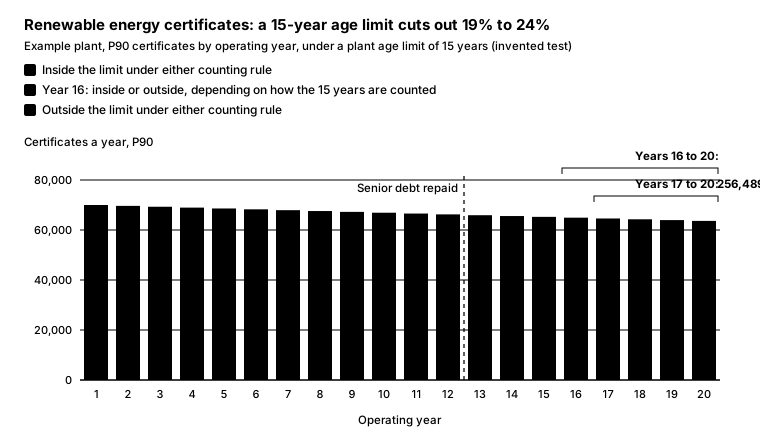
The age limit bites only after the senior debt is repaid in year 12, so it moves equity cash flows, not debt sizing. Exemptions soften it: RE100 exempts "Long-term project-specific procurement done as the original off-taker", including project-specific unbundled certificate purchases.
RE100 also lets a buyer source 15% of its consumption from older projects. Green-e certifies some long-term contracts beyond the 15-year window, up to 30 years. Our reading: a buyer that signs early and long can keep using late-life certificates that a spot buyer cannot.
Our reading: both tests count calendar years, so a plant commissioned in late December loses almost a year of eligibility against one commissioned in January. The commissioning date is therefore a pricing input for late-life certificates, not only a construction milestone.
How close to consumption must a renewable energy certificate's vintage be?
The vintage must fall within the window the buyer's framework sets, and the windows range from undefined to fixed. The GHG Protocol asks for issue and redemption "as close as possible" to consumption, and RE100 asks for "reasonably close" without defining it.
CDP recommends a vintage from six months before to three months after a 12-month reporting period, which it calls a 21-month vintage limitation. Green-e applies the same shape to the calendar year of sale. In the Directive's original 2018 text, a GO itself is valid for 12 months after production and expires by 18 months.
National rules sit on top of the Directive. The Association of Issuing Bodies (AIB) notes that national authorities set "who can trade certificates, when they expire, and how they can be cancelled". These rules can differ between AIB members.
Our reading: the vintage window is the shelf life of unsold certificates. In the example, the 18,000 year 1 certificates above the forward contract must sell inside that window or lose value for that buyer.
What if the example's certificates were GOs (invented what-if)? Issuance 64 days after each half-year leaves about 120 days of validity on the first day's output and about 300 on the last day's. After the 11-day delivery lag, the oldest certificates reach the buyer with about 110 days left (invented, derived).
The proposed Scope 2 revision would add the hour of production to the vintage test for large buyers. EECS certificates already record "the start and end time (minute, hour, date) of energy production", so the data exists in some systems.
In which market can a renewable energy certificate be claimed?
A renewable energy certificate can be claimed only in the market where it was generated, and most frameworks treat that market as a country. CDP says its market conditions "describe, almost universally, national borders". RE100 treats individual countries as distinct markets, apart from the single markets it names.
Both recognise a United States and Canada market, and a European market of grid-connected EU single market countries that issue EECS GOs. The GHG Protocol's 2015 guidance tells companies to follow boundaries set by regulators or issuing bodies, and calls the EU a multi-country market.
Among Member States, Directive 2018/2001 allows a refusal to recognise another state's GO only on well-founded doubts. It bars recognition of third-country GOs unless the Union has a mutual recognition agreement with that country and energy is directly imported or exported.
Our reading: location fixes the buyer pool for the plant's whole life. The example plant sits in no named market, so its certificates can serve only buyers consuming electricity in that same market. Size spot demand from buyers in that market, not from global demand.
Our reading: the proposed deliverability test would narrow the pool further, to buyers the plant could plausibly deliver to. A plant with few large consumers nearby would feel that most.
What does a lower price for late-life renewable energy certificates do to the example?
It trims equity cash flows by up to 6.2% of 20-year net certificate revenue, and leaves debt untouched. The example's senior debt is repaid in year 12, before any age limit bites.
In this invented what-if, certificates outside the age limit sell at USD 1.5 instead of USD 2.0, the bottom of the invented range. The loss is the price gap times the late-life volume:
If years 16 to 20 are affected, 321,419 certificates lose USD 0.50 each, or USD 160,709. Net certificate revenue for those years falls from USD 621,881 to USD 461,172, and 20-year net revenue from USD 2.59m to USD 2.42m. If only years 17 to 20 are affected, the loss is USD 128,245 (all invented, derived).
Even at USD 1.5, a late-life certificate still covers its issuer costs of about USD 0.06 in year 20 (invented, derived). Our reading: the discount is a buyer pool question, so test it in the equity case rather than assume it away.
Which specification fields must a renewable energy certificate sale agreement carry?
The agreement must carry every field a buyer needs to test vintage, market and plant age before it pays. That means the production period, technology, plant identity and location, and the commissioning date.
| Field | I-REC(E) Standard Single Trade Agreement, annex | EFET certificates master agreement, Confirmation | North American master REC agreement, Product Order |
|---|---|---|---|
| Production period | "Production Period" | "Production Year" | "Vintage" (month/year, as applicable) |
| Technology | "Technology" | "Technology" | Renewable Energy Source specific |
| Plant and place | "Country of Production"; "Production device details (if any)" | "Domain of Production" | "Name of Facility", "Location of Facility", "EIA number" |
| Commissioning date, or a free-text field for it | "Additional details (if any)" | "Additional quality" | "Online Date" |
| Shelf life | "Minimum validity of the Certificates upon delivery" | ||
| Buyer's use | Beneficiary and redemption purpose, for a Redemption Statement Transfer | "Designated Purpose" | Eligibility for named renewable portfolio standard (RPS) programmes |
Only the North American Product Order has a named field for the plant's start date. In the other two, our reading is that the commissioning date belongs in the free-text field shown, or the age test cannot be checked.
Buyers will ask for it anyway. GOs state the date the installation became operational and whether it received support, and CDP asks reporters for the commissioning year.
Our reading for the example: the forward sale should carry the half-year production period, technology, plant identity, country and commissioning date. For GO-type certificates, a minimum validity on delivery protects the buyer from the shelf life problem above.
How do you model it?
Model buyer eligibility as a flag on each year's certificates, then price each buyer group separately. "How to read a renewable energy certificate sale agreement for a solar project: a modeller's guide" places these fields in the whole agreement.
- Record the plant's market, its commissioning date and the age tests of the buyers you expect to sell to.
- Forecast certificates by half-year at P90 and P50, after the issuance lag: 70,000 at P90 in year 1 of the example.
- Flag each year's certificates as usable by age-limited buyers, by other buyers, or by both.
- Price each group, and run any late-life discount as a labelled sensitivity, not as the base case.
- Compare issuance and delivery dates with each buyer's vintage window or GO validity, and drop unsold certificates to a lower price after it.
- Put late-life effects in the equity case, and check whether any year falls inside the debt tenor.
- Check that the sale agreement carries the production period, technology, plant identity, location and commissioning date.
- Add a rule-change case for any buyer framework under revision, such as the Scope 2 Guidance.
"Pricing renewable energy certificates: volume, vintage, spot trades and forward sales" covers the price inputs. "Renewable energy certificate revenue in the lender's model: how much counts for debt sizing" covers the debt view.
What are the common mistakes?
- Treating every buyer as indifferent to plant age. RE100 and Green-e apply a 15-year test, so 19% to 24% of the example's 20-year certificates lose those buyers.
- Counting the 15 years the same way everywhere. RE100 counts from 1 January of the year 15 years before the claim, while Green-e's table gives 15 calendar years. Year 16 of the example passes one and fails the other.
- Assuming a certificate keeps its value until sold. Vintage windows and GO validity give unsold certificates a shelf life, and issuance lags use part of it.
- Leaving the commissioning date out of the agreement. Two of the three templates have no named field for it, and without it the buyer cannot check the age test.
- Selling outside the buyer's market. A certificate from one country usually cannot support a claim in another, outside the United States and Canada market or the European market.
- Ignoring exclusivity. A certificate whose attribute is claimed elsewhere fails the second Quality Criterion. "Renewable energy certificates and carbon credits from the same solar plant: avoiding double counting" covers this.
Frequently asked questions
Does the GHG Protocol set a plant age limit for renewable energy certificates?
Its 2015 Scope 2 Quality Criteria do not include one. Its list of instrument features suggests companies "note the year the generation facility that created the certificate/contract was first operational or substantially repowered". RE100 and Green-e add age tests of their own.
Has the GHG Protocol's Scope 2 revision for renewable energy certificates been finalised?
Not as of its feedback summary dated 29 July 2026. The consultation ran from 20 October 2025 to 31 January 2026 and drew nearly 1,100 responses. In July 2026 the Independent Standards Board tasked the Technical Working Group with refining the approach and resolving open questions.
Can a long-term buyer keep using renewable energy certificates after the plant turns 15?
Under RE100, yes, if it is the original off-taker in long-term project-specific procurement, which includes project-specific unbundled certificate purchases. RE100 accepts a delay between commissioning and off-take only for regulatory reasons, and no longer than one year. Green-e certifies some long-term contracts for up to 30 years.
How long is a Guarantee of Origin valid for a buyer's claim?
In the 2018 text of Directive (EU) 2018/2001, a GO is valid for 12 months after production of the energy unit. Uncancelled GOs expire at the latest 18 months after production and are counted in the residual mix. Energy companies must cancel GOs for disclosure within six months after validity ends.
Must buyers use renewable energy certificates from their own country?
Usually, yes. CDP and RE100 treat most countries as separate markets, with a United States and Canada market and a European market as the main exceptions.
Sources
Pages opened and checked on 10 October 2026. The example project is invented and has no source.
- GHG Protocol Scope 2 Guidance: An amendment to the GHG Protocol Corporate Standard, GHG Protocol (World Resources Institute and WBCSD). Scope 2 Quality Criteria (Table 7.1), vintage and market boundary explanations, facility age as an instrument feature (Table 8.1).
- Scope 2 Public Consultation Feedback Summary: Executive Summary, GHG Protocol. Consultation dates, proposed hourly matching, deliverability and legacy clause, feedback and the July 2026 next steps.
- RE100 Technical Criteria, RE100 (Climate Group). Publication of 24 March 2025: fifteen-year commissioning or re-powering date limit, 15% allowance, exemptions, vintage, market boundaries.
- Accounting of Scope 2 emissions: CDP Corporate Questionnaire, CDP Worldwide. Version 12.0 of 20 April 2026: vintage recommendation, market definitions, commissioning year in the reporting example.
- Green-e Renewable Energy Standard for Canada and the United States, Center for Resource Solutions. Version 4.6: vintage, New Date window, long-term contracts, single use, facility location.
- Directive (EU) 2018/2001 of the European Parliament and of the Council of 11 December 2018 on the promotion of the use of energy from renewable sources (recast), European Parliament and Council (Official Journal text, copy hosted by the AIB). Article 19 in its original 2018 text: GO validity, expiry, cancellation for disclosure, content and recognition.
- Imposed conditions for trade, expiry and cancellation, Association of Issuing Bodies. National rules on trade, expiry and cancellation.
- Content, Association of Issuing Bodies. Information carried by EECS certificates, including production start and end times.
- I-REC(E) Standard Single Trade Agreement, RECS Energy Certificate Association and DLA Piper. Annex fields and the beneficiary information for a Redemption Statement Transfer.
- EECS Certificate & National Scheme Certificate Master Agreement, Version 1.1(b), European Federation of Energy Traders. Confirmation fields.
- Memorandum of Understanding, with Exhibit A: Master REC Purchase and Sale Agreement, Illinois Power Agency. Product Order fields.