Pricing renewable energy certificates: volume, vintage, spot trades and forward sales
By SolarQuant Editorial. Published 2026-10-10. Last updated 2026-10-10.
A sale agreement for renewable energy certificates sets revenue through three terms: price, volume and vintage. Public templates fix a price per certificate for each delivery, with a firm quantity or one that follows output. For a modeller, the key choice is how much to sell forward against P90.
What example does this article use?
We use the same invented 40 MWp solar plant as the rest of the series. The project sells its power under a PPA, keeps its certificates and sells part of them forward for three vintage years. Every figure below is invented and describes no real project, buyer, issuer or market.
| Item | Example figure (invented) |
|---|---|
| Plant and power sale | 40 MWp, one 20-year USD PPA at USD 80 per MWh for power only |
| Certificates | Kept by the project and sold separately (unbundled), one per MWh of metered net output |
| Certificates, year 1 | P90 70,000; P50 76,000; falling 0.5% a year |
| Year 1 PPA revenue and CFADS | USD 5.6m and USD 4.2m |
| Base price | USD 2.0 per certificate, flat; year 1 gross revenue USD 140,000; 20 years USD 2.67m |
| Price range tested | USD 1.5 to 4.0 (invented range, not a market range) |
| Forward sale | 52,000 a year for three vintage years (74.3% of year 1 P90), in two batches of 26,000, at USD 2.0 |
| Contract value | USD 104,000 a year, USD 312,000 in total |
| Spot sales | All certificates above the contract quantity (18,000 in year 1 at P90), and all certificates from year 4 |
| Timing | Issuance 64 days after each half-year ends, delivery 11 days after issuance |
How do sale agreements fix the price of renewable energy certificates?
Most public templates fix a price per certificate for each delivery, agreed when the trade is made. They differ in whether each batch carries its own price, and in some compliance programmes a cost formula sets the price instead.
- I-REC(E) Standard Single Trade Agreement. Its Annex has one line per batch, each with a production period, delivery date, quantity in MWh, an I-REC(E) Price and a Contract Price. The guidance note says lines "may be deleted or added as appropriate", depending on the number of batches.
- EFET certificates master agreement. Each Individual Contract has a Confirmation listing production year, technology, quantity, a price per certificate and a delivery date. The Contract Price is simply "the price agreed between the Parties".
- North American master REC agreement (EMA and ACORE, attached to an Illinois Power Agency memorandum). Each row of a Product Order gives a delivery its own quantity, vintage and Purchase Price. Its guidance notes add that if a compliance programme is later cancelled, "delivery is still to be made and paid for at the original price". Parties can provide otherwise in the original Product Order.
- NYSERDA Agreement for the Sale of Renewable Energy Certificates. A regulator's order set the price as "the estimated weighted average cost per MWh NYSERDA paid to acquire the RECs". For 2017 that was $21.16, a cost-based price rather than a traded one.
In the example, all six batches carry the same USD 2.0, so the contract fixes USD 104,000 a year whatever the market does. Our reading: a price column per batch also lets parties price each vintage differently.
Does a renewable energy certificate sale fix a firm quantity or follow what the plant generates?
Some agreements fix a firm quantity that the seller must deliver whatever the plant produces. Others excuse the seller when the named plant generates less, or cap the quantity at what is delivered. The choice decides who carries the plant's output risk.
- Firm quantity. Under the I-REC(E) Standard Single Trade Agreement, the buyer agrees to buy and accept "a Quantity of I-REC(E)s". A full or partial failure to deliver, not cured after written notice, leads to compensation unless force majeure or the buyer's non-performance excuses it.
- Unit Contingent or Generation Contingent. The North American master REC agreement offers both as elections. Unit Contingent excuses a shortfall caused by "failure of a specified Renewable Energy Facility to generate the amount of RECs necessary". Its guidance says this "puts Buyer at the top of the stack" and warns two such sales from one unit risk breaching both contracts.
- Up to a quantity, as delivered. The Illinois Power Agency's own Product Order sets a "Total Contract Quantity: Up to XXX RECs". The seller has no minimum, and the buyer pays only for what is delivered.
- A share of what exists. NYSERDA delivers each quarter a "proportionate share of the RECs actually owned by NYSERDA". If the total falls short, the buyer receives "a proration of the projected purchase price" back.
The example's forward sale is firm: 52,000 certificates a year are owed whatever the plant generates. Our reading: a Unit Contingent version would excuse low output. It might not excuse an issuer rejecting evidence for output the plant did generate.
How do renewable energy certificate agreements define the vintage or production period?
The templates tie each delivery to a vintage or production period, but the definitions differ. Some name a production period or year for each batch; others define vintage by when the certificate is created or first valid.
- I-REC(E) Standard Single Trade Agreement. The Annex has a Production Period column on every line, beside the delivery date and quantity.
- EFET certificates master agreement. The Confirmation lists a Production Year per line and has a field for "Minimum validity of the Certificates upon delivery".
- North American master REC agreement. Vintage is the year or other period "in which the Product is created or first valid for use under an Applicable Program". For voluntary market trades, its guidance offers optional wording that cites Green-e true-up periods. The wording adds energy from "the last six months of the preceding calendar year, or the first three months of the following calendar year".
- Illinois Power Agency amendment. The agency's version redefines Vintage as "the period set forth in the Confirmation during which the renewable energy supporting the REC is generated."
Our reading: a creation-based definition and a generation-based one can give the same certificate different vintages. In the example, certificates for the second half-year are issued 64 days after year end, so they are created in the following year.
Buyers' own reporting rules may narrow the vintages they accept. "What buyers need from renewable energy certificates: Scope 2 quality criteria, market boundaries and vintage" covers them.
Should a solar project sell renewable energy certificates spot, forward or under a long-term offtake?
The public templates support single trades, forward sales over several vintages and long-running sales. They differ mainly in how many trades and deliveries one document covers.
- One trade, one or several deliveries. The I-REC(E) Standard Single Trade Agreement covers "one transaction with one or multiple delivery date(s)". RECS describes its EECS GO standard agreement as letting small market players or new market entrants "easily negotiate a single delivery GO trade".
- Many trades under one master agreement. The EFET agreement governs each trade as an Individual Contract with its own Confirmation. A North American Product Order covers one Transaction that "may include multiple deliveries of a single Product and, accordingly, multiple Vintages."
- A forward price fixed now. Australia's Clean Energy Regulator defines a calendar year forward. "Cal26 is the 2026 calendar year, where an agreement is made to buy/sell LGCs at a specified price in 2026."
- Long-term sales. The Illinois Power Agency's memorandum refers to a seller's "long-term sales agreement" for bundled renewable energy resources, with an "Annual Contract Quantity". The North American guidance suggests semiannual payments "may be appropriate for small projects generating a long-term stream of RECs".
Our reading of the trade-off: a spot sale of issued certificates carries price risk but no delivery risk. A forward sale fixes the price for later vintages but adds delivery risk on a firm quantity. A long-term offtake stretches both over many years, closer to the debt tenor.
How much renewable energy certificate volume is contracted, and what happens when the forward sale ends?
In the example, about three-quarters of P90 certificates are contracted in years 1 to 3, and none from year 4. Over 20 years, 88% of P90 certificates are sold spot (invented, derived).
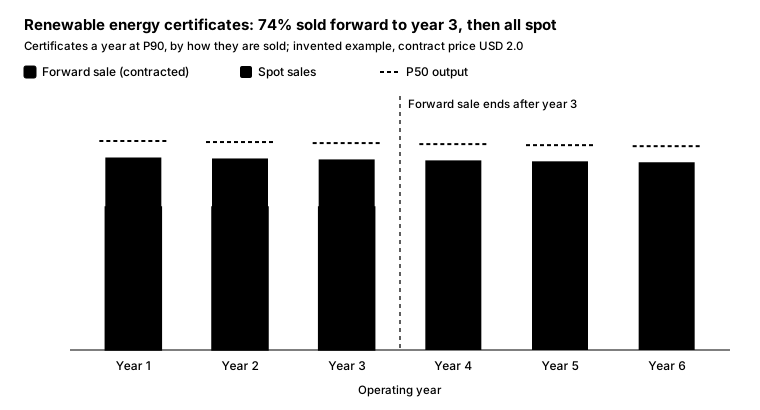
Spot volume roughly quadruples between year 3 and year 4, and price exposure jumps with it. Our reading: the model should test both all-spot sales and a new forward sale from year 4. Output between P90 and P50 is spot in every year.
What drives the price of renewable energy certificates?
A public regulator's report links certificate price moves to supply and buying activity. It also shows that prices can move sharply within months.
Australia's Clean Energy Regulator covers large-scale generation certificates (LGCs) in its June quarter 2026 report, last updated 9 September 2026:
- "LGC supply continues to outpace demand". Even so, prices rose in mid-June, "with the spot price ending the quarter at $7, up from $2.90 at the start of the quarter".
- "Market intelligence suggests the rally in prices was associated with increased purchasing activity", and with interest in future electricity demand from data centres.
- On forward prices: "All vintages up to 2030 have converged to the spot price since April 2026".
Those figures describe one market, in its local currency, and say nothing about other certificate systems. The lesson for a modeller is the size of the move: the spot price rose about 2.4 times within one quarter. That is why the example tests a wide invented range, USD 1.5 to 4.0.
How sensitive is renewable energy certificate revenue to price, with and without a forward sale?
A forward sale fixes the price on the contracted volume, so only spot volume moves with the market. In year 1 of the example, that cuts the revenue swing across the tested price range by about three-quarters.
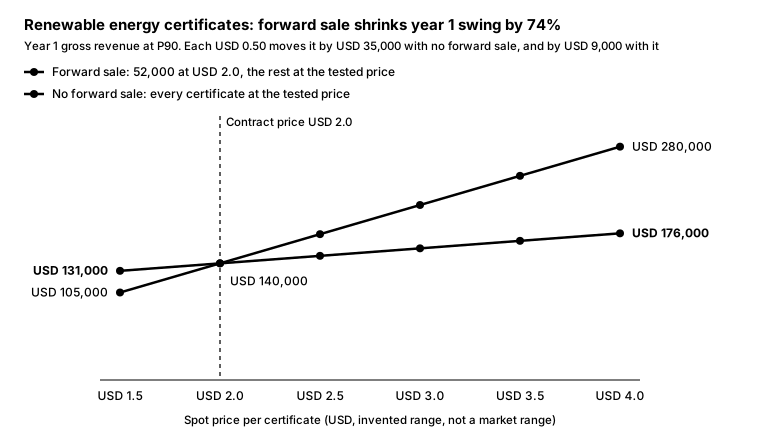
The forward line is flatter because only 18,000 certificates face the market. Below USD 2.0 the forward sale protects revenue; above it, the project gives up the upside on 52,000 certificates.
How many renewable energy certificates should a solar project sell forward against P90 and P50?
Our reading: a firm forward quantity should sit below P90 with a buffer, because every certificate short must be replaced at the market price. The example sells 52,000 a year, which is 74.3% of year 1 P90 and 68.4% of year 1 P50.
On an annual view the buffer looks wide: year 1 output would have to fall 25.7% below P90 before the forward sale runs short. The buffer is still 17,302 certificates in year 3 (invented, derived). A forward quantity equal to P50 would, by the definition of P50, leave a shortfall in about half of all years.
Vintage matching narrows the buffer further where each batch names its own production period, as on the I-REC(E) Annex. A half-year batch of 26,000 is then met from that half-year alone. If the weaker half produced 40% of year 1 P90 (invented split), it would yield 28,000 certificates: a buffer of 2,000, not 9,000.
At P50 and USD 2.0, year 1 gross revenue is USD 152,000: USD 104,000 contracted plus 24,000 spot certificates worth USD 48,000 (invented, derived). The extra P50 output is all spot, so it carries the full price risk.
How do you model it?
Model contracted and spot certificates as two revenue lines with their own volume, price and timing. "How to read a renewable energy certificate sale agreement for a solar project: a modeller's guide" places these terms in the whole agreement.
- Forecast certificates at P90 and P50, one per MWh of metered net output: 70,000 and 76,000 in year 1, falling 0.5% a year.
- Set the contracted volume by vintage year from the sale agreement: 52,000 in years 1 to 3, then zero.
- Set spot volume as forecast certificates less contracted volume, floored at zero.
- Price contracted volume at the contract price per batch, and spot volume at a separate spot price input.
- Check each batch against certificates from its own production period, after the issuance lag, not against the annual total.
- Apply the volume clause: under a firm quantity, cost any shortfall at a replacement price; under a Unit Contingent sale, reduce volume only.
- Run the spot price across the tested range and report contracted and spot revenue separately.
- Add a switch for what follows the forward sale: all spot, or a new forward sale at its own price.
For shortfall costs, see "Failure to deliver or accept renewable energy certificates: replacement cost and termination amounts". For how lenders credit each line, see "Renewable energy certificate revenue in the lender's model: how much counts for debt sizing".
What are the common mistakes?
- Applying one price to every certificate. With a forward sale, only spot volume moves with the market. Pricing all 70,000 at the tested price overstates year 1 sensitivity almost fourfold.
- Sizing the forward sale on annual P90 alone. Half-year batches tied to production periods can cut an 18,000 buffer to 2,000 in a weak half-year (invented split).
- Ignoring the roll-off. From year 4 all volume is spot, so each USD 0.50 move changes revenue by about USD 34,478, not USD 9,000 (invented, derived).
- Reading vintage as the year of issuance. Creation-based and generation-based definitions can give a late-issued certificate different vintages.
- Reporting one revenue line. A single price times total volume hides how much of the revenue is fixed; keep contracted and spot lines apart.
Frequently asked questions
Is the price of renewable energy certificates fixed for the whole contract?
In most public templates, each batch or Individual Contract carries its own price per certificate, agreed when the trade is made. The prices can be the same for every batch or differ by vintage.
What is the difference between a firm and a Unit Contingent sale of renewable energy certificates?
Under a firm sale, the seller owes the quantity whatever the plant generates and pays compensation for a shortfall. Under the North American Unit Contingent election, the seller is excused if the named facility does not generate enough. A Generation Contingent sale excuses the seller only if the facility cannot cover all the sales assigned to it.
Can renewable energy certificates from another production period fill a forward sale?
Only if the contract allows it. The templates tie each line to a production period, production year or vintage. The North American guidance offers optional true-up wording that widens the accepted window around a calendar year.
Why sell renewable energy certificates forward if the price equals the base case price?
In the example, gross revenue at USD 2.0 is the same either way: USD 140,000 in year 1 at P90. The forward sale fixes USD 104,000 of it and cuts the year 1 swing in revenue across the tested price range. In exchange, the project takes on delivery risk on a firm quantity.
Sources
Pages opened and checked on 10 October 2026. The example project is invented and has no source.
- I-REC(E) Standard Single Trade Agreement, RECS Energy Certificate Association and DLA Piper. One transaction with one or multiple delivery dates, Quantity, failure to deliver, Annex columns for production period, quantity and price per batch.
- Guidance Notes to the I-REC(E) Standard Single Trade Agreement, International REC Standard Foundation and DLA Piper. Annex fields and adding lines for each batch.
- EECS Certificate & National Scheme Certificate Master Agreement, Version 1.1(b), European Federation of Energy Traders. Individual Contracts, Contract Price, Confirmation fields for production year, price per certificate and minimum validity.
- RECS International publishes EECS-GO and RECS Standard Contract for Single Delivery, RECS Energy Certificate Association. Single delivery GO trades.
- Memorandum of Understanding, Illinois Power Agency, with the EMA and ACORE Master Renewable Energy Certificate Purchase and Sale Agreement as Exhibit A. Product Order, Purchase Price, cancelled programmes, Unit Contingent and Generation Contingent. Vintage definitions, true-up wording, up-to quantity, long-term sales agreement, semiannual payments.
- Agreement for the Sale of Renewable Energy Certificates, NYSERDA. Cost-based REC Certificate Price, proportionate quarterly delivery and proration.
- Large-scale renewable electricity, Clean Energy Regulator, in its Quarterly Carbon Market Report June Quarter 2026. LGC supply and demand, spot price move in the June quarter 2026, forward vintages converging to spot, calendar year forward definition.