How to read a renewable energy certificate sale agreement for a solar project: a modeller's guide
By SolarQuant Editorial. Published 2026-10-10. Last updated 2026-10-10.
Selling renewable energy certificates adds a small revenue line to a solar model, with its own volume, timing and default rules. Read the sale agreement in model order: volume, timing, price, deductions and failure. This guide walks through each clause with one invented 40 MWp plant and shows what lenders are likely to count.
What example does this article use?
We use one invented plant throughout: a 40 MWp ground-mounted solar plant in no named market. Its 20-year USD power purchase agreement (PPA) sells power only, so the project keeps its certificates and sells them separately. Every figure below is invented and describes no real deal.
| Item | Invented value |
|---|---|
| Plant | 40 MWp ground-mounted solar, no named market, 12 months of construction |
| Power sale | One buyer, 20-year USD PPA at USD 80 per MWh, flat, power only |
| Generation, year 1 | P90 70.0 GWh, P50 76.0 GWh, degradation 0.5% a year (year t = year 1 x 0.995^(t-1)) |
| Lender's case, year 1 | PPA revenue USD 5.6m, operating costs USD 1.0m, tax USD 0.4m, CFADS USD 4.2m falling 0.5% a year |
| Senior debt | USD 25.07m (say USD 25.1m), 7.0% all-in, 12 years after construction, debt service = CFADS / 1.30, year 1 debt service USD 3.231m |
| DSCR levels | Sizing 1.30x, lock-up 1.20x, default 1.10x |
| Certificates | One per MWh of metered net output. P90: year 1 70,000, year 12 66,245, year 20 63,641. P50 year 1: 76,000 |
| Price | USD 2.0 per certificate, flat. Sensitivity from USD 1.5 to USD 4.0 in steps of USD 0.5 (an invented range, not a market range) |
| Gross revenue | Year 1 USD 140,000; 20 years USD 2.67m |
| Costs | Issuance fee USD 0.04 per certificate; account fee USD 1,250 a year; registration USD 1,850 in years 1, 6, 11 and 16. Year 1 USD 5,900; year 2 USD 4,036; 20 years USD 85,818 |
| Net revenue | Year 1 USD 134,100 (2.39% of PPA revenue, 3.19% of CFADS); year 2 USD 135,264; 20 years USD 2.59m |
| Forward sale | Three vintage years, 52,000 certificates a year (74.3% of year 1 P90) in two batches of 26,000. USD 104,000 a year, USD 312,000 in total. The rest is sold spot (18,000 in year 1) |
| Timing | Issuance 64 days after each half-year ends; delivery 11 days after issuance; payment 27 days after invoice. Average year 1 receivable about USD 74,000 |
| Shortfall case | The issuer rejects one month of production evidence: 2,100 certificates missing. Replacement price USD 2.65, buyer's costs USD 350, compensation USD 1,715 |
| Non-acceptance case | The buyer refuses a batch of 26,000. Resold at USD 1.45, seller's costs USD 350, compensation USD 14,650 |
| Termination case | Four batches (104,000) undelivered after year 1. Buyer default: USD 57,550 at a resale price of USD 1.45 and costs of USD 350. Seller default: USD 67,950 at a replacement price of USD 2.65 |
| VAT case | Invented rate of 15%: USD 7,800 on one batch |
| Debt view | Full credit for net certificate revenue at 1.30x adds USD 0.81m (USD 25.88m); 50% credit adds USD 0.40m. Sized with full credit, a loss of certificate revenue from year 4 gives a year 4 DSCR of 1.26x |
The model uses annual periods for simplicity. Real deals usually test cover over six-month periods.
What does a renewable energy certificate sale agreement sell?
A certificate sale agreement sells the right to claim the renewable attributes of electricity, usually one certificate for each MWh. The power is sold under a separate contract, so the certificates add a second revenue line beside the PPA.
The main certificate systems share that unit. The guidance notes to the I-REC(E) trade agreement describe an I-REC(E) as "an electronic certificate issued for 1 MWh of renewable source electricity". EECS certificates in Europe are issued per 1 MWh by default, says the AIB, and an Australian LGC equals 1 MWh generated or displaced.
Agreements also differ on what each certificate carries. The US master REC agreement offers a "Standard REC", with all Environmental Attributes, and a "Basic REC", certifying only the generation. The choice matters for carbon credits, as Renewable energy certificates and carbon credits from the same solar plant: avoiding double counting explains.
The PPA decides whether there is anything left to sell. The GHG Protocol Scope 2 Guidance notes that certificates can be bundled with a contract for energy or sold separately. Our example PPA sells power only, so the project sells its certificates unbundled.
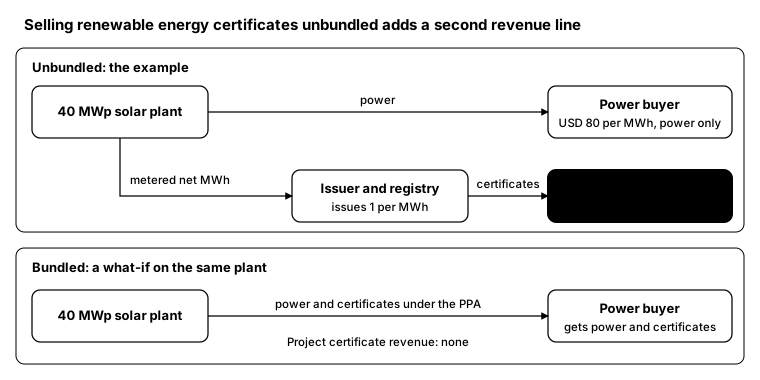
In the bundled what-if, the certificates pass to the power buyer and the project's certificate revenue is zero. Read the PPA's definition of the product before adding any certificate line to the model.
How do renewable energy certificates get from the meter to the seller's account?
Certificates reach the seller only after the plant is registered and an issuer has checked its production data. That gap between generation and cash is the first timing input in the model.
The I-REC guide on how the system works sets out the steps. A registrant registers the plant once, applies for issuance and submits meter readings, which a third party must confirm. The issuer then issues certificates into an account that the generator names.
Other systems follow the same pattern with different actors. The AIB describes certificates issued as electronic records into a registry account, then transferred on the owner's instruction. In Australia, accredited power stations create LGCs in the REC Registry, and must register them before they can be bought or sold.
In our example the issuer issues certificates 64 days after each half-year ends. Delivery follows 11 days after issuance, and the buyer pays 27 days after the invoice; all three steps are invented. We assume the invoice goes out on the delivery day.
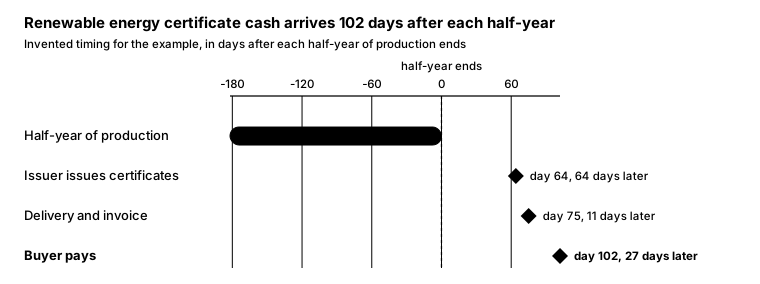
The average MWh waits about 193 days for cash: half of the half-year plus 102 days. On year 1 gross revenue of USD 140,000, that lag holds an average receivable of about USD 74,000. How a solar plant gets renewable energy certificates issued: registration, issuance and fees covers what each issuer asks for.
What do the transaction details of a renewable energy certificate sale fix?
The transaction details fix the volume, the specification of the certificates and the price, which together set the revenue line. Most templates put them in a schedule or confirmation, apart from the legal terms.
The I-REC(E) Standard Single Trade Agreement uses an annex listing production period, country, device, issuer, technology, delivery date, quantity and price. RECS International's 2021 EECS GO trade agreement lets one trade cover a single batch or several batches. Its standard contract version 2.2 allows a fixed delivery date or a window, with fields for minimum validity, support received and commissioning date.
The US master REC agreement records each trade in a Product Order. It defines Vintage as the calendar year, reporting year or other period in which the product is created or first valid. A Unit Specific product names the facility, while a Unit Non-specific product need not.
Quantity comes in two broad forms. The EFET master agreement and the I-REC(E) agreement work from an agreed quantity per delivery. The master REC agreement also lets a trade be Unit Contingent, which excuses a shortfall when the named facility does not generate enough.
Our example sells 52,000 certificates a year forward for three vintage years, in two batches of 26,000. That is 74.3% of year 1 P90, so 18,000 certificates sell spot in year 1, and all output sells spot after year 3. Pricing renewable energy certificates: volume, vintage, spot trades and forward sales covers how to set that split.
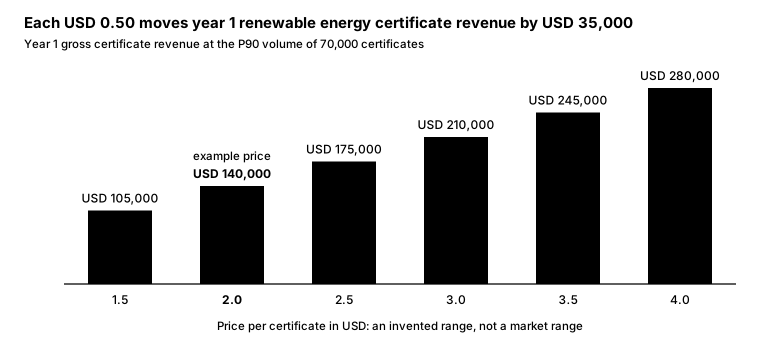
At the example price of USD 2.0, year 1 gross revenue is USD 140,000. While the forward sale runs, only the 18,000 spot certificates carry price risk. A USD 0.50 move then changes year 1 revenue by USD 9,000.
How are renewable energy certificates delivered, and when do title and risk pass?
Certificates are delivered by transfer into the buyer's registry account or by cancellation on the buyer's behalf. Under the I-REC(E) and EFET templates, title and risk pass at that step, so the model books revenue on delivery, not at production.
Under the I-REC(E) agreement's Electronic Transfer, title and risk pass when the certificates are credited to the buyer's account. Under its Redemption Statement Transfer, they pass when the buyer receives the Redemption Statement. Its guidance notes add that redemption statements are common where a buyer has no registry account or does not want one.
The EFET master agreement passes risk and title at the Delivery Point named in each Individual Contract. It allows Transfer by Cancellation Statement only where a Cancellation Agreement exists or national scheme rules permit it. The master REC agreement goes further: none of the seller's property interest passes until Delivery and payment are both complete.
Payment timing varies as much. EFET payment falls due on the later of the 20th calendar day of the month and the fifth Business Day after invoice. The master REC agreement offers payment on delivery (due within three Business Days), monthly or semiannual invoicing, or prepayment.
The I-REC(E) agreement has the seller invoice after delivery, with a short period to pay. Its guidance notes say an uncredited transfer leaves the risk with the seller and no payment due, subject to relief such as force majeure.
In our example, revenue lands on day 75 after each half-year and cash on day 102. Under the I-REC(E) agreement, redemption on the buyer's behalf also needs a seller redemption account and the buyer's beneficiary details before delivery. Delivering renewable energy certificates: transfer, redemption and when title and risk pass compares the steps in detail.
Which taxes and costs reduce renewable energy certificate revenue?
Issuer and registry fees reduce certificate revenue directly, while VAT usually passes through to the buyer and changes only cash timing. Both belong in the model, on separate lines.
The I-REC guide says issuers charge generators for registering production devices and for issuing certificates. Trade accounts carry a yearly fee and a one-time registration fee. In Australia, the regulator charges a registration fee per created LGC after a free allowance, paid in the REC Registry.
Between the parties, the I-REC(E) agreement has each side bear its own fees and expenses. The master REC agreement puts the costs of the Certification Authority on the seller unless the Product Order or program rules say otherwise.
Our example costs USD 5,900 in year 1: USD 0.04 per certificate issued, a USD 1,250 account fee and USD 1,850 for registration. Registration recurs in years 1, 6, 11 and 16, so year 2 costs fall to USD 4,036. Over 20 years, fees total USD 85,818 against gross revenue of USD 2.67m.
The I-REC(E) and EFET agreements both state prices exclusive of VAT, with the buyer paying VAT against a valid VAT invoice. The I-REC(E) agreement also lets the seller pass on other taxes shown separately on the invoice. The master REC agreement splits taxes at delivery, and EFET splits them at the transfer of risk and title.
At an invented VAT rate of 15%, one batch of 26,000 certificates at USD 2.0 carries USD 7,800 of VAT. Our reading: model VAT as a pass-through with its own timing, because the seller may owe it before the buyer pays. Tax on renewable energy certificate sales: VAT and other taxes covers where each regime places the supply.
What happens if one side fails to deliver or accept renewable energy certificates?
In most templates the failing side pays the gap between contract and market price, but only when that gap hurts the other side. The model treats this as a scenario cost or receipt, not as base-case revenue.
The I-REC(E) agreement allows a short cure period after written notice. After that, a failing seller pays any excess of the buyer's replacement price over the contract price. A failing buyer pays any shortfall of the seller's resale price below it, with reasonable costs added in each case.
Its guidance notes call this a mark-to-market method and suggest special conditions if the parties prefer replacement certificates. The EFET master agreement uses the same gap after three Business Days, but the amount "shall not be increased by any costs and expenses". The master REC agreement lets a failing party avoid an Event of Default by paying a Settlement Amount promptly, unless failures repeat.
Here Q is the quantity not delivered or not accepted, and K is reasonable costs, which some templates exclude. In our example the issuer rejects one month of production evidence, so 2,100 certificates are missing. At a replacement price of USD 2.65 and buyer's costs of USD 350, the project pays USD 1,715.
If the buyer instead refuses a batch of 26,000, the seller resells at USD 1.45 with USD 350 of costs. The buyer then owes USD 14,650. Without costs, as in the EFET variant, the two amounts become USD 1,365 and USD 14,300.
Under the I-REC(E) agreement, an issuer's failure to validly issue is force majeure unless the seller, or optionally an upstream party, breached the rules. EFET does so where the contract names a specific Production Device. Our reading: rejected evidence usually traces back to the seller, so model it as unexcused.
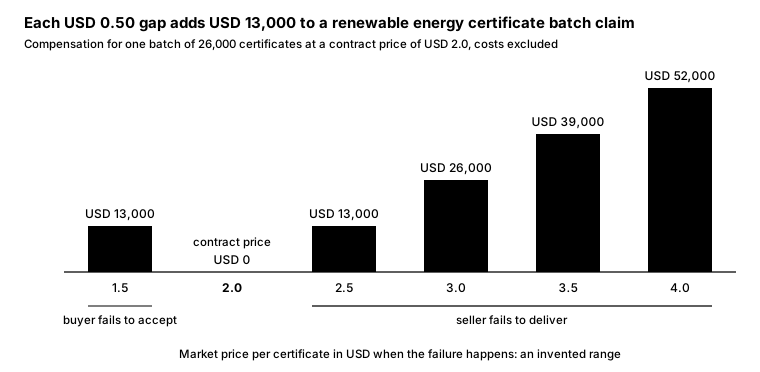
The claim is the same size whichever way the market moves; only the payer changes. Our reading: that symmetry is why a forward sale below P90 output, like the example's 74.3%, leaves a buffer. Failure to deliver or accept renewable energy certificates: replacement cost and termination amounts works through more cases.
What do force majeure, change in rules and termination do to renewable energy certificate revenue?
Force majeure and a change in scheme rules can stop certificate revenue with no compensation. Termination after a default instead produces a one-off termination amount. The model needs a downside case for the first and a single cash entry for the second.
The I-REC(E) agreement lists registry failure, a registry operator's delay or refusal to redeem, and an issuer's failure to validly issue as force majeure. Relief covers only the affected quantity and releases the other side too; a long-running event affecting the whole quantity allows termination. The EFET agreement says affected parties are "released (and not merely suspended)", while the master REC agreement suspends obligations while the event lasts.
The I-REC(E) agreement asks for good-faith talks after a Change in Applicable Rules that blocks performance or materially harms the deal for either party. If they fail, either party may terminate, owing only amounts for earlier deliveries. Its definition includes a country leaving the I-REC system.
EFET gives thirty calendar days to agree amendments, then optional Expert Determination, then termination. Under the master REC agreement, a cancelled program leaves the obligation to buy and sell at the agreed price, unless the trade says otherwise. A seller who sells a product as Regulatorily Continuing takes compliance risk up to delivery.
On default, termination amounts apply the failure rule to the whole remaining quantity. The I-REC(E) agreement makes the non-defaulting party's mark-to-market amount, plus costs, the sole compensation. The master REC agreement nets the Settlement Amounts of all terminated trades into one Termination Payment.
In our example the buyer defaults after year 1 with four batches, 104,000 certificates, undelivered. Resale at USD 1.45 and costs of USD 350 give the project a termination amount of USD 57,550. If the project defaults instead and replacement costs USD 2.65, it owes USD 67,950.
Our reading: book either amount as a one-off line and move the 104,000 certificates to spot sales at the assumed price. Registry, issuer and rule-change risk in renewable energy certificate sales: force majeure and change in applicable rules covers the downside cases.
What do buyers need from renewable energy certificates?
Buyers pay for certificates they can use in a claim. Their claim rules shape the price, the eligible volume and the specification the seller warrants. Several frameworks apply, and an agreement can reflect any of them.
The GHG Protocol Scope 2 Guidance sets Scope 2 Quality Criteria for market-based reporting. Instruments must be tracked and redeemed, retired or cancelled by or on behalf of the reporting entity. They must be issued and redeemed as close as possible to the period of consumption, and sourced from the reporting entity's market.
RE100's October 2022 update to its technical criteria added a 15-year commissioning or re-powering date limit for purchases, with exceptions. The same update defined a single European market by EU single-market membership, AIB membership and grid connection. Climate Group's announcement notes that CDP brings its reporting experience to these criteria.
National and regulatory uses form a third group. The I-REC(E) guidance notes list Scope 2 reporting, national energy reporting where the country allows it, and general end-user claims. In Europe, the AIB says Guarantees of Origin show a final customer that energy came from renewable sources.
Our reading: these rules reach the model through the specification fields and the seller's warranties. A vintage or market rule narrows who will pay the contract price. A commissioning limit like RE100's could shut a 20-year plant's later output out of one buyer group, so test a lower late-life price.
What buyers need from renewable energy certificates: Scope 2 quality criteria, market boundaries and vintage compares the frameworks side by side.
How much is renewable energy certificate revenue worth to the lenders?
In our example, certificate revenue is worth at most USD 0.81m of extra debt, and probably less. Lenders tend to discount uncontracted revenue, and most certificate revenue is short-dated or sold spot.
Writing on merchant risk, Bracewell notes that merchant revenues are "typically discounted for the purposes of the debt sizing", which lowers leverage. Net certificate revenue in our example is USD 134,100 in year 1, or 3.19% of CFADS. Full credit at the 1.30x sizing ratio adds USD 0.81m, taking debt to USD 25.88m, while 50% credit adds USD 0.40m.
Our reading: the forward sale covers three years and part of the volume, so partial credit is the likelier starting point. The risk of full credit shows in the cover ratios. Suppose debt is sized with full credit and certificate revenue then stops from year 4.
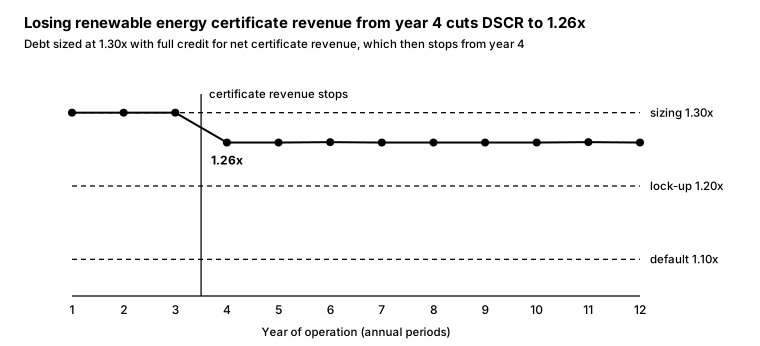
CFADS still covers debt service, but headroom to lock-up shrinks from 0.10x to about 0.06x for the rest of the loan. A larger certificate share would push that line closer to 1.20x. Renewable energy certificate revenue in the lender's model: how much counts for debt sizing shows how to build the lender case.
How do you model renewable energy certificate revenue?
Build the certificate line in the order the certificates move, from meter to cash. Each step below uses one input from the agreement or the issuer's rules.
- Confirm there is something to sell. Read the PPA's product definition first. A bundled PPA leaves no certificate line at all.
- Build volume from metered net output. Use one certificate per MWh: 70,000 at P90 in year 1, falling 0.5% a year. Keep the P50 figure of 76,000 for the equity case.
- Place issuance in time. Group output by issuance period, half-years in the example. Add the issuer's lag of 64 days and 11 more days to delivery.
- Split contracted and spot volume. Price 52,000 certificates a year at USD 2.0 for three vintage years, in batches of 26,000. Price the rest at a spot assumption with its own sensitivity.
- Deduct fees. Add the issuance fee per certificate, the annual account fee and the periodic registration fee as operating costs.
- Model cash and working capital. Book revenue on delivery and cash 27 days after invoice. Carry VAT as a pass-through with its own timing.
- Add failure and termination cases as scenarios. Enter shortfall, non-acceptance and termination amounts as one-off lines. Include or exclude costs to match the template.
- Set the lender case. Choose the share of certificate revenue the lenders credit. Then test the DSCR with certificate revenue stopped.
What are the common mistakes in modelling renewable energy certificate revenue?
Most errors come from treating certificates like power: produced, sold and paid in the same month. The list below covers the most frequent ones.
- Counting certificates from P50 gross output. Certificates follow metered net output, and lenders size on P90.
- Booking revenue in the month of production. Revenue follows delivery, here 75 days after each half-year ends.
- Treating the forward sale as covering all output. In year 1 of the example, 18,000 certificates still sell spot.
- Assuming every shortfall is force majeure. Templates excuse an issuer's failure only in set cases, such as where no seller breach caused it.
- Netting VAT into revenue. VAT passes through to the buyer and affects only cash timing.
- Ignoring termination amounts. A buyer default brings a one-off receipt and moves contracted volume to spot.
- Giving spot revenue full lender credit. Lenders typically discount uncontracted revenue in sizing.
Which renewable energy certificate agreement term feeds which model input?
Every clause that changes volume, price, timing or risk maps to one model input. Use this table as a checklist when you read a new agreement.
Frequently asked questions
Is renewable energy certificate revenue large enough to matter in a solar model?
In our example it is 3.19% of year 1 CFADS, so it rarely decides an investment. It matters at the margin: full lender credit adds USD 0.81m of debt, and losing the revenue cuts DSCR headroom. Keep it on its own line, apart from PPA revenue.
Should renewable energy certificate volumes use P50 or P90 generation?
Use the same basis as the case you are running. Our example's lender case uses P90, which gives 70,000 certificates in year 1 against 76,000 at P50. A forward sale sized below P90 output leaves room for a weak year.
Can a project sell renewable energy certificates if its PPA is bundled?
Not the certificates that the PPA already transfers to the power buyer. The GHG Protocol Scope 2 Guidance notes that certificates can be bundled with an energy contract or sold separately, so the PPA wording decides. In our bundled what-if, the project has no certificate revenue.
Does a forward sale of renewable energy certificates have to fix the quantity?
No. The I-REC(E) and EFET agreements work from an agreed quantity per delivery, but the master REC agreement also offers Unit Contingent trades. These excuse a shortfall when the named facility does not generate enough.
When should renewable energy certificate revenue be recognised in the model?
On delivery, when title and risk pass under the chosen transfer mechanism. In our example that is 75 days after each half-year ends, with cash 27 days later.
Sources
Pages opened and checked on 10 October 2026. The example project is invented and has no source.
- I-REC(E) Standard Single Trade Agreement, RECS Energy Certificate Association and DLA Piper. Transaction annex, transfer, redemption statement steps, title and risk, VAT, costs, failure, force majeure, rule changes and termination, described without its figures.
- Guidance Notes to the I-REC(E) Standard Single Trade Agreement, International REC Standard Foundation and DLA Piper. Definition of an I-REC(E), uses of certificates, redemption statements, mark-to-market compensation and risk before crediting.
- I-REC Guide: How I-REC Works, International REC Standard Foundation. Registration and issuance steps, third-party confirmation of meter data, issuer and account fees.
- New EECS GO Trade Agreement and Guidance document available, RECS Energy Certificate Association. Single or multiple batch deliveries under the EECS GO trade agreement.
- EECS GO Standard Contract V2.2 published, RECS Energy Certificate Association. Delivery window, minimum validity, support received and commissioning date fields.
- EECS Certificate & National Scheme Certificate Master Agreement, Version 1.1(b), European Federation of Energy Traders (now Energy Traders Europe). Delivery Point, agreed quantity per Individual Contract, cancellation statements, failure compensation without costs, force majeure, change in law, VAT, tax and payment timing.
- Life cycle, Association of Issuing Bodies. Issue per unit of 1 MWh by default, transfer and cancellation.
- Renewable Energy Guarantees of Origin, Association of Issuing Bodies. Purpose of Guarantees of Origin for final customers.
- Memorandum of Understanding, Illinois Power Agency, with the Master Renewable Energy Certificate Purchase and Sale Agreement (version 1.0) of the ABA SEER committees, Environmental Markets Association and ACORE attached. Standard and Basic RECs, Product Order, Vintage, Unit Contingent, payment options, title, taxes, Certification Authority costs, Settlement Amount, Termination Payment, force majeure, Government Action and Regulatorily Continuing.
- Large-scale generation certificates, Clean Energy Regulator. One LGC per MWh generated or displaced.
- Create large-scale generation certificates, Clean Energy Regulator. Creating LGCs in the REC Registry, registration before trading and the registration fee.
- GHG Protocol Scope 2 Guidance, World Resources Institute and World Business Council for Sustainable Development. Scope 2 Quality Criteria and bundled versus unbundled certificates.
- RE100 updates its technical criteria to accelerate corporate impact, Climate Group. Commissioning date limit, European single market definition and the role of CDP.
- Merchant Risk and the Energy Transition: Tensions in the Capital, Bracewell. Discounting of merchant revenue in debt sizing.