Delivering renewable energy certificates: transfer, redemption and when title and risk pass
By SolarQuant Editorial. Published 2026-10-10. Last updated 2026-10-10.
Renewable energy certificates reach a buyer by transfer into its registry account, or by cancellation on its behalf, proven by a statement. I-REC(E) terms pass title and risk on crediting or statement receipt, EFET's at the agreed Delivery Point, and one North American template after payment. For a modeller, the route sets when revenue is earned, how long the receivable runs and how early the buyer's data is needed.
What example does this article use?
We use the same invented 40 MWp solar plant as the rest of the series. It sells power under a PPA, keeps its certificates and sells 52,000 of them a year forward in two batches. Every figure below is invented and describes no real project, buyer, registry or market.
| Item | Example figure (invented) |
|---|---|
| Plant and power sale | 40 MWp, one 20-year USD PPA at USD 80 per MWh for power only |
| Certificates | Kept by the project and sold separately (unbundled), one per MWh |
| Year 1 certificates, P90 | 70,000 |
| Price | USD 2.0 per certificate; year 1 gross revenue USD 140,000 |
| Forward sale | 52,000 a year for three vintage years, in two batches of 26,000 (USD 52,000 a batch) |
| Contract value | USD 104,000 a year, USD 312,000 in total; certificates above the contract quantity are sold spot |
| Timing | Issuance 64 days after each half-year ends; delivery 11 days after issuance; payment 27 days after invoice |
| Average year 1 receivable | About USD 74,000 |
| Shortfall case | 2,100 certificates missing on a delivery date; compensation USD 1,715 |
| Senior debt | USD 25.1m at 7.0% all-in |
What are the two ways to deliver renewable energy certificates?
Public templates offer two routes: a transfer between registry accounts, or a cancellation for the buyer in the seller's account, evidenced by a statement. The parties pick one route per trade, and it decides what the buyer ends up holding.
- I-REC(E) Standard Single Trade Agreement. Clause 6.1 offers "Electronic Transfer" or "Redemption Statement Transfer", chosen by ticking a box. The guidance note says electronic transfers "are in general more frequently used". Redemption statements are "commonly used in transactions, where a buyer does not have or does not wish to have a registry account".
- EFET certificates master agreement. Electronic Transfer applies unless the Individual Contract specifies "Transfer by Cancellation Statement". It applies only where a Cancellation Agreement links the cancelling Domain and the Domain of Delivery, or where National Scheme Rules expressly permit it.
- North American master REC agreement (EMA and ACORE, published by the Illinois Power Agency). Its example Product Order has a Method of Transfer line offering Attestation or a GIS REC tracking system. Its Transfer Certificate can be "an Attestation, GIS record of ownership transfer, or other document evidencing Delivery".
When do title and risk in renewable energy certificates pass?
Under the I-REC(E) template, title and risk pass when the certificates reach the buyer's account, or when the buyer receives the statement. EFET passes them at the Delivery Point each contract specifies, and one North American template also waits for payment.
- I-REC(E) Standard Single Trade Agreement. Under Electronic Transfer, title and risk pass "when the I-REC(E)s are credited to the Buyer's Account". Under Redemption Statement Transfer, title and risk pass "in the attributes conferred by the redeemed I-REC(E)s and to the Redemption Statement itself". They pass when the buyer receives the statement by fax or email.
- I-REC(E) guidance note. If transferred certificates are not credited, "the risk lies with the seller and the buyer will not be obliged to pay". That holds subject to relief such as force majeure.
- EFET certificates master agreement. On both routes, risk and title pass "at the Delivery Point", which each Individual Contract specifies.
- North American master REC agreement. No property interest passes "until the Delivery and payment set forth above are complete".
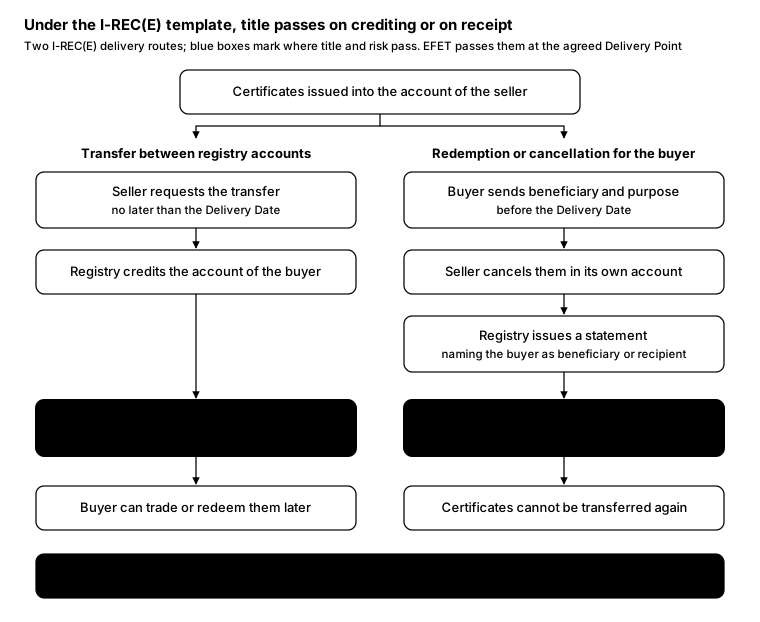
The redemption route has more steps before title passes, and one of them depends on the buyer. In the example, both routes put the title point 75 days after each half-year ends, if the statement arrives on the delivery day.
What must the buyer provide for a redemption of renewable energy certificates?
For a redemption, the buyer must tell the seller who the beneficiary is and what the redemption is for, before the delivery date. Under the I-REC Code, those details cannot be amended once the redemption is processed.
- I-REC(E) Standard Single Trade Agreement. The seller must redeem by the Delivery Date only if it received the beneficiary and redemption purpose a few Business Days before. The details may be pre-agreed in the Annex under "Additional Details".
- I-REC Code for Electricity. "At Redemption, the responsible Participant shall record the Beneficiary, purpose of Redemption, location of related consumption, and Reporting Period relating to the Redemption." It adds: "Once a Redemption has been processed these details may not be amended."
- EFET certificates master agreement. The seller's statement gives the quantity cancelled, the cancelling Domain, the recipient and the cancellation purpose. Scheduling also covers "the usage for any cancellation".
- Energinet guidelines for Guarantees of Origin. The holder's text "must describe the purpose, meaning which electricity supply the Guarantee of Origin documents", for example by customer name, address or consumption year. Cancellation must take place in a register in the country where the consumption occurred.
The buyer picks these details to fit its own claim. The I-REC(E) guidance note lists Scope 2 reporting under the GHG Protocol, country-dependent national energy reporting and general end-user claims as uses of I-REC(E)s.
In the example, a redemption route needs the beneficiary, purpose, location and reporting period for each batch of 26,000 before redemption. Under the I-REC(E) wording, a seller without timely data is not bound to redeem by the Delivery Date. Clause 10.1 also excuses a failure caused by the buyer's non-performance.
What registry account obligations come with delivering renewable energy certificates?
Each party must have a working registry account in time for its part of the delivery. Under the I-REC(E) redemption route, that obligation applies only to the seller.
| Template or rule | Who needs an account | What the text requires |
|---|---|---|
| I-REC(E) Standard Single Trade Agreement | Both parties for Electronic Transfer; only the seller for Redemption Statement Transfer | Each party ensures its account "is properly established in time"; the seller, and for Electronic Transfer the buyer, warrants on each Delivery Date that its account is validly registered |
| I-REC(E) guidance note | Both parties for Electronic Transfer | Full transfer rights, "rather than restricted accounts" |
| EFET certificates master agreement | Each party, for its own obligations | Scheduling includes ensuring Accounts are "properly established in time to discharge their respective Delivery, cancellation or acceptance obligations" |
| I-REC Code for Electricity | The sending account holder acts alone | A transfer is "initiated and completed by the Account Holder of the source Account", with no confirmation from the destination |
| AIB certificate life cycle | The owner instructs its issuing body | The issuing body records the transfer and confirms it to the seller; the receiving body notifies the buyer |
Because the receiving holder does not confirm, an I-REC buyer's acceptance mostly means holding a valid account. The guidance note says non-acceptance covers cases "where the buyer's account is incapable of receiving I-REC(E)s".
How do delivery windows and partial deliveries of renewable energy certificates work?
Most templates give each batch a delivery date, and the seller must deliver by that date. Under the I-REC(E) agreement, compensation for a partial delivery is priced on the undelivered quantity only, not the whole batch.
Some agreements set a date per batch, others a window tied to the registry's calendar:
- I-REC(E) and EFET agreements. The seller acts "no later than on the relevant Delivery Date" (EFET wording; the I-REC(E) clause is the same in substance). The I-REC(E) Annex has one line per batch, with its production period, Delivery Date and quantity.
- North American master REC agreement. A Delivery Date "must be on or after the date the Product comes into existence". A Product Order lists set dates or deliveries as generated.
- Tracking system wording in the same document. Its NEPOOL GIS example delivers "Quarterly within five business days of the close of the applicable quarterly trading period". Its PJM-GATS example delivers "Monthly within 45 business days of certificate creation date".
- Energinet guidelines for Guarantees of Origin. Any trade or cancellation must take place "no later than 12 months after the calendar month in which it was issued".
On partial delivery, the I-REC(E) agreement's failure clause applies when the seller fails to deliver "in whole or in part". Under the North American master agreement, a failure to Deliver the agreed quantity "will not excuse" the seller's performance, unless the Transaction says otherwise.
In the example, the shortfall case leaves 2,100 certificates missing, so the project delivers 23,900 and invoices USD 47,800 (invented, derived). It then owes USD 1,715 of compensation on the 2,100 only.
What happens to a renewable energy certificate after it is cancelled?
A cancelled, redeemed or retired certificate stays on the registry record but can no longer be transferred. That is what lets only one party claim it, and why the step is hard to undo.
- I-REC Code for Electricity. "A Redeemed I-REC(E) ceases to be transferable to another Entity." Redemption is irreversible; error correction needs proof to Evident that the details have not been used, and is at its sole discretion. The certificate is "deemed owned by the Beneficiary recorded on the Redemption transaction".
- AIB certificate life cycle. "Once a certificate has been cancelled in this way, it can no longer be transferred." The instruction is irrevocable.
- Energinet guidelines for Guarantees of Origin. Cancellation leaves the guarantee "no longer being tradable/transferable to other account holders". In justified cases, Energinet may withdraw a cancellation made by mistake if told within 3 working days.
- NEPOOL GIS. Certificates can move in and out of a Reserve Sub-Account during an active trading period. At its end they "will permanently retire".
Under the I-REC(E) and EFET agreements, the seller must not request a statement for the same cancelled certificates to any third party after delivery. EFET treats a certificate as Ineffective if it has "already been cancelled other than in agreement with the Buyer".
In the example, a redeemed batch of 26,000 cannot be taken back and resold, even if the buyer never pays. After a transfer, unpaid certificates sit in the buyer's account instead.
What does the delivery route of renewable energy certificates change in the model?
The delivery route sets the revenue date, how long the receivable runs and which buyer data the project must collect before issuance. A registry outage near a delivery date mostly moves cash rather than creating a default.
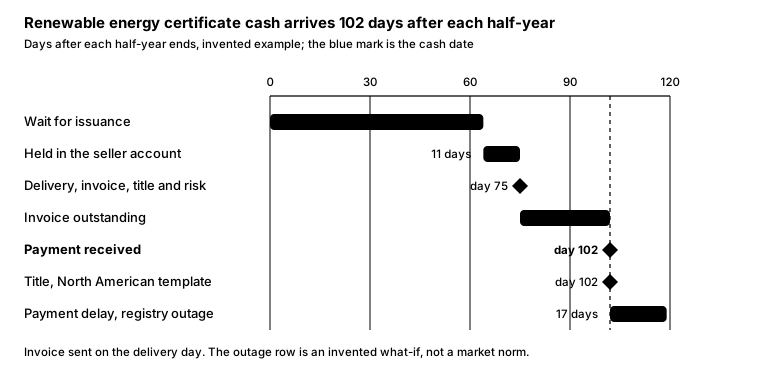
Each MWh waits for the end of its half-year, then 64 days for issuance, 11 for delivery and 27 for payment. On average that is about 193 days, which ties up about USD 74,000 on year 1 gross revenue of USD 140,000.
What follows is our reading of the clauses above, applied to the example.
- The revenue point. The title date is the natural point to recognise certificate revenue: day 75 on both the I-REC(E) and EFET routes. With annual model periods (real deals usually use six-month periods), the second half-year's batch falls 75 days into the next model year. Under the North American template, title waits for payment at day 102.
- The receivable. Each batch invoice of USD 52,000 is outstanding for 27 days. Under the North American template the seller keeps title over those days; after a redemption it has nothing to take back.
- A registry outage near a delivery date. The I-REC(E) and EFET agreements treat a registry failure as force majeure, so the model shows a delay, not compensation. An invented 17-day outage moves payment to day 119, which costs about USD 170 on one batch at 7.0% (invented, derived).
- Earlier buyer data for a redemption sale. The beneficiary, purpose, location and reporting period are fixed at redemption. Requesting them before issuance keeps the 11 days between issuance and delivery free of waiting for the buyer.
"Registry, issuer and rule-change risk in renewable energy certificate sales: force majeure and change in applicable rules" covers outages.
How do you model it?
Model delivery as a dated event per batch that sets revenue, cash and credit exposure. "How to read a renewable energy certificate sale agreement for a solar project: a modeller's guide" places this clause in the whole agreement.
- Record the delivery route for each sale: transfer into the buyer's account, or redemption with a statement.
- Set each batch's title date from your template: crediting or statement receipt, or delivery plus payment. In the example that is day 75 or day 102 after the half-year ends.
- Recognise certificate revenue on the title date if your model follows title, and show the gap to generation as accrued income.
- Run the invoice from delivery to payment: 27 days on USD 52,000 per batch in the example.
- For a redemption sale, add a date for the buyer's beneficiary data before issuance, and a switch that delays delivery if it is late.
- Add a registry outage case that shifts delivery and cash, and check whether cash crosses a calculation date.
What are the common mistakes?
- Booking revenue at issuance. Title passes on delivery at the earliest, 11 days after issuance in the example, and under one North American template only after payment.
- Treating a redemption as reversible. A redeemed or cancelled certificate cannot be transferred again, so an unpaid redeemed batch cannot be resold.
- Ignoring expiry and registry windows. Energinet's guarantees of origin must be traded or cancelled within 12 months after the month of issue, and tracking systems close trading periods.
Frequently asked questions
Does the buyer of renewable energy certificates need its own registry account?
Only for a transfer: under Redemption Statement Transfer, the I-REC(E) account obligation does not apply to the buyer. The guidance note ties redemption statements to buyers without an account. Under the EFET agreement, cancellation for the buyer needs a Cancellation Agreement between Domains or express national scheme permission.
What if the redemption statement for renewable energy certificates never arrives?
Title and risk stay with the seller until the buyer receives it. The I-REC(E) guidance note says the buyer "may request the seller to send another copy of the email". It says the non-acceptance clause also covers a statement email that the buyer's email server does not accept.
Can the seller keep title to renewable energy certificates until the buyer pays?
Under the North American master agreement it does: no property interest passes until Delivery and payment are complete. Its Prepayment election goes further, as the seller "will not be obligated to make Delivery until Seller is in receipt of such payment". The I-REC(E) and EFET agreements pass title on delivery, whether or not the buyer has paid.
Is a registry outage near the delivery date a failure to deliver renewable energy certificates?
Usually not. The I-REC(E) agreement lists "a suspension, failure or malfunction of the I-REC(E) Registry, including its transfer system" as force majeure. EFET lists failures of the EECS Transfer System, Transfer Links or the AIB Hub, and a Registry Operator delaying or rejecting a cancellation.
Sources
Pages opened and checked on 10 October 2026. The example project is invented and has no source.
- I-REC(E) Standard Single Trade Agreement, RECS Energy Certificate Association and DLA Piper. Electronic Transfer and Redemption Statement Transfer, buyer data for redemption, account obligations, title and risk, failure in whole or in part, excuse for buyer non-performance, seller warranties, registry force majeure.
- Guidance Notes to the I-REC(E) Standard Single Trade Agreement, International REC Standard Foundation and DLA Piper. How each route works and when it is used, full transfer rights, title and risk on each route, a lost statement email, non-acceptance cases, lines per batch in the Annex, uses of I-REC(E)s.
- Evident. I-REC Code for Electricity, Evident, authorised by the I-REC Standard Foundation. Transfers without confirmation, redemption details recorded, irreversibility, no further transfer, ownership by the Beneficiary.
- EECS Certificate & National Scheme Certificate Master Agreement, Version 1.1(b), European Federation of Energy Traders. Electronic Transfer and Transfer by Cancellation Statement, statement contents, Scheduling and accounts, title and risk at the Delivery Point, delivery no later than the Delivery Date, Ineffective certificates, the seller warranty on later statements, registry force majeure.
- Memorandum of Understanding, with Exhibit A: Master REC Purchase and Sale Agreement, Illinois Power Agency. EMA and ACORE master agreement: Method of Transfer in the example Product Order, Transfer Certificate, Delivery Date, failure to Deliver not excusing performance, title after Delivery and payment, Prepayment, NEPOOL GIS and PJM-GATS example delivery wording.
- Life cycle, Association of Issuing Bodies. Transfer through issuing bodies, and no further transfer after cancellation.
- Guidelines for Guarantees of Origin for Renewable Electricity, Energinet. Cancellation text and country of consumption, withdrawal of mistaken cancellations, 12-month use period.
- Transfer Certificates to the Reserve Sub-Account, NEPOOL GIS. Permanent retirement at the end of an active trading period.