Renewable energy certificate systems compared: I-REC, Guarantees of Origin and US RECs
By SolarQuant Editorial. Published 2026-10-10. Last updated 2026-10-10.
Renewable energy certificates from a solar plant live in a tracking system, and that system sets rules the model depends on. I-REC(E), European Guarantees of Origin (GOs) and US RECs all issue one certificate per megawatt hour by default and end each certificate once. They differ on who issues, how long a certificate stays usable, what holding costs and who can buy, which moves fees, timing and price.
What example does this article use?
We use the same invented 40 MWp solar plant as the rest of the series, in no named market. The project sells power under a PPA, keeps its certificates and has the plant registered with an issuer under a certificate system. We do not say which system: every comparison below is a what-if case on the same plant.
Every figure is invented and describes no real project, buyer, issuer or market.
| Item | Example figure (invented) |
|---|---|
| Plant and power sale | 40 MWp, one 20-year USD PPA at USD 80 per MWh for power only |
| Certificates | Kept by the project and sold separately (unbundled), one per MWh of metered net output |
| Certificates, P90 | Year 1 70,000; year 12 66,245; year 20 63,641 (0.5% a year degradation) |
| Certificates, P50 | Year 1 76,000 |
| Price | USD 2.0 per certificate, flat; year 1 gross revenue USD 140,000 |
| Certificate costs | Issuance fee USD 0.04 per certificate; account fee USD 1,250 a year; registration USD 1,850 in years 1, 6, 11 and 16 |
| Total certificate costs | Year 1 USD 5,900; year 2 USD 4,036; 20 years USD 85,818 |
| Net certificate revenue | Year 1 USD 134,100; year 2 USD 135,264; 20 years USD 2.59m |
| Forward sale | 52,000 a year for three vintage years, in two batches of 26,000, at USD 2.0; certificates above that sold spot |
| Timing | Issuance 64 days after each half-year ends; delivery 11 days after issuance |
| Price range tested | USD 1.5 to 4.0 (invented range, not a market range) |
What are I-REC, Guarantees of Origin and US RECs?
They are three tracking systems for renewable energy certificates, each an electronic record of the attributes of one unit of renewable electricity. I-REC(E) works in any country with an accredited issuer, and Guarantees of Origin (GOs) are the instrument set out in EU law. US RECs run through tracking systems such as PJM-GATS and WREGIS.
All three are built on the same idea: one certificate per megawatt hour, held in a registry account, used once. The table compares what a modeller needs from each.
| Attribute | I-REC(E) | EECS Guarantee of Origin | US REC |
|---|---|---|---|
| Rule book | I-REC Code for Electricity, held by Evident and accredited by the International Tracking Standard Foundation | Article 19 of the EU Renewable Energy Directive, plus national rules on trade, expiry and cancellation | Regional tracking systems, state programmes and, for voluntary products, certification such as Green-e |
| Who issues | An accredited Issuer for the country or region | The issuing body that keeps the registry | The generation tracking system, such as PJM-GATS or WREGIS |
| Unit | MWh, with resolution to the Wh optional | 1 MWh by default, optionally 1 Wh | 1 MWh |
| What it records | Where the electricity was produced, the facility's capacity and the energy source | Energy source, production dates, the installation's identity, location, type and capacity, any support received, date operational, date and country of issue | Fuel type, location, nameplate capacity, project and generation vintage, tracking system ID, eligibility for certification or RPS |
| How long it lasts | No expiry date; eligibility for a given claim may expire | Valid for 12 months after production; uncancelled GOs expire at the latest 18 months after production | Green-e certified products use renewables from a vintage window around the year of sale |
| How it ends | Redemption into a Redemption Account, naming a Beneficiary, or cancellation without one | Cancellation, expiry or withdrawal | Retirement in a tracking system account |
| Typical uses | Scope 2 reporting, national energy reporting, general end-user claims, support mechanisms | Energy source disclosure to final customers | Renewable electricity use claims, state renewable portfolio standards, certified retail products |
The I-REC(E) rows come from its Product Code page and Code. The GO rows use the AIB life cycle and imposed conditions pages and Article 19 of Directive (EU) 2018/2001. The US rows use the EPA REC and tracking system pages and the Green-e standard, all listed in Sources.
Who runs each renewable energy certificate system?
Each system splits the work between a rule setter, an issuer that checks production evidence and a registry that records ownership. The names differ, and so do the parties a project pays.
- I-REC(E). The International Tracking Standard Foundation accredits the parties, and Evident is both Code Manager and Registry Operator. Issuers register production devices in their country or region and issue certificates after verifying the data. A Registrant registers the plant and asks for issuance into a Participant's trade account, its own or a third party's.
- EECS Guarantees of Origin. Article 19 of the EU Renewable Energy Directive requires Member States to issue a GO on a renewable producer's request. The issuing body records issue, transfer and cancellation in an electronic registry. National authorities set who can trade, when certificates expire and how they are cancelled, and these rules may differ between AIB members.
- US RECs. Generation tracking systems such as PJM-GATS and WREGIS issue the certificates to generators and hold them in accounts. Green-e certified products must be supplied from renewable MWh tracked in a system Green-e approves. Exceptions include facilities of 2 MW or less.
For the example, the party behind "an issuer under a certificate system" therefore changes with the system. It is an accredited Issuer plus Evident's registry under I-REC(E), an issuing body for GOs and a tracking system in the US.
How does a renewable energy certificate move from issue to cancellation?
In all three systems a certificate is issued once into a registry account, can move between accounts, and ends once. It ends when it is used for a claim, when it expires or, for GOs, when an issuing body withdraws it.
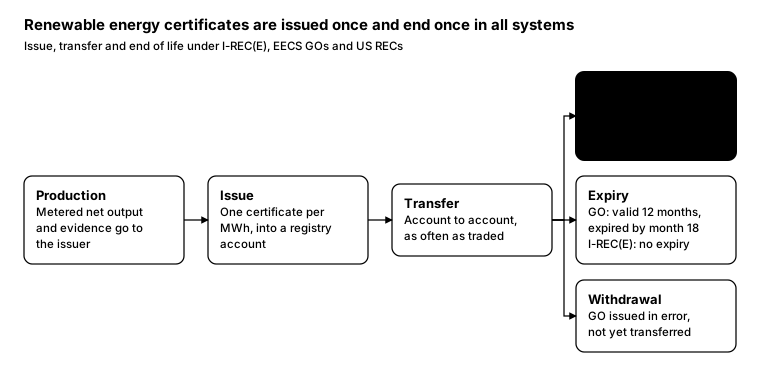
The claim step has a different name in each system, and only GOs carry a fixed expiry. Under I-REC(E) and GO rules, a redeemed or cancelled certificate can no longer be transferred.
In the example, each of the 70,000 year 1 certificates would take this path once. Under the forward sale, 52,000 go to the buyer in two batches of 26,000 and 18,000 are sold spot. Whoever then redeems, cancels or retires them makes the claim.
How long does a renewable energy certificate stay usable?
It depends on the system. Under the 2018 EU directive, a GO is valid for 12 months after production. An uncancelled GO expires at the latest 18 months after production.
An I-REC(E) has no expiration date, though its eligibility for a particular claim may expire under the rules of whoever receives that claim.
For US RECs, Green-e sets a vintage window for certified products. They may only use renewables generated in the calendar year of sale or the first three months of the next year. The last six months of the year before also count.
The chart runs the example's timing as a GO what-if. A batch holds certificates from a whole half-year, so its oldest certificate is already 257 days old when it reaches the buyer.
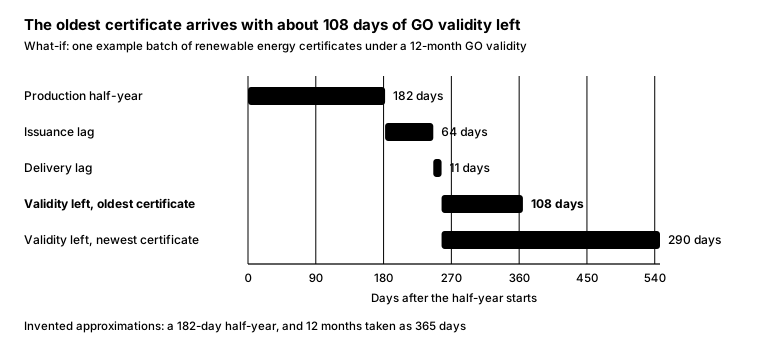
The issuance lag uses about six times as much validity as delivery does. Our reading: under a GO, the buyer has about 108 days to use the oldest certificates, and unsold surplus cannot wait long either.
What does the choice of renewable energy certificate system change in the model?
The system sets five inputs: fees, issuance lag, how long unsold certificates keep their use, who can buy and, through all of these, price. The example's invented costs and USD 2.0 price stand in for any system until you know which one applies.
Fees. The I-REC(E) fee structure for 2026 lists issuance, facility registration and participant fees separately, and charges redemption per MWh to whoever redeems. The what-if below prices the example with the central issuer's published fees and the project holding its own Participant account.
| Cost line | Example (invented) | What-if: I-REC(E) 2026 published fees |
|---|---|---|
| Issuance | USD 0.04 per certificate, USD 2,800 in year 1 | USD 0.03 per MWh, USD 2,100 in year 1 |
| Registration | USD 1,850 in years 1, 6, 11 and 16 | USD 1,170 facility assessment for 3 MW or more in year 1, valid five years; renewal at 40%, USD 468, in years 6, 11 and 16 |
| Account | USD 1,250 a year | USD 2,354 annual participant fee, plus USD 588.50 to open the account |
| Year 1 total | USD 5,900 | USD 6,212.50 |
| Year 2 total | USD 4,036 | USD 4,443.50 |
| 20-year total | USD 85,818 | USD 90,306 |
What-if figures are derived from the published fees and the example's P90 volumes. Year 1 net certificate revenue would fall from USD 134,100 to USD 133,788. The redemption fee of USD 0.08 per MWh, USD 5,600 on 70,000 certificates, falls on whoever redeems.
Issuance lag. Under the I-REC(E) Code, an Issuer will normally issue within one Business Week of a complete Issue Request. The Code calls this service level indicative and non-binding, and keeps each production period within one calendar year. Our reading: most of the example's 64-day lag is the project gathering and submitting evidence, not the issuer.
Holding cost. An I-REC(E) does not expire, but holding one can bring the redemption fee forward. An advance redemption fee applies if it is still in a trade account after 30 September of the second year after vintage. If the 18,000 surplus year 1 certificates sat unsold that long, the fee would be USD 1,440 (derived), with no later redemption fee.
Who can buy. An I-REC(E) moves between registry accounts held by Participants, and a transfer needs no confirmation from the receiving account holder. Unless an exception applies, Green-e participants must use an account in an approved tracking system to back certified sales.
For GOs, national authorities decide who can trade. The EU directive also lets a Member State withhold GOs from a producer on a support scheme, to account for their market value.
Price. Our reading: the system decides which buyers and which claims a certificate can serve, so a price assumption belongs to one system. Test the invented USD 1.5 to 4.0 range for the system that applies. In the example it moves year 1 gross revenue from USD 105,000 to USD 280,000.
Are there other renewable energy certificate systems besides I-REC, GOs and US RECs?
Australia's large-scale generation certificates (LGCs) are one example: an LGC is equal to 1 MWh of renewable electricity generated or displaced by a power station. Liable entities such as electricity retailers surrender LGCs to meet Renewable Energy Target obligations. Private buyers can also buy them for voluntary goals.
The Clean Energy Regulator says the Renewable Energy Target ends in 2030. Accredited power stations can join the Renewable Electricity Guarantee of Origin (REGO) to keep creating certificates beyond 2030. Our reading: check which certificate the plant can create in each forecast year, not only at financial close.
How do you model it?
Model the certificate system as one block of inputs beside the price, so a change of system changes one block. "How a solar plant gets renewable energy certificates issued: registration, issuance and fees" covers the issuance steps in depth.
- Name the system and the issuer, and record the unit: one certificate per MWh of metered net output in the example.
- Enter published fees: issuance per MWh, registration with its renewal cycle, annual account fees and any redemption fee you bear.
- Set the issuance lag from your own evidence cycle plus the issuer's service level. Check deadlines such as the I-REC(E) Residual Mix Deadline. Unless otherwise communicated, it is 31 May of the next year for January to June production, and 30 September of the next year for July to December.
- Add a validity clock for each vintage: none for I-REC(E), 12 months for GOs, Green-e's vintage window for certified US REC products.
- Flag certificates that would pass their validity, or trigger a holding fee, before their forecast sale date, and value them net of that loss.
- Limit the buyer pool to parties that can hold an account in that registry and use the claim you are selling.
- Run the price range for each system rather than one price for all: USD 1.5 to 4.0 in the example.
What are the common mistakes?
- Treating all renewable energy certificates as one product. A GO, an I-REC(E) and a US REC serve different buyers and claims, so one price cannot cover all three.
- Ignoring GO validity. A GO is valid for 12 months after production, so holding certificates for a better price can leave nothing usable to sell.
- Assuming no expiry means no cost. An unsold I-REC(E) keeps its use but can trigger the advance redemption fee late in its second year after vintage.
- Forgetting the account fee. In the I-REC(E) what-if, the USD 2,354 annual participant fee is larger than year 1 issuance fees of USD 2,100.
- Booking redemption as the seller's cost by default. The I-REC(E) redemption fee falls on whoever redeems, which the sale terms decide.
Frequently asked questions
Is an I-REC the same as a US REC?
No. Both stand for one MWh of renewable electricity, but they sit in different systems. I-REC(E) has accredited issuers and one registry, while US RECs sit in generation tracking systems. The claim a buyer wants to make decides which one it can use.
Do renewable energy certificates expire?
It depends on the system. An I-REC(E) has no expiration date, though its eligibility for a given claim may expire. Under the 2018 directive, a GO is valid for 12 months after production and expires at the latest after 18 months.
Can one MWh earn renewable energy certificates in two systems?
The rules are written to stop it. The I-REC(E) Code requires Foundation approval where another tracking system operates, plus clear evidence against a double claim, such as a cancelled certificate. The EU directive allows no more than one GO per unit of energy produced.
What is the difference between redeeming, cancelling and retiring a renewable energy certificate?
They are the names each system gives to the last step. An I-REC(E) is redeemed into a Redemption Account naming a Beneficiary, a GO is cancelled and a US REC is retired. The I-REC(E) Code and the AIB both state that a certificate cannot be transferred after that step.
Who pays the fees on renewable energy certificates?
Under the I-REC(E) fee structure, Registrants pay issuer fees for registration and issuance, and Participants pay account and redemption fees. In the example, the project bears issuance, registration and account costs of USD 5,900 in year 1.
Sources
Pages opened and checked on 10 October 2026. The example project is invented and has no source.
- Product Code for Electricity, International Tracking Standard Foundation. What an I-REC(E) is and records, the Code Manager, Registry Operator, Issuer, Registrant and Participant roles, typical uses.
- I-REC Code for Electricity, Version 1.13, Evident. Unit, no expiration date, five-year registration, eligible production periods, Residual Mix Deadline, issuer service timing, transfer, redemption and cancellation, other tracking systems.
- Fee Structure I-REC(E) 2026, International Tracking Standard Foundation. Participant, redemption and advance redemption fees, the zero redemption fee after an advance fee, and the central issuer's facility assessment, renewal assessment and issuance fees used in the what-if.
- Life cycle, Association of Issuing Bodies. Issue per 1 MWh or 1 Wh, transfer through the issuing body, cancellation, expiry and withdrawal of EECS certificates.
- Imposed conditions for trade, expiry and cancellation, Association of Issuing Bodies. National authorities set who can trade, when certificates expire and how they are cancelled.
- Directive (EU) 2018/2001 of the European Parliament and of the Council of 11 December 2018 on the promotion of the use of energy from renewable sources (recast) (Text with EEA relevance), legislation.gov.uk. Article 19 as it stood on 31 December 2020: issue on request, standard size of 1 MWh, contents, 12-month validity, 18-month expiry, one GO per unit, the support exception.
- Renewable Energy Certificates (RECs), US Environmental Protection Agency. Definition of a US REC, issue per MWh, data attributes, use to substantiate claims.
- Energy Attribute Tracking Systems, US Environmental Protection Agency. Tracking systems issue US RECs to generators in a region, hold each certificate in one account at a time and help verify state renewable portfolio standard compliance.
- Green-e Renewable Energy Standard for Canada and the United States, Version 4.6, Center for Resource Solutions. Vintage window, tracking system use and its exceptions, PJM-GATS and WREGIS as generation tracking systems, retirement.
- Large-scale generation certificates, Clean Energy Regulator. LGC definition, surrender by liable entities, voluntary buyers, the Renewable Electricity Guarantee of Origin.