Renewable energy certificate glossary: I-REC, GO, REC and trade agreement terms
By SolarQuant Editorial. Published 2026-10-10. Last updated 2026-10-10.
Renewable energy certificates have their own vocabulary, and one idea often has different names in I-REC, Guarantee of Origin and US REC markets. This glossary defines 80 entries a solar modeller meets in a certificate sale, each with the series article that covers it. Definitions agree with the public sources listed at the end, and all example figures are invented.
What example does this article use?
We use one invented 40 MWp ground-mounted solar plant across the series. It sells power only under a 20-year USD PPA at USD 80 per MWh and keeps its certificates to sell separately (unbundled). Several definitions below point to these figures.
The example uses annual debt periods for simplicity, while real deals usually use six-month periods.
| Item | Example figure (all invented) |
|---|---|
| Plant and power sale | 40 MWp; PPA for power only, USD 80 per MWh, 20 years |
| Year 1 generation | P90 70.0 GWh; P50 76.0 GWh |
| Certificates, year 1 (P90) | 70,000, one per MWh of metered net output |
| Certificate price | USD 2.0 per certificate, flat; year 1 gross revenue USD 140,000 |
| Issuer and registry fees | USD 0.04 per certificate issued; account fee USD 1,250 a year; registration USD 1,850 in years 1, 6, 11 and 16; year 1 total USD 5,900 |
| Net certificate revenue, year 1 | USD 134,100 (2.39% of PPA revenue) |
| Sale contract | Forward sale of three vintage years: 52,000 certificates a year in two batches of 26,000; USD 104,000 a year; surplus sold spot |
| Timing | Issuance 64 days after each half-year ends; delivery 11 days after issuance; payment 27 days after invoice |
| Shortfall case | 2,100 certificates missing; replacement price USD 2.65; buyer's costs USD 350; compensation USD 1,715 |
| Non-acceptance case | Batch of 26,000 refused; resale price USD 1.45; seller's costs USD 350; compensation USD 14,650 |
| Termination case | 104,000 certificates undelivered; buyer defaults: USD 57,550; seller defaults: USD 67,950 |
| VAT case | Invented rate 15%; VAT on one batch USD 7,800 |
| Debt | Senior debt USD 25.07m; year 1 CFADS USD 4.2m; DSCR levels 1.30x sizing, 1.20x lock-up, 1.10x default |
| Certificate revenue in debt sizing | Full credit adds USD 0.81m of debt; 50% credit adds USD 0.40m |
How are the renewable energy certificate terms grouped?
This glossary sorts renewable energy certificate terms into eight families that follow a certificate from registration to the buyer's claim. Each table below covers one family.
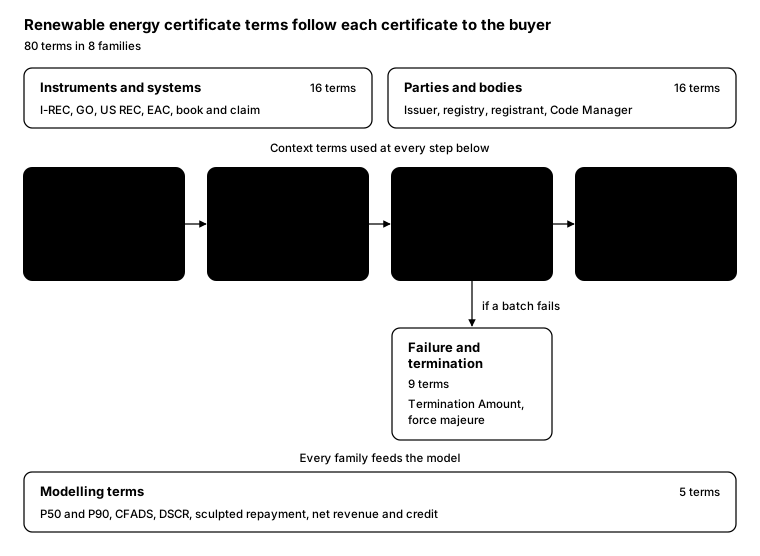
Instruments and parties apply throughout, while the four steps in blue carry the certificate itself. Failure terms branch off delivery, and modelling terms turn every family into volume, cash and debt.
What are the renewable energy certificate instruments and systems?
A renewable energy certificate is a tradable record of 1 MWh of renewable generation, but each system names and runs it differently. These terms separate the generic idea from the I-REC, Guarantee of Origin and US REC versions.
| Term | System | Definition | Covered in |
|---|---|---|---|
| Renewable energy certificate | All systems | A tradable record that one unit of renewable electricity, usually 1 MWh, was generated. It carries that unit's attributes and can be sold apart from the power. | Renewable energy certificate systems compared: I-REC, Guarantees of Origin and US RECs |
| Energy attribute certificate (EAC) | All systems | The umbrella term in the RE100 criteria for standardised, tradable certificates that track energy attributes per unit of generation. RE100 notes it is often used interchangeably with renewable energy certificate. | Renewable energy certificate systems compared: I-REC, Guarantees of Origin and US RECs |
| Energy attributes | All systems | The physical characteristics of generation and the environmental benefits they bring: technology, capacity, location, commissioning date, emissions and the time of generation. | What buyers need from renewable energy certificates: Scope 2 quality criteria, market boundaries and vintage |
| Environmental Attribute | US master agreement | A measurable benefit or claim linked to generation other than the electricity itself, such as avoided emissions. The template excludes production tax credits and other direct subsidies. | Renewable energy certificate trade agreements compared: I-REC, EECS GO, EFET and US master agreements |
| I-REC(E) | I-REC | A verified record of electricity production at a registered production facility, issued under the I-REC Standard. The I-REC(E) single trade agreement sets one I-REC(E) equal to one MWh. | Renewable energy certificate systems compared: I-REC, Guarantees of Origin and US RECs |
| I-REC Standard | I-REC | The International Attribute Tracking Standard, owned by the International REC Standard Foundation. Product codes, such as the I-REC Code for Electricity, set the detailed rules under it. | Renewable energy certificate systems compared: I-REC, Guarantees of Origin and US RECs |
| Guarantee of Origin (GO) | GO | A certificate issued for energy produced under guarantee of origin legislation. In the EU the legal basis is Article 19 of Renewable Energy Directive 2018/2001. | Renewable energy certificate systems compared: I-REC, Guarantees of Origin and US RECs |
| EECS | GO | The European Energy Certificate System: national registers, a central hub that links them and a common set of standards. | Renewable energy certificate systems compared: I-REC, Guarantees of Origin and US RECs |
| EECS Hub | GO | The central link through which GOs move from one national register to another, much like a transfer between two banks. | Delivering renewable energy certificates: transfer, redemption and when title and risk pass |
| US REC | US RECs | An instrument that conveys the property rights to the non-power attributes of renewable generation. One is issued for each MWh generated and delivered to the grid. | Renewable energy certificate systems compared: I-REC, Guarantees of Origin and US RECs |
| Generation information system (GIS) | US RECs | A regional tracking system that records generation from renewable facilities, such as WREGIS, NEPOOL GIS, PJM EIS GATS or M-RETS. | Renewable energy certificate systems compared: I-REC, Guarantees of Origin and US RECs |
| Renewable Portfolio Standard (RPS) | US RECs | A law or regulation requiring a set share or quantity of electricity sold or used to come from renewable sources. | Renewable energy certificate systems compared: I-REC, Guarantees of Origin and US RECs |
| Standard, Basic and Specified REC | US master agreement | Product types in one US template. A Standard REC carries all environmental attributes, a Basic REC only certifies generation, and a Specified REC carries named attributes. | Pricing renewable energy certificates: volume, vintage, spot trades and forward sales |
| Book and claim | I-REC, GO | Tracking in which certificates are traded apart from the physical electricity. The I-REC Code uses it, and AIB notes GOs can be sold with the energy or separately. | Renewable energy certificate systems compared: I-REC, Guarantees of Origin and US RECs |
| Bundled and unbundled | All systems | Bundled means energy and its attributes are bought in one transaction; unbundled means separate transactions. The example is unbundled: its PPA sells power only. | How to read a renewable energy certificate sale agreement for a solar project: a modeller's guide |
| Label (ecolabel) | All systems | A set of extra criteria, owned by a labelling body, that a facility or certificate may meet on top of its base system. | What buyers need from renewable energy certificates: Scope 2 quality criteria, market boundaries and vintage |
Who are the parties and bodies in a renewable energy certificate sale?
Besides seller and buyer, a renewable energy certificate sale relies on an issuer, a registry and the body that sets the rules. Their names differ between I-REC, Guarantees of Origin and US RECs.
| Term | System | Definition | Covered in |
|---|---|---|---|
| Issuer | I-REC | The body that processes production facility registrations and Issue Requests. I-REC(E)s are issued by the issuer for the relevant country or region. | How a solar plant gets renewable energy certificates issued: registration, issuance and fees |
| Issuing Body | GO | The body that issues GOs within its domain. AIB stresses one issuing body per domain as the basis of each GO's uniqueness. | How a solar plant gets renewable energy certificates issued: registration, issuance and fees |
| Registry | I-REC, GO | The database that records certificates through their life, from issuance to transfer and use. Fingrid describes the GO register as a book-entry system. | How a solar plant gets renewable energy certificates issued: registration, issuance and fees |
| Registry Operator | I-REC | The entity that runs the I-REC registry and keeps the record of issuance, transfer and use. | Registry, issuer and rule-change risk in renewable energy certificate sales: force majeure and change in applicable rules |
| Code Manager | I-REC | The entity that defines a certificate product in a product code and coordinates the service operators under it. For I-REC(E), Evident fills this role. | Registry, issuer and rule-change risk in renewable energy certificate sales: force majeure and change in applicable rules |
| International REC Standard Foundation | I-REC | The not-for-profit foundation that owns the I-REC Standard and accredits the bodies that operate under it. | Registry, issuer and rule-change risk in renewable energy certificate sales: force majeure and change in applicable rules |
| Association of Issuing Bodies (AIB) | GO | The association that maintains EECS. Its members keep the national GO registers. | Renewable energy certificate systems compared: I-REC, Guarantees of Origin and US RECs |
| Registrant | I-REC | The entity that registers a production facility and submits Issue Requests on the owner's behalf. The owner may act as its own registrant. | How a solar plant gets renewable energy certificates issued: registration, issuance and fees |
| Participant | I-REC | An entity holding trade or redemption accounts in the registry. It owns the certificates held in those accounts. | Delivering renewable energy certificates: transfer, redemption and when title and risk pass |
| Account | I-REC, GO | A record in a registry assigned to one entity, in which its certificates sit. GO systems also vet and register each account holder. | Delivering renewable energy certificates: transfer, redemption and when title and risk pass |
| Aggregator | GO | An operator that applies for GOs and runs the related account on behalf of several producers. | How a solar plant gets renewable energy certificates issued: registration, issuance and fees |
| End-user and Beneficiary | I-REC | The end-user uses or claims a certificate. A beneficiary is an end-user to which a certificate may be irrevocably assigned as part of a redemption. | Delivering renewable energy certificates: transfer, redemption and when title and risk pass |
| Production Auditor | I-REC | A party independent of the registrant that checks the measured volume of eligible production stated in an Issue Request. | How a solar plant gets renewable energy certificates issued: registration, issuance and fees |
| Upstream Party | I-REC(E) agreement | Anyone in the certificate supply chain before the seller, including the operator of the production device. The parties choose whether its breach of the rules can still count as force majeure. | Registry, issuer and rule-change risk in renewable energy certificate sales: force majeure and change in applicable rules |
| Competent Authority | I-REC(E) agreement | The I-REC bodies, governments and their agencies, any entity with jurisdiction over the certificates, and the courts. | Registry, issuer and rule-change risk in renewable energy certificate sales: force majeure and change in applicable rules |
| Certification Authority | US master agreement | An entity that certifies the generation, characteristics or delivery of a REC, or a facility's eligibility under a programme. It may be a tracking system, an agency or another named party. | Renewable energy certificate trade agreements compared: I-REC, EECS GO, EFET and US master agreements |
What do the registration and issuance terms for renewable energy certificates mean?
Registration and issuance terms describe how a plant's metered output becomes renewable energy certificates in an account. They set the volume a seller can deliver and the date it first holds them.
| Term | System | Definition | Covered in |
|---|---|---|---|
| Production Facility (Production Device) | I-REC, GO | One or more generating units of substantially the same technology whose output passes an identifiable measurement point. GO systems verify the plant data when the device is registered. | How a solar plant gets renewable energy certificates issued: registration, issuance and fees |
| Registration | I-REC, GO | Recording a production facility with the issuer so certificates can be issued for it. An I-REC registration expires five years after its effective registration date unless the issuer sets an earlier date. Example: registration fee in years 1, 6, 11 and 16. | How a solar plant gets renewable energy certificates issued: registration, issuance and fees |
| Effective Registration Date | I-REC | The first date that can earn certificates at a facility. It is the later of the earliest period the product code allows and the date the owner grants exclusive attribute rights. | How a solar plant gets renewable energy certificates issued: registration, issuance and fees |
| Production Period | I-REC | The span of time over which a facility reports eligible production. Under the I-REC Code it is one year or less and falls within one calendar year. Example: half-years. | How a solar plant gets renewable energy certificates issued: registration, issuance and fees |
| Issue Request | I-REC | The registrant's formal request to the issuer to issue certificates for a facility, backed by evidence for one production period. Example: the shortfall case starts when the issuer rejects one month of evidence. | How a solar plant gets renewable energy certificates issued: registration, issuance and fees |
| Issuance | I-REC, GO | Creating certificates in a registry account. Fingrid's glossary says GOs are issued on request once the production method is certified; AIB bases GO issuing on verified meter readings. Example: issuance 64 days after each half-year ends. | How a solar plant gets renewable energy certificates issued: registration, issuance and fees |
| Residual Mix Deadline | I-REC | The date by which Issue Requests must reach the issuer. Unless told otherwise, it falls in the following year: 31 May for January to June output and 30 September for July to December. | How a solar plant gets renewable energy certificates issued: registration, issuance and fees |
| Issuer and registry fees | I-REC, GO | Charges for registration, accounts and issuance. For I-REC(E), the I-REC Code points to a separate fee schedule. Example (invented): USD 0.04 per certificate, USD 1,250 a year, USD 1,850 per registration. | How a solar plant gets renewable energy certificates issued: registration, issuance and fees |
What do the trade agreement terms for renewable energy certificates mean?
Trade agreement terms fix what is sold, how many renewable energy certificates, at what price and on which dates. Some templates cover one trade; others set terms once for many trades.
| Term | System | Definition | Covered in |
|---|---|---|---|
| Single Trade Agreement (I-REC(E) STA) | I-REC | A standard template for one transaction with one or several deliveries of I-REC(E)s. It brings in the I-REC(E) Code and Standard, and its own terms prevail if they conflict. | Renewable energy certificate trade agreements compared: I-REC, EECS GO, EFET and US master agreements |
| Master agreement and confirmation | US master agreement | A master agreement sets terms once for many trades; each trade is then fixed in a short Product Order or confirmation. One US template was prepared by ABA committees with EMA and ACORE. | Renewable energy certificate trade agreements compared: I-REC, EECS GO, EFET and US master agreements |
| EFET EECS Master Agreement | GO | The European Federation of Energy Traders' master agreement for trading EECS certificates such as GOs. AIB lists it with a comparison of its 2013 version and the EFET CMA of September 2020. | Renewable energy certificate trade agreements compared: I-REC, EECS GO, EFET and US master agreements |
| Annex and Product Order | I-REC(E) agreement, US master agreement | The schedule of trade details. The I-REC(E) Annex lists production period, country, device, issuer, technology, delivery date, quantity and prices; a US Product Order can add vintages and facilities. | Renewable energy certificate trade agreements compared: I-REC, EECS GO, EFET and US master agreements |
| Quantity | I-REC(E) agreement | The number of certificates the seller must deliver and the buyer must accept, at one I-REC(E) per MWh. Example: 52,000 a year in two batches of 26,000. | Pricing renewable energy certificates: volume, vintage, spot trades and forward sales |
| I-REC(E) Price and Contract Price | I-REC(E) agreement | The I-REC(E) Price is the price per certificate. The Contract Price is what the buyer pays for a delivery; the Total Contract Price is the deal's whole value. Example: USD 2.0; USD 52,000 a batch; USD 312,000 in total. | Pricing renewable energy certificates: volume, vintage, spot trades and forward sales |
| Purchase Price and Trade Date | US master agreement | The Purchase Price is the price for a delivery of Product. The Trade Date is when a trade is agreed, by signing a Product Order or orally with written confirmation. | Pricing renewable energy certificates: volume, vintage, spot trades and forward sales |
| Vintage | All systems | The period in which certificates are created or first valid, usually a calendar or reporting year. Buyers use it to match generation to the year of consumption. Example: three vintage years. | Pricing renewable energy certificates: volume, vintage, spot trades and forward sales |
| Default Interest Rate | I-REC(E) agreement | The agreed rate charged on late payment, set as a margin over a reference rate. It runs from the invoice due date until payment. | How to read a renewable energy certificate sale agreement for a solar project: a modeller's guide |
| VAT and Other Taxes | I-REC(E) agreement | Prices exclude VAT; the law where the taxable supply takes place decides its treatment, and the buyer pays VAT against a valid invoice. Other Taxes are any other taxes due on transfer. Example (invented 15%): USD 7,800 a batch. | Tax on renewable energy certificate sales: VAT and other taxes |
| Representations and warranties | I-REC(E) agreement | Statements each party makes and repeats on every delivery date. The seller confirms, among other things, that it may dispose of the certificates and that they match the agreed specification. | Renewable energy certificate trade agreements compared: I-REC, EECS GO, EFET and US master agreements |
What do the delivery and title terms for renewable energy certificates mean?
Delivery terms say how renewable energy certificates reach the buyer and when ownership and risk move. The answer depends on the transfer method the agreement selects.
| Term | System | Definition | Covered in |
|---|---|---|---|
| Delivery and Delivery Date | I-REC(E) agreement, US master agreement | Delivery is the transfer of the agreed certificates from seller to buyer; the Delivery Date is the date set for it. A US template adds that delivery can happen apart from the electricity, and only once the certificates exist. | Delivering renewable energy certificates: transfer, redemption and when title and risk pass |
| Electronic Transfer | I-REC(E) agreement | Delivery by moving certificates from the seller's registry account to the buyer's. Title and risk pass when they are credited to the buyer's account. | Delivering renewable energy certificates: transfer, redemption and when title and risk pass |
| Redemption Statement Transfer | I-REC(E) agreement | Delivery in which the seller redeems the certificates for a beneficiary the buyer names, then sends the statement. Title and risk pass when the buyer receives it; it suits buyers without a registry account. | Delivering renewable energy certificates: transfer, redemption and when title and risk pass |
| Title and risk | All systems | Ownership of the certificates and the risk of their loss. The I-REC(E) agreement ties the moment both pass to the transfer method, such as crediting to the buyer's account. | Delivering renewable energy certificates: transfer, redemption and when title and risk pass |
| Redemption, cancellation and retirement | I-REC, GO, US RECs | The final use of a certificate to back a claim, which takes it out of circulation. I-REC calls it redemption, GO systems say cancellation, and US sources speak of retiring RECs. | Delivering renewable energy certificates: transfer, redemption and when title and risk pass |
| Redemption Statement | I-REC | The document that evidences a redemption. An auditor without a registry account can verify it. | Delivering renewable energy certificates: transfer, redemption and when title and risk pass |
| Assignment | I-REC | Allocating a redeemed certificate to a named end-user, for its disclosure over a stated consumption period. | Delivering renewable energy certificates: transfer, redemption and when title and risk pass |
| Expiry | GO, I-REC | Fingrid's glossary says GOs are valid for 12 months and expire automatically if not cancelled. For I-REC(E)s, eligibility for a claim may lapse under the rules of the body the claim is reported to, or under applicable law. | Pricing renewable energy certificates: volume, vintage, spot trades and forward sales |
| Transfer Certificate | US master agreement | An attestation, a tracking-system record of the transfer or another document that evidences delivery of a REC. | Delivering renewable energy certificates: transfer, redemption and when title and risk pass |
What do the failure and termination terms in a renewable energy certificate sale mean?
Failure and termination terms set what one party owes when renewable energy certificates are not delivered or not accepted. They also say which events excuse a party, from registry failures to rule changes.
| Term | System | Definition | Covered in |
|---|---|---|---|
| Failure to deliver | I-REC(E) agreement | The seller's duty to pay when it misses delivery and does not cure within a short period after written notice. It owes the positive gap between the buyer's market replacement cost and the I-REC(E) Price for the missing quantity, plus reasonable costs. The guidance note calls this a mark-to-market valuation. Example: USD 0.65 x 2,100 + USD 350 = USD 1,715. | Failure to deliver or accept renewable energy certificates: replacement cost and termination amounts |
| Failure to accept | I-REC(E) agreement | The buyer's duty to pay when it refuses delivery and does not cure. It owes the positive gap between the I-REC(E) Price for the refused quantity and the seller's market resale price, plus reasonable costs. Example: USD 0.55 x 26,000 + USD 350 = USD 14,650. | Failure to deliver or accept renewable energy certificates: replacement cost and termination amounts |
| Termination Event and Early Termination Date | I-REC(E) agreement | Events that let the other party end the agreement early by notice, such as insolvency, unpaid amounts, uncured delivery failures or lasting force majeure. The notice names the Early Termination Date, after which no further deliveries are owed. | Failure to deliver or accept renewable energy certificates: replacement cost and termination amounts |
| Termination Amount | I-REC(E) agreement | The sole compensation the non-defaulting party calculates after early termination, using the same market-gap formula on the undelivered certificates. Example: USD 57,550 if the buyer defaults, USD 67,950 if the seller defaults. | Failure to deliver or accept renewable energy certificates: replacement cost and termination amounts |
| Settlement Amount and Termination Payment | US master agreement | The non-defaulting party values its losses or gains, and its costs, on each terminated trade. It then nets all amounts owed both ways into one Termination Payment. | Failure to deliver or accept renewable energy certificates: replacement cost and termination amounts |
| Unit Contingent and Generation Contingent | US master agreement | Product terms that excuse the seller when a named facility does not generate enough for the vintage. The seller then owes no damages for the shortfall. | Failure to deliver or accept renewable energy certificates: replacement cost and termination amounts |
| Limitation of liability | I-REC(E) agreement | A cap on each party's liability tied to the contract value. It does not cover failure and termination payments, and indirect losses and lost profit are excluded. | Failure to deliver or accept renewable energy certificates: replacement cost and termination amounts |
| Force Majeure | I-REC(E) agreement, US master agreement | An event outside a party's control that affects its ability to perform. The I-REC(E) agreement requires delivery or acceptance to be impossible, names registry and some issuer failures, and relieves only the affected quantity. A US template asks for a material adverse effect on a party's ability to perform. | Registry, issuer and rule-change risk in renewable energy certificate sales: force majeure and change in applicable rules |
| Change in Applicable Rules and Government Action | I-REC(E) agreement, US master agreement | A change to the certificate rules, scheme contracts or laws after signing. The I-REC(E) agreement first seeks good-faith amendments, then allows termination; a US template's Government Action covers changes to a product's eligibility. | Registry, issuer and rule-change risk in renewable energy certificate sales: force majeure and change in applicable rules |
What do the claims and reporting terms for renewable energy certificates mean?
Claims terms describe what a buyer needs before a renewable energy certificate supports a reporting claim. Frameworks differ in detail, so the definitions below name the variants rather than one rule.
| Term | System | Definition | Covered in |
|---|---|---|---|
| Scope 2 market-based method and Scope 2 Quality Criteria | GHG Protocol, as summarised by RE100 | Market-based Scope 2 claims rest on market-based instruments such as certificates. RE100 lists Quality Criteria including an emission rate conveyed by one instrument only, redemption for the reporting entity, residual mix, boundary and vintage. | What buyers need from renewable energy certificates: Scope 2 quality criteria, market boundaries and vintage |
| Market boundary | All frameworks | The region within which certificates must be bought and used for a claim, generally where electricity laws and regulation are consistent. RE100 publishes its own boundaries, and the Scope 2 Quality Criteria also limit claims by market. | What buyers need from renewable energy certificates: Scope 2 quality criteria, market boundaries and vintage |
| Vintage limitation | All frameworks | A rule that a certificate's vintage must be reasonably close to the year of consumption it supports. There is no single standard, and some certification programmes set fixed windows. | What buyers need from renewable energy certificates: Scope 2 quality criteria, market boundaries and vintage |
| Double counting and double claiming | All frameworks | Double counting is one unit's attributes held in more than one instrument or by more than one owner. Double claiming is two parties claiming the same attribute; credible claims exclude both. | Renewable energy certificates and carbon credits from the same solar plant: avoiding double counting |
| Residual mix | I-REC, GO | The attribute mix left for consumption not covered by certificates. The I-REC Code normally keeps output with issued certificates out of it. Where applicable, GO disclosure rules require its use for untracked energy. | What buyers need from renewable energy certificates: Scope 2 quality criteria, market boundaries and vintage |
| Carbon credit (offset) | All systems | An instrument for one metric ton of emissions avoided or reduced. EPA contrasts it with a US REC, which covers the attributes of 1 MWh. RE100 requires offsets issued for the claimed generation to be retired by or for the same claimant. | Renewable energy certificates and carbon credits from the same solar plant: avoiding double counting |
Which modelling terms apply to renewable energy certificate revenue?
Modelling terms link renewable energy certificate revenue to the lender's case. They decide which volume is counted and how much debt that revenue can support.
| Term | System | Definition | Covered in |
|---|---|---|---|
| P50 and P90 | Lender's model | Energy yield estimates with a 50% and a 90% probability of being exceeded. Lenders may set DSCR targets on either basis. Example: 76,000 certificates at P50 and 70,000 at P90 in year 1. | Renewable energy certificate revenue in the lender's model: how much counts for debt sizing |
| CFADS | Lender's model | Cash flow available for debt service: the cash a project generates after operating costs, taxes and capital spending, before lenders are paid. Example: USD 4.2m in year 1. | Renewable energy certificate revenue in the lender's model: how much counts for debt sizing |
| DSCR, lock-up and default ratios | Lender's model | DSCR is CFADS divided by scheduled principal and interest for a period. Below the lock-up level, payouts to shareholders stop; below the default level, lenders may demand repayment. Example: 1.30x, 1.20x and 1.10x. | Renewable energy certificate revenue in the lender's model: how much counts for debt sizing |
| Sculpted repayment and target DSCR | Lender's model | A repayment profile in which each period's debt service equals CFADS divided by a target DSCR set by the lenders. Example: year 1 debt service USD 3.231m at 1.30x. | Renewable energy certificate revenue in the lender's model: how much counts for debt sizing |
| Net certificate revenue and credit | Example | Certificate sales less issuer and registry fees. Credit is the share of it a lender's case counts for debt sizing. Example: USD 134,100 in year 1; full credit adds USD 0.81m of debt, 50% credit adds USD 0.40m. | Renewable energy certificate revenue in the lender's model: how much counts for debt sizing |
How do you use this renewable energy certificate glossary in a model?
Use the glossary to turn each clause of a renewable energy certificate agreement into a model input. Each becomes a volume, a price, a date or a downside case. Work through the term families in the order the certificate moves.
- Name the system first. Read issuer, registry and delivery terms in the sense of that system, whether I-REC, Guarantees of Origin or US RECs.
- Turn registration and issuance terms into a volume and a date. In the example, 70,000 certificates at P90 in year 1, issued 64 days after each half-year ends.
- Turn trade terms into a revenue line: contract quantity at the contract price, with any surplus sold spot. The example contracts 52,000 a year at USD 2.0, or USD 104,000.
- Turn delivery and payment terms into cash timing. Delivery 11 days after issuance and payment 27 days after invoice leave an average year 1 receivable of about USD 74,000.
- Deduct issuer and registry fees, and keep VAT out of revenue. In our reading VAT is collected from the buyer and paid on, so it moves cash but not profit.
- Keep failure and termination amounts in a downside case. The example's shortfall costs USD 1,715 and a buyer default after year 1 yields USD 57,550.
- Apply the lender's credit last. Net revenue of USD 134,100 in year 1 at full credit adds USD 0.81m of debt.
Frequently asked questions
Is a US REC the same as an I-REC or a Guarantee of Origin?
All three are renewable energy certificates for 1 MWh of renewable generation, but each sits in its own system. A GO rests on EU legislation and a national issuing body. An I-REC(E) rests on the I-REC Standard, and a US REC on a regional tracking system. The sale agreement names the system, so its delivery terms follow that system's registry.
What is the difference between redeeming, cancelling and retiring a renewable energy certificate?
They name the same final step in different systems: the certificate backs a claim and leaves circulation. I-REC calls it redemption, GO systems call it cancellation, and US sources speak of retiring certificates. After that step the certificate can no longer be transferred.
Why do renewable energy certificate agreements use different names for the same clause?
Each template was written for its own market. The I-REC(E) agreement calls its post-default payment a Termination Amount, while one US master agreement nets Settlement Amounts into a Termination Payment. Read the formula, not the label: one uses market replacement or resale prices, the other the present value of losses or gains.
Which renewable energy certificate terms change the numbers in a lender's model?
Volume, price and payment timing terms change the base case. Failure, termination, force majeure and rule-change terms shape the downside case. The lender's credit then sets how much net revenue supports debt; in the example, full credit adds USD 0.81m.
Sources
Pages opened and checked on 10 October 2026. The example project is invented and has no source.
- I-REC(E) Standard Single Trade Agreement, RECS Energy Certificate Association and DLA Piper, hosted by the International REC Standard Foundation. Single trade agreement, Annex, quantity and prices, transfer methods, title and risk, VAT and Other Taxes, failure to deliver and accept, termination, force majeure, change in applicable rules, Upstream Party, Competent Authority, Default Interest Rate, representations and warranties, liability cap.
- Guidance Notes to the I-REC(E) Standard Single Trade Agreement, International REC Standard Foundation and DLA Piper. I-REC(E) issued by the country issuer, use of redemption statements by buyers without accounts, mark-to-market valuation, liability cap tied to the contract value.
- Evident. I-REC Code for Electricity, Evident (version 1.11). I-REC bodies and roles, International REC Standard Foundation, production facility, Effective Registration Date, registration expiry, production period, Issue Request, Residual Mix Deadline, residual mix exclusion, redemption, assignment, book and claim, labels, fee schedule.
- Glossary: Fingrid, Fingrid. Guarantee of Origin, register, issuing, transfer, cancellation, 12-month validity, EECS, AIB, EECS Hub, aggregator.
- AIB and EECS, Association of Issuing Bodies. GO legal basis in Directive 2018/2001 Article 19, account holder and device registration, issuing on verified meter readings, one issuing body per domain, book and claim, residual mix.
- EFET standard agreement between market parties, Association of Issuing Bodies. EFET EECS Master Agreement and the comparison with the EFET CMA of September 2020.
- Renewable Energy Certificates (RECs), US Environmental Protection Agency. US REC definition, issuance per MWh delivered to the grid, difference between RECs and offsets.
- Memorandum of Understanding, Exhibit A: Master REC Purchase and Sale Agreement, Illinois Power Agency. US master agreement terms: Environmental Attribute, REC, GIS, RPS, Product Order, Purchase Price, Trade Date, Vintage, Delivery, Transfer Certificate, Certification Authority, product types, Unit Contingent, Settlement Amount, Termination Payment, Government Action, retirement.
- RE100 Technical Criteria, RE100, hosted by Climate Group (dated 24 March 2025). Energy attribute certificates, energy attributes, bundled and unbundled procurement, Scope 2 Quality Criteria comparison, market boundaries, vintage limitations, double counting and double claiming, EAC cancellation and retirement, including retirement of RECs under US RPS.
- How to calculate P90 and other Pxx energy yield estimates, Solargis. P50 and P90 definitions.
- Debt Sizing with Target DSCR: Project Finance, Renewables Valuation Institute. CFADS, target DSCR and sculpted repayment.
- Debt Service Coverage Ratio (DSCR), Renewables Valuation Institute. DSCR definition and targets on a P50 or P90 basis.
- 8.1 Measuring Commercial Feasibility, APMG Public-Private Partnerships Certification Program. Lock-up and default DSCR levels.