Tax on renewable energy certificate sales: VAT and other taxes
By SolarQuant Editorial. Published 2026-10-10. Last updated 2026-10-10.
I-REC(E) and EFET templates for renewable energy certificate sales exclude VAT from the price; the buyer pays any VAT against a valid VAT invoice. In the model, VAT is therefore a pass-through with its own cash timing, not revenue. Other taxes, withholding and VAT on fees that cannot be recovered are real costs, and the contract decides who bears them.
What example does this article use?
We use the same invented 40 MWp solar plant as the rest of the series. The project sells its power under a PPA, keeps its certificates and sells 52,000 of them a year forward in two batches. Every figure below is invented and describes no real project, buyer, issuer, tax authority or market.
| Item | Example figure (invented) |
|---|---|
| Plant and power sale | 40 MWp, one 20-year USD PPA at USD 80 per MWh for power only |
| Certificates | Kept by the project and sold separately (unbundled), one per MWh |
| Year 1 certificates, P90 | 70,000 |
| Certificate costs | Issuance fee USD 0.04 per certificate; account fee USD 1,250 a year; registration USD 1,850 in years 1, 6, 11 and 16 |
| Year 1 certificate costs | USD 5,900 (year 2: USD 4,036) |
| Year 1 net certificate revenue | USD 134,100 |
| Forward sale | 52,000 a year for three vintage years, in two batches of 26,000, at USD 2.0 |
| Contract value | USD 52,000 a batch, USD 104,000 a year, USD 312,000 in total |
| Timing | Issuance 64 days after each half-year, delivery 11 days after issuance, payment 27 days after invoice |
| Invoice date (assumption for this article) | Invoice issued on the delivery date |
| VAT case | Invented VAT rate of 15%: VAT on one batch USD 7,800 |
| VAT payment lag (invented for this article) | Output VAT paid to the tax authority 23 days after the invoice date; what-if 41 days |
How do renewable energy certificate trade agreements allocate VAT?
The I-REC(E) and EFET templates state every price exclusive of VAT. The buyer pays any VAT on top, but only against a valid VAT invoice, and local law decides whether VAT applies. The two North American agreements we opened have no VAT clause and split all taxes at delivery instead.
- I-REC(E) Standard Single Trade Agreement. Clause 7.1 says all amounts are "exclusive of any applicable value added tax", and VAT is payable once the seller provides a "valid VAT invoice". Where both parties are established in the EU, the buyer represents that it is a taxable person. That representation serves the place of supply rule in article 44 of the EU VAT Directive.
- EFET certificates master agreement. Section 13.1 adds a paperwork duty where EU or national law lets a supply be "Zero-Rated and/or subject to the reverse charge". A party that fails indemnifies the other for VAT, penalties and interest. Without the buyer's documents, "the Seller reserves the right to charge local VAT".
- North American master REC agreement (an ABA, EMA and ACORE working group draft, attached to an Illinois Power Agency memorandum) and the NYSERDA agreement. Neither mentions VAT. Section 2.4 of the master agreement puts Taxes "up to and including the time and place of its Delivery" on the seller. Taxes at or after Delivery fall on the buyer, and NYSERDA splits taxes and fees at the date of Delivery.
The I-REC(E) guidance note adds that the tax position "should however be considered by local counsel when negotiating the I-REC(E) STA". The table sets the four templates side by side. "Renewable energy certificate trade agreements compared: I-REC, EECS GO, EFET and US master agreements" covers their other clauses.
| Template | VAT | Other taxes and who bears them | Documents and indemnity |
|---|---|---|---|
| I-REC(E) Standard Single Trade Agreement | Prices exclusive of VAT; buyer pays on a valid VAT invoice; EU buyer gives taxable person representations | Other Taxes are taxes other than VAT payable on transfer; buyer pays them if shown separately on the invoice and, where applicable, confirmed as paid or accounted for | Both parties do what is needed to secure an exemption; the party that fails indemnifies Other Taxes, penalties and interest; without the buyer's documents the seller may charge Other Taxes |
| EFET certificates master agreement | Prices exclusive of VAT; buyer pays on a valid VAT invoice; zero rating or reverse charge under Articles 44, 196 or 199a of the VAT Directive | Other Tax is an energy Tax or excise duty, not Taxes targeted at end users; Tax before the Delivery Point is the seller's, after it the buyer's; New Tax rules; optional withholding gross-up | Same covenant for zero rating, reverse charge and exemptions; indemnity for VAT, Other Taxes, penalties and interest |
| North American master REC agreement | No VAT clause | Seller bears Taxes up to and including Delivery, buyer at or after it; each party pays its own fees, including brokers fees | Seller warrants the Product free and clear of taxes; each party indemnifies the other for the Taxes it is responsible for |
| NYSERDA Agreement for the Sale of Renewable Energy Certificates | No VAT clause | NYSERDA bears taxes or other fees up to the date of Delivery, the buyer on and after it | No separate tax indemnity in its tax clause |
How do tax authorities treat VAT and GST on renewable energy certificate sales?
The official pages we opened treat a business sale of renewable energy certificates as a taxable supply. They differ on who accounts for the tax, at what rate, and when a seller falls outside it. Each statement below is as at the page's own date, so check the current position before relying on it.
| Country | Publisher and date | What the page says |
|---|---|---|
| United Kingdom | HM Revenue and Customs, Revenue and Customs Brief 4 (2019), published 13 June 2019 | From 14 June 2019 a domestic reverse charge applies to supplies of renewable energy certificates between UK VAT-registered businesses. Its list includes Guarantees of Origin, REGOs and I-RECs. The customer accounts for the VAT and "can deduct the VAT due on the supplies as input tax", subject to the normal rules. The invoice must say the reverse charge applies. |
| United Kingdom | HM Revenue and Customs, internal manual VFUP4300, amended 11 July 2019 per the manual's update history | Issue of ROCs by the regulator to generators is no supply and outside the scope of VAT. Trading in ROCs is a standard-rated supply of services, under the reverse charge from 14 June 2019. Renewable electricity sold with ROCs is a single supply of electricity. |
| India | Ministry of Finance, Tax Research Unit, Circular No. 46/20/2018-GST, 6 June 2018 | Renewable Energy Certificates are classified under heading 4907 and "attract 12% GST". |
| Australia | Australian Taxation Office, GST and the Small-scale Renewable Energy Scheme, last updated 11 December 2025 | REC agents registered or required to be registered for GST pay GST on a transfer or sale of STCs. A home owner whose system is not used for business pays no GST on the sale. A registered business owner whose system is used for the business pays GST and issues a tax invoice above AUD 82.50 including GST. |
For the UK rule, the HMRC brief cites section 55A of the VAT Act 1994 and Article 199a(1)(f) of Directive 2006/112/EC. In the brief's words, that article "allows member states to provide for a reverse charge for supplies of gas and electricity certificates". The brief adds that UK-based VAT-registered businesses trading certificates are subject to UK VAT, "even if those certificates are being traded outside the UK".
Our reading: a project selling to a buyer in another country may find that VAT is due in the buyer's country, not its own. The template's documentation clause then decides whether the seller still charges local VAT.
Which other taxes can apply to a renewable energy certificate sale, and who bears them?
Beyond VAT, the templates deal with taxes on transfer, energy taxes, new taxes and withholding. Most put taxes arising before delivery on the seller and those after it on the buyer. In the I-REC(E) and EFET templates, paperwork for exemptions is a shared duty, backed by an indemnity.
- Taxes passed on by invoice. The I-REC(E) agreement defines Other Taxes as "any taxes other than VAT payable upon transfer of the I-REC(E)s from Seller to Buyer". The buyer pays them only if "identified separately on the invoice issued by the Seller" and confirmed as paid. EFET narrows Other Tax to "any energy Tax or excise duty, but not including Taxes targeted at end users".
- Exemptions and documents. In both templates, the parties must do what is needed to secure an exemption, backed by an indemnity for tax, penalties and interest. Without the buyer's documents, the I-REC(E) seller "reserves the right to charge Other Taxes".
- A public buyer's variant. The State of Illinois business terms attached to the Illinois Power Agency memorandum put the burden of proof on the seller. "Vendor shall not bill for any taxes unless accompanied by proof that the State is subject to the tax."
- A split at delivery. EFET section 13.3, the North American master agreement (section 2.4) and NYSERDA (section 2.5) all divide taxes at the delivery point or date. The master agreement adds that each party indemnifies the other "against any Taxes for which such Party is responsible under Section 2.4".
Under EFET section 13.4, the buyer bears a New Tax if it can obtain exemption or relief, or pass it to a third party. Under section 13.5, unless elected otherwise, a contract running over two years can be terminated over a New Tax that cannot be passed on. The test is a tax on the remaining quantity above "five percent (5%) of the product of the Remaining Contract Quantity and the Contract Price".
In the example, after year 1 the remaining 104,000 certificates at USD 2.0 are worth USD 208,000. If that clause applies, the threshold is USD 10,400, or USD 0.10 a certificate (invented, derived). Below it, that clause gives the taxed party no right to terminate.
EFET section 13.6, where elected, bars withholding unless the law requires it, and then requires a gross-up with listed exceptions. The gross-up means the receiving party "receives the same amount it would have received had no such withholding or deduction been made".
With an invented 7% withholding on one batch, the project would receive USD 48,360 without a gross-up. With it, the gross payment rises to USD 55,914, the buyer withholds USD 3,914 and the project still nets USD 52,000 (invented, derived).
How does VAT change the cash timing of a batch of renewable energy certificates?
With the invented timing, the project invoices a batch on day 75 after the half-year ends and the buyer pays on day 102. If output VAT is due 23 days after the invoice (invented), the project pays USD 7,800 on day 98, 4 days before it collects it. In an annual model both legs usually fall in the same period, so the gap shows only in a monthly or daily working capital schedule.
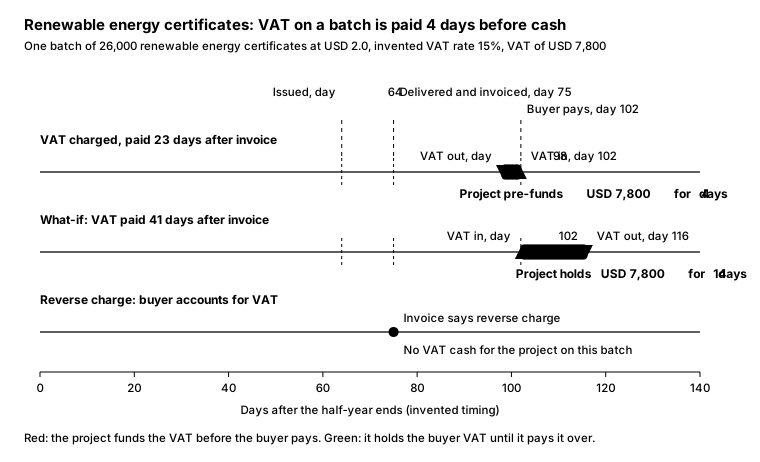
The VAT itself nets to zero; what the model must carry is the gap between the two dates. A late buyer payment widens the gap day for day, while a later VAT date or a reverse charge removes it.
What do the tax clauses of a renewable energy certificate sale change in the model?
They change cash timing, the cost line and, in rare cases, the life of the contract. VAT never enters revenue or CFADS, but it moves cash between the buyer, the project and the tax authority on different dates. What follows is our reading of the clauses above, applied to the example.
- VAT is a pass-through with its own timing. On each batch the project bills USD 52,000 plus USD 7,800 of VAT, USD 59,800 in all. Revenue stays USD 52,000, and the USD 7,800 sits in working capital until both legs settle. Over the three-year contract the VAT billed totals USD 46,800 (invented, derived).
- Input VAT on fees is timing if recoverable and a cost if not. If the year 1 fees of USD 5,900 carried the invented 15%, input VAT would be USD 885 (invented, derived). If the project cannot recover it, year 1 net certificate revenue falls from USD 134,100 to USD 133,215.
- Other taxes and withholding are real costs. A tax the contract leaves with the seller, such as one arising before delivery, reduces net revenue directly. Withholding without a gross-up cuts a batch's cash from USD 52,000 to USD 48,360 in the invented 7% case.
- A reverse charge removes the VAT leg for the seller. Where the buyer accounts for the VAT, as under the UK rule, the project collects and pays no VAT on the sale. The VAT working capital disappears, but the invoice must still carry the reverse charge wording.
In the bundled what-if, the PPA transfers the certificates to the power buyer. The project then has no certificate revenue and no separate certificate sale to tax. HMRC's manual, for example, treats UK renewable electricity sold with ROCs as a single supply of electricity.
"Renewable energy certificate revenue in the lender's model: how much counts for debt sizing" covers how much net certificate revenue a lender credits.
How do you model it?
Model tax on certificate sales as a working capital layer and a cost layer around the net certificate revenue. "How to read a renewable energy certificate sale agreement for a solar project: a modeller's guide" places these clauses in the whole agreement.
- List each batch with its quantity, delivery date and net price: six batches of 26,000 at USD 2.0 in the example.
- Set a VAT switch for each sale: VAT charged by the seller, reverse charge, zero rated or outside the scope, based on tax advice for both parties' locations.
- Where the seller charges VAT, compute it on the invoice (USD 7,800 a batch at the invented 15%) and keep it out of revenue and CFADS.
- Date each leg: the invoice, the VAT received with the buyer's payment, and the VAT paid on your return date.
- Carry the net VAT balance in working capital, and fund any days when VAT leaves before the buyer's cash arrives.
- Add input VAT on issuer, registry and broker fees, as a receivable if you can recover it and as a cost if you cannot.
- Add other taxes the contract leaves with the project as costs, and withholding as a cut in cash unless a gross-up applies.
- Test a late payment case, where VAT is paid to the tax authority well before the buyer pays the invoice.
What are the common mistakes?
- Booking VAT as revenue. USD 59,800 billed on a batch is USD 52,000 of revenue and USD 7,800 owed to the tax authority.
- Assuming VAT nets to zero in cash. It nets to zero over time, but the payment date and the cash receipt rarely match. In the example the project pre-funds USD 7,800 for 4 days on every batch.
- Charging VAT where a reverse charge applies. Under the UK rule the customer accounts for the VAT, and HMRC asks for errors to be corrected as soon as possible.
- Ignoring the documentation duty. Under the I-REC(E) and EFET templates, a party that fails to provide the paperwork indemnifies the other for the tax, penalties and interest.
- Treating unrecoverable input VAT as timing. It is a cost: USD 885 in year 1 at the invented 15%.
Frequently asked questions
Is VAT charged on the sale of renewable energy certificates?
Often, but it depends on the country and the parties. HMRC treats trading in ROCs as a standard-rated supply of services, under a reverse charge since 14 June 2019. India's 2018 circular put renewable energy certificates at 12% GST, and Australia's tax office says GST-registered REC agents pay GST on sales of STCs.
Who pays VAT under a renewable energy certificate trade agreement?
In the I-REC(E) and EFET templates, the buyer pays VAT on top of the price, but only against a valid VAT invoice. The two North American agreements we opened have no VAT clause and split taxes at delivery instead.
Does the issue of renewable energy certificates to a generator attract VAT?
HMRC's manual says the issue of ROCs by the regulator to accredited generators is no supply and outside the scope of VAT. The fees an issuer or registry charges are a separate question, so check whether they carry VAT you can recover.
Does a reverse charge change the net price of renewable energy certificates?
No. Only the party that accounts for the VAT changes. HMRC says the customer can deduct the VAT as input tax, so no net tax is payable, subject to the normal rules for reclaiming VAT.
Can a new tax end a renewable energy certificate contract?
Under EFET section 13.5 it can, unless elected otherwise, for a contract running more than two years. The New Tax must exceed 5% of the remaining quantity times the contract price and be impossible to pass on. The other party can block termination by electing to pay the New Tax month by month.
Sources
Pages opened and checked on 10 October 2026. The example project is invented and has no source.
- I-REC(E) Standard Single Trade Agreement, RECS Energy Certificate Association and DLA Piper. Clause 7 on VAT and Other Taxes, exemptions and indemnity.
- Guidance Notes to the I-REC(E) Standard Single Trade Agreement, International REC Standard Foundation and DLA Piper. Note on clause 7 and review by local counsel.
- EECS Certificate & National Scheme Certificate Master Agreement, Version 1.1(b), European Federation of Energy Traders. Section 13 on VAT, Other Taxes, the split at the Delivery Point, New Tax and withholding; definitions of Other Tax and New Tax.
- Memorandum of Understanding, with Exhibit A: Master REC Purchase and Sale Agreement, Illinois Power Agency. Taxes and fees (section 2.4), title warranty, tax indemnity, and the State of Illinois business terms on billing taxes.
- Agreement for the Sale of Renewable Energy Certificates, NYSERDA. Taxes and fees split at the date of Delivery (section 2.5).
- Revenue and Customs Brief 4 (2019): VAT: domestic reverse charge for businesses trading in renewable energy certificates, HM Revenue and Customs. Reverse charge scope and date, certificate names, input tax, invoicing, place of supply, error correction, section 55A and Article 199a(1)(f).
- VFUP4300: Renewable Obligation Certificates (ROCs), HM Revenue and Customs. VAT treatment of the issue of ROCs, trading in ROCs and electricity sold with ROCs.
- Circular No. 46/20/2018-GST: Applicable GST rate on Priority Sector Lending Certificates (PSLCs), Renewable Energy Certificates (RECs) and other similar scrips, Government of India, Ministry of Finance, Tax Research Unit. Classification of RECs under heading 4907 at 12% GST.
- GST and the Small-scale Renewable Energy Scheme, Australian Taxation Office. GST on sales of STCs and the tax invoice threshold.