Renewable energy certificates and carbon credits from the same solar plant: avoiding double counting
By SolarQuant Editorial. Published 2026-10-10. Last updated 2026-10-10.
A solar plant can earn renewable energy certificates or carbon credits, but most of the standards we cite stop one MWh backing both. A certificate supports a buyer's claim about the electricity it used; a credit supports a claim to have offset emissions. For a modeller, the task is to assign every MWh to one revenue line and make every contract say so.
What example does this article use?
We use the same invented 40 MWp solar plant as the rest of the series, which sells power only and keeps its certificates. The carbon credit figures are a separate what-if on the same plant, using an invented grid emission factor and credit price. We do not assume the plant is eligible for credits.
| Item | Example figure (invented) |
|---|---|
| Plant and power sale | 40 MWp, one 20-year USD PPA at USD 80 per MWh for power only |
| Certificates | Kept by the project and sold separately (unbundled), one per MWh of metered net output |
| Bundled what-if | A PPA that transfers the certificates to the power buyer leaves the project no certificate revenue |
| Year 1 output, P90 | 70,000 MWh, so 70,000 certificates |
| Certificate price | USD 2.0, flat; year 1 gross revenue USD 140,000 |
| Certificate price range tested | USD 1.5 to 4.0 (invented range, not a market range) |
| Year 1 net certificate revenue | USD 134,100 (3.19% of CFADS of USD 4.2m) |
| Forward sale | 52,000 certificates a year for three vintage years at USD 2.0 |
| Grid emission factor (what-if) | 0.62 tonnes CO2e per MWh, invented |
| Carbon credit price (what-if) | USD 6.30 per tonne, invented |
What is the difference between a renewable energy certificate and a carbon credit?
A renewable energy certificate records the attributes of one MWh of renewable generation, which a buyer uses to claim the electricity it consumed. A carbon credit records one tonne of emissions reduced or removed against a baseline, which a buyer uses to offset its own emissions.
The US EPA puts it in one line: "Offsets represent a metric ton of emissions avoided or reduced; RECs represent attributes of 1 MWh renewable electricity generation." The GHG Protocol's Scope 2 Guidance draws the same line for buyers. "An offset credit does not confer any claims about the use of electricity attributes applicable to scope 2."
The same guidance says companies "purchasing and claiming offsets should document these purchases outside of the scopes". The I-REC Code for Electricity agrees that an I-REC(E) does not by its nature include the same attributes as a carbon offset certificate. It also notes that "some market actors assert that the conveyed attributes are similar".
Can one MWh carry both a renewable energy certificate and a carbon credit?
Under the carbon crediting standards and the Green-e standard we cite, one MWh cannot back both a renewable energy certificate and a carbon credit. Any second instrument on it must be cancelled, retired or never issued. The Scope 2 Guidance says that in most industrialised markets a MWh "could not produce both".
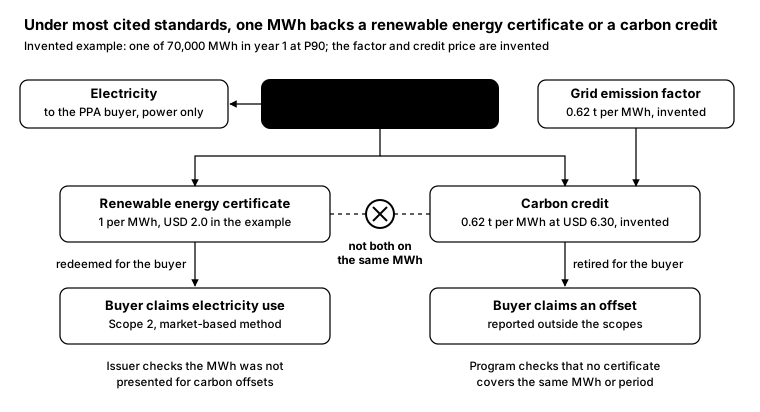
The electricity goes to the PPA buyer either way. What the project chooses is which claim each MWh's attributes support, and it records that choice once.
What do carbon crediting and renewable energy certificate standards say about the same MWh?
Every standard we opened guards against two instruments on the same output, but they draw the line in different places. Some count MWh, one counts project periods, and some certificate standards say who holds the carbon rights.
| Standard | Side | Rule on the same output | What the project provides |
|---|---|---|---|
| Verra VCS Standard v5.0 | Carbon credits | No VCS credit for reductions "receiving or seeking GHG-related credit for the same project activity and time period"; energy attribute certificates, RECs and GOs are examples of such credit systems | For other periods: the certificate system's administrator, vintages and evidence such as a signed letter that overlapping certificates were cancelled or do not overlap |
| Gold Standard GHG and Renewable Energy Label requirements | Carbon credits | Co-issuance of renewable energy attribute certificates and credits "for same MWh of electricity generated is not permitted"; the project chooses per MWh | MWh tracking in the monitoring report; on co-issuance, retire credits "with additional 25% as a penalty" |
| Gold Standard label on CDM credits (GS CERs) | Carbon credits | A declaration not to issue a CER and a renewable energy certificate from the same MWh | Net MWh supplied to the grid and issuance tracked by product type |
| I-REC Code for Electricity v1.13 | Certificates | Unless relevant legislation dictates otherwise, "carbon offset rights shall by default be associated with an I-REC(E)"; any exclusion is stated on the certificate | The registrant confirms and assigns those rights; the issuer checks, to the extent possible, that the volume was not presented for carbon offsets |
| EECS Rules, Release 8 v1.11 | Certificates (GOs) | No other transferable certificate for the same Output and attributes "for the same Purpose" (Disclosure, Support or Target) | Optionally, a carbon footprint in kg/MWh on the certificate |
| Green-e Renewable Electricity Standard for International Certification v1.0 | Certificate label | Where the market allows, all attributes, including all GHG benefits, go in the product; selling an offset from the same generation to another party is a prohibited double use | A generator that also creates offsets "must retire an equivalent amount of its own carbon offsets from the same monitoring period" |
| GHG Protocol Scope 2 Guidance | Buyer claims | In most industrialised markets a MWh produces a certificate or an offset credit, not both | Buyers should disclose whether the MWh behind their instrument also produced offset credits |
Gold Standard and Verra differ on the unit of separation. Gold Standard's rules let a project "choose between Renewable Energy Labels and VERs at issuance", MWh by MWh. Verra's rule refers to "the same project activity and time period".
Gold Standard also lets a developer cancel credits to issue certificates in their place, or the reverse. This works only for units not yet transferred or retired, and only where the certificate registry can show the cancellation.
Can a grid-connected solar plant earn carbon credits at all?
A grid-connected solar plant often cannot earn carbon credits by default. Verra and Gold Standard limit new grid-connected solar projects by location, and the Integrity Council for the Voluntary Carbon Market has raised the additionality bar.
- Verra. The VCS Standard v5.0 sets the default eligibility of grid-connected solar PV as "Activities in LDCs", the least developed countries. A methodology's own geographic conditions take precedence over that default.
- Gold Standard. Its Renewable Energy Activity Requirements v1.4 admit new grid-connected projects in least developed countries, small island developing states or landlocked developing countries. They also admit low and lower-middle income countries where the technology is below 5% of grid installed capacity at first submission. Small island and landlocked states classed as high income are excluded.
- Integrity Council. In August 2024 it found that eight renewable energy methodologies "fail to meet the CCP Assessment Framework requirements on additionality". In May 2026 it approved VCS VMR0017 for the CCP label, with a condition. A benchmark analysis must show carbon revenue decisively improves project economics to at least the financial viability benchmark.
Credits meant for Article 6 of the Paris Agreement add a further layer. Gold Standard asks for the host country's authorisation, and, for CORSIA eligibility, evidence of a corresponding adjustment or a guarantee to replace the credits.
Should a solar project sell renewable energy certificates, carbon credits or both?
The choice exists only if the plant is eligible for carbon credits, and it is made per MWh or per period, not per buyer. On the invented figures, credits earn more than renewable energy certificates only above USD 3.23 a tonne (invented, derived).
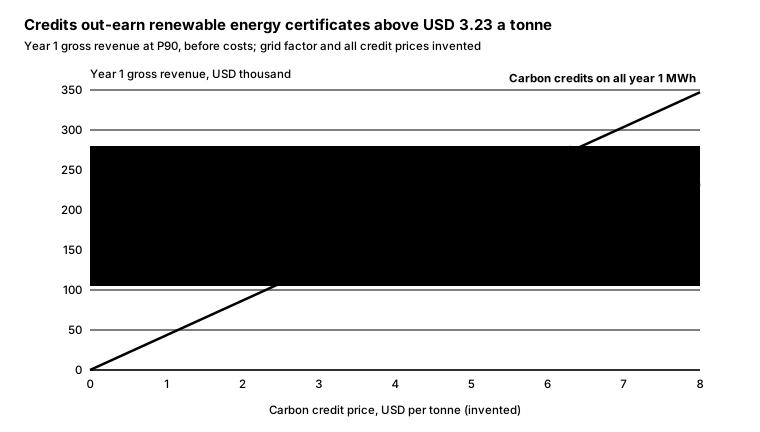
The breakeven is the certificate price divided by the emission factor: USD 2.0 over 0.62 tonnes. Across the invented certificate range of USD 1.5 to 4.0, it moves from USD 2.42 to USD 6.45 a tonne (invented, derived).
A split is also possible on paper. With 52,000 MWh sold forward as certificates, year 1's other 18,000 MWh would earn 11,160 tonnes (invented, derived). At the invented price they are worth USD 70,308.
Our reading: these are gross figures before the costs of validation, verification and issuance, which we do not estimate. "Renewable energy certificate revenue in the lender's model: how much counts for debt sizing" covers how lenders treat unproven revenue.
What contract terms keep renewable energy certificates and carbon credits apart?
The sale agreement must say which attributes travel with the certificate, and the seller must promise it has not sold them elsewhere. Public codes and templates do this in three ways.
- Carbon rights travel with the certificate by default. Under the I-REC Code, carbon offset rights go with each certificate by default, unless relevant legislation dictates otherwise. When requesting issuance, the registrant confirms it holds any such rights and assigns them. Where rights are excluded, that "shall be clearly stated on each I-REC(E)".
- The certificate holds every attribute, but parts can be split off with disclosure. A US master REC purchase and sale agreement says an Environmental Attribute may include "avoided NOx, SOx, CO2 or greenhouse gas emissions". Its commentary says "The standard REC product includes all these attributes intact and together", and offers a Disclosure Document for parties that disaggregate.
- The seller warrants clean title. The I-REC(E) Standard Single Trade Agreement has the seller warrant, on each Delivery Date, that it may dispose of the certificates. Gold Standard's example declaration has the developer warrant it has not sold or encumbered the "underlying Environmental Benefits".
Our reading for the model: in the bundled what-if, the PPA's attribute definition decides whether carbon rights went with the certificates. If it covers avoided emissions, the project has neither revenue line left.
What will a buyer of renewable energy certificates or carbon credits ask for?
Each buyer wants proof that the other instrument was not issued on the same output. The evidence differs by side.
- Certificate buyer reporting Scope 2. The Scope 2 Guidance lists a disclosure: "Is the facility producing offset credits from the same MWh reflected in the contractual instrument?"
- Buyer of a Green-e certified product. Where the market's rules allow, the product must carry all attributes, including the GHG benefits, under a legally enforceable contract or instrument.
- Verra credit buyer. For other periods, the verifier and Verra receive the certificate system's details, vintages and evidence such as its administrator's signed letter.
- Gold Standard credit buyer. Where the project also uses the Renewable Energy Label, the verifier reviews registries that could hold certificates. The monitoring report shows each MWh is a credit or a label "but never both".
"What buyers need from renewable energy certificates: Scope 2 quality criteria, market boundaries and vintage" covers the certificate buyer's other checks.
How do you model it?
Model renewable energy certificates and carbon credits as two exclusive uses of the same metered MWh. "How to read a renewable energy certificate sale agreement for a solar project: a modeller's guide" places this choice in the whole agreement.
- Record which attributes the PPA and the certificate rules give the project, including any carbon rights.
- Test credit eligibility before any credit revenue: program location rules, methodology and label conditions.
- Allocate each period's metered net output to certificates, credits or neither, by MWh or by period as the program requires.
- Convert MWh allocated to credits into tonnes with the methodology's emission factor.
- Price each line on its own, net of its own fees and costs.
- Time each line on its own issuance cycle: 64 days after each half-year for certificates in the example.
- Add a check row: certificates issued plus MWh credited never exceed metered net output in any period.
- Keep credit revenue out of the base case until eligibility and registration are confirmed.
What are the common mistakes?
- Adding both revenues on the same MWh. At the invented figures, year 1 would show USD 413,420 rather than USD 140,000 or USD 273,420.
- Assuming any solar plant can earn carbon credits. Default program eligibility for grid-connected solar is limited by location and additionality.
- Forgetting that the certificate may already hold the carbon rights. Under the I-REC Code, carbon offset rights travel with the certificate by default, unless legislation says otherwise or they are excluded.
- Splitting by MWh where the program splits by period. Verra's rule refers to the same project activity and time period.
- Comparing gross credit revenue with net certificate revenue. Compare each line after its own costs.
Frequently asked questions
Is a renewable energy certificate a carbon credit?
No. A renewable energy certificate represents the attributes of one MWh of renewable generation, while a carbon credit represents one tonne of emissions avoided, reduced or removed. The GHG Protocol treats them as different instruments supporting different claims.
What happens if a project issues renewable energy certificates and carbon credits on the same MWh?
Under Gold Standard's label rules, the developer retires equivalent credits plus 25% as a penalty, and Gold Standard may deregister the project. Under Green-e, a generator's certificates are eligible only if it retires an equivalent amount of its own offsets from the same monitoring period.
Can a project switch between renewable energy certificates and carbon credits later?
Gold Standard allows cancel and replace in either direction, for units not yet transferred or retired. Verra allows credits for different periods with evidence that the same reductions are not also counted in the certificate system. Such evidence may be the administrator's signed letter showing no overlap, or that overlapping certificates were cancelled and not used.
Does selling carbon credits from a solar plant change other buyers' Scope 2 figures?
The Scope 2 Guidance says the coexistence of offsets does not in itself prevent zero-emission Scope 2 claims. Local or international regulation may adjust a grid-average emission factor to "add back in" a sold offset. It may also require contract terms that retire the plant's attributes, so that no consumer can use them for market-based Scope 2 claims.
Sources
Pages opened and checked on 10 October 2026. The example project is invented and has no source.
- VCS Standard, Version 5.0, Verra. Default eligibility of grid-connected solar PV (Table 1) and the rules on double claiming and other forms of environmental credit (sections 3.22.5 and 3.22.6).
- VCS Program Definitions, Version 5.0, Verra. Definitions of double claiming and of a GHG-related environmental credit system, which lists energy attribute certificates, RECs and GOs.
- GHG Emissions Reduction & Sequestration Product Requirements, Version 3.2, Gold Standard. Ban on co-issuance for the same MWh (section 10.5) and the Article 6 annex on authorisation and corresponding adjustments.
- Renewable Energy Label Product Requirements, Version 1.2, Gold Standard. Choice per MWh, the GS CER declaration, the 25% penalty, cancel and replace, MWh tracking and the example declaration.
- Renewable Energy Activity Requirements, Version 1.4, Gold Standard. Location and penetration conditions for grid-connected renewable energy projects.
- Carbon credits from current renewable energy methodologies will not receive high-integrity CCP® label, Integrity Council for the Voluntary Carbon Market. The August 2024 decision on eight renewable energy methodologies.
- Integrity Council announces new batch of assessment decisions, Integrity Council for the Voluntary Carbon Market. The May 2026 conditional approval of VCS VMR0017.
- Evident. I-REC Code for Electricity, Version 1.13, Evident Ev Limited. Carbon offset rights held within each I-REC(E), the issuer's check at issuance and the statement on attributes.
- EECS Rules, Release 8 v1.11, Association of Issuing Bodies. Uniqueness principle, the definition of Purpose and the optional carbon footprint field.
- Green-e Renewable Electricity Standard for International Certification, Version 1.0, Center for Resource Solutions. Fully aggregated attributes, retirement of offsets from the same monitoring period, prohibited double uses.
- GHG Protocol Scope 2 Guidance, World Resources Institute and World Business Council for Sustainable Development. Relationship to offset credits (section 8.2.4) and the recommended offsets disclosure.
- Renewable Energy Certificates (RECs), US Environmental Protection Agency. The difference between RECs and offsets.
- Memorandum of Understanding, Illinois Power Agency. Its Exhibit A, the Master REC Purchase and Sale Agreement: definition of Environmental Attribute and the commentary on the Disclosure Document.
- I-REC(E) Standard Single Trade Agreement, RECS Energy Certificate Association and DLA Piper. Seller's representations and warranties (clause 11.1).