Renewable energy certificate trade agreements compared: I-REC, EECS GO, EFET and US master agreements
By SolarQuant Editorial. Published 2026-10-10. Last updated 2026-10-10.
Public trade agreements for renewable energy certificates come in two architectures. A single trade agreement holds one transaction in one document; a master agreement holds general terms shared by many confirmations or product orders. For a modeller, the architecture decides where each input sits and which elections or special conditions can change it.
What example does this article use?
We use the same invented 40 MWp solar plant as the rest of the series. The project sells its power under a PPA, keeps its certificates and sells 52,000 of them a year forward in two batches. Every figure below is invented and describes no real project, buyer, issuer or market.
| Item | Example figure (invented) |
|---|---|
| Plant and power sale | 40 MWp, one 20-year USD PPA at USD 80 per MWh for power only |
| Certificates | Kept by the project and sold separately (unbundled), one per MWh |
| Year 1 certificates, P90 | 70,000 |
| Year 1 net certificate revenue | USD 134,100 (3.19% of CFADS of USD 4.2m) |
| Forward sale | 52,000 a year for three vintage years, in two batches of 26,000, at USD 2.0 |
| Contract value | USD 52,000 a batch, USD 104,000 a year, USD 312,000 in total |
| Certificates sold spot in year 1 | 18,000 (70,000 less 52,000, derived) |
| Timing | Issuance 64 days after each half-year, delivery 11 days after issuance, payment 27 days after invoice |
| VAT case | Invented rate of 15%: USD 7,800 on one batch |
| Seller-default termination amount | USD 67,950 |
What are the two architectures of renewable energy certificate trade agreements?
A single trade agreement puts the legal terms and one transaction's commercial details in one signed document. A master agreement is signed once and then governs many trades, each recorded in a confirmation or product order.
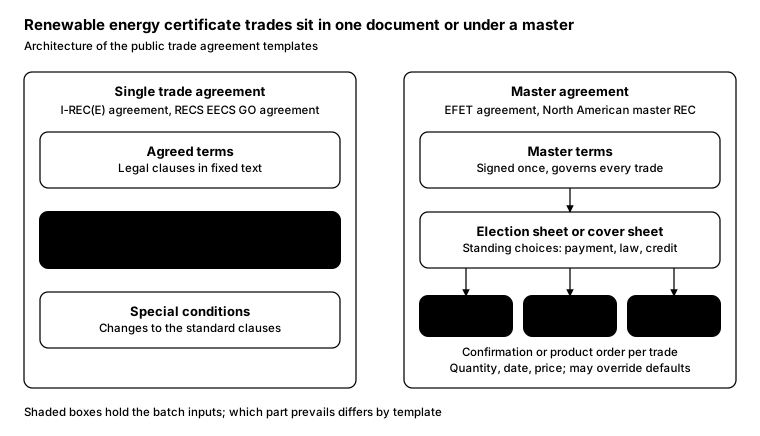
For a model, a single trade agreement is one input sheet, while a master agreement is a sheet of defaults plus one override sheet per trade. Only the shaded parts change from trade to trade.
- Single trade agreements. The I-REC(E) Standard Single Trade Agreement and the RECS EECS GO agreement are forms with blanks for each trade's details. The I-REC(E) agreement covers one transaction with one or several delivery dates. The AIB describes the RECS agreement, now at version 2.2, as being for single or multiple deliveries.
- Master agreements. The EFET certificates master agreement says "All Individual Contracts and this Certificate Master Agreement shall form a single agreement between the Parties". The North American master REC agreement, prepared by a working group including EMA and ACORE, puts standing choices on a Cover Sheet. Its Product Order is "intended to work like a confirmation in a typical trading contract".
- Public procurement agreements. The NYSERDA Agreement for the Sale of Renewable Energy Certificates covers the agency's sales to New York load serving entities for compliance year 2017. The agency sets the terms. Each buyer receives a confirmation of its quantity, and the price follows a regulator's order.
Which document wins when the parts of a renewable energy certificate trade conflict?
It depends on the template. Some agreements rank the trade terms above the certificate scheme's rules, while others rank the scheme's rules on top.
- I-REC(E) Standard Single Trade Agreement. It incorporates the I-REC(E) Code and the I-REC Standard in force at the Effective Date. Where they conflict with the agreement, "this Agreement will prevail".
- EFET certificates master agreement. Where the Election Sheet and the master differ, "the Election Sheet shall prevail". An Individual Contract's terms prevail over both for that contract, but "the Issuance and Registry Rules shall prevail" over the Agreement.
- North American master REC agreement. Its user notes say Cover Sheet elections "can be varied for any particular transaction by so stating on the Product Order".
Our reading: under a master agreement, the confirmation or product order is the last word on a trade's inputs, so read it first. Where the scheme's rules prevail, test rule changes in the model as changes to the trade itself.
What does each renewable energy certificate trade agreement fix, and what does it leave to the parties?
The public templates fix most legal mechanics and leave the commercial inputs to the parties. They differ most on payment and on which risks are switched on by election. Governing law is always left to an election or to the issuer of the form.
| Clause | I-REC(E) Standard Single Trade Agreement | EFET certificates master agreement | North American master REC agreement | NYSERDA Agreement for the Sale of Renewable Energy Certificates |
|---|---|---|---|---|
| Where trade terms sit | Annex, one line per batch, plus Special Conditions | Confirmation of each Individual Contract; standing choices in the Election Sheet | Product Order; standing choices on the Cover Sheet | The agency's order confirmation; price set under a regulator's order |
| Transfer | Electronic Transfer or Redemption Statement Transfer, ticked | Electronic Transfer unless Transfer by Cancellation Statement is specified | Attestation or a GIS REC tracking system, named in the Product Order | Quarterly delivery of a pro rata share through the state tracking system |
| Payment | Invoice after each Delivery Date, due a short period after receipt; default interest rate filled in | Monthly invoice, due on the later of the 20th calendar day and the fifth Business Day after receipt; netting if elected | Elected: Payment on Delivery, Monthly Invoicing, Semiannual Invoicing or Prepayment | Uniform monthly payments; no delivery before payment |
| Taxes | Exclusive of VAT and Other Taxes; buyer pays VAT against a valid VAT invoice | Exclusive of VAT; buyer pays VAT against a valid VAT invoice; withholding tax clause if elected | Seller bears Taxes up to Delivery, buyer at and after | Same split at Delivery |
| Failure to deliver or accept | Price gap plus reasonable costs, after a short cure period | Price gap, costs excluded | Settlement Amount route before an Event of Default | No price formula; terminate, withhold or set off |
| Force majeure and rule change | Registry and issuer failures listed; Upstream Party test by tick box; Change in Applicable Rules leads to talks, then termination | Force majeure limbs elected; Change in Law leads to talks, Expert Determination if elected, then termination; if elected, the talks cannot change the price | Force majeure suspends; buyer bears programme changes unless the product is sold Regulatorily Continuing | Broad force majeure; NYSERDA may terminate after more than 45 days |
| Termination | Fixed Termination Events and cure periods, changeable in Special Conditions | Material Reasons; failure to deliver or accept counts only if elected; master ends on an Expiration Date or 30 calendar days' notice | Events of Default; cross default if indicated on the Cover Sheet | Event of Default after a five Business Day cure |
| Liability | Cap tied to the contract value; failure and termination amounts sit outside it | Cap elected as the amounts payable for the certificates or a Limitation Amount; failure and termination amounts sit outside it | Limits the kinds of damages, not their size | Article 5 remedies are exclusive; indirect damages excluded |
| Confidentiality | Applies, with disclosure to a bank or other financing institution allowed; survives for a limited period | Applies unless disapplied in the Election Sheet; same financier carve-out | Applies only if elected on the Cover Sheet; lenders may be told | Subject to a freedom of information law; documents marked "Confidential" or "Proprietary" |
| Governing law | Filled in by the parties, with arbitration rules and seat | Elected from set options or the parties' own wording; a default option applies if none is elected | Elected on the Cover Sheet | Fixed by the agency's form |
The two master templates also carry elective credit terms. EFET's Election Sheet names Credit Support Documents and Material Adverse Change triggers. The master REC Cover Sheet offers credit assurances, a collateral threshold and a guarantee.
"Failure to deliver or accept renewable energy certificates: replacement cost and termination amounts" covers the failure and termination rows in depth.
Which product fields does each renewable energy certificate trade agreement ask for?
Every template asks for quantity, price and delivery date. They differ in how finely they describe origin and quality, and each field narrows which certificates can fill a delivery.
- I-REC(E) Standard Single Trade Agreement. Its annex asks for production period, country of production, production device, issuer, country of delivery, technology, delivery date, quantity, unit price and contract price. The guidance note says lines "may be deleted or added" to match the number of batches.
- RECS EECS GO standard contract. RECS's notes on version 2.2 list fields for minimum validity, earmark, production device information, type of support received and commissioning date. The delivery date "can now be a fixed date or the earliest and latest dates of delivery".
- EFET certificates master agreement. Its confirmation names the certificate type, energy source, production year, technology, minimum validity, earmarks, domains of production and delivery, and the Delivery Point.
- North American master REC agreement. Its example Product Order asks for product type, number of RECs, vintage, price, delivery date, method of transfer, facility and energy source. It also lists the Applicable Programs the seller says the RECs comply with.
The I-REC(E) guidance note adds that a reselling buyer may want tighter seller warranties. These may restrict the certificates to "a certain project, energy source (e.g. wind, solar) or country". "What buyers need from renewable energy certificates: Scope 2 quality criteria, market boundaries and vintage" explains why buyers ask for these fields.
In the example, 18,000 certificates are sold spot in year 1. They can cover a delivery shortfall only if they match the batch's fields, such as production period. Our reading: the tighter the fields, the smaller the buffer the model can count on.
Where can elections and special conditions change a renewable energy certificate model?
In the I-REC(E) single trade agreement, any input can change through the special conditions. In a master agreement, the election sheet or cover sheet sets defaults, and each confirmation or product order can override them for its trade.
The I-REC(E) guidance note says clause 25 "allows users to add, remove (disapply), or modify any provisions". It names uses such as varying cure periods, adding termination events and restricting price changes in rule-change talks. The following inputs move with these choices, in our reading.
- Quantity and dates. These sit in the annex, confirmation or product order. In the example, all three describe the same six batches of 26,000 worth USD 312,000.
- Cash timing. The example pays 27 days after invoice, so each USD 52,000 batch is a receivable for 27 days. A master REC Payment on Delivery election makes payment due within three Business Days of delivery, and Prepayment brings it before delivery.
- Currency. The I-REC(E) annex shows EUR placeholders and EFET pays in EURO unless elected otherwise. The example's USD 2.0 price needs that field or election set, or the model needs a currency line.
- Taxes. Where prices are VAT-exclusive, the buyer pays USD 7,800 of VAT on top of each USD 52,000 batch at the invented 15% rate. Model it as cash passed through, not revenue; "Tax on renewable energy certificate sales: VAT and other taxes" covers the detail.
- Risk switches. The Upstream Party tick box, EFET's force majeure limbs, failure as a termination ground and Regulatorily Continuing decide which shortfalls the project carries.
- Exposure size. The example's seller-default termination amount of USD 67,950 sits outside the I-REC(E) and EFET liability caps, so no cap election reduces it.
Confidentiality decides what lenders may see. The I-REC(E) and EFET texts allow disclosure to a "bank or other financing institution". The master REC clause applies only if elected, and it names lenders among permitted recipients.
How do you model it?
Build the certificate sale inputs from the trade-level document, then record which clause or election set each one. "How to read a renewable energy certificate sale agreement for a solar project: a modeller's guide" places these steps in the whole agreement.
- Identify the architecture and collect every document. For a single trade, that is the agreement, its annex and its special conditions. For a master, it is the master, its election or cover sheet and every confirmation or product order.
- Rank the documents with the template's own precedence clause, and read the trade-level document first.
- Build the batch schedule: quantity, delivery date, price, currency and production period for each batch. The example has six rows of 26,000 at USD 2.0.
- Set the payment lag from the payment clause or election, and add a currency line if the contract currency differs from the model's.
- Add VAT and other taxes as cash passed through, not as revenue.
- Record each risk switch as a flag: force majeure scope, Upstream Party test, failure as termination ground, Regulatorily Continuing, change in law price adjustment.
- Tag certificate volumes with the product fields, so only matching volume can cover a shortfall.
- Keep a source column that names the clause, election or special condition behind every input.
What are the common mistakes?
- Reading the master and skipping the confirmation. Under the EFET agreement, an Individual Contract's terms prevail over the master and the Election Sheet for that contract.
- Taking the template default as the deal. Payment terms, confidentiality, liability caps and termination grounds can all be changed by an election or a special condition.
- Leaving the currency at the template default. The I-REC(E) annex shows EUR and EFET pays in EURO unless elected, while the example prices in USD.
- Counting VAT as revenue. The USD 7,800 of VAT on a batch passes through the project's cash; it is not certificate income.
- Assuming every template prices a failure. The NYSERDA agreement offers termination, withholding and set-off rather than a price gap formula.
Frequently asked questions
Is the I-REC(E) Standard Single Trade Agreement only for one delivery of renewable energy certificates?
No. It covers "one transaction with one or multiple delivery date(s)", with one annex line per batch. A forward sale of several batches can therefore sit in one signed document.
Is the RECS EECS GO agreement a master agreement?
No. RECS said in 2014 that users "fill-in the variable information about each individual trade while the legal text and formatting remains unchanged". That was a single delivery form; the AIB describes version 2.2 as a trade agreement "for single or multiple deliveries".
Does an EFET renewable energy certificate trade need a written confirmation to be binding?
No, unless the parties agree otherwise: Individual Contracts "may be concluded in any form of communication". The agreement adds that "A written Confirmation shall not constitute a requirement for a legally valid Individual Contract." If both parties send confirmations without delay and they contradict, each counts as a notice of objection.
Which payment election suits a solar project selling renewable energy certificates under the master REC agreement?
Its user notes suggest Payment on Delivery may suit "a single project entity that is delivering RECs as generated". Semiannual Invoicing "may be appropriate for small projects generating a long-term stream of RECs".
Who chooses the governing law of a renewable energy certificate trade agreement?
In the I-REC(E), EFET and master REC templates, the parties fill it in or elect it. EFET's form applies a default option if none is elected. In a public procurement agreement such as NYSERDA's, the agency's form fixes it.
Sources
Pages opened and checked on 10 October 2026. The example project is invented and has no source.
- I-REC(E) Standard Single Trade Agreement, RECS Energy Certificate Association and DLA Piper. Single transaction with one or several delivery dates, precedence, annex fields, transfer, payment, taxes, force majeure, change in applicable rules, termination events, liability, confidentiality, governing law blanks.
- Guidance Notes to the I-REC(E) Standard Single Trade Agreement, International REC Standard Foundation and DLA Piper. Annex lines per batch, uses of clause 25 special conditions, seller warranties on origin, Upstream Party tickboxes.
- RECS International publishes EECS-GO and RECS Standard Contract for Single Delivery: RECS Energy Certificate Association, RECS Energy Certificate Association. Fill-in design of the 2014 EECS GO standard agreement for single delivery.
- EECS GO Standard Contract V2.2 published: RECS Energy Certificate Association, RECS Energy Certificate Association. Product field updates in versions 2.1 and 2.2.
- RECS International EECS GO Delivery Standard Contract | AIB, Association of Issuing Bodies. EECS GO trade agreement for single or multiple deliveries.
- EECS Certificate & National Scheme Certificate Master Agreement, Version 1.1(b), European Federation of Energy Traders. Single agreement of master and Individual Contracts, confirmations, precedence, Election Sheet options, confirmation fields, transfer, force majeure, failure remedies, termination, payment, VAT, change in law, liability, confidentiality, governing law options, credit support.
- Memorandum of Understanding, with Exhibit A: Master REC Purchase and Sale Agreement, Illinois Power Agency. Master agreement prepared by a working group including EMA and ACORE: user notes, Cover Sheet elections, Product Order fields, transfer methods, payment options, taxes, force majeure, government action, events of default, liability, confidentiality, governing law, credit terms.
- Agreement for the Sale of Renewable Energy Certificates, NYSERDA. Public procurement variant: order confirmation, quarterly delivery, payment before delivery, taxes, events of default, remedies, force majeure, freedom of information, governing law.