Registry, issuer and rule-change risk in renewable energy certificate sales: force majeure and change in applicable rules
By SolarQuant Editorial. Published 2026-10-10. Last updated 2026-10-10.
When a registry fails, an issuer cannot issue or the scheme rules change, renewable energy certificates may not be delivered. Most templates cited here then excuse the affected delivery without compensation, so the project simply loses that revenue. For a modeller, this means a downside case in which certificate revenue pauses or stops, and a check that the cover ratios survive it.
What example does this article use?
We use the same invented 40 MWp solar plant as the rest of the series. It sells power under a PPA, keeps its certificates and sells 52,000 of them a year forward in two batches. Every figure below is invented and describes no real project, buyer, issuer or market.
| Item | Example figure (invented) |
|---|---|
| Plant and power sale | 40 MWp, one 20-year USD PPA at USD 80 per MWh for power only |
| Certificates | Kept by the project and sold separately (unbundled), one per MWh of metered net output |
| Year 1 certificates, P90 | 70,000, falling 0.5% a year |
| Certificate price | USD 2.0 per certificate, flat |
| Year 1 net certificate revenue | USD 134,100 (3.19% of CFADS) |
| Forward sale | 52,000 a year for three vintage years, in two batches of 26,000, USD 104,000 a year, USD 312,000 in total |
| Issuance timing | 64 days after each half-year ends |
| Year 1 CFADS (lender's case) | USD 4.2m, falling 0.5% a year |
| Senior debt | USD 25.07m, 7.0%, 12 years, sculpted so debt service = CFADS / 1.30; year 1 debt service USD 3.231m |
| DSCR levels | Sizing 1.30x, lock-up 1.20x, default 1.10x |
| Debt view of certificates | Full credit for net certificate revenue adds USD 0.81m of debt (USD 25.88m); 50% credit adds USD 0.40m |
| Stop case | Debt sized with full credit, certificate revenue stops from year 4: year 4 DSCR 1.26x |
We use annual periods for simplicity; real deals usually test cover every six months.
What counts as force majeure in a renewable energy certificate sale?
All four templates cited here define force majeure around an event beyond a party's reasonable control. The I-REC(E) and EFET templates add that it must make delivery or acceptance impossible. Several name registry and issuer failures as examples, but differ on when an issuer's failure counts and whose fault defeats the claim.
- I-REC(E) Standard Single Trade Agreement. Its examples are a Registry suspension, failure or malfunction, a Registry Operator's delay or refusal to redeem, and an Issuer's failure to validly issue. The last two count only if no Seller breach of the Applicable Rules caused them, and the redemption one only for Redemption Statement Transfer. A tick box extends that test to an Upstream Party, which includes "the operator of the production device".
- EFET certificates master agreement. Its examples include a failure of the EECS Transfer System or the AIB Hub, and a Registry Operator's rejection of a cancellation. An issuing body's failure "to create, issue and give legal effect" to certificates is a listed example only where the contract names a specific Production Device.
- North American master REC agreement (EMA and ACORE, published by the Illinois Power Agency). Force majeure "may include a change in Applicable Law, except for Regulatorily Continuing Transactions". It may also include a failure or disruption in Deliveries of any Certification Authority that is not the Claiming Party.
- NYSERDA Agreement for the Sale of Renewable Energy Certificates. Its list includes "compliance with any law, order or request" of a governmental authority.
The exclusions differ too. The I-REC(E) agreement leaves a blank for exclusions, and its guidance note says that, if unused, "no express exclusions apply". The North American agreement bars force majeure based on the buyer's lost markets or the seller's chance to sell elsewhere at a higher price.
Our reading: where the project is both plant operator and seller, the seller-breach carve-out does most of the work. An issuer that rejects the project's own registration or meter data is unlikely to give it force majeure relief.
What happens to delivery and payment of renewable energy certificates during force majeure?
The affected quantity is excused for both sides: the seller need not deliver, and the buyer need not accept or pay. Nobody owes compensation for it. The templates differ on whether the obligations are released for good or only paused, and on what a long event allows.
| Template | Effect on the affected quantity | Long-running event |
|---|---|---|
| I-REC(E) Standard Single Trade Agreement | Claiming party relieved to the extent prevented, and the guidance note says its obligations "are not suspended"; the other party's matching obligations are also relieved | After a set period, parties may agree to discharge an affected part; if the whole quantity is affected, the other party may terminate |
| EFET certificates master agreement | Obligations are "released (and not merely suspended)"; the buyer's acceptance and payment obligations are released too | After more than thirty consecutive calendar days, the other party may extend the release or terminate the affected Individual Contracts |
| North American master REC agreement | Obligations "suspended during the continuance of said inability, but for no longer period" | No separate termination right in the force majeure article |
| NYSERDA Agreement for the Sale of Renewable Energy Certificates | Neither party liable for the failure or delay | After more than 45 days, NYSERDA may terminate, owing only delivery of certificates already paid for |
Our reading: release and suspension lead to different models. A released batch is gone from the contract, although certificates issued after the event could still be sold spot. A suspended delivery may only move later in time.
In the example, if registry failure excuses one batch of 26,000 certificates, the project loses USD 52,000 of contract revenue for that half-year. It owes nothing, and is owed nothing.
What does a change in applicable rules clause do in a renewable energy certificate sale?
It covers a change to the certificate scheme's rules, to the law, or to the system itself. The I-REC(E) and EFET templates ask for good-faith renegotiation first, then allow termination with no amount owed if talks fail. The North American master agreement instead keeps most trades alive at the agreed price.
- I-REC(E) Standard Single Trade Agreement. Changes to I-REC rules, scheme contracts or law count, including "the withdrawal of a country relevant to this Agreement from the I-REC system". If a change makes performance impossible or unlawful, or materially harms either party, the parties seek amendments. If they fail within a set period, either may terminate "at no liability to the other Party", apart from amounts owed for earlier deliveries.
- EFET certificates master agreement. Triggers include a Change in Law that "introduces, replaces, modifies or extinguishes any scheme" benefiting certificate holders, if it materially harms either Party. The parties first seek amendments that preserve the economic intent, with optional Expert Determination after thirty calendar days. If no one refers it within fifteen further days, either may terminate the affected Individual Contracts with no damages.
- North American master REC agreement. A seller's statement that a product meets a programme speaks only at the Trade Date, unless the trade is "Regulatorily Continuing". Then the seller must deliver compliant product at the Delivery Date. Unless the Product Order says otherwise, Government Action that changes a product's value, even cancelling the programme, leaves the trade at its agreed price.
The overlap rules also differ. The I-REC(E) agreement treats an event that is both force majeure and a Change in Applicable Rules as the latter. EFET says a Change in Law is not of itself force majeure, unless it makes performance prohibited or impossible.
Price is negotiable in some templates. The I-REC(E) guidance note says its clause "does not exclude price adjustments". EFET offers an election under which amendments "shall not include any upward or downward adjustments to the Contract Price".
Force majeure, change in rules or seller breach: which clause applies to missing renewable energy certificates?
Ask three questions in order: did the seller cause it, is it a rule change, and is it an event beyond control? Only the last two excuse the seller, and they lead to different ends.
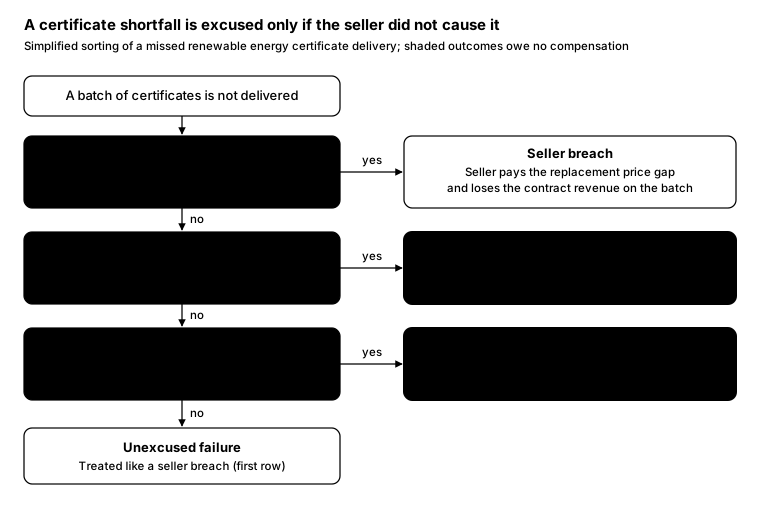
The order matters because the I-REC(E) agreement treats an event that fits both definitions as a rule change. In the I-REC(E) agreement, both tests also exclude some failures caused by a party's own breach. A registry outage on a delivery date falls in the third row; a country leaving the system falls in the second.
Have registries or rule changes actually stopped renewable energy certificates?
Yes, in part and for a time. Public notices describe an issuance pause, a suspension of GO exports and a buyer standard that narrowed eligibility.
| Date | Body | Event | Clause it would test (our reading) |
|---|---|---|---|
| 10 November 2023 | Association of Issuing Bodies (AIB) | Board decided not to reinstate the suspension of Icelandic GO exports | None further: the suspension ended |
| 1 June 2023 | AIB | Board conditionally lifted the suspension, pending resolution of a rectification order by its Icelandic member | Release ends; later deliveries resume |
| 27 April 2023 | AIB | Board suspended all exports of Icelandic GOs after a compliance assessment on "double claiming of energy attributes" | Registry or transfer system suspension, or a change in law or scheme rules |
| 12 December 2022 | RE100 | Published technical criteria with a "fifteen-year commissioning or re-powering date limit", assessed on disclosures covering twelve months starting on or after 1 January 2024, with grandfathering for contracts with operational commencement dates before 1 January 2024 | Usually neither clause: certificates still issue, but fewer buyers may value older plants' certificates |
| 16 September 2022 | I-REC Standard Foundation (now the I-TRACK Foundation) | Lifted the pause, having had no feedback from a national authority | Release ends; later deliveries resume |
| 15 August 2022 | I-REC Standard Foundation | Paused I-REC(E) issuance for a select group of devices in Indonesia while it gathered the national authority's requirements | Issuer failure to issue, or an official notice that is a Change in Applicable Rules |
Our reading: a pause that lifts within weeks puts one batch at risk, while a country leaving a system stops certificate revenue. A claims standard change sits outside both clauses and reaches the model through price.
Other claim frameworks, such as GHG Protocol Scope 2, CDP and national reporting, set their own criteria. "What buyers need from renewable energy certificates: Scope 2 quality criteria, market boundaries and vintage" compares them.
What do force majeure and rule changes do to renewable energy certificate revenue in the model?
They remove certificate revenue without paying anything in return. In the model, that shows up three ways: revenue that pauses, revenue that stops, and a forward sale that ends with no amount owed.
- Revenue pauses. In an invented pause case, issuance for one half-year of year 4 is lost and never recovered. Year 4 net certificate revenue falls from USD 133,902 to USD 66,326 (invented, derived).
- Revenue stops. If a country leaves the system or a rule change ends issuance from year 4, net certificate revenue is zero from then on. Years 4 to 12 lose USD 1.18m (invented, derived).
- The forward sale ends with no amount owed. If a rule change ends the forward sale after year 1, four batches (104,000 certificates, USD 208,000 of contract revenue) fall away. Unlike a default, no termination amount is due either way.
Cover ratios move only if lenders counted certificate revenue when sizing. With full credit, debt rises to USD 25.88m and year 4 debt service is USD 3.286m (invented, derived). With half credit, a stop from year 4 gives 1.28x; with none, cover stays at 1.30x.
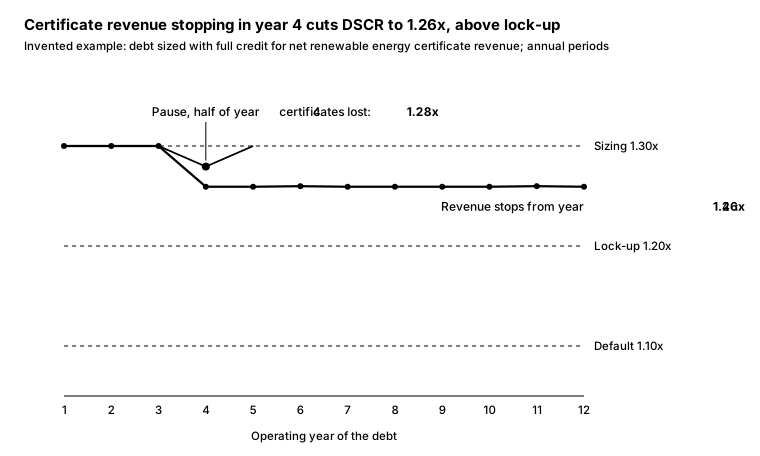
A permanent stop costs about 0.04x and leaves 0.06x of headroom above lock-up, because net certificate revenue is only about 3% of CFADS. The invented pause costs about 0.02x, in year 4 only. "Renewable energy certificate revenue in the lender's model: how much counts for debt sizing" covers how much credit lenders give.
How do you model it?
Model registry, issuer and rule-change risk as downside cases on top of an unchanged base case. "How to read a renewable energy certificate sale agreement for a solar project: a modeller's guide" places these clauses in the whole agreement.
- Record, for each forward batch, which template governs it and whether force majeure releases or suspends the affected quantity.
- Build a pause case: remove the certificates of the affected issuance period, and drop the matching batch revenue if the template releases it.
- Add back a later spot sale only if issuance resumes and your template allows it; otherwise treat the pause as a loss.
- Build a stop case: set net certificate revenue to zero from the year a country leaves the system or a rule change ends issuance.
- For a termination with no amount owed, end the forward sale and enter no termination amount.
- Recompute DSCR in each period against the debt service the lenders sized, then compare it with the lock-up and default levels.
- Repeat for each level of credit the lenders gave certificate revenue: full, half or none.
- Report the lowest DSCR and the first period, if any, that falls below lock-up.
What are the common mistakes?
- Treating every issuer problem as force majeure. The I-REC(E) agreement excuses an issuer's failure only where the seller, and where elected an upstream party, did not breach the rules.
- Assuming a pause shifts revenue rather than losing it. Under EFET and I-REC(E) wording, an excused quantity is released, not suspended, so the batch revenue may be gone for good.
- Expecting a termination amount after a rule change. Termination after failed renegotiation is at no liability, so nothing replaces the lost contract revenue.
- Assuming a cancelled programme ends a North American trade. The master REC agreement keeps the agreed price unless the trade says otherwise or delivery becomes illegal.
- Testing only the year of the event. A stop lasts to the end of the debt, so check every remaining period.
Frequently asked questions
Is a registry outage force majeure in a renewable energy certificate sale?
The I-REC(E) and EFET agreements name a suspension, failure or malfunction of the registry or transfer system as an example. Relief covers only what the outage prevents; the claiming party must notify the other side and use reasonable efforts to overcome or mitigate it. Our reading: an outage that ends before the delivery date excuses nothing.
Can a seller rely on an upstream party's failure to excuse missing renewable energy certificates?
The I-REC(E) agreement has tick boxes that add an Upstream Party, such as the plant operator, to its breach test for redemption and issuer failures. Its guidance note says this "may be of particular relevance in a chain transaction". EFET lists an issuing body's failure as an example only where the contract names a specific Production Device.
What happens to a renewable energy certificate sale if a country leaves the certificate system?
The I-REC(E) agreement names a country's withdrawal from the I-REC system as a Change in Applicable Rules. The parties first try to amend the agreement; if that fails, either may terminate with no liability. Certificates already delivered must still be paid for.
Can the price of a renewable energy certificate sale change after a rule change?
It depends on the template. The I-REC(E) guidance note allows price adjustments in the renegotiation, and EFET lets the parties rule them out by election. The North American master agreement's commentary says trades continue at the agreed price even if the RPS is cancelled.
Who bears the risk that renewable energy certificates stop qualifying for a compliance programme?
Under the North American master agreement, the buyer bears it unless the seller represents compliance, and that representation speaks only at the Trade Date. If the trade is Regulatorily Continuing, the seller must deliver product that complies at the Delivery Date, including substitute product acceptable to the buyer if appropriate.
Sources
Pages opened and checked on 10 October 2026. The example project is invented and has no source.
- I-REC(E) Standard Single Trade Agreement, RECS Energy Certificate Association and DLA Piper. Force majeure examples, Upstream Party, relief and long-running events, Change in Applicable Rules and country withdrawal, described without its figures.
- Guidance Notes to the I-REC(E) Standard Single Trade Agreement, International REC Standard Foundation and DLA Piper. Exclusions, chain transactions, relief not suspension, price adjustments in renegotiation.
- EECS Certificate & National Scheme Certificate Master Agreement, Version 1.1(b), European Federation of Energy Traders. Force majeure examples and release, long-term force majeure, Change in Law, Expert Determination, price adjustment election.
- Memorandum of Understanding, with Exhibit A: Master REC Purchase and Sale Agreement, Illinois Power Agency. EMA and ACORE master agreement: force majeure and its exclusions, Government Action, Regulatorily Continuing, change in law commentary.
- Agreement for the Sale of Renewable Energy Certificates, NYSERDA. Force majeure list and termination after a long event.
- Lifting the Pause in Issuance, Indonesia, I-TRACK Foundation. Dates and scope of the 2022 issuance pause and its lifting.
- Public: Press releases, Association of Issuing Bodies. Dates of the 2023 suspension of Icelandic GO exports, its conditional lifting and the decision not to reinstate it.
- Press release: 27 April 2023, Association of Issuing Bodies. Reason for the suspension.
- RE100 technical criteria, RE100 and Climate Group. Publication date, the commissioning or re-powering date limit, grandfathering and when members are first assessed.