Failure to deliver or accept renewable energy certificates: replacement cost and termination amounts
By SolarQuant Editorial. Published 2026-10-10. Last updated 2026-10-10.
When a sale of renewable energy certificates fails, most public templates pay the innocent party the market price gap, sometimes plus costs. A seller that cannot deliver therefore pays when prices rise, and a buyer that will not accept pays when they fall. For a modeller, the task is to turn an issuance shortfall into a cost and size it across a price range.
What example does this article use?
We use the same invented 40 MWp solar plant as the rest of the series. The project sells its power under a PPA, keeps its certificates and sells 52,000 of them a year forward in two batches. Every figure below is invented and describes no real project, buyer, issuer or market.
| Item | Example figure (invented) |
|---|---|
| Plant and power sale | 40 MWp, one 20-year USD PPA at USD 80 per MWh for power only |
| Certificates | Kept by the project and sold separately (unbundled), one per MWh |
| Year 1 certificates, P90 | 70,000 |
| Year 1 net certificate revenue | USD 134,100 (3.19% of CFADS of USD 4.2m) |
| Year 1 debt service | USD 3.231m |
| Forward sale | 52,000 a year for three vintage years, in two batches of 26,000, at USD 2.0 |
| Contract value | USD 104,000 a year, USD 312,000 in total |
| Timing | Issuance 64 days after each half-year, delivery 11 days after issuance, payment 27 days after invoice |
| Price range tested | USD 1.5 to 4.0 (invented range, not a market range) |
| Shortfall case | 2,100 certificates missing on a delivery date; replacement price USD 2.65; buyer's costs USD 350; compensation USD 1,715 |
| Non-acceptance case | Buyer refuses a batch of 26,000; resale price USD 1.45; seller's costs USD 350; compensation USD 14,650 |
| Termination case | 104,000 certificates undelivered after year 1; buyer default USD 57,550; seller default USD 67,950 |
What does the seller owe if it fails to deliver renewable energy certificates?
Under most public templates, a seller that misses a delivery pays the replacement price gap on the missing quantity. The gap is the market cost of replacement certificates less the contract price. The templates differ on whether the buyer's transaction costs are added, and on whether paying turns a default into a mere breach.
- I-REC(E) Standard Single Trade Agreement. Clause 10.1 pays the difference, if positive, between what the buyer would pay in the market for the undelivered certificates and their contract price. It adds "any reasonable transaction costs and expenses which the Buyer incurs". The guidance note calls this the "mark-to-market valuation method" and lists "brokerage fees, commissions and other third-party costs and expenses".
- EFET certificates master agreement. Section 7.1 uses the same replacement price measure. However, the amount "shall not be increased by any costs and expenses incurred by the Accepting Party".
- North American master REC agreement (EMA and ACORE, published by the Illinois Power Agency). A seller paying a Settlement Amount within three Business Days of notice avoids an Event of Default. Five such failures in a consecutive rolling ninety day period still make one. Its Costs can include fines or fees an Administrator imposes because Delivery did not occur.
Some agreements accept certificates instead of cash: the I-REC(E) guidance note says parties may wish to consider adding replacement certificates as a special condition. They could come "either from the same project or a project of similar location or generation type". The North American Regulatorily Continuing election commits the seller to deliver "substitute Product acceptable to Buyer if appropriate".
In the example, the issuer rejects one month of production evidence and 2,100 certificates are missing on a delivery date. Replacement certificates cost USD 2.65, so the compensation is 2,100 times USD 0.65 plus USD 350 of costs: USD 1,715. Under the EFET wording the costs fall away and the amount is USD 1,365 (invented, derived from the example).
What does the buyer owe if it fails to accept renewable energy certificates?
A buyer that refuses a delivery pays the resale price gap on the refused quantity. The gap is the contract price less the price at which the seller can resell. The same split on transaction costs applies.
- I-REC(E) Standard Single Trade Agreement. Clause 10.2 uses the resale price measure and adds the seller's reasonable transaction costs. The guidance note says non-acceptance "may be considered an unlikely event" with electronic transfer. It covers cases such as a buyer account that cannot receive certificates.
- EFET certificates master agreement. Section 7.2 uses the same resale price measure and again excludes costs.
- NYSERDA Agreement for the Sale of Renewable Energy Certificates. Here NYSERDA, a public benefit corporation, sells certificates to load serving entities. The agreement has no price formula, and NYSERDA "will not Deliver REC Certificates prior to receipt of payment". On default, a party may terminate, withhold payments, set off or withhold delivery.
In the example, the buyer refuses one batch of 26,000 and the project resells it at USD 1.45, with USD 350 of costs. The compensation is 26,000 times USD 0.55 plus USD 350: USD 14,650. Add the resale proceeds of USD 37,700 and the project receives USD 52,350, the batch's contract value plus its costs (invented, derived).
Is there a cure period, and what excuses a failure to deliver or accept?
Most templates give the failing party a short window after written notice to deliver or accept before compensation is due. A failure excused by force majeure, or by the other side's own non-performance, costs nothing.
- The I-REC(E) Standard Single Trade Agreement allows a short cure period after written notice, and a longer one after written demand before termination.
- The EFET certificates master agreement allows three Business Days after written notice and excuses force majeure or the other party's non-performance.
- NYSERDA treats a material breach as an Event of Default if it is not cured within five Business Days of written notice.
Force majeure decides whether an issuance shortfall is excused. The I-REC(E) agreement lists a failure of the Issuer to validly issue, unless the seller's breach of the Applicable Rules caused it. Parties can extend that test to an Upstream Party.
The EFET agreement lists a failure of the Authorised Issuing Body as force majeure where the contract names a specific Production Device. In both, the other side's matching obligations fall away for the affected quantity.
The North American master agreement adds a volume option instead. A Unit Contingent sale excuses the seller if the named facility does not generate enough. Its force majeure cannot rest on the seller's ability to sell elsewhere at a higher price.
In the example, whether the 2,100 missing certificates cost USD 1,715 depends on why the issuer rejected the evidence. Our reading: an error in the project's own submission looks like a seller breach, so the issuer example would not excuse it. "Registry, issuer and rule-change risk in renewable energy certificate sales: force majeure and change in applicable rules" covers this in depth.
When can either side terminate a renewable energy certificate sale, and how is the termination amount computed?
Most templates let a party terminate when the other becomes insolvent, misses a payment or leaves a delivery failure uncured after demand. The termination amount then applies the same market price measure to every certificate still undelivered.
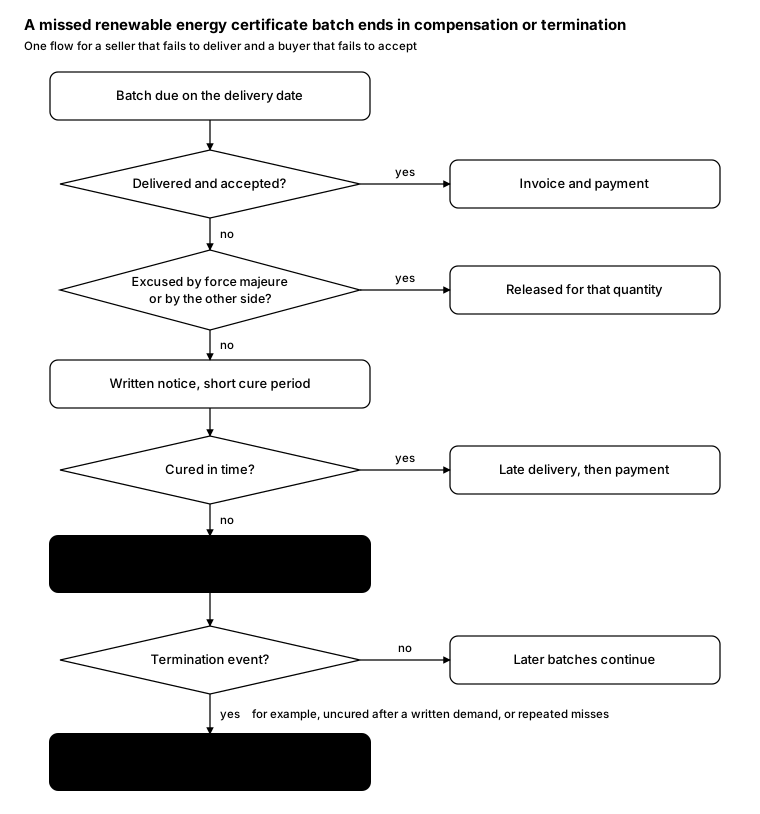
Compensation settles one missed batch and the contract carries on. Only a termination event replaces all remaining batches with a single amount. "Renewable energy certificate trade agreements compared: I-REC, EECS GO, EFET and US master agreements" sets the templates side by side.
- I-REC(E) Standard Single Trade Agreement. Its termination events include insolvency, uncured failures to pay, transfer or accept, other material breach, prolonged force majeure and an unresolved rule change. For the default events, the non-defaulting party calculates the price gap on the undelivered quantity plus reasonable costs. That amount is "the sole and all-inclusive compensation".
- EFET certificates master agreement. A failure to deliver or accept is a termination ground only "If specified as applying in the Election Sheet". The amount adds up each contract's Gains less its Losses and Costs, "whether positive or negative", with gains and losses at present value.
- North American master REC agreement. The non-defaulting party liquidates all Transactions and nets their Settlement Amounts against unpaid deliveries and performance assurance. The single Termination Payment is due within two Business Days following notice.
In the example, the buyer defaults after year 1 with four batches, 104,000 certificates, undelivered. At a resale price of USD 1.45 and costs of USD 350, the termination amount is USD 57,550. If the seller defaults instead and replacement costs USD 2.65, the seller owes USD 67,950.
How large can the compensation on one batch of renewable energy certificates get?
For one batch of 26,000 certificates at USD 2.0, every USD 0.50 that the market moves against the failing side adds USD 13,000. A seller that fails with the market at USD 4.0 owes as much as the batch's whole contract value.
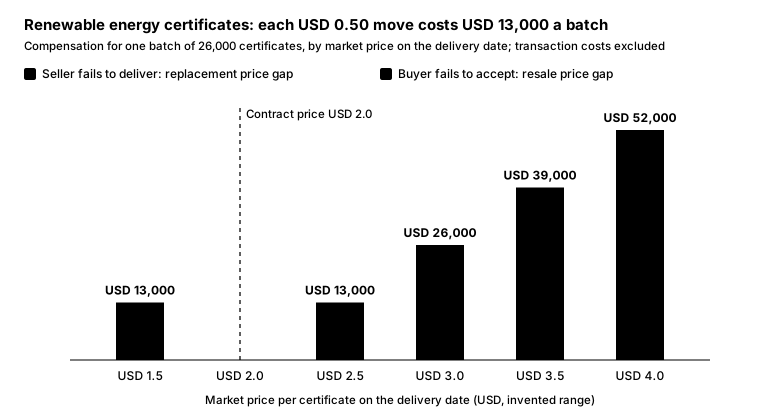
The seller's exposure keeps growing as the market rises, while the buyer's can never exceed the contract value. Our reading: the seller side is the one a project should size, because an issuance shortfall is the failure it controls least.
Do limits of liability cap the compensation or termination amount in a renewable energy certificate sale?
Usually not. The I-REC(E) and EFET agreements cap general liability but carve both amounts out of the cap. All four templates also exclude indirect loss in some form.
| Template | Cap on liability | Indirect and consequential loss |
|---|---|---|
| I-REC(E) Standard Single Trade Agreement | Tied to the Total Contract Price; does not apply to clause 10 or clause 15 amounts, or to gross negligence, intentional default or fraud | Excluded, with loss of profit, business opportunity, goodwill and anticipated savings |
| EFET certificates master agreement | Elected as the amounts payable for the certificates or a Limitation Amount; does not apply to section 7 or section 10 payments | Excluded, with loss of profit, goodwill, business opportunity or anticipated saving |
| North American master REC agreement | Limits the kinds of damages rather than their size | Punitive, exemplary, indirect, lost profit and business interruption damages excluded; consequential damages excluded except for Regulatorily Continuing deliveries |
| NYSERDA Agreement for the Sale of Renewable Energy Certificates | Article 5 remedies are the "sole and exclusive remedies" | Consequential, incidental, punitive, exemplary and indirect damages excluded |
For a modeller, the exclusions matter more than the caps. Our reading: a buyer's downstream loss, such as a weaker claim in its own reporting, is unlikely to be recoverable. The seller's exposure stays at the price gap plus costs.
Two templates reach further. EFET's termination Losses can include regulatory fines where elected, for certificates bought to meet a regulatory obligation. The North American Costs include fines an Administrator imposes when Delivery does not occur.
In the example, the seller-default termination amount of USD 67,950 is 21.8% of the USD 312,000 contract value (invented, derived).
What do the failure and termination clauses of a renewable energy certificate sale change in the model?
These clauses change three things: who carries the price risk, when cash moves, and how an issuance shortfall becomes a cost. What follows is our reading of the clauses above, applied to the example.
- Price risk sits with the party that fails. A project that cannot deliver is in effect short certificates at the market price. A buyer that refuses delivery takes the price fall. The project keeps its contract value but swaps price risk for credit risk on the buyer.
- Cash moves later and in a lump. Compensation follows a notice, a cure period and an invoice, so it lands after the batch's normal payment date.
- A shortfall costs the replacement price, not just the gap. The project loses the contract revenue on the missing certificates and pays the gap and costs on top. For 2,100 certificates that is USD 4,200 plus USD 1,715, or USD 5,915 (invented, derived).
In the example, certificates are issued 64 days after each half-year and delivered 11 days later. So the project learns of a shortfall about 11 days early and can buy replacements itself rather than wait for a claim.
If the buyer defaults after year 1, the project receives USD 57,550. It also sells the 104,000 released certificates at USD 1.45, for USD 150,800 (invented, derived). Together these restore the four batches' contract value plus costs, but only if the buyer actually pays.
At USD 4.0, a seller default on the four remaining batches would cost USD 208,000 plus costs (invented, derived). That is about 6.4% of year 1 debt service.
"Renewable energy certificate revenue in the lender's model: how much counts for debt sizing" shows how lenders treat such downside cases. "Pricing renewable energy certificates: volume, vintage, spot trades and forward sales" covers how much to sell forward.
How do you model it?
Model the failure clauses as a downside layer on top of the base case certificate revenue, using your own stress prices. "How to read a renewable energy certificate sale agreement for a solar project: a modeller's guide" places these clauses in the whole agreement.
- List each batch with its quantity, delivery date and contract price: six batches of 26,000 at USD 2.0 in the example.
- Forecast certificates issued for each batch period at P90 and P50, after the issuance lag.
- Compute each batch's shortfall as the batch quantity less certificates issued for it, floored at zero.
- Price each shortfall at a stressed replacement price, and add transaction costs only if your template allows them.
- Switch off the shortfalls your contract excuses, such as issuer failure under force majeure or a Unit Contingent sale.
- For buyer default, compute the termination amount at a stressed resale price, and move the released certificates into spot sales.
- Place each amount in time: compensation after notice, cure and invoice; the termination amount after the early termination date.
- Report the exposure as a range in the downside case, and keep it out of base case revenue.
What are the common mistakes?
- Costing a shortfall at the price gap only. The project also loses the contract revenue on the missing certificates, so 2,100 missing certificates cost USD 5,915, not USD 1,715.
- Assuming transaction costs are always recoverable. The I-REC(E) agreement adds them, while the EFET agreement excludes them from failure compensation.
- Treating every issuer rejection as force majeure. The I-REC(E) test fails where the seller's own breach of the rules caused the problem.
- Pricing exposure at the contract price. Compensation depends on the market on the delivery date, so test the top of your price range.
Frequently asked questions
Which market price measures the replacement cost of renewable energy certificates?
The I-REC(E) and EFET agreements use the price the innocent party could get in the market, acting in a commercially reasonable manner. At termination, EFET values gains and losses at the Early Termination Date "without being required to enter into any replacement transactions". In the I-REC(E), EFET and North American templates, the non-defaulting party calculates the termination amount.
Can the defaulting party in a renewable energy certificate sale ever receive a termination amount?
Under the EFET agreement it can, because the sum counts "whether positive or negative". Under the I-REC(E) agreement the difference counts only if positive, so a defaulting party gains nothing from a favourable market.
Can the buyer insist on replacement renewable energy certificates instead of cash?
Only if the contract says so, for example through an I-REC(E) special condition or a North American Regulatorily Continuing election. Otherwise these templates pay their remedies in cash.
Is compensation for a failed renewable energy certificate delivery or acceptance a penalty?
The templates present it as the innocent party's loss. The I-REC(E) guidance note says it reflects "the loss suffered by the non-defaulting party in selling or buying replacement I-REC(E)s". The North American master agreement says the parties intend that no amount due under its remedies article "represents a penalty".
Sources
Pages opened and checked on 10 October 2026. The example project is invented and has no source.
- I-REC(E) Standard Single Trade Agreement, RECS Energy Certificate Association and DLA Piper. Failure to deliver and accept (clause 10), limitation of liability, force majeure, termination events and termination amount.
- Guidance Notes to the I-REC(E) Standard Single Trade Agreement, International REC Standard Foundation and DLA Piper. Mark-to-market method, transaction costs, replacement certificates option, non-acceptance cases.
- EECS Certificate & National Scheme Certificate Master Agreement, Version 1.1(b), European Federation of Energy Traders. Remedies for failure to deliver and accept without costs, force majeure, Material Reasons, Settlement Amount, limitation of liability.
- Memorandum of Understanding, with Exhibit A: Master REC Purchase and Sale Agreement, Illinois Power Agency. EMA and ACORE master agreement: Settlement Amount route, Costs, Termination Payment, Unit Contingent, Regulatorily Continuing, limitation of liability, not a penalty.
- Agreement for the Sale of Renewable Energy Certificates, NYSERDA. Payment before delivery, cure period, exclusive remedies, exclusion of indirect damages.