Renewable energy certificate revenue in the lender's model: how much counts for debt sizing
By SolarQuant Editorial. Published 2026-10-10. Last updated 2026-10-10.
Lenders give renewable energy certificate revenue little or no credit when sizing debt, unless the certificates are sold forward to a creditworthy buyer. In our invented example, full credit would add USD 0.81m of debt, while a three-year forward sale supports about USD 0.20m. The safer model sizes debt on power revenue and tests certificates as a separate layer.
What example does this article use?
We use the same invented 40 MWp solar plant as the rest of the series. The project sells its power under a PPA, keeps its certificates and sells 52,000 of them a year forward for three years. Every figure below is invented and describes no real project, lender, buyer, issuer or market.
| Item | Example figure (invented) |
|---|---|
| Plant and power sale | 40 MWp, one 20-year USD PPA at USD 80 per MWh for power only |
| Certificates | Kept by the project and sold separately (unbundled), one per MWh |
| Year 1 certificates, P90 | 70,000, falling 0.5% a year |
| Certificate price and costs | USD 2.0 flat; issuance fee USD 0.04 each, account fee USD 1,250 a year, registration USD 1,850 in years 1, 6, 11 and 16 |
| Year 1 net certificate revenue | USD 134,100 (3.19% of CFADS) |
| Forward sale | 52,000 a year for three vintage years at USD 2.0, or USD 104,000 a year |
| Year 1 CFADS, lender's case | USD 4.2m from power, falling 0.5% a year |
| Senior debt | USD 25.07m, 7.0% all-in, 12 years, sculpted so debt service = CFADS / 1.30 |
| Year 1 debt service | USD 3.231m |
| DSCR levels | Sizing 1.30x, lock-up 1.20x, default 1.10x |
We use annual periods for simplicity; real deals usually use six-month periods.
How do lenders treat renewable energy certificate revenue when they size debt?
Public guidance says lenders discount renewable energy certificate revenue heavily, or leave it out, unless the certificates are sold forward to a creditworthy buyer. Contracted certificate revenue is worth more to investors than spot sales, and uncontracted revenue is often treated as upside.
- Development bank guidance. IFC's 2015 developer guide says banks are likely to "highly (even entirely) discount" REC value "unless they are sold forward to a highly credit-worthy off-taker". Such revenue then cannot be borrowed against like power revenue. A lifetime forward sale often fetches a price "well below the current forward price", if a buyer exists at all.
- Developer evidence from US REC markets. In a February 2026 report for the Center for Resource Solutions, US developers agreed "investors discount uncontracted REC revenues", but not to zero. One developer said such revenue may count "for the first three years of the project", after which it is "treated as upside potential risk". The report cites earlier research putting the discount at roughly 30 to 80%.
- Guarantees of Origin in Europe. Montel writes that "a liquid market with transparent forward curves helps banks provide more favourable financing options". It adds that "When long-term offtake is combined with GO delivery, projects become more bankable."
Our reading for the example: the forward sale covers 52,000 certificates, 74.3% of year 1 P90 output, for three years only. Everything else is spot revenue, so a lender would treat most of the 20-year certificate stream as merchant.
What credit options does a lender have for renewable energy certificate revenue?
A lender can leave certificate revenue out, credit only the contracted part, apply a haircut, or size it at a higher cover ratio than power.
- Higher cover ratio. IFC's guide lists a DSCR "of at least 1.3, or 1.5 for merchant solar PV projects". Morningstar DBRS says a merchant hydro, wind or solar project "may need a DSCR in the range of 1.5 times (x) to 1.7x" for a minimum investment-grade rating.
- Contracted volume only. IFC's condition of a forward sale points to crediting only what is sold forward. One developer in the CRS report gives a variant: uncontracted revenue may be considered for the first three years only.
- Haircut. The 30 to 80% discounts cited in the CRS report describe partial credit rather than none.
In a sculpted loan, the credit share k scales the certificate line before it enters the sizing sum.
We tested four cases on the example. The contracted case credits USD 104,000 a year less all certificate costs for three years, then nothing. The 1.50x case sizes the whole certificate stream at 1.50x while power stays at 1.30x.
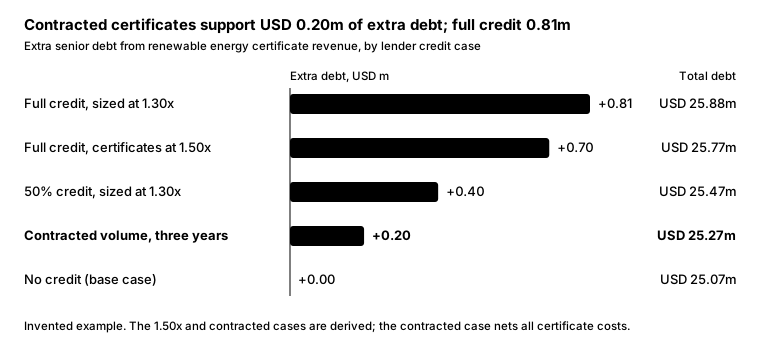
A three-year forward sale supports about a quarter of the debt that full credit would. Our reading: contracted volume is the likelier starting point, because the guidance above ties credit to a forward sale.
What happens to the DSCR if renewable energy certificate revenue stops?
If debt is sized with full credit and certificate revenue then stops, the DSCR falls to 1.30x divided by one plus the certificates' share of CFADS. In the example it drops from 1.30x to 1.26x from year 4, still above the 1.20x lock-up.
The drop follows from sculpting. Debt service was set to CFADS plus certificate revenue, divided by 1.30. Once the certificates stop, power CFADS alone must cover that higher debt service.
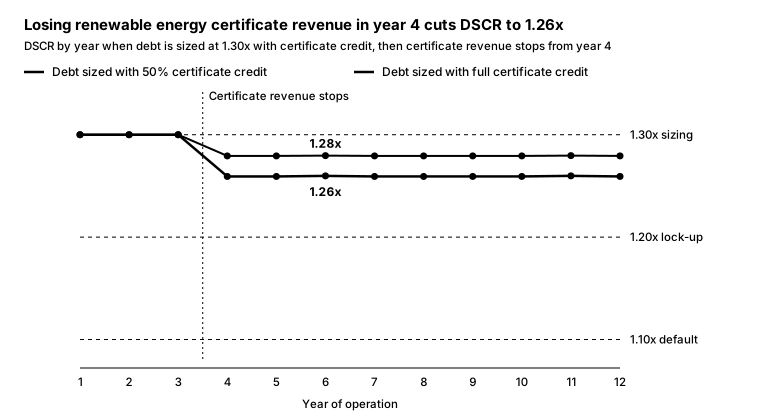
Headroom over lock-up shrinks from 0.10x to about 0.06x with full credit, or about 0.08x with 50% credit (invented, derived). Our reading: only if certificates exceeded about 8.3% of CFADS would losing them take a fully credited loan to lock-up (invented, derived).
How is renewable energy certificate cash treated in the waterfall and the security package?
The public templates differ on whether a seller can pledge a certificate sale agreement to its lenders without the buyer's consent. Guidance on merchant revenue also points to cash sweeps and larger reserves.
- North American master REC agreement (EMA and ACORE, published by the Illinois Power Agency). Section 9.2 lets either party pledge or assign "the accounts, revenues or proceeds hereof" for a financing without consent.
- I-REC(E) Standard Single Trade Agreement. Apart from transfers to a creditworthy affiliate, assignment needs the other party's prior written consent, which "may not be unreasonably refused, withheld or delayed". An assignment, charge or transfer made without it is void.
- EECS certificates master agreement. Assignment to a third party also needs prior written consent, and "Such consent shall not be unreasonably delayed, refused or withheld." Both European templates let a party disclose the contract to its "bank or other financing institution".
On cash, Morningstar DBRS expects merchant solar and wind projects to have "cash sweeps" and "enhanced liquidity reserves". IFC's guide says a debt service reserve account "is typically required (usually six months of debt service)".
Our reading: model certificate receipts on their own line, entering the waterfall with power revenue ahead of debt service. A sale agreement that cannot be pledged without consent is weaker support for crediting its revenue. In the example, only the USD 312,000 forward sale could count as contracted.
How do you model it?
Model certificate revenue as a separate layer that the lender credits in part, on top of a power-only base case. "How to read a renewable energy certificate sale agreement for a solar project: a modeller's guide" places this layer in the whole model.
- Keep certificate revenue and costs on their own lines, net of issuance, account and registration fees.
- Split each year's volume into contracted (the forward sale quantity and tenor) and uncontracted (spot).
- Size debt on power-only CFADS at the sizing DSCR: USD 25.07m in the example.
- Give each slice a credit share set by the lender, and test 0%, 50% and 100%.
- If the lender uses a higher cover ratio for certificates, size that line at its own ratio and add the two debt amounts.
- Run a stop case: hold debt service fixed, remove certificate revenue after the contract ends, and check the DSCR against lock-up and default.
- Report the debt each credit case supports and the stop-case minimum DSCR beside the base case.
What are the common mistakes?
- Crediting gross instead of net revenue. Issuance, account and registration fees cut year 1 certificate revenue from USD 140,000 to USD 134,100.
- Giving spot volume the same credit as the forward sale. Only 52,000 of the 70,000 year 1 certificates are sold forward, and only for three years.
- Sizing on full credit without a stop case. The DSCR falls to 1.26x once certificates stop, and a larger certificate share would sit closer to lock-up.
- Crediting certificates the PPA already transfers. Under a bundled PPA the project has no separate certificate revenue to credit.
Frequently asked questions
Do lenders ever give full credit to renewable energy certificate revenue?
IFC's guide links bankable certificate revenue to a forward sale to a highly creditworthy buyer. Our reading: full credit is most plausible for contracted volume. For uncontracted revenue, the CRS report records one developer's view that no investor discounts it to zero.
Is a higher cover ratio the same as a haircut on renewable energy certificate revenue?
In a sculpted loan, the two work the same way. Sizing certificates at 1.50x while power stays at 1.30x equals crediting about 87% of certificate revenue at 1.30x (invented, derived). In the example both add about USD 0.70m.
Does a bundled PPA change how lenders view renewable energy certificate revenue?
Yes. If the PPA transfers the certificates to the power buyer, the project has no separate certificate revenue. The CRS report notes that bundled contracts carry an implicit certificate value inside the power price.
How large must renewable energy certificate revenue be before it matters for debt sizing?
In the example it is 3.19% of year 1 CFADS, worth at most USD 0.81m of debt. Our reading: above about 8.3% of CFADS, losing fully credited certificates alone would take the DSCR to lock-up.
Sources
Pages opened and checked on 10 October 2026. The example project is invented and has no source.
- Utility-Scale Solar Photovoltaic Power Plants: A Project Developer's Guide, International Finance Corporation. Banks discounting certificate value without a forward sale, lifetime forward sale prices, DSCR of 1.3 or 1.5 for merchant solar, debt service reserve account.
- Developer Insights on Financial Modeling to Describe Renewable Energy Certificate Impacts, Center for Resource Solutions. Investor discounts on uncontracted REC revenue, the three-year view, the cited 30 to 80% range, bundled contracts.
- Morningstar DBRS' Takeaways from the Evolution of Project Finance Event: Our Methodologies Keep Pace With Technologies, Morningstar DBRS. DSCR range for merchant renewables, cash sweeps and liquidity reserves.
- How do Guarantees of Origins impact investment choices in energy?, Montel. Guarantee of Origin forward curves and bankability.
- Memorandum of Understanding, with Exhibit A: Master REC Purchase and Sale Agreement, Illinois Power Agency. Assignment and pledge of the agreement and its proceeds for financing.
- I-REC(E) Standard Single Trade Agreement, RECS Energy Certificate Association and DLA Piper. Consent to assignment, disclosure to financing institutions.
- EECS Certificate & National Scheme Certificate Master Agreement, Version 1.1(b), European Federation of Energy Traders. Consent to assignment, disclosure to financing institutions.